EditorialWD 285 · Inside cover
Paul Sawyer discovers how the old Mail Order department has become a team of Hobby Specialists, with online shopping changing the balance between sales and advice. A tour of the department leads to an explanation of its work answering rules queries, suggesting conversion components and helping painters. The column presents the change as part of the hobby’s growth, while also reflecting on how unfamiliar a former employee can find the organisation he once knew.
CommunityWD 285 · pp. 2–3
The news pages urge a final effort in the Eye of Terror campaign before its results close, and preview opportunities to try the forthcoming Return of the King game. The WarCry card game’s Siege of Darkness expansion brings war machines and new factions to deck building. Other notices cover collectible figures, the developing online hobby resources and a reader competition, preserving a snapshot of the releases and organised play surrounding the issue.
Warhammer 40,000Middle-earth Strategy Battle Game
InterviewWD 285 · pp. 12–17
Pete Haines explains why the revised Imperial Guard codex aims to diversify existing armies rather than rebuild the faction. Cheaper or more flexible elite choices, revised Rough Riders and changes to weapon costs challenge the familiar static gun line. Advisors and Enginseers restore some of the Imperium’s eccentric religious and technological character without turning ordinary Guardsmen into superhuman assault troops.
Warhammer 40,000Astra Militarum
ModellingWD 285 · pp. 18–19
Steve Cumiskey explores how the new plastic Cadian infantry and heavy-weapon kits can produce varied soldiers from interchangeable parts. Small changes to leg placement, torso angle and head direction create different poses, while dry fitting keeps weapon arms convincing. Accessories conceal conversion joins and turn large weapon-team bases into miniature scenes. Cross-kit examples extend the same parts into kneeling infantry, standing loaders and vehicle crew.
Warhammer 40,000Astra Militarum
ModellingWD 285 · pp. 20–23
Adrian Wood follows Mark Jones’s construction of the prefabricated defences shown in the new Imperial Guard codex. Templates, card walls and foamboard floors create repeatable barricade sections, with tape and glue reinforcing the joins before damage and texture are added. A dark-to-grey drybrush scheme separates concrete walls from earth, and variations raise parapets, shelter a tank or become a guard tower. The modular pieces can be rearranged into different defensive layouts.
Warhammer 40,000Astra Militarum7 paint colours
Battle reportWD 285 · pp. 26–31
Paul Sawyer takes his growing Chaos army to Adepticon in Chicago, meeting painters and hobbyists before playing two specially arranged Warhammer games. Ralston Heath’s Empire force tests his ability to reach protected shooting units; tournament winner Mike Marko then fields a large Greenskin army against a refused-flank Chaos deployment. Both encounters include army choices, narrated turns and the incidents that reshape each plan.
Warhammer Fantasy BattlesWarriors of Chaos
LoreWD 285 · pp. 36–39
Index Malleus examines Chaos’s human followers, from organised traitor regiments to immense mutant hordes and daemon-haunted uprisings. Their origins in corrupted worlds and rebellions explain why their equipment, discipline and tactics vary so widely. The account follows Imperial encounters from the Great Crusade through later wars, then contrasts traitor firepower with mass assaults and daemon engines. Its uncompromising Imperial perspective treats corruption and its witnesses as threats requiring ruthless suppression.
Warhammer 40,000Chaos Cults
ModellingWD 285 · pp. 40–41
Inspired by Gaunt’s Ghosts, Bo Tolstrup builds human followers of Nurgle who retain the appearance of recognisable soldiers. Catachan limbs combine with Marauder, Skaven and Zombie parts, while altered Chaos helmets give the squad a distinctive military silhouette. A hunched agitator and a converted rotary heavy stubber add character and firepower. Green uniforms and pale grey-white skin make the models look diseased without turning every trooper into an extravagant mutant.
Warhammer 40,000Chaos Cults3 paint colours
RulesWD 285 · pp. 44–45
Che Webster introduces a small-force Warhammer format intended to fit into a lunch break or limited gaming space. Restrictions on heroes, unit numbers and expensive models keep each patrol compact, while objective-focused scenarios create a purpose beyond destroying the opposition. Army-specific exceptions accommodate forces such as Tomb Kings, and sample Vampire Counts and Dwarf patrols demonstrate different ways to balance movement, resilience, magic and shooting within the format.
Warhammer Fantasy BattlesVampire Counts
RulesWD 285 · p. 46
Two patrols compete for one clearly defined terrain objective on a narrow battlefield. Alternating deployment and a variable finishing turn make commitment and timing important, while the victory conditions require an eligible unit to claim the objective. The adaptation encourages players to use a shrine, supply building, hill or other evocative feature as the focus, turning a small game into a contest over a recognisable place.
Warhammer Fantasy Battles
RulesWD 285 · p. 46
Each commander secretly sets aside part of a patrol to enter from a chosen flank after the battle has begun. The main forces deploy across a broad, shallow battlefield, then await reserves whose arrival becomes more likely as turns pass. Because arriving troops cannot immediately charge, the scenario rewards planning a supporting position rather than relying on an instant surprise assault. Victory points determine how well the two separated elements cooperate.
Warhammer Fantasy Battles
RulesWD 285 · p. 47
The doubles version combines two small patrols into a shared army and uses an alliance chart to distinguish natural partners from uneasy or forbidden combinations. A randomly selected general leads the joint force, while distrustful allies can undermine nearby troops’ confidence. References to Capture, Meeting Engagement and Flank Attack provide a mission framework for the larger game. The accompanying collecting diary shows how manageable forces can make regular play practical.
Warhammer Fantasy Battles
InterviewWD 285 · pp. 50–55
Matt Keefe reviews Battlefleet Gothic’s growth beyond the original Gothic War and outlines a future organised around specific conflicts. Armageddon, the Eye of Terror and the forthcoming Damocles material provide contexts for new fleets without pretending every new ship was present in the original campaign. Fleet summaries contrast Space Marine assaults, Necron technology, Tyranid customisation and Dark Eldar raiding.
Battlefleet GothicSpace Marines
RulesWD 285 · pp. 56–57
A rules-development report presents experimental changes intended to reduce the dominance of ordnance and address concerns about escorts. Attack-craft limits replace the old exhaustion mechanism, while a revised Nova cannon procedure uses scatter instead of range guessing. Escort victory points are considered by squadron, and Brace for Impact is clarified against assault boats. Explanatory passages connect these proposals to the scale and survivability of the ships, with their experimental status explicitly preserved.
Battlefleet Gothic
CampaignWD 285 · pp. 58–61
Dylan Owen explains the referee’s role in keeping a map campaign fair, varied and moving. Minor realms create buffers between players, give occasional participants a role and let the organiser fight without controlling a major empire. Advice on map size, terrain, settlement names and secret subterfuge turns the administrative map into a setting where raids, kidnappings and sabotage can produce smaller narrative games.
Warhammer Fantasy Battles
TacticsWD 285 · pp. 62–63
Matt Hutson’s 13th Company reaches a fully painted fighting force and tests it against T’au and Dark Angels. Wulfen return to the list after proving unexpectedly effective, while Long Fangs replace part of the biker contingent to counter transports. The games demonstrate both the damage of coordinated assault and the danger of tank shock. Modelling notes explain mutated Fenrisian Wolves and a converted biker Wolf Lord, linking the army’s battlefield development with its distinctive appearance.
Warhammer 40,000Space Wolves
TacticsWD 285 · pp. 66–69
Anthony Reynolds plans a Beastmen army around models he enjoys and a charity challenge to paint a usable force in one day. His initial army combines Bestigor, Minotaurs, Trolls and chariots with a supporting shaman, relying on mutually supporting charges rather than isolated monsters. A larger list adds plastic herds, Pestigor and more characters. The discussion shows how available kits, modelling opportunities and tactical roles all influence a collection’s growth.
Warhammer Fantasy BattlesBeastmen
PaintingWD 285 · pp. 70–71
Paul Rudge demonstrates an army-friendly scheme for the new plastic Gor and Ungor, beginning with assembly choices that make the herd’s members distinct. Brown skin and dark fur are drybrushed and selectively highlighted, while subdued cloth, horns and hooves keep attention on the muscular faces. Weathered metallics and bloodied weapons reinforce the savage appearance. The guide finishes with a traditional green-edged base and protective varnish.
Warhammer Fantasy BattlesBeastmen15 paint colours
ModellingWD 285 · pp. 72–75
Steve Cumiskey examines Mark Jones’s herdstone, a tribal gathering place built from stacked polystyrene sheets. Rough cuts form the stone’s angular outline, ledges and recessed trophy alcoves, with carved Chaos symbols kept deep enough to survive texturing. Layered greys over a warm base colour define the rock. Weapons, skulls and other trophies then personalise the finished piece, with the suggestion that later campaign victories can add fresh decorations.
Warhammer Fantasy BattlesBeastmen5 paint colours
PaintingWD 285 · pp. 76–77
Tammy Haye follows Darren Latham’s treatment of the Shaggoth’s contrasting surfaces: greenish lower skin, warmer flesh above and a dark scaled back. Repeated highlights define the muscles, while coloured ink glazes give the face and belly extra depth. Separate recipes cover the loincloth, hair, horns, metallic axe and gold fittings. Small imps and a rocky base complete a centrepiece whose many textures remain coherent across the whole model.
Warhammer Fantasy BattlesBeastmen29 paint colours
RulesWD 285 · pp. 80–81
Pete Haines adds mounted Daemonettes to eligible Chaos Space Marine and Lost and the Damned armies. The entry combines daemonic summoning and instability with a fast-moving assault role and the effects of Slaanesh’s supernatural presence. An accompanying story follows disciplined Mordian troops confronting the creatures, showing how seductive horror and speed can break soldiers who are otherwise willing to face conventional enemies.
Warhammer 40,000Daemons of Chaos
RulesWD 285 · p. 82
A new Pathfinder weapon option brings rail technology to infantry, with a targeting interface that can divide a team’s fire at a dangerous cost. The short rules entry describes the weapon’s battlefield profile and upgrade restrictions. Its accompanying firing-range scene reveals why the technology is still under trial: impressive stopping power is offset by lethal feedback, forcing commanders to weigh the lives of individual warriors against the demands of the Greater Good.
Warhammer 40,000T’au Empire
CampaignWD 285 · p. 83
Andy Hoare introduces campaign wargear that records participation in the Eye of Terror rather than simply adding another combat advantage. Loyalist scrolls, standards and relics alter experience or advancement, while captured banners and dark icons give Chaos armies their own rewards and risks. Orks and Dark Eldar use grisly trophies to assert their leaders’ authority. Recovery and loss rules make each honour a visible part of an army’s developing history.
Warhammer 40,000Space Marines
CommunityWD 285 · pp. 84–85
Jervis Johnson presents the Carnival of Chaos as a Nurgle warband disguised as travelling entertainers, drawing attention to the personality of its miniatures. Blood Bowl receives new star players and a Necromancer team. A reader question about availability leads to an explanation of why specialist miniatures rely heavily on direct ordering, linking uneven local demand and limited shop space to the practical effort required to keep the games supported.
MordheimBlood BowlNurgle
CommunityWD 285 · pp. 86–87
Ian Huxley visits Wargames World in Ilkley, where a detailed modular battlefield becomes the centre of a Bretonnian rescue attempt against a Greenskin siege. Early disasters give way to a spectacular comet and a renewed cavalry attack, producing a story the players remember differently from the formal result. The report shows how an independent shop’s painting area, displayed armies and organised games can turn a retail space into a local hobby community.
Warhammer Fantasy BattlesBretonnia
Battle reportWD 285 · pp. 88–105
Gav Thorpe’s new Beastmen face Martin Bunting’s Wood Elves in a mobile contest of ambushes, shooting and carefully timed counter-attacks. The report explains changes made after an earlier test game, then follows how small Elven units and supporting creatures frustrate the herd’s attempts to coordinate its strengths. A crucial terror failure and effective combined attacks secure the forest for the Wood Elves. Both players’ conclusions distinguish unlucky moments from the positioning and target priorities that made them decisive.
Warhammer Fantasy BattlesBeastmen
EditorialWD 285 · p. 108
Matthew Ward introduces the Middle-earth section while Alessio Cavatore works on the forthcoming Return of the King material. He describes an appendix covering battles beyond Gondor, then explains why older character profiles are being printed again for players who entered through The Two Towers. Revised Elven weapons, a stronger Gil-galad and trial cavalry rules make the issue especially useful to High Elf players, balancing the recent attention given to Evil’s new flying monsters.
Middle-earth Strategy Battle GameRivendell
TacticsWD 285 · pp. 112–115
Adrian Champion explains how High Elves use superior skill, courage and archery to compensate for their limited numbers. Movement and target selection help delay unfavourable combats, while swordsmen and supporting spearmen combine different attacks to improve their chances once battle is joined. Advice for Gil-galad, Elrond and mounted Glorfindel stresses teamwork over solitary heroics. Separate enemy assessments show how tactics must change against Goblin numbers, Uruk-hai formations and the speed of Warg Riders.
Middle-earth Strategy Battle GameRivendell
RulesWD 285 · p. 113
A designer’s note revises the way Elven swords work, allowing a finely balanced blade to be used as an ordinary hand weapon or with two hands at the player’s choice. Equipment restrictions prevent the stronger attack being combined freely with shields or spears. The change applies to both heroes and warriors from the earlier manuals, supporting a tactical style in which adjacent Elves can contribute different strengths to the same fight.
Middle-earth Strategy Battle GameRivendell
RulesWD 285 · p. 116
John Carter’s converted cavalry inspire trial rules for mounted High Elf warriors, with weapon options and expert riding reflecting their elite status. A related addition lets an Elven Captain take a horse. The modelling notes show how High Elf upper bodies combine with Riders of Rohan legs and mounts, using putty to blend cloaks and joins. The source explicitly requires an opponent’s agreement to use these experimental troops.
Middle-earth Strategy Battle GameRivendell
RulesWD 285 · p. 116
An updated profile restores Gil-galad’s intended stature among Middle-earth’s greatest warriors. His leadership reaches farther than an ordinary hero’s, his fearlessness lets him confront terrifying enemies, and Aeglos makes him a frightening opponent in turn. The accompanying options retain the choice of a shield, while the surrounding tactical discussion explains why the High King should fight at the front rather than lend his spear from a safer supporting rank.
Middle-earth Strategy Battle GameRivendell
RulesWD 285 · p. 117
Gil-galad leads a limited foray against divided Orc forces to relieve pressure on his allies in Eriador. One enemy group is placed by each side before the Elves enter from the board edge, creating choices about where to concentrate the attack. The scenario’s special treatment of the Elven Rings improves the High King’s endurance and lets the Good player surrender priority at a useful moment. A points-match option allows alternative armies to attempt the same delaying action.
Middle-earth Strategy Battle GameRivendell
PaintingWD 285 · pp. 118–119
Tammy Haye examines Darren Latham’s schemes for Tom Bombadil, Goldberry, Barrow-wights and the paralysed Hobbits. Bright blue clothing and warm boots distinguish Tom, while Goldberry’s flowing green dress and pale highlights create a different character. The undead figures use restrained grey-white cloth and flesh, aged metal and green eyes. Detailed finishing steps for faces, ornaments, candlelight and shrouds give each small model a clear role in the Barrow-downs scene.
Middle-earth Strategy Battle GameThe Fellowship30 paint colours
ModellingWD 285 · pp. 120–123
Mark Jones researches ancient burial mounds before building a terrain piece for Fog on the Barrow-downs. Foamboard foundations and shaped polystyrene walls create the chamber, while a removable roof keeps the interior usable during a game. Real slate forms the doorway and optional inner lining, with an MDF base supporting the structure. Earth colours, weathered grey stones and green staining finish a model whose historical inspiration also solves practical tabletop access problems.
Middle-earth Strategy Battle GameBarrow-wights7 paint colours
RulesWD 285 · pp. 124–127
A collection of character profiles makes heroes from the first film’s game available to readers who own The Two Towers. Bilbo’s equipment and relationship to the Ring, Haldir’s archery, the Last Alliance leaders Elendil and Isildur, and Gandalf’s magical powers receive complete contemporary entries. Sharku, Grishnakh and Lurtz provide the Evil counterparts. The introduction notes that some profiles are updated ahead of their planned appearance in The Return of the King.
Middle-earth Strategy Battle GameThe Fellowship
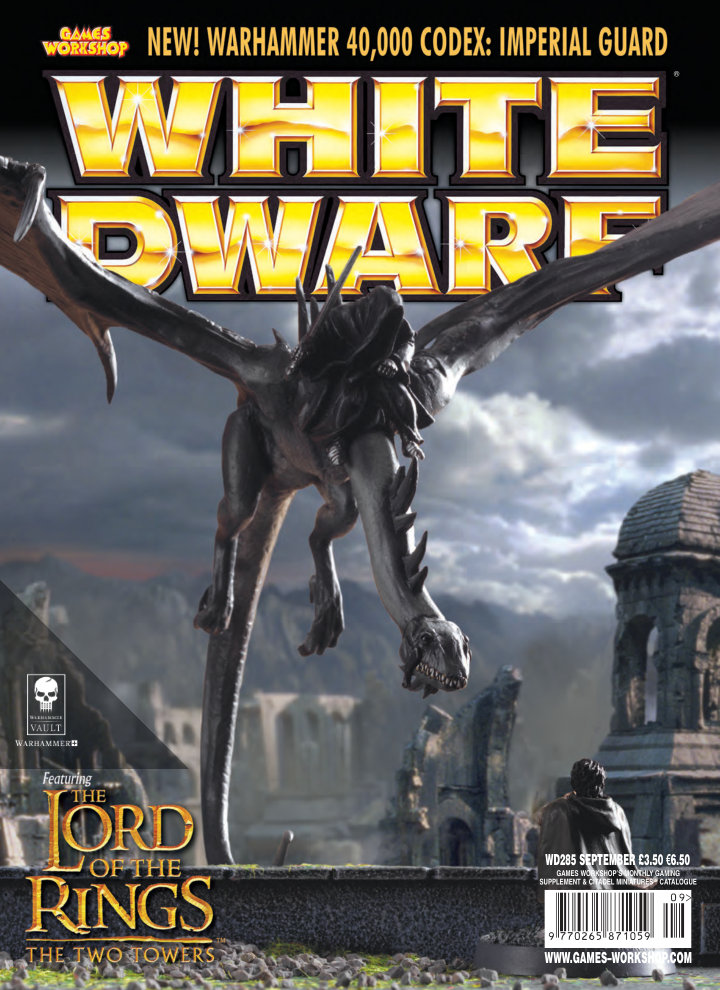
Cover and imprint confirm September 2003, issue 285. Main features, substantial rules and tutorials are indexed. Release catalogues, directories, short event listings, advertisements and art-only pages are excluded.