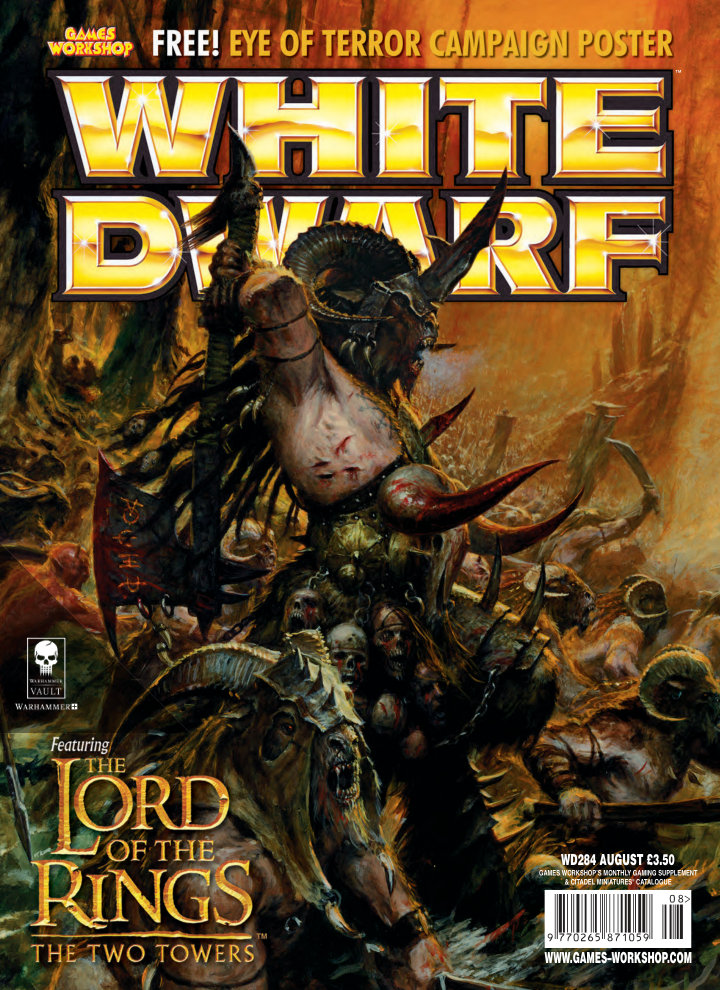
EditorialWD 284 · Inside cover
Paul Sawyer reflects on bringing his Chaos army project towards its conclusion, recalling the pleasure of painting and the difficulty of learning a mobile, magical army after playing Dwarfs. His experience of fielding only the models he had finished leads into the appeal of small games for growing collections. The editorial previews Border Patrol and the expanded 40K in 40 Minutes format as ways to enjoy an army before it reaches the usual battle size.
Warhammer Fantasy BattlesWarhammer 40,000
CommunityWD 284 · pp. 2–3
The news pages report the Warhammer 40,000 Grand Tournament final at Warhammer World, with Max Horseman taking the overall title and awards recognising generalship, presentation and sportsmanship. Website updates point readers towards the Eye of Terror campaign, Beasts of Chaos and Shadow and Flame material. A Black Library roundup connects the campaign’s themes to novels about the Black Crusade, the Iron Warriors and Gaunt’s Ghosts, including the forthcoming Sabbat Martyr.
Warhammer 40,000Warhammer Fantasy Battles
InterviewWD 284 · pp. 12–15
Gav Thorpe explains how the Beasts of Chaos army was designed to feel unpredictable rather than behave like another regimented force. Germanic forest warfare informs Ambush, while mixed Gor and Ungor herds, Raiders movement and unruly behaviour give Beastmen a distinct rhythm. The discussion also follows the return of Centigors and the creation of the Dragon Ogre Shaggoth, then examines the balancing problems of allowing Beast, Mortal and Daemonic contingents to share a Chaos army.
Warhammer Fantasy BattlesBeastmen
ModellingWD 284 · pp. 16–17
Mark Jones builds a burnt-out Empire farmhouse from foamboard walls, a card base and splintered wooden framing. The guide uses filler and salvaged offcuts to create broken masonry, fallen timbers and an uneven floor, making damage part of the construction rather than a final decoration. Dark red wall colours and grey-black drybrushing distinguish surviving plaster from charred wood, and the same approach can be varied into a barn or a larger ruined settlement.
Warhammer Fantasy BattlesThe Empire6 paint colours
CommunityWD 284 · pp. 18–19
A visitor’s guide maps the Games Day arena and lower hall, showing how participation games, the studios, Forge World and Golden Demon fit into the event. Featured mega-battles recreate the Sundering, a clash involving twenty Warhound Titans and the defence of Helm’s Deep. The lower-hall plan places the miniature archive and design process beside painting displays, while the Golden Demon timetable explains registration, judging and collection arrangements for the 2003 show.
Warhammer Fantasy BattlesWarhammer 40,000
LoreWD 284 · pp. 20–23
The forthcoming Imperial Guard codex is introduced through the enormous variety of worlds and cultures represented in its regiments. The preview stresses the spectacle of a mass infantry army and the ability to create a regiment with its own identity, rather than presenting the new codex’s complete army rules.
Warhammer 40,000Astra Militarum
RulesWD 284 · pp. 24–27
Mounted Daemonettes are introduced through a Kislevite patrol’s disastrous encounter with Slaanesh’s hunters, whose speed and seductive appearance unsettle their victims before the killing begins. The accompanying background presents the riders and their sinuous steeds as predators that deliberately prolong a pursuit.
Warhammer Fantasy BattlesDaemons of Chaos
RulesWD 284 · pp. 28–29
Che Webster revisits the compact Patrol Clash format for the Eye of Terror campaign, explaining how restrictions on army size, wounds, armour and vehicles produce a short game using existing collections. The article also expands into paired play: an alliance chart distinguishes trusted, distrustful and forbidden partners, and a command procedure determines how allied forces act together. Suggested missions and advice for resolving unusual interactions keep the emphasis on practical, friendly games rather than treating the format as a separate rules engine.
Warhammer 40,000
RulesWD 284 · p. 30
Tim Eagling’s Patrol Clash mission begins with two small forces unexpectedly meeting in disputed territory. Alternating deployment and an initial move for infiltrators set up the engagement, while numerical losses can force a patrol to test its commander’s leadership and abandon the fight. Random game length and a damage-based fallback result give both players a reason to balance aggression against keeping their limited force intact.
Warhammer 40,000
RulesWD 284 · p. 31
This night-attack scenario adapts Strongpoint Attack for a small patrol sleeping in a central camp. The defender can arrange improvised obstacles around a vulnerable billet while sentries provide the warning of an approaching enemy. The attacker must drive off or destroy the defenders; the defender instead survives until the assault loses momentum. Standardised sentry profiles and altered deployment let very different armies use the same ambush framework.
Warhammer 40,000
RulesWD 284 · p. 32
A hidden-object patrol mission sends both armies into no man’s land to identify and recover an important item or person. Three concealed markers create uncertainty at the centre of the board, and deployment can begin from either corners or long table edges. Taking the objective is only part of the task: the winning patrol must bring it back out through its own deployment edge, while a force that breaks abandons the prize during its retreat.
Warhammer 40,000
TacticsWD 284 · p. 33
Four sample patrols demonstrate how the new Eye of Terror armies work within the small-game restrictions. Cadians combine mobile special weapons and a Hellhound; an Ulthwé force substitutes a Warlock for more expensive psykers and relies on ranged firepower. The Lost and the Damned emphasise a large mutant horde backed by bigger creatures, while the 13th Company uses Storm Claw bikers, Grey Slayers and Fenrisian Wolves for a fast assault. Each list includes its builder’s reasoning rather than simply presenting points totals.
Warhammer 40,000Astra Militarum
TacticsWD 284 · pp. 34–35
Luke Peterschmidt explains how Winds of Magic adds a limited spell-point resource to Sabertooth’s WarCry card game, making timing and resource management matter within each battle. He then previews Siege of Darkness, whose large war machines, support WarCry abilities and new Skaven and Bretonnian units change deck construction. Examples show the effects on terror, discard, ranged and single-race decks, with particular attention to cards that can disrupt a predictable opponent’s central trick.
WarCry Collectible Card GameSkaven
Battle reportWD 284 · pp. 40–51
Paul Sawyer’s Chaos army faces Valten, Luthor Huss and five Warrior Priests, each controlled by a different player, in a variation on The Seven Knights scenario. Army choices and character conversions show how the priestly band hopes to compensate for its tiny size with prayers, protective items and carefully chosen challenges. Chaos instead seeks to divide the heroes with mobile troops and deal with them in smaller groups.
Warhammer Fantasy BattlesThe Empire
RulesWD 284 · pp. 54–57
Matt Keefe traces the Ultramarines’ naval organisation through the Codex Astartes and the defence of Ultramar. The article explains why a Space Marine fleet is primarily an assault and transport force, then shows how the Tyranid incursions exposed the weaknesses of rigid doctrine and encouraged cooperation with the Imperial Navy. Worlds, shipyards and named vessels place the fleet within its wider political and military setting.
Battlefleet GothicSpace Marines
CommunityWD 284 · pp. 58–59
Jervis Johnson explains that a quieter Specialist Games release schedule allows work on the forthcoming Epic relaunch. New Space Marine escorts for Battlefleet Gothic and Skaven machines for Warmaster accompany news of the free Mighty Empires campaign system and a glimpse of a future T’au ship. A reader question prompts a broader explanation of the Specialist Games range: seven titles kept available for established players who want a more focused setting or style of battle.
Battlefleet GothicWarmasterSpace Marines
CampaignWD 284 · pp. 60–65
Dylan Owen introduces a new studio map campaign set a thousand years after the catastrophic Seven Realms conflict. Its history grows directly from earlier players’ alliances, betrayals and improvised adventures, demonstrating how recurring characters and a referee can turn individual battles into a shared narrative. Seven participating realms then reveal the personalities and army choices behind the new struggle.
Warhammer Fantasy BattlesTomb Kings
LoreWD 284 · pp. 70–73
Phil Kelly examines the Phoenix Lord who founded the Dark Reaper Aspect, explaining the continuity of identity carried within a Phoenix Lord’s armour and the philosophy behind Maugan Ra’s heavy weapons. Altansar’s loss gives his story a darker context, while an extended account of the defence of Iyanden shows his precision and resolve against the Tyranids. The article ends by questioning whether his association with death is simply heroic reputation or a more troubling part of Eldar belief.
Warhammer 40,000Aeldari
RulesWD 284 · p. 73
The accompanying character profile turns Maugan Ra’s background into a battlefield role built around the Maugetar’s shooting and its formidable close-combat blade. Warrior powers offer alternative shooting benefits, while fearlessness can extend to a squad of Dark Reapers he leads. The entry also addresses character selection and his special availability to an Ulthwé Strike Force, making this a useful reference for the contemporary Eye of Terror army rather than a current character datasheet.
Warhammer 40,000Aeldari
PaintingWD 284 · pp. 74–75
Seb Perbet and Neil Green demonstrate a coordinated scheme for Farseers and Warlocks, beginning with smooth black armour and cloaks built up through controlled grey highlights. Warm bone colours distinguish masks, runes and wraithbone equipment, while leather pouches receive separate brown-and-bone mixtures. Red gems and fittings provide the main contrast, with small reflected highlights and pale green eyes giving the finished council its sharpest points of light.
Warhammer 40,000Aeldari12 paint colours
TacticsWD 284 · pp. 78–79
Matt Hutson reviews his successful small-game campaign before planning a larger 13th Company army. Storm Claw bikers become the main striking force, supported by Grey Slayers repositioned with the Rune Priest’s Gate power and a separate pack of Fenrisian Wolves. His decision to omit the more predictable Wulfen shows how playing experience reshapes a collection. The printed list and tactical discussion focus on coordinating a small, elite army whose speed is easy for an opponent to underestimate.
Warhammer 40,000Space Wolves
LoreWD 284 · pp. 80–85
Andy Hoare and Graham McNeill profile five distinctive Guard traditions through their home worlds, uniforms and battle honours. The Necromundan Spiders bring hive-gang loyalties into military service; the Mordant Acid Dogs specialise in darkness and tunnels; Drookian Fen Guard exploit marshland and infiltration. Finreht Highlanders and the mechanised Jouran Dragoons show different relationships between tribal populations, noble officers and Imperial authority. Illustrated soldiers and campaign dispatches connect these local identities to the fighting around the Cadian Gate.
Warhammer 40,000Astra Militarum
LoreWD 284 · pp. 88–91
This Index Astartes dispatch surveys Space Marine Chapters answering the call to defend the Cadian Gate. The Space Wolves coordinate much of the response, while the Howling Griffons pursue a hated enemy, the Death Spectres conduct a prolonged siege and the Subjugators sacrifice troops to deny Chaos an orbital fortress. Other accounts follow the Doom Eagles, Marines Exemplar, Harbingers and Ultramarines honour guard. The Dark Angels’ independent operations emphasise the competing obligations hidden beneath the apparent unity of the Imperial defence.
Warhammer 40,000Space Marines
Battle reportWD 284 · pp. 92–107
The concluding half of the Eye of Terror mega-battle follows the fight for Basilica Dufaux alongside three linked clashes: Ulthwé against Dark Eldar in the jungle, the 13th Company attempting to secure a gunship, and Daemonhunters trying to halt a Word Bearers ritual. Reinforcements from these smaller tables can influence the central struggle, tying several different mission objectives into one day’s gaming.
Warhammer 40,000Astra Militarum
EditorialWD 284 · p. 112
Alessio Cavatore explains the delayed arrival of the Fell Beast model and the challenge of adapting cinematic creatures to practical miniature production. He distinguishes the secretive Nazgûl of the first film from the more openly powerful captains of Sauron’s later armies, connecting that change to their expanded heroic resources and magic. Comments on flight, combat and future releases show the design reasoning behind the new models rather than simply promoting their size.
Middle-earth Strategy Battle GameMordor
RulesWD 284 · pp. 116–117
New Ringwraith rules combine a larger reserve of Will with heroic resources and a suite of magical powers, including Black Dart. The entry explains how supernatural existence, terror and the One Ring interact with the model’s battlefield role. Separate horse and Fell Beast rules then distinguish ordinary cavalry from a flying mount that contributes its own attacks and can knock down enemy cavalry, giving the release a complete contemporary rules reference.
Middle-earth Strategy Battle GameMordor
RulesWD 284 · pp. 118–119
An Osgiliath scenario places Frodo under the influence of the Ring while Faramir’s defenders face an expanding Orc attack. The Evil player initially controls the Ringbearer and tries to bring him to the arriving Nazgûl; the Good side must protect him while breaking the attacking army. Reinforcements, heavy armour and unpredictable siege bombardment complicate the struggle, and a points-match option lets other heroes and forces take the central roles.
Middle-earth Strategy Battle GameGondor
PaintingWD 284 · pp. 120–121
Tammy Haye follows the ’Eavy Metal process for assembling and painting the Ringwraith on Fell Beast, with pinning and separate preparation making the large kit easier to handle. Flesh-grey mixtures, layered highlights and ink glazes build the creature’s skin and membranes, while the rider uses restrained grey highlights and weathered black robes. The guide also covers the accompanying Frodo model, including his clothes, face, metallic details and a base that matches the larger display.
Middle-earth Strategy Battle GameMordor18 paint colours
TacticsWD 284 · pp. 124–126
Adrian Champion argues that Moria Goblins succeed by turning cheap warriors and difficult terrain into advantages rather than trying to match elite opponents individually. Shielded front ranks and spear support protect the force’s weaker elements, while climbing and jumping allow Goblins to move through the mines more freely than their enemies. Advice for Durburz, drums, shamans and Cave Trolls shows how leadership, Fury and powerful counter-attacks work together, with special care needed to keep support models alive until battle is joined.
Middle-earth Strategy Battle GameMoria
RulesWD 284 · p. 127
After Balin’s death, a Dwarven rearguard is cut off by Goblins in a chamber divided by a deep chasm. The scenario separates the Dwarf force and gives the attackers freedom to surround it, making the narrow bridge and scattered rubble central to the rescue attempt. Goblins traverse the terrain with confidence, while a defeated Dwarf on the bridge risks falling. A small points-match alternative preserves the encounter’s emphasis on position and survival.
Middle-earth Strategy Battle GameKhazad-dûm
ModellingWD 284 · pp. 128–131
Mark Jones turns the monumental architecture of Moria into a manageable set of reusable gaming pieces. Polystyrene columns, foamboard collars and repeated templates make several matching pillars practical, while filler and textured paint hide joins and prepare the surfaces for painting. Warm brown shading beneath grey drybrushing avoids a flat stone colour, and progressively lighter details near the base suggest pillars disappearing into darkness above. Matching rubble and repurposed plastic scenery complete a flexible underground battlefield.
Middle-earth Strategy Battle GameKhazad-dûm6 paint colours
CampaignWD 284 · pp. 134–137
Paul Crowcroft creates a campaign for an alternative Fellowship, with a chosen Ringbearer and companion supported by seven other heroes. Replacement characters occupy the original Fellowship’s narrative roles, so selecting a powerful fighter also determines where that fighter will appear later. Separate campaign trees accommodate Hobbit Ringbearers or an Isildur who survives the Gladden Fields and attempts to undo his earlier mistake.
Middle-earth Strategy Battle GameThe Fellowship
Release catalogues, store directories, event listings, advertisements and art-only pages are excluded. Contents-listed main features and substantive named scenarios, rules and tutorials are indexed.