EditorialWD 499 · p. 1
Lyle reflects on how an opponent’s reaction can determine whether a game remains enjoyable after the result is decided. An uncomfortable victory against a poor loser prompts him to consider his own behaviour when a later game goes badly. He argues for treating defeat with the same generosity one hopes to receive after winning.
CommunityWD 499 · pp. 4–7
Reader questions consider the relationship between Chaos, the Mortal Realms and realmstone, while Waldo Buchner explains the warm flesh and cool hair of his Kragnos. Benoit Bartkowiak’s Gate Crushers celebrate pride flags through individual Space Marines rather than a uniform Chapter palette. A final Seraphon question supplies the pale flesh, blue scales and celestial markings of the studio’s Starborne Kroxigor.
Age of SigmarWarhammer 40,000Sons of Behemat24 paint colours
LoreWD 499 · pp. 8–11
Nick explores reasons for battles between armies that ostensibly belong to the same faction. Training exercises and commercial disputes can become lethal, while incompatible prophecies, succession struggles and personal rivalries make cooperation fragile even among servants of the same god. Examples range from Stormcast contests and Kharadron contracts to Nighthaunt condemned by Nagash to fight their former allies forever.
Age of SigmarStormcast Eternals
CommunityWD 499 · pp. 12–13
Lyle encourages clubs to adapt the Bunker to their own interests, using Blood Bowl leagues, Underworlds events and painting displays as readily as the magazine’s suggested activities. The continuing Crusade framework provides a common campaign structure without prescribing every local game. Combat Patrol participation, painting achievements and battles between teammates retain their distinct personal and team rewards.
Warhammer 40,000
CommunityWD 499 · pp. 14–15
The painting challenge turns to models associated with psychic, magical or supernatural power. Its monthly record places completed miniatures alongside games and other hobby achievements, allowing participants to build their Bunker rank through different activities. The continuing schedule gives clubs a shared theme while leaving each painter free to interpret it through a preferred game or collection.
CampaignWD 499 · pp. 16–19
The Imperial defenders win the second Bastior phase as infighting weakens the raiders and invaders, although the remaining stage could still produce a shared result. Sam, Nyle and Wade claim the phase awards. Their relics allow shooting after advancing or falling back, provide a fast and elusive lone operative, or sharpen an infantry character’s melee weapon, while army diaries record Steve’s Tyranids and Nick’s Pallid Hand.
Warhammer 40,000Imperium
PaintingWD 499 · pp. 18–19
Steve uses small lines and dots to build insect-like patterns across Hive Fleet Karkinos, allowing the marks to merge naturally on larger carapaces. Nick’s Pallid Hand pursues a quicker rotten-white finish, with dark green armour details and oxidised copper reinforcing the Death Guard’s decay. Their contrasting recipes demonstrate how a clear repeatable method supports the expanding demands of a campaign army.
Warhammer 40,000Tyranids18 paint colours
RulesWD 499 · pp. 20–21
Battleline troops gain an accuracy bonus when they or their targets contest objectives, making the army’s ordinary infantry central to the fight. Duplicate non-Battleline units also offer the opponent additional victory points, discouraging concentrated specialist spam. Progressive control and a final award for objectives held by the greater number of Battleline models reward durable troops that remain useful through the last turn.
Warhammer 40,000
RulesWD 499 · pp. 22–23
This large-battle format compresses deployment into a simultaneous three-minute scramble, with units left unplaced destroyed. Simplified magic and simultaneous melee fighting keep huge armies moving, while additional artefacts give their leaders suitable prominence. Objectives grow more valuable toward the enemy’s territory, so the timed spectacle still rewards an organised advance rather than merely filling the battlefield with models.
Age of Sigmar
RulesWD 499 · pp. 24–27
A combination of deployment maps, twelve victory conditions and environmental twists turns the Scales of Talaxis terrain into many different battles. Objectives include looting, ritual work, machine control and dangerous harvesting rather than a single repeated contest. The expanded twist table adds swamp hazards, unstable ruins and violent weather when the relevant scenery is available, letting the physical collection determine how hostile the battlefield becomes.
Warcry
TacticsWD 499 · pp. 28–31
Jimbo explains how to plan for both possible priority results instead of gambling everything on a double turn. Screens can protect a valuable second line, resilient units can tie up enemy shooters, and objective positioning can make giving away the next turn worthwhile. Spell ranges and battle tactics complicate that choice, while a Daughters of Khaine puzzle tests whether an army can preserve control through either turn order.
Age of SigmarDaughters of Khaine
PaintingWD 499 · pp. 32–35
Emily takes Hive Fleet Agadza beyond its initial test model, recording each stage so that the scheme can be reproduced across differently sized Tyranids. The Trygon’s broad shell requires larger shapes and more careful distribution than a Termagant, but the same warm flesh, orange carapace and dark blue weapons keep the collection coherent. Documenting decisions also makes future additions easier after a break from painting.
Warhammer 40,000Tyranids19 paint colours
PaintingWD 499 · p. 34
Broad dark shapes establish the carapace pattern before smaller stippled marks break up their boundaries. Pale spots and edge highlights then sharpen the blue design without requiring perfectly blended transitions. Emily scales the markings to the creature and tests a green variation, showing how the same underlying method can produce a related scheme rather than an exact copy of one miniature.
Warhammer 40,000Tyranids4 paint colours
ModellingWD 499 · p. 35
A heavy white drybrush over a grey undercoat creates brighter raised areas before a red Contrast coat, adding definition with little additional work. Dan’s modelling tip removes locating pegs from large walkers so their limbs can be repositioned. Both techniques make a small preparatory change do more work later, either improving the paint’s contrast or giving a familiar kit a more individual stance.
3 paint colours
CommunityWD 499 · pp. 36–41
Matt Purdie introduces Redditch Tabletop Gamers and its large collaborative campaigns, including a nine-a-side boarding assault aboard the Lion of Calth. The studio’s supernatural challenge includes Celestine, ghostly executioners and a molten C’tan, alongside vampires and an Aeldari campaign hero. Reader submissions broaden the theme into a gallery of spellcasters and otherworldly creatures.
Warhammer 40,000Age of SigmarUltramarines12 paint colours
LoreWD 499 · pp. 44–49
Spymistress Lorien’s report examines the power of Sigmarite belief and the sprawling priesthood that organises it. Arch-Lectors, local pontifices and humble lay acolytes influence politics as well as devotion, while the Dawnbringer Crusades give their rituals renewed urgency. Profiles of Elethrus Vinc, Pontifex Zenestra and Cleona Zeitengale mix useful intelligence with uncertainty, and the account warns that corruption can flourish beneath extreme outward piety.
Age of SigmarCities of Sigmar
FictionWD 499 · pp. 50–51
Sewerjack Gollac and his mastiff Ratsnagger investigate a disturbance beneath Hammerhal Aqsha, where the crusade has stripped the city of experienced help. The familiar noises of the pipes conceal ghouls and a spreading appetite that reaches even his loyal dog. Gollac’s practical courage cannot protect him from a horror that turns the city’s buried infrastructure into a channel for cannibalistic contamination.
Age of SigmarCities of Sigmar
InterviewWD 499 · pp. 52–55
Jimbo selects ten rules whose mechanical effects express the personalities of their models, from Brutes bullying weaker troops to Skaven abandoning a fight. His choices include the Scriptor Mortis’s delayed sentence, a Maw-grunta’s growing momentum and Alarielle’s renewal of life. The discussion connects rules writing to background and miniature design, treating narrative character as something a player can feel during a battle.
Age of SigmarOrruk Warclans
RulesWD 499 · pp. 56–63
Six Underworlds warbands receive Warcry profiles and abilities, bringing their named personalities into skirmishes in the Gnarlwood. The introduction explains how leaders and followers enter other warbands and how Bladeborn differ in narrative campaigns: they avoid normal injuries and advancement but cannot collect the usual artefacts. Their individual cards translate each group’s story into distinctive reactions and combinations.
WarcryIdoneth Deepkin
RulesWD 499 · p. 58
Cyreni’s companions combine the changing force of the tides with Hammertide’s disruptive movement. Ink jets can deny a melee attacker its strike, while the octopus threatens opponents without remaining exposed in the same place. Their abilities reward timing and coordinated attacks, allowing a small group to interfere with an enemy’s plans before committing its own fragile fighters.
WarcryIdoneth Deepkin
RulesWD 499 · p. 59
The three daemons compete through a shared repertoire of reactions and blessings. An ally’s death can provoke immediate movement or an attack, while the Coiled Lash prevents a victim from simply withdrawing. Their aggressive bonuses demand suitable dice and positioning, and including all three leaders in another warband is constrained by the normal limit on allies.
WarcryHedonites of Slaanesh
RulesWD 499 · p. 60
Daggok’s hunters turn brutal kills into resources and use hooks and dirty tricks to keep victims within reach. Leaving an enemy bleeding makes its existing wounds more dangerous, while their battle cry strengthens nearby Kruleboyz. The resulting profiles reward a group that concentrates on vulnerable prey and follows a successful attack with another opportunistic advantage.
WarcryKruleboyz
RulesWD 499 · p. 61
Zondara and Ferlain fight as a devoted pair, with stronger movement and attacks when the other has fallen. Their undead servants can break graves for useful extra actions and return through Soulblight resurrection abilities. Protective strikes and linked activations make the lovers’ relationship part of the warband’s tactics rather than leaving it solely in their background.
WarcrySoulblight Gravelords
RulesWD 499 · p. 62
The Brethren pass their charged conviction through a chain of nearby fighters, making careful spacing central to their strongest effects. Defensive resistance can reduce incoming damage, while a burst of righteous fury supplies extra movement and an attack. Their rules turn a group of apparently humble zealots into a coordinated threat when its members remain close enough to sustain the relay.
WarcryCities of Sigmar
RulesWD 499 · p. 63
The court’s cooks treat the battlefield as a source of ingredients, accumulating the means for a restorative banquet through successful kills. A reaction lets a wounded fighter disengage, while precise carving and paired activations create opportunities to finish vulnerable enemies. The warband’s gruesome culinary identity therefore governs both its offensive rhythm and its ability to recover from casualties.
WarcryFlesh-eater Courts
ShowcaseWD 499 · pp. 66–79
The year-long collection challenge concludes with 489 models, 153 units and more than a hundred games between the participants. Joe finishes ahead on points, but the final armies demonstrate very different ambitions: Norn beasts, converted Death Guard, Angron’s followers and an expanding armoured regiment. Their reflections emphasise discovering practical painting habits and leaving room for new ideas as a planned collection develops.
Warhammer 40,000World Eaters
PaintingWD 499 · p. 68
Rhuairidh replaces Mortarion’s wings with a turbine assembly made from three Bloat-drone fans, carrying the army’s industrial character into its largest model. A classic Daemon Prince, tanks and a deliberately battered rather than heavily mutated aesthetic complete the force. His recipes balance dirty pale armour, red robes and sickly globes, while his advice favours small regular painting sessions that fit around family life.
Warhammer 40,000Death Guard12 paint colours
PaintingWD 499 · p. 69
James adds Angron, Eightbound and heavy support to an army approaching four thousand points. Glowing Butcher’s Nails make the Primarch’s head the focal point, with hot yellows against dark red flesh and worn brass. Completing the force has depended on family support and sustained effort, but the final character rewards that work with a centrepiece appropriate to the World Eaters’ relentless aggression.
Warhammer 40,000World Eaters16 paint colours
PaintingWD 499 · p. 74
Joe finishes his Tyranids with a Norn Emissary and reflects on a year that combined weekly games with several tournaments. Pale shaded flesh, red-over-black carapaces and sharp glowing details unite the increasingly varied organisms. The experience has made him more willing to choose models for enjoyment rather than impose restrictions on himself, leaving the collection open to further expansion after the challenge.
Warhammer 40,000Tyranids11 paint colours
PaintingWD 499 · p. 75
Andy’s armoured force reaches 142 models and approximately 4,600 points, with Leman Russ tanks, a Rogal Dorn and super-heavy support. Antonin Kursveil stands in for the Lord Solar on a converted half-track assembled from a House Greim officer, Jackal Alphus bike and Kataphron tracks. Contrasting green Cadian and pale Narmenian tank recipes distinguish allied formations while retaining a common weathered battlefield appearance.
Warhammer 40,000Astra Militarum10 paint colours
LoreWD 499 · pp. 80–87
An inquisitorial dossier surveys the sciences that let Crypteks manipulate bodies, energy, time and emotion. Their indispensable skills coexist uneasily with noble authority, personal obsessions and the restrictions surrounding forbidden research. Accounts of Szeras, Orikan and the Technomandrites show that mastery of reality does not produce political unity: rival laboratories and dynasties can be as dangerous to one another as to the Imperium.
Warhammer 40,000Necrons
FictionWD 499 · pp. 88–91
Magos Tathyk Shon struggles to reach a secret device while Necrons board her isolated explorator ship. Contradictory timestamps, impossible repairs and wounds that disappear suggest a threat to time itself, but she repeatedly dismisses the evidence as corrupted data. Her determination to awaken the stolen machine drives her through the fighting even as the ship’s familiar systems cease to behave consistently.
Warhammer 40,000Adeptus Mechanicus
RulesWD 499 · pp. 92–95
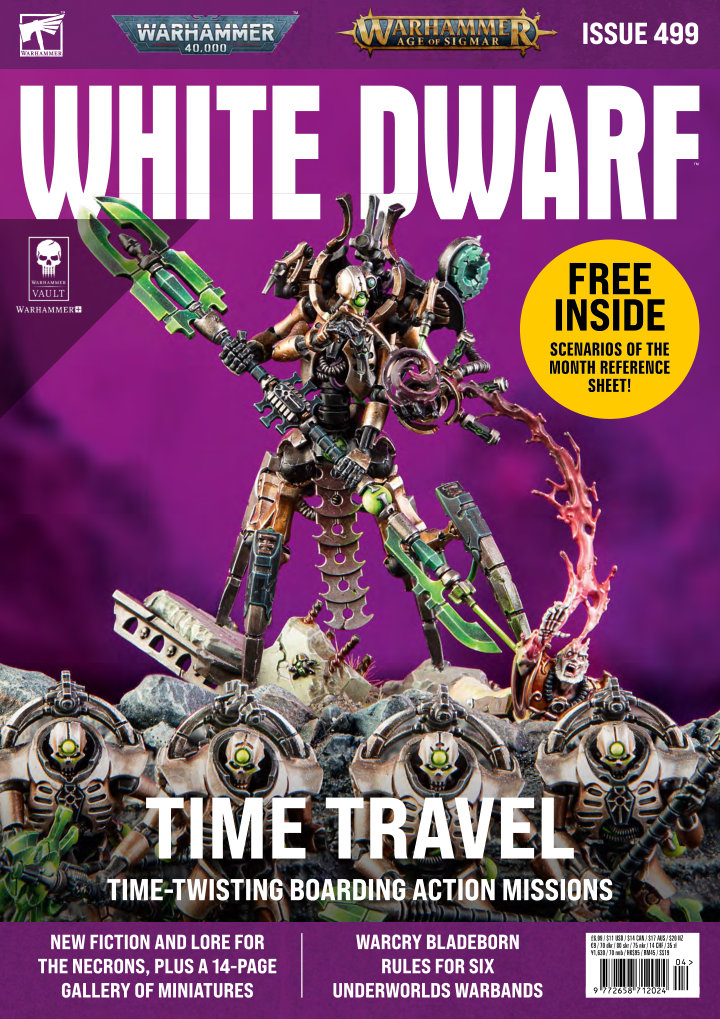
Two matching Boarding Actions boards represent the past and present of the same location. Players fight on both in a fixed sequence, with ordinary attacks remaining on their own board while mission rules transmit selected consequences through time. The framework supports six scenarios in which sabotage, moving objectives and changing resources make a decision in one battle reshape the other.
Warhammer 40,000
RulesWD 499 · pp. 96–97
Units in the past plant bombs whose explosions threaten the corresponding locations in the present. The delay leaves opponents uncertain whether a contested position will remain safe. End-game control is far more valuable on the present board, so the past army’s most useful contribution may be preparing destruction rather than holding its own objectives.
Warhammer 40,000
RulesWD 499 · pp. 98–99
Opening and closing hatchways in the past changes the matching doors in the present, except where that would disrupt unit coherency. Present-day objective control supplies progressive points, while the past rewards the army with more surviving units. Door operations therefore become a way for one force to manage its counterpart’s routes without sacrificing every fighter to immediate scoring.
Warhammer 40,000
RulesWD 499 · pp. 100–101
Moving a connected objective in the past shifts its counterpart in the present. Units can pull valuable locations toward friendly positions or away from an opponent, subject to the movement restrictions. A large final reward for present-day control makes the changing geography more important than the smaller tally on the past board.
Warhammer 40,000
RulesWD 499 · pp. 102–103
Unengaged units exploit crystal zones in the past to generate new objectives in the corresponding present. Each zone is used once and the new markers must respect distance and wall restrictions. The present scores progressively from these growing resources, while the past can earn a final reward by pushing units forward rather than merely guarding exhausted zones.
Warhammer 40,000
RulesWD 499 · pp. 104–105
Warp rifts transport units from the present into the past, with the risk of damage increasing as the battle continues. Arriving troops must remain clear of enemies and cannot immediately charge. Objective values also change over time, encouraging early exploitation of the present followed by a carefully timed migration to the past.
Warhammer 40,000
RulesWD 499 · pp. 106–107
A harvesting manoeuvre converts control of an objective into samples and points, but removing a resource in the past also removes its counterpart in the present. Present-day supplies may regrow, giving the later battlefield a chance to recover from earlier extraction. Players must balance immediate harvests against what their own counterpart will need during subsequent turns.
Warhammer 40,000
PaintingWD 499 · pp. 108–121
The studio explores how dynastic names, awakening histories, damaged engrams and noble personalities can guide a Necron collection. Individual projects range from improvised Destroyer royalty to armies weathered by hostile worlds, with energy colours and armour finishes distinguishing their owners. The collected recipes show how ancient metal can appear polished, oxidised, ceramic, rusted or almost spectral without losing the models’ shared mechanical character.
Warhammer 40,000Necrons
PaintingWD 499 · p. 110
Flayed Ones wear pelts in several flesh tones, including the remains of an ork. Stippled blood unifies the varied skins and gives the impression of a feeding frenzy, while simple washed metal keeps attention on the grisly trophies. The method embraces uneven decay rather than treating every strip of stolen skin as a clean uniform surface.
Warhammer 40,000Necrons7 paint colours
PaintingWD 499 · p. 110
Dave imagines a phaeron who has embraced the Destroyer Cult, mounting a Skorpekh torso on a Canoptek Wraith tail. Parts from several Necron characters and Triarch Praetorians create an elaborate royal silhouette, with a single eye beneath its crown. Dark metal, warm gold and brilliant green energy distinguish its ornate upper body from the sinuous mechanical base.
Warhammer 40,000Necrons13 paint colours
PaintingWD 499 · p. 110
James places Szeras in Novokh colours but uses contrasting accents to reveal the model’s stranger details. Jade blades and overcharged machinery sit against red armour, while magenta draws attention to the human material being consumed. The layered green recipe shifts from a very dark base to pale sharp highlights, separating the weapons from the surrounding metallic structure.
Warhammer 40,000Necrons10 paint colours
PaintingWD 499 · p. 111
Elliot deliberately pursues liquid chrome to distinguish the Void Dragon from the grimier appearance of his Imperial models. Gloss medium preserves reflective silver and gold, while translucent blue alters the lightning without concealing its metallic foundation. A darker blackstone structure provides the necessary contrast, keeping the brilliant figure readable against its own elaborate setting.
Warhammer 40,000Necrons11 paint colours
PaintingWD 499 · p. 112
Bethany’s Nihilakh machine combines cold black and turquoise with heavily oxidised copper. Sponging the original copper colour back over the oxide creates irregular patches rather than a uniform blue-green coat. Cracked earth over luminous colour extends the contrast onto the base, giving the walker a terrain setting that echoes its energy effects.
Warhammer 40,000Necrons19 paint colours
PaintingWD 499 · p. 112
Dan’s Mephrit-associated Warden uses pale ceramic armour instead of the expected exposed metal. A warm bone base and shade lead to a bright flesh-toned highlight, while burnt brown through orange gives the technological details a strong contrasting glow. The limited palette makes the alternative material treatment legible without adding many separate colours.
Warhammer 40,000Necrons6 paint colours
PaintingWD 499 · p. 112
John draws inspiration from The Twice-dead King and depicts Oltyx after the loss of his royal gold. Cold black armour and increasingly pale grey highlights create a battered, stripped-down figure whose diminished appearance reflects the character’s disgrace. A final grey shade links the layers and avoids making the exposed surfaces look freshly polished.
Warhammer 40,000Necrons6 paint colours
PaintingWD 499 · p. 113
Failed terraforming has left the Kaprazekh among lethal dust, which informs the collection’s weathered metals and red earth. Pale ceramic faces provide a focal point against turquoise details and warm copper. Orange-to-yellow energy makes the weapons stand out while preserving the impression of a dynasty enduring a hostile environment rather than emerging pristine from its tomb.
Warhammer 40,000Necrons14 paint colours
PaintingWD 499 · p. 114
The Zathanor awaken beneath a night world’s ultraviolet light, their necrodermis no longer functioning perfectly. Purple stippling suggests an aged patina across otherwise familiar silver bodies. The recipe develops that colour from near-black violet through lilac, with pale highlights distinguishing damaged armour from its brighter mechanical edges.
Warhammer 40,000Necrons10 paint colours
PaintingWD 499 · p. 115
Nyle builds a Mar’dekh force around Urudekh and the battles against the Tome Keepers in the Macharius Alpha Sector. Completing the army quickly encourages a restrained recipe of darkened silver, pale details and green luminosity. Selective copper oxidation and cold grey-blue components break up the machines without undermining the common appearance needed across the rapidly painted collection.
Warhammer 40,000Necrons14 paint colours
PaintingWD 499 · pp. 116–117
Andy’s vassals of the Silent King use fast washes and drybrushing to give silver bodies a warm ancient cast. A walking Plasmancer combines Royal Warden legs with character components, keeping the army visually individual despite its efficient painting method. Dark armour, bright green energy and dusty bases complete a palette that can be repeated over a large host.
Warhammer 40,000Necrons12 paint colours
PaintingWD 499 · pp. 116–117
Luke names the dynasty for being forgotten and looks to abandoned desert vehicles for its finish. A hairspray technique lets turquoise paint peel away to expose a rusty foundation, while clean silver gives the mechanisms a different material character. The approach made it possible to complete an army rapidly for Four Warlords without sacrificing a distinctive sense of age and neglect.
Warhammer 40,000Necrons10 paint colours
PaintingWD 499 · pp. 118–119
Jim uses deep blue to indicate the standing of his Charnovokh nobles, whose dynasty has lost worlds to Hive Fleet Behemoth. A converted Destroyer Lord joins a Skorpekh upper body to a Lokhust Heavy Destroyer chassis and carries an Overlord’s scythe. Blue armour, bright green energy and warm red ground create a consistent visual identity across the surviving machines.
Warhammer 40,000Necrons16 paint colours
PaintingWD 499 · pp. 120–121
Dean distinguishes the dynasty’s ranks with silver fighting units and gold nobility, culminating in a richly metallic Silent King. Red cloth and dark machinery keep the large centrepiece’s composition readable. Gradually shaded menhirs and carefully brightened energy orbs add depth to the throne, while the accompanying recipes carry the same red, white and luminous green accents through the army.
Warhammer 40,000Necrons15 paint colours
ShowcaseWD 499 · pp. 122–129
Martin Waller traces his Deathwatch from five converted Intercessors to an army that won painting awards at No Retreat events. A background in Golden Demon competition informs the finish, but this project offers a more relaxed return to gaming and collecting. Chapter-specific details, customised veterans and a personal Watch Master give the force individuality, while the hobby provides a practical release from work and family pressures.
Warhammer 40,000Deathwatch
PaintingWD 499 · p. 128
Cold neutral highlights define the Deathwatch’s black armour, with extra stages on vehicles to prevent their broad panels becoming flat. Warm gold, worn leather and bright silver distinguish equipment without competing with the red accents. A separate Dark Angels shoulder recipe preserves a veteran’s origin, illustrating how the shared black uniform can accommodate many Chapter identities.
Warhammer 40,000Deathwatch32 paint colours
CampaignWD 499 · pp. 130–135
Gorshiv’s systematic assault cuts Cinderak City into isolated pockets until Athera challenges him in its central market. The studio concludes its Succession campaign with the Street Fight scenario, recording gang battles and the rebellion’s overall advantage. Final Triumphs recognise territory, wealth, reputation, survival and loyalty, with players explaining how their most valued fighters shaped the campaign’s memorable victories and disasters.
NecromundaHouse Escher
FictionWD 499 · pp. 136–141
Ushizar and Ilum search the Tome Keepers’ oldest records while the last defenders retreat toward the All-vault. Reordering ancient tablets reveals that an honoured sky warrior was actually the ascended Word Bearer leading the present attack. Knowing its daemonic name gives Ushizar a final chance to defeat it, but the costly victory leaves him uncertain whether an old prophecy of the Chapter’s doom has been broken or merely delayed.
Warhammer 40,000Tome Keepers
LoreWD 499 · p. 142
A distressed transmission describes Tyranid organisms saturating Samarik’s atmosphere while tectonic disturbances and dormant cult activity undermine its defences. Reports of approaching Kin vessels add another uncertain element to the crisis. A Tome Keepers mission transcript places the coming invasion within a month, setting up the magazine’s next major battlefield rather than presenting a finished studio army project.
Warhammer 40,000Tome Keepers
TacticsWD 499 · p. 143
The team compares several ways to attack the Boltboyz and hold the objective against a possible orruk double turn. Its preferred solution uses the Lifetakers to absorb Unleash Hell, the Avatar to trap a shooting unit and layered aelf screens to delay the Brutes. The positioning protects the Blood Sisters’ claim even if the opponent receives consecutive turns.
Age of SigmarDaughters of Khaine