CommunityWD 426 · p. 2
Short introductions connect the magazine’s editorial, design, writing and photography staff with their favourite releases of the previous year. Their choices range from Primaris specialists and Mortarion to Kharadron leaders and Grombrindal, providing a personal counterpart to the larger retrospective later in the issue.
EditorialWD 426 · p. 3
The editor introduces a revised format designed to help new readers find their way into the hobby while making room for more advanced material. Paint Splatter gains a reusable introduction to basic techniques, while the issue combines Nurgle releases, new small-game adventures, army projects and a scenery-building feature.
CommunityWD 426 · pp. 6–19
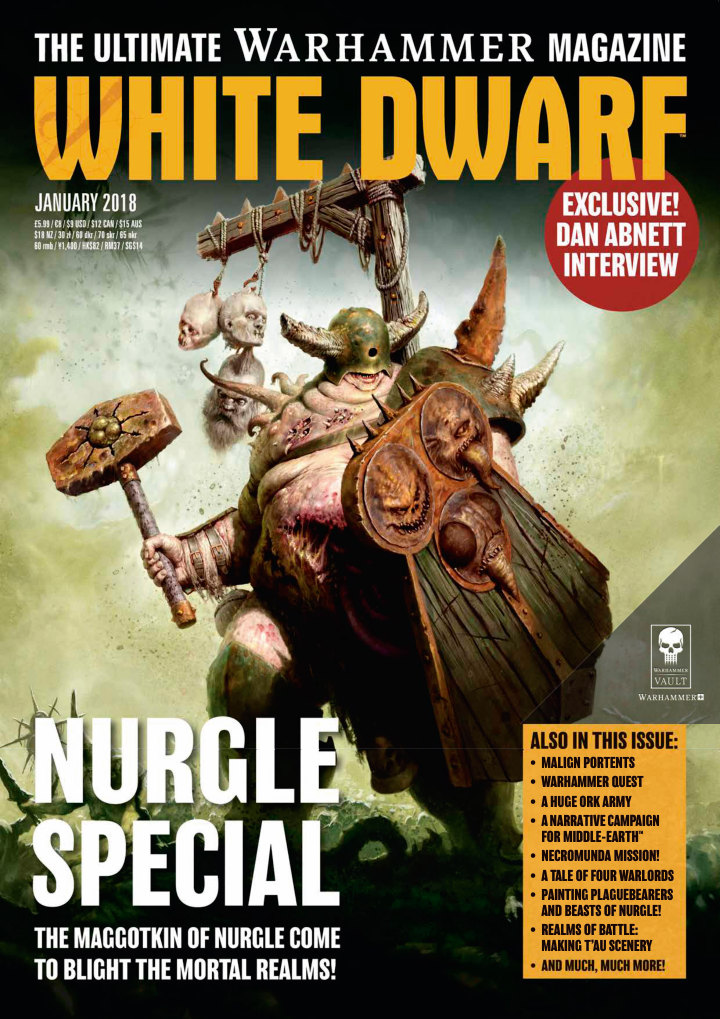
January’s news is dominated by Nurgle, with new daemon characters, monsters and terrain appearing alongside the Maggotkin battletome and Chaos Daemons codex. Middle-earth models, licensed games and Black Library releases broaden the roundup, establishing the publication context for the longer design and painting features.
ReviewWD 426 · pp. 6–7
The new Nurgle releases bring mortal Rotbringers and daemonic allies together in the Maggotkin battletome, while Chaos Daemons receives a new codex for the far future. The preview contrasts their settings and army options and introduces the month’s wider collection of plague-bearing miniatures without presenting the books’ full rules.
Age of SigmarWarhammer 40,000Maggotkin of Nurgle
ReviewWD 426 · p. 8
The plastic Great Unclean One is presented as a configurable centrepiece with alternative heads, weapons and accompanying Nurglings. The annotated model stresses its enormous diseased body and characterful details, while the Rotigus alternative gives the same kit a distinct named sorcerer identity.
Age of SigmarWarhammer 40,000Daemons of Nurgle
ReviewWD 426 · p. 9
This living terrain piece represents the Garden of Nurgle forcing itself into another world. Its diseased trunk, gaping maw and cultivated bells make it more than an ordinary dead tree, while the preview directs players to the separate army books for the rules governing its battlefield effects.
Age of SigmarWarhammer 40,000Daemons of Nurgle
ReviewWD 426 · p. 10
The two heralds embody opposing kinds of encouragement: the Bilepiper spreads a lethal infectious mirth, while the Scrivener bullies his charges through meticulous record keeping. Their instruments, quill and distorted faces turn these roles into sculpted jokes, expanding Nurgle’s character beyond undifferentiated decay.
Age of SigmarWarhammer 40,000Daemons of Nurgle
ReviewWD 426 · p. 11
The new plastic beast is described as an exuberant creature whose attempts at friendship are fatal to mortals. Alternative body, crest and head components allow several versions of its slug-like form, with the preview emphasising the contrast between a playful personality and its monstrous, toxic anatomy.
Age of SigmarWarhammer 40,000Daemons of Nurgle
ReviewWD 426 · pp. 12–13
The Lord of Blights supplies his followers with harvested death’s heads, while Pusgoyle Blightlords carry armoured champions into battle on Rot Flies. The accompanying Lord of Afflictions option adds another airborne leader, linking the models’ equipment and silhouettes to Nurgle’s existing mortal and daemonic ranges.
Age of SigmarMaggotkin of Nurgle
InterviewWD 426 · p. 12
Ben Jefferson explains how the new mortal kits communicate rank and role through their weapons and trophies. David Waeselynck’s Blightlords use banners, carried bodies and more insect-like Rot Flies, whose legs also support the models; the Lord of Blights retains the established lordly bulk while exchanging familiar equipment for harvested heads.
Age of SigmarMaggotkin of Nurgle
ReviewWD 426 · p. 14
Three resin miniatures give individual forms to the Witch-king, the Dark Headsman and the Slayer of Men as they appear at Dol Guldur. Their masks, armour and weapons distinguish the otherwise hidden servants of Sauron, with the preview noting how these identities fit into the larger collection of nine wraiths.
Middle-earth Strategy Battle GameDol Guldur
ReviewWD 426 · p. 16
Devil Pig Games adapts its compact battlefield system to a confrontation between Sicarius’s Ultramarines and Zanzag’s Orks. Counters stand in for units in short engagements, with the preview describing the creators’ enthusiasm for the setting and the prospect of expanding the opposing forces beyond the initial boxed game.
Heroes of Black ReachUltramarines
ReviewWD 426 · p. 17
The historical preview outlines the Tomb Kings expansion’s four legendary lords and its distinct campaign economy. Canopic Jars, the Mortuary Cult, recovered Books of Nagash and battlefield reinforcements differentiate the undead kingdom, while familiar constructs and mounted units translate the miniature range into the strategy game.
Total War: WarhammerTomb Kings
ReviewWD 426 · p. 18
The preview follows Occam the Untrue into the Maelstrom in search of a future for the Alpha Legion. Its emphasis on unreliable loyalties and manipulation positions the novel around the Legion’s conflicting identities, promising a journey in which an apparent ally or objective may conceal another layer of deception.
Warhammer 40,000Alpha Legion
ReviewWD 426 · p. 18
Castellan Crowe confronts the consequences of the Great Rift while an ancient enemy exploits the new instability. The book announcement places his duty as bearer of the daemon blade Antwyr at the centre of a conflict that threatens both the Chapter and the wider Imperium.
Warhammer 40,000Grey Knights
ReviewWD 426 · p. 19
The collection gathers the adventures of Lucian Gerrit, patriarch of a declining trading house willing to risk everything to restore its fortunes. Its novels and short stories take him to the Damocles Gulf, where personal ambition becomes entangled with the approach of a larger Imperial and alien war.
Warhammer 40,000Imperium
ReviewWD 426 · p. 19
The omnibus collects the Von Carstein trilogy and related short fiction from the world-that-was. This announcement connects the family’s old struggles for power with the issue’s growing interest in death and undeath, offering literary background rather than reproducing any of the novels.
Warhammer Fantasy BattlesVampire Counts
ReviewWD 426 · p. 19
Athene Santiago’s pursuit of pirates changes character when a vanished ship reappears damaged and apparently stricken. The audio-drama announcement uses this mystery to move from an ordinary frontier hunt toward a threat with potentially much wider consequences for the Imperium.
Warhammer 40,000Rogue Traders
InterviewWD 426 · p. 19
Andy Hoare explains why Rogue Traders are useful guides to the uncertain margins of Imperial space. His novels retain enough familiar elements to anchor the setting while allowing unusual frontier societies, and he connects that interest in peripheral worlds with his later work leading games such as Necromunda and Blood Bowl.
Warhammer 40,000
CommunityWD 426 · pp. 20–21
Readers discuss painting with children, slow-growing campaigns and the balance between imaginative battle reports and technical advice. Other replies address modelling sources and the period’s developing Primaris background, capturing the questions hobbyists were asking as several recently relaunched games and armies settled into use.
PaintingWD 426 · p. 21
The painting reply suggests yellow lenses made by tinting a silver base and finishing it with gloss varnish. It also describes black blood through a dark gloss wash mixed into the blood-effect paint, and a green alternative using a green wash and varnish, demonstrating how existing products can serve unusual effects.
6 paint colours
TacticsWD 426 · pp. 22–23
Dan Harden, Adrian Wood and Iain Gonzalez introduce Orks through their exuberant models and contrasting approaches to warfare. The collecting advice branches from straightforward bosses and armoured walkers toward cunning support characters and heavy guns, explaining how the starter collection, Index rules and Chapter Approved could support an initial army in this publication period.
Warhammer 40,000Orks
CommunityWD 426 · pp. 24–25
The retrospective revisits the colourful Lizardmen release and the designers’ reasons for looking to venomous animals rather than a uniform scheme. Other memories include an Iron Warriors army, a refought Lizardmen battle, Bretonnian personalities, scenery collection and kitbashing, showing the variety packed around the original launch coverage.
Warhammer Fantasy BattlesWarhammer 40,000
FictionWD 426 · pp. 26–27
Pietru van Harrow faces a dawn in which his familiar farm becomes hostile and uncanny: livestock falter, the crop changes and dead figures rise from the soil. His wife’s unsettling appearance leaves the situation uncertain, but the farmer answers the threat with a scythe and the stubborn instincts of a life spent working the land.
Age of SigmarDeath
FictionWD 426 · pp. 28–29
Horticulous Slimux discovers a sterile region where the ordinary propagation of Nurgle’s garden fails. As skeletons emerge to seize fleeing humans, the gardener recognises a force hostile to his god’s cycle of growth and decay, retreating to reconsider an enemy that offers neither fertile life nor useful corruption.
Age of SigmarMaggotkin of Nurgle
InterviewWD 426 · pp. 30–35
Stuart Edney talks with Dan Abnett about the origins of Gaunt’s Ghosts and the long process of sustaining a large, changing cast. Abnett discusses the tension between satisfying character development and war’s arbitrary losses, the notes needed to preserve continuity, and how writing The Warmaster renewed his enthusiasm after an exceptionally demanding period of output.
Warhammer 40,000The Horus HeresyAstra Militarum
InterviewWD 426 · p. 32
Abnett describes the challenge of writing Space Marines as recognisably human characters who nevertheless experience war on a different scale. Earlier work on Brothers of the Snake and Horus Rising helped him find that perspective, while an ordinary soldier’s view can make the same warrior seem nearly invulnerable and profoundly alien.
Warhammer 40,000The Horus HeresySpace Marines
InterviewWD 426 · p. 34
The interview turns from front-line military fiction to the distant historical setting of the Inquisition stories. Abnett explains how a short connecting piece for an Eisenhorn and Ravenor collection grew unexpectedly into The Magos, illustrating how an intended framing device can become a substantial new story in its own right.
Warhammer 40,000Inquisition
InterviewWD 426 · pp. 38–45
The sculptors trace Nurgle’s visual language from the earliest Great Unclean Ones and Plaguebearers to the latest plastics. Their explanations connect old illustrations, material limitations, biological textures and comic details, showing how repeated motifs can unite cheerful daemons, grim mortals and industrial war machines without making them identical.
Age of SigmarWarhammer 40,000Daemons of Nurgle
InterviewWD 426 · p. 40
Steve Buddle draws on Aly Morrison’s original belly-mouth idea, Trish Carden’s later movement and Tom Harrison’s exaggerated anatomy to create a new plastic centrepiece. Corroded yet carefully crafted weapons and references to Wayne England’s art balance the body’s revolting textures with a sense of deliberate, recognisable design.
Age of SigmarWarhammer 40,000Nurgle
InterviewWD 426 · p. 40
Dave Andrews describes an organic terrain piece that should appear to have grown into existence rather than simply been built. Its mouths and tubular growths relate it to Nurgle’s beasts, while bells and iron bands suggest that someone has tended this apparently natural intrusion from the god’s garden.
Age of SigmarWarhammer 40,000Nurgle
InterviewWD 426 · p. 41
Rotigus adapts the Great Unclean One kit into a ritual gardener and sorcerer through a new head and arms. Multiple faces, seven tentacles, a grotesquely attached cowl and a staff parodying a life-giving wizard make his role readable while retaining the shared body and overall character of a greater daemon.
Age of SigmarWarhammer 40,000Nurgle
InterviewWD 426 · p. 42
Aly Morrison explains the difficulty of combining a slow slug-like body with an eager, affectionate monster’s personality. The design mixes rubbery underparts, cracked surfaces and extravagant head growths so that the beast’s textures communicate corruption without erasing its exuberant movement and expression.
Age of SigmarWarhammer 40,000Nurgle
InterviewWD 426 · pp. 42–43
Gardeners, musicians, scribes and warriors give Nurgle’s heralds distinct occupations. The designers revisit Adrian Smith’s early concepts through a snail and gardening tools, a grotesque bureaucrat’s record book and a jester’s corpse-bagpipes, using small narrative details to suggest an entire diseased society.
Age of SigmarWarhammer 40,000Nurgle
InterviewWD 426 · p. 42
The Rot Fly’s background transforms a rejected Beast of Nurgle into a much less friendly creature through a period of pupation. Mike Anderson connects that story with Adrian Smith’s visual ideas, explaining a model whose insect anatomy and gruesome equipment extend the army’s biological vocabulary.
Age of SigmarWarhammer 40,000Nurgle
InterviewWD 426 · p. 43
The modern Plaguebearers exaggerate the old combination of thin limbs, swollen bellies and grim expressions. Plastic construction permits exposed intestines and unusual mouths that older materials restricted, while their organic swords and humourless demeanour distinguish them from the more exuberant servants of the same god.
Age of SigmarWarhammer 40,000Nurgle
InterviewWD 426 · pp. 44–45
The discussion links Poxwalkers and Plague Marines with the broader Nurgle range through horns, maggots and distorted flesh. Daemon engines develop that language into mechanical creatures, culminating in designs whose armour, engines and raw tissue look like parts of a single corrupted organism.
Age of SigmarWarhammer 40,000Nurgle
CommunityWD 426 · pp. 46–51
The retrospective follows a year of major changes, from Cadia’s fall and Guilliman’s return to the new edition, Primaris reinforcements and Mortarion. It also covers new Mortal Realms armies, Shadespire, Necromunda, Forge World projects and Black Library books, with a parallel month-by-month account of how White Dwarf reported those developments.
Warhammer 40,000Age of Sigmar
CommunityWD 426 · p. 52
The magazine invites readers to rank five favourite Citadel releases from the previous year and sets the team’s own choices beside a monthly visual reminder. As an archive item it records the original poll and its January deadline, rather than offering an active voting opportunity today.
Battle reportWD 426 · pp. 54–67
Martyn Lyon’s Maggotkin attack Michael Wieske’s two-lodge Fyreslayer force while it protects Battlemage Augus Goldenhand’s purification spell. Durable units and carefully positioned heroes create a prolonged struggle, but the Nurgle army eventually overwhelms the defenders; Augus escapes without completing his work and still receives a formidable bill from the surviving lodge.
Age of SigmarMaggotkin of Nurgle
RulesWD 426 · pp. 54–59
This custom escort-and-defence setup places the wizard in a central tower with Fyreslayers deployed around him and Nurgle forces approaching from outside. His survival through five rounds is the principal goal, while casualty tallies distinguish levels of success; the tower rules allow magical support but make physical access to the wizard a key attacking problem.
Age of SigmarMaggotkin of Nurgle
LoreWD 426 · pp. 70–77
The guide introduces Nagash’s dominion through his own survival, his Mortarchs and the many forms of undeath serving them. Shyish’s varied afterlives become the setting for a struggle over souls, while vampires, skeletons, ghouls and spirits illustrate the very different creatures that can answer the Great Necromancer’s summons.
Age of SigmarDeath
LoreWD 426 · pp. 72–73
Nagash’s pursuit of immortality leads from his origins in the old world to his reappearance in Shyish and repeated wars with the Chaos Gods. Arkhan, Mannfred and Neferata serve him through sorcery, military command and manipulation respectively, but the guide stresses the very different loyalties behind their apparent obedience.
Age of SigmarDeathlords
LoreWD 426 · p. 74
The Realm of Death originally contains countless underworlds shaped by mortal cultures’ beliefs about the afterlife. Nagash’s arrival disrupts that natural passage, conscripting souls and bodies into his designs; Chaos occupation brings another form of torment, making his eventual return a grimly preferable alternative for some inhabitants.
Age of SigmarDeath
LoreWD 426 · p. 75
Nagash’s personally fashioned Morghasts stand beside vampires who retain considerable autonomy until their master calls. The vampire account connects Neferata’s origins with Blood Knights, thralls and the danger of degeneration, contrasting outward courtly behaviour with the predatory hunger sustaining these undead rulers.
Age of SigmarSoulblight
LoreWD 426 · p. 76
Four concise faction portraits separate animated bones, reanimated flesh, deluded cannibals and disembodied spirits. Deathrattle discipline, Deadwalker numbers, the Flesh-eater Courts’ strange living status and the Nighthaunt’s hatred of life show why these forces fight differently even when their ultimate allegiance is shared.
Age of SigmarDeathrattle
LoreWD 426 · p. 77
Necromancers supply the magic that sustains and replenishes many undead armies, compensating for vampire lords without strong sorcerous gifts. The conclusion hints at Nagash’s new work with underworlds and realmstone, while the Shadespire sidebar illustrates the elaborate punishment he inflicts on those who keep souls beyond his reach.
Age of SigmarDeathmages
RulesWD 426 · pp. 80–81
Gangs compete for elevation across a board of tall spires linked by walkways, scoring for the highest fighter and for enemies taken out of action. Fixed tactics cards, bottling provisions and campaign rewards make the contest more than a simple rooftop race, rewarding a gang that can hold height while continuing to inflict losses.
Necromunda
RulesWD 426 · pp. 82–83
The second instalment points gamesmasters toward another optional dungeon and expands the Raven Bridge Bastille’s role as a source of work. Its introduction explains how the earlier cards support continuing adventures, with the hidden foldout keeping the new locations and encounters away from players until the gamesmaster reveals them.
Warhammer Quest
RulesWD 426 · p. 82
The Bastille offers bounties for three optional dungeons and allows the party to switch between them without losing progress elsewhere. Each completed investigation rewards the whole group with renown, while concealed completion conditions and a finite list of contracts let the gamesmaster control what the adventurers learn.
Warhammer Quest
RulesWD 426 · p. 82
A mapped multi-level dungeon sends the heroes into a rat-infested lair of hidden doors, ambushes and a sorcerer’s workshop. Search actions and movement can trigger encounters at awkward moments, while alternatives using the original boxed-game adversaries make it playable without a full Skaven collection; Hezerek’s Wand is the concluding hidden treasure.
Warhammer QuestSkaven
CampaignWD 426 · pp. 84–89
Jay Clare begins a five-scenario Battle Companies campaign written primarily for Evil warbands. Sauron’s servants journey from Angmar toward a lost stone in Osgiliath, using the campaign structure of the book’s Quest to Fornost while substituting new encounters; notes allow Good companies to participate with adjusted narrative and rewards.
Middle-earth Strategy Battle Game
RulesWD 426 · pp. 86–87
The first encounter allows a company to ambush Mirkwood Rangers among the dark ruins of Dol Guldur. The Elves remain unaware until attacked or sufficiently close to detect the intruders, while victory unlocks a reward table ranging from influence and equipment to an unusual new recruit, with a different recruit provided for Good companies.
Middle-earth Strategy Battle GameMirkwood
RulesWD 426 · pp. 88–89
The journey continues through Emyn Muil, where Dwarf Rangers attempt to intercept the company among rocky obstacles. Success depends on getting a sufficient fraction of the warband off the opposite edge, and the rewards support further campaigning through recovery, influence, equipment or a new companion rather than merely counting enemy casualties.
Middle-earth Strategy Battle GameDurin’s Folk
ShowcaseWD 426 · p. 90
Gareth Nicholas’s gold-winning Arwen combines stippled cloth, restrained freehand and carefully built translucent skin. His comments describe restoring colour with glazes after texturing the coat, using a bright foundation for luminous flesh, and drawing on film references while simplifying embroidery to suit the miniature’s tiny surface.
Middle-earth Strategy Battle GameRivendell
ShowcaseWD 426 · p. 91
Patric Sand’s silver-winning Gandalf separates several apparently similar grey fabrics through subtle shifts of warmth, coolness and texture. Glazing produces broad transitions from deep shadows to bright highlights, while the judges praise the ability to keep the whole miniature coherent without allowing its layers of clothing to merge visually.
Middle-earth Strategy Battle GameThe Fellowship
ShowcaseWD 426 · p. 91
David McGowan’s bronze-winning captain is treated as a reluctant hero wearing inherited and weathered equipment. Cracked leather, chipped metal and an icy base reinforce that character, while thin verdigris layers over the shield create the impression of aged copper rather than a freshly issued piece of armour.
Middle-earth Strategy Battle GameLake-town1 paint colour
ShowcaseWD 426 · pp. 92–93
Marc Masclans’s gold-winning Magnus combines a cool palette with floating symbols built from wire and putty. He describes controlled brush direction, glazes and textured strokes for blending and non-metallic metals, then uses airbrushed light and fluorescent colour to make the hand-held symbols illuminate the surrounding body and feathers.
Warhammer 40,000Thousand Sons
ShowcaseWD 426 · p. 94
Timothé Bossard imagines an Avatar in the colours of a Drukhari Mandrake rather than a conventional fiery god. Cold blue-green skin and spectral flames contrast with a flayed-flesh loincloth and warm metalwork, while repeated green shading ties the separate surfaces together and red spiritstones supply small focal accents.
Warhammer 40,000Aeldari2 paint colours
ShowcaseWD 426 · p. 95
Steve Perry converts a defeated Nemesis Dreadknight into a diseased servant of Nurgle, reshaping a daemon head and using hot glue for cysts and bubbly textures. Wet blending and yellow glazes brighten the green body, while metallic sores, glossy blood effects and weathered machinery make the conversion look actively infected.
Warhammer 40,000Chaos5 paint colours
PaintingWD 426 · pp. 96–99
Members of the painting team explain why Nurgle’s familiar greens and yellows work so well beside raw red and purple wounds. Their examples compare warm and cold palettes, smooth flesh and crisp armour, and neutral areas that prevent busy models becoming overwhelming, demonstrating colour decisions without prescribing a single named-paint recipe.
Age of SigmarWarhammer 40,000Nurgle
PaintingWD 426 · p. 99
Chris Innes describes the Great Unclean One as a cheerful centrepiece whose diseases should be vivid rather than uniformly muddy. Smooth blending suggests rubbery skin, glazes deepen greasy fat, pale edges make torn flesh look dead, and repeated pink and purple accents form visual triangles that guide the eye around the enormous figure.
Age of SigmarWarhammer 40,000Daemons of Nurgle
CommunityWD 426 · pp. 100–103
Four hobbyists begin a six-month project covering Order, Chaos, Death and Destruction, with early goals aligned to the Malign Portents collecting event. Their opening choices show several ways to start an army, from a boxed warband to a carefully selected collection, with painting, games and shared deadlines planned to sustain momentum.
Age of Sigmar
ShowcaseWD 426 · p. 101
Andy Keddie returns to a long-standing interest in sinister aelves through a Blood Coven collection. Turquoise, purple and pale skin relate the new models to his earlier Sea Guard while making the Witch Aelves unsettling, leaving room for the project to grow into a broader allied force as it develops.
Age of SigmarDaughters of Khaine
ShowcaseWD 426 · p. 101
Jes Bickham expands an existing interest in Nurgle into a full daemon army with possible mortal support. The Blightwar half provides his starting collection, a Gnarlmaw anchors the idea of a garden spreading into reality, and spray basecoating with washes and drybrushing reserves detailed attention for important characters.
Age of SigmarMaggotkin of Nurgle1 paint colour
ShowcaseWD 426 · p. 102
Anthony Saliba revisits the undead through a force inspired by the Von Drak family, planning vampires, spirits and large blocks of infantry. His already completed starter collection uses ghostly colours, subdued metals and selective blood red to bind the ethereal and aristocratic elements into one army.
Age of SigmarSoulblight1 paint colour
ShowcaseWD 426 · p. 103
Nick Bayton sets the Everwinter against the unexpected backdrop of a Realm of Life jungle. Large beasts let him spend more time on each model, while vines, bracken and skulls establish a landscape about to freeze in the raiders’ wake; the display board becomes part of the collecting plan from the start.
Age of SigmarBeastclaw Raiders
ModellingWD 426 · pp. 104–107
Dan Harden builds alien battlefield scenery from plumbing pipe, plastic sheet and spare T’au components. Starting with a consistent rounded, functional aesthetic lets ammunition containers, water storage, a shield generator and a command tower read as related pieces, while retaining enough practical access to serve as gaming terrain.
Warhammer 40,000T’au Empire
ModellingWD 426 · p. 105
Drone bodies cap short lengths of pipe to make compact supply containers, while larger pipe sections fit spare Sky Ray turrets to form water silos. Dan annotates the weapons, support systems and canisters used as industrial fittings, showing how recognisable military components can gain a convincing civilian function.
Warhammer 40,000T’au Empire
ModellingWD 426 · p. 106
Spare Tidewall barriers form arches around a bisected ventilation pipe, establishing the main body of a shield generator. Plastic-sheet end caps and a selection of guns, tanks and support components conceal the mundane core and break up its broad surfaces, leaving an object that looks designed for the same army as the official scenery.
Warhammer 40,000T’au Empire
ModellingWD 426 · p. 107
A Tidewall Gunrig platform sits on a tall pipe body supported by repurposed Piranha hulls and heavy weapons. Dan explains how its communications array, doorway, steps and mechanical legs turn spare parts into a coherent command post, while acknowledging that this unusually large collection of components reflects his own well-stocked bits box.
Warhammer 40,000T’au Empire
ShowcaseWD 426 · pp. 108–115
Iain Gonzalez’s huge red Ork collection grows through successive event armies: first Grot-led machines, then bikes, and later a force built around multiple Weirdboyz. He explains how tournaments and the Staines Invaders gaming group motivate constant painting, with conversions and a deliberately quick, weathered finish keeping such an enormous project manageable.
Warhammer 40,000Orks
PaintingWD 426 · pp. 110–115
Iain establishes dark red machines with metallic areas and yellow markings, then uses repeated washes and sponged chips to create oily wear. Bright green skin and warm flesh details keep the infantry readable, while occasional verdigris and varied colours on the Grots add interest without sacrificing a repeatable army-painting method.
Warhammer 40,000Orks13 paint colours
ShowcaseWD 426 · pp. 118–121
Seven collectors show teams with distinctive uniforms and personalities, ranging from lurid Goblins to violently red-bearded Dwarfs. The gallery combines league anecdotes with practical painting comments, illustrating how a small sporting roster offers room to try unfamiliar colours, freehand markings and characterful weathering.
Blood Bowl
PaintingWD 426 · p. 118
Louise Sugden makes her Goblins resemble lurid mushrooms with bright yellow and white kit, using a common foundation to simplify the small players. Blended yellow highlights and reddish noses give the team a cheerful presence, even though its league performance yields far more admiration for its appearance than successful touchdowns.
Blood BowlGoblins7 paint colours
PaintingWD 426 · p. 119
Chris Drew gives his Dwarfs contractually dyed red beards and a reputation for brutality that their casualty tally fulfils. Airbrushed grey foundations and an overhead highlight establish the uniform quickly, with brushwork and a dark wash completing a team whose blood effects fit its aggressively comic background.
Blood BowlDwarfs4 paint colours
PaintingWD 426 · p. 119
Michael Wieske uses the Bright Crusaders upgrade figures for a northern Human team with striped blue-and-white uniforms. Simple shaded blue and warm off-white recipes make the elaborate kit manageable, while red noses and the heroic faces suggest players as fond of a drink as they are of the game.
Blood BowlHumans5 paint colours
ShowcaseWD 426 · p. 120
Dominic Murray limits his Human uniforms to three principal colours with a red sporting stripe, applying basecoats, washes and a single highlight as a consistent process. Differently coloured boots suggest individual sponsors, while a bruised, sweaty Mighty Zug gives the tidy team concept a suitably rough-edged star.
Blood BowlHumans
PaintingWD 426 · p. 120
Jay Clare revisits his first Blood Bowl team with upgraded orange armour and dingy grey clothing. A clear sequence of orange highlights produces the eye-catching sporting element, while the subdued cloth keeps the players recognisably Skaven; his long-term gaming ambition is to recreate a particularly fast childhood Gutter Runner.
Blood BowlSkaven7 paint colours
PaintingWD 426 · p. 121
Anthony Saliba follows the established Underworld Creepers identity with red armour and tiger stripes. One completed test player fixes colour placement before batch painting, while diluted black makes the freehand easier to control and tarnished brass gives the mixed team a weathered character.
Blood BowlUnderworld Denizens9 paint colours
PaintingWD 426 · p. 121
Robin Cruddace builds his Blitzmania team around its name, choosing black kit with chipped edges and some freehand checks. A simple metallic edge treatment provides the wear, and the accompanying league stories celebrate an intimidating Black Orc even when the team’s ability to score results remains uncertain.
Blood BowlOrcs1 paint colour
ShowcaseWD 426 · pp. 122–127
Three Design Studio projects demonstrate how staged deadlines can produce very different armies. A compact Custodes force, a growing T’au cadre and a Space Wolves collection designed for two eras all use the same broad challenge structure, with conversions and deliberate purchasing decisions shaping what each participant can finish.
Warhammer 40,000The Horus Heresy
ShowcaseWD 426 · pp. 122–123
Ben Johnson chooses a small, powerful first army, adding Inquisitors and Assassins to the limited Custodes selection then available. Converted command tanks emphasise their Imperial status, while a custom Coteaz built around a Deathwatch body and components from several ranges supplies a distinctive human commander.
Warhammer 40,000Adeptus Custodes
ShowcaseWD 426 · pp. 124–125
Ulrich Ryssel returns to T’au through staged additions of Fire Warriors, Crisis suits and a Ghostkeel. Shared work-in-progress photographs sustain the challenge, while revised yellow markings and enlarged drone insignia show how a collection can evolve coherently even after some of its models have already been completed.
Warhammer 40,000T’au Empire4 paint colours
ShowcaseWD 426 · pp. 126–127
Simon Grant equips Space Wolves so that the same figures can represent warriors in both the Heresy and the far future. Fenrisian heads, shared weapon choices and long-lived heraldry support that flexibility, while bright Custodes and coordinated Sisters of Silence vehicles deliberately contrast with the Wolves’ darker, rougher metals.
Warhammer 40,000The Horus HeresySpace Wolves
PaintingWD 426 · pp. 128–129
The revised introduction explains how to follow the photographs, paint labels and brush suggestions in the step-by-step guides. It distinguishes the main paint families and demonstrates basecoating, layering, edge highlights, washes, drybrushing, overbrushing and glazing, providing the basic vocabulary used by the more detailed recipes that follow.
PaintingWD 426 · pp. 130–131
Paul Norton paints a pale, rotten Plaguebearer using overbrushing and drybrushing for the broad skin areas, with optional layering for more controlled highlights. A crimson blood mixture preserves a wet look on the entrails, while the black sword receives cool blue-green edges to distinguish hard, reflective material from leathery flesh.
Age of SigmarWarhammer 40,000Daemons of Nurgle23 paint colours
PaintingWD 426 · pp. 132–134
The Beast of Nurgle guide countershades pale and dark green skin, then separates its belly, tentacles and exposed organs through different colours and finishes. Medium-assisted gradients, selective washes and tiny bright dots create translucent colour changes and wet drool, while the text also suggests simpler versions for collectors painting several beasts.
Age of SigmarWarhammer 40,000Daemons of Nurgle33 paint colours
ShowcaseWD 426 · pp. 138–141
The reader gallery gathers large centrepieces, armoured vehicles and smaller characters across the two main settings. Alarielle, Nagash and a Deathwatch Land Raider appear beside vividly painted heroes and daemon models, with the accompanying photography advice stressing clear backgrounds, controlled lighting and a useful viewing angle.
Age of SigmarWarhammer 40,000
PaintingWD 426 · p. 141
Michał Szymeczko explains how airbrushed preshading establishes the blue tank’s broad colour transitions before glazing and edge highlights refine them. The method uses the underlying light-dark gradient for volume, a blue glaze for saturation and a final pale edge to make the vehicle’s armour panels read clearly.
Warhammer 40,000Space Marines1 paint colour
CommunityWD 426 · pp. 144–145
The team launches its own Malign Portents collecting challenge, choosing armies that invite fresh painting approaches. Wintery ogors, sinister Kharadron, purple-skinned Witch Aelves, blue Ironjawz and icy Sylvaneth show how shared deadlines can lead to highly individual projects even when several painters independently choose the same accent colour.
Age of Sigmar
PaintingWD 426 · pp. 144–145
The opening test figures establish repeatable approaches before the team paints whole units. Melissa Holland uses a basecoat, wash and drybrush sequence for skin and blue armour, Michael Wieske builds a cold Sylvaneth palette, and Jonathan Stapleton makes his Kharadron leader’s purple metal appear richer than the troops around him.
Age of SigmarIronjawz10 paint colours
InterviewWD 426 · p. 145
Martyn and Dan explain how a group challenge provides both an excuse to explore unfamiliar armies and a practical shared deadline. Starting from small additions lets players learn their units gradually, while the choice between a few large Beastclaw models and entirely new Kharadron aesthetics shows different ways to maintain enthusiasm.
Age of Sigmar
Battle reportWD 426 · pp. 146–147
The Firestorm campaign’s four players fight over Dan’s fortified territory, scoring for buildings with the central stronghold worth the most. Seraphon monsters and an aggressive Kharadron advance overwhelm the Skaven and Tzeentch alliance, producing a 27–21 Order victory and allowing the winners to reveal additional campaign objectives.
Age of SigmarKharadron Overlords
PaintingWD 426 · p. 148
Matthew Hutson completes Hellblasters and an Easy to Build Redemptor for his growing Fifth Company collection. The feature explains the pale glowing plasma coils and his habit of reserving a little painting time each evening, showing how small regular sessions can finish a substantial addition to an existing force.
Warhammer 40,000Imperial Fists3 paint colours
All substantive body features and named recipe guides read and indexed. Article folios exclude advertisements inside advertised contents ranges. December’s separate cards are referenced but not reproduced as an attached card set. The Plaguebearer Ogryn Flesh label is a visible source error and is retained with a paint note.