EditorialWD 369 · p. 1
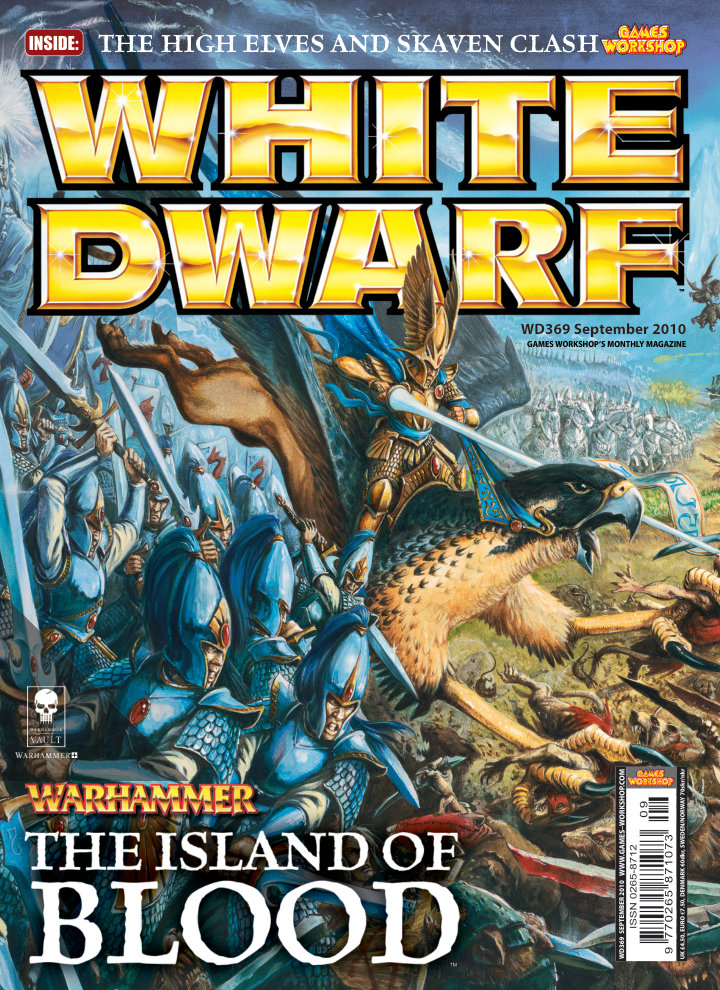
Andrew Kenrick remembers Warhammer editions through their boxed armies and the projects they inspired, beginning with sharing the 1992 High Elf and Goblin set with his brother. The Island of Blood rekindles that enthusiasm, tempting him away from his Tomb Kings and making him determined to keep both of its new armies.
Warhammer Fantasy Battles
CommunityWD 369 · pp. 10–13
A studio painting competition rewards the miniature that best expresses Warhammer’s character rather than technical perfection, with Martin Footitt’s converted Ogre Tyrant winning the vote. The news pages also introduce the 2011 School League’s expanded regional heats and War of the Ring format, preview Space Marine’s forge-world action, and describe the online painting, collecting and scenario support accompanying The Island of Blood.
Warhammer Fantasy BattlesWarhammer 40,000
InterviewWD 369 · pp. 14–19
Andy Hall opens the new boxed game and asks Ted Williams and Dave Thomas how its contrasting armies were chosen and fitted onto the plastic frames. The elite High Elves and numerous Skaven provide different silhouettes and battlefield roles; mixed frames, push-fit construction and three-part Reavers allow surprisingly elaborate models without sacrificing quantity or accessibility. Character and unit profiles establish Althran’s defenders and Verminkin’s invaders, while the designers explain centrepieces such as Brian Nelson’s Griffon, the Mage’s sculpted fire and the first plastic Skaven weapon teams.
Warhammer Fantasy BattlesHigh Elves
Battle reportWD 369 · pp. 20–39
Jervis Johnson’s Skaven face Adam Troke’s High Elves in a 1,998-point Blood and Glory battle built from two starter sets, battalions and modest reinforcements. Plague and Howling Warpgale devastate the Elves early, but Jervis avoids a Venom Thicket and traps his advance behind the depleted Plague Furnace. Surviving Sword Masters cut through Ratchitt’s regiment and the Rat Ogres, while Althran, Spearmen and a Tiranoc Chariot destroy Verminkin’s unit to break Skaven fortitude on turn four. The post-game discussion links the result to traffic management, preserving standards, directing damage at the right targets and the Reavers’ persistent interference.
Warhammer Fantasy BattlesHigh Elves
LoreWD 369 · pp. 40–45
Jervis Johnson explains why the Phoenix Stone matters: Aenarion’s twelve knight-mages poured their lives into it to seal a primordial Chaos rift, then remained as the island’s eternal guardians. Ratchitt exploits a feud between Verminkin and Spinetail to invade, disable the wards and seize the artefact, bringing Althran and eventually Tyrion to its defence. Skaven betrayal repeatedly changes the battle’s course, until Caladris summons the knights’ spirits through the Stone and destroys the invaders; the surviving Verminkin regains a much diminished clan.
Warhammer Fantasy BattlesHigh Elves
ModellingWD 369 · pp. 46–51
Dave Andrews, Chad Mierzwa and Duncan Rhodes translate the campaign’s geography into a playable coastal battlefield assembled on four internal doors. Foam contours, textured wallpaper and cork cliffs provide the large manoeuvring area, while combined Arcane Ruins and Temple of Skulls kits form the ancient shrine. A balsa shipwreck, varnished sea, mastic surf, seaweed and wet shingle establish the island setting; the extensive finished-board photographs show how the temple approach, cliffs and landing beach organise the coming battle.
Warhammer Fantasy BattlesHigh Elves
LoreWD 369 · pp. 54–55
An account of Absolom Reach’s destruction introduces four daemon formations through a five-day planetary catastrophe. Khârn erupts into the governor’s gladiatorial tournament, Khorne and Slaanesh hunt the fleeing population, the Changeling turns apparently loyal troops into Horrors, and Fateweaver’s princes complete the planet’s transformation. The narrative makes the accompanying Apocalypse datasheets parts of one coordinated invasion rather than unrelated collections of models.
Warhammer 40,000Chaos Daemons
RulesWD 369 · p. 56
This Apocalypse formation binds Khârn and Khorne Berzerkers to a Khorne Daemon Prince and eight chosen Khorne units. Its alliance extends Daemonic Assault to the mortal followers and brings the whole formation into the same arrival group: Khârn and the prince establish the landing point, then their accompanying units arrive nearby without scattering. It creates a concentrated mixed mortal-daemon attack rather than the normal dispersed arrival of a large daemon army.
Warhammer 40,000Chaos Daemons
RulesWD 369 · p. 57
The Changeling and a core unit of twenty Pink Horrors, optionally supported by more Horror units, infiltrate the enemy army disguised as its own troops. The datasheet places them inside the opposing deployment area after normal deployment and Scout moves, then shields both sides from shooting and assaults involving the impostors until the second turn. That delay models the confusion of their transformation while giving the daemon player an unusual way to position a substantial force behind enemy lines.
Warhammer 40,000Chaos Daemons
RulesWD 369 · p. 58
A Bloodthirster leads Bloodcrushers and Seekers alongside optional flying princes, heralds and a Keeper of Secrets. Unlike ordinary daemon forces, these outriders can deploy conventionally as a coherent host or use strategic reserve to widen their possible entry edges with each passing turn. The combination gives the formation’s fast Slaanesh hunters and heavy Khorne killers a shared approach to encirclement.
Warhammer 40,000Chaos Daemons
RulesWD 369 · p. 59
Fateweaver gathers three to five Daemon Princes into a council whose presence transforms the battlefield into a foothold of the Realm of Chaos. The formation removes the ordinary Daemonic Assault and daemon-summoning deployment rules for the battle, while each nearby council member cumulatively erodes enemy Leadership. Its benefits therefore extend beyond its own monsters to the way the entire daemon army enters play and pressures enemy morale.
Warhammer 40,000Chaos Daemons
CampaignWD 369 · pp. 62–65
Jeremy Vetock uses a teaching game to explore how Middle-earth’s long-standing feuds can inspire armies and linked battles. He proposes Lothlórien against Dol Guldur, Rohan against Isengard and Dwarves against treasure-hungry Dragons, then extends the idea to alternative histories and fractious alliances between Evil forces. These suggestions encourage campaigns around recognisable rivalries while leaving room for departures such as a surviving Balrog invading Lothlórien or Mordor turning upon its own servants.
War of the RingLothlórien
RulesWD 369 · pp. 66–67
Mordor intercepts Uglúk’s scouts to steal the captured Merry and Pippin before Isengard can deliver them to Saruman. The scenario supplies asymmetric forces and deployment, with the two Hobbit tokens starting in Uruk-hai formations and moving between friendly formations or changing hands when their carriers lose combat. Both captives must be secured or carried off the far edge to win; unusually high protection against shooting represents the attackers’ need to preserve their prizes. Vetock also describes his introductory game, in which crossbow-armed Uruk-hai brought down the Winged Nazgûl.
War of the RingMordor
EditorialWD 369 · pp. 68–69
Jervis Johnson traces Games Workshop tournaments to a wish to bring hobbyists together and explains why winning alone has never been his aim. His revised Throne of Skulls format rewards opponents’ favourite armies, recognises success within each army type, and chooses the overall winner by performance above that army’s average. He argues that these incentives can encourage varied, enjoyable armies without restrictive composition rules or judges trying to decide which lists are sufficiently characterful.
Warhammer Fantasy Battles
InterviewWD 369 · pp. 70–75
Joe Tomaszewski describes the route from painting Lord of the Rings figures and winning Golden Demon silver to commission work and the ’Eavy Metal team. He contrasts the bold, all-round readability of the studio style with directional lighting and explains why non-metallic metal gives him control over reflections but suits some display contexts better than others. His selected work demonstrates balanced warm and cool colours, reptile-inspired patterns, freehand, digital camouflage and increasingly confident reflective armour across Straken, Sigvald, Tycho, Eldar and other subjects.
Warhammer 40,000Warhammer Fantasy Battles
PaintingWD 369 · pp. 76–83
The returning painting clinic turns readers’ questions into worked examples for power weapons, Chapter armour, Eldar colours, living and necrotic skin, tarnished metal and elaborate banners. Each answer pairs practical colour stages with an explanation of the effect, from reserving the brightest energy highlights for a focal point to keeping weathering washes local enough that a metallic model remains readable. A final banner gallery shows the same principles in finished standards from several game ranges.
Warhammer 40,000Warhammer Fantasy Battles
PaintingWD 369 · p. 76
Joe Tomaszewski builds a radiating energy field on a black power axe with successively narrower blue and turquoise lines. Bleached Bone and fine white highlights increase the intensity around a raised focal point, while leaving darker outlines makes the lightning structure clear. The accompanying advice treats the design as a flexible effect whose colour and pattern should suit the miniature.
Warhammer 40,0005 paint colours
PaintingWD 369 · p. 77
Darren Latham separates the Blood Ravens’ cream insignia and shoulder pads from their deep red armour, using distinct brown shadows for each. Bone and white lift the cream panels while progressively warmer red, orange and brown edge highlights define the armour. The example also illustrates his broader advice that neatly bounded Marine plates make useful exercises in brush control.
Warhammer 40,000Space Marines9 paint colours
PaintingWD 369 · p. 77
The Disciples of Caliban example combines dark green and black armour with a red bolter casing. Thinned black shade keeps the recesses deep, then green and pale flesh-coloured highlights sharpen the green plates while greys define the black sections. Warm highlights on the weapon provide a contrasting detail without disturbing the Chapter’s restrained armour palette.
Warhammer 40,000Space Marines11 paint colours
PaintingWD 369 · p. 77
Darren Latham shows a compact four-stage Crimson Fists scheme, starting with rich blue armour and a dark red fist. Black shade establishes separation before icy blue and pale blue-grey highlights pick out the armour, while the fist receives warmer red, orange and brown accents. The two colour sequences keep the small Chapter-defining detail visible against the much larger blue surfaces.
Warhammer 40,000Space Marines8 paint colours
PaintingWD 369 · p. 78
Mark Holmes creates the studio’s yellow-green Gretchin complexion by layering thin paint over a darker green foundation. Repeated green washes reinforce the recesses before the raised surfaces are rebuilt and highlighted with increasing Bleached Bone. He stresses smooth transitions and lively colour rather than treating skin as a single flat block of green.
Warhammer 40,000Orks5 paint colours
PaintingWD 369 · p. 78
Joe Tomaszewski reproduces the film banner’s unusual muted green and blue palette by completing the fabric before its filigree. Carefully targeted green, brown, blue and black washes define the folds, then pale highlights restore the cloth before the dark decoration and yellow central emblem are added. The order is as important as the mixtures because painting the fine ornament first would obstruct the underlying banner work.
Middle-earth Strategy Battle GameLothlórien14 paint colours
PaintingWD 369 · p. 79
Mark Holmes uses a white undercoat to maintain the Iyanden Guardian’s bright yellow armour and contrasts it with a deep blue helmet. Rather than flooding the figure with wash, he places a brown-and-flesh mixture directly into armour recesses and shades the helmet separately. Pale yellow and icy blue edge highlights preserve both colours’ vibrancy.
Warhammer 40,000Eldar8 paint colours
PaintingWD 369 · p. 79
The Saim-Hann Guardian combines red armour, a white helmet and a black face mask. Mark Holmes uses precise dark red shading and warm armour highlights, while blue-grey shading gives the helmet definition without turning it dull. Successive grey highlights on the face mask separate that small dark area from both the red body and the clean white helmet.
Warhammer 40,000Eldar11 paint colours
PaintingWD 369 · p. 80
Mark Holmes ages a Necron Warrior with a sequence of sepia, flesh, brown and green washes over Boltgun Metal. The washes become increasingly localised so the recesses develop depth and corrosion while the figure retains bright metallic surfaces. A final Chainmail edge highlight restores definition and avoids the uniformly muddy result of covering every stage with another all-over wash.
Warhammer 40,000Necrons7 paint colours
PaintingWD 369 · p. 80
Konrad von Carstein’s dense cloak is approached from a grey mid-tone rather than built entirely upward from black. Mark Holmes separates leathery wings from brown fur, adds light highlights, then uses black, brown and red washes to create depth and a more organic tone. The final pale wing and warm fur accents keep individual bats visible, and contrasting armour prevents the whole miniature becoming one dark mass.
Warhammer Fantasy BattlesVampire Counts9 paint colours
PaintingWD 369 · p. 81
Fabius Bile’s stitched coat receives several related flesh, grey and green base mixtures so that each patch suggests a different piece of skin. Joe Tomaszewski unifies them with red and purple shading, restores their individual mid-tones, then increases the amount of Rotting Flesh and finishes with tiny white highlights. Completing panels individually makes the patchwork manageable without flattening its variety.
Warhammer 40,000Chaos Space Marines7 paint colours
PaintingWD 369 · pp. 82–83
Neil Hodgson supplies a Valhallan bear-and-cross design and Joe Tomaszewski turns it into a carefully shaded miniature banner. Separate base colours establish the scroll, bear, background, cross, gold and skull, after which brown or grey shadows and controlled pale highlights give the flat design depth. The walkthrough emphasises neat brushwork and a repeatable basecoat-to-highlight sequence; the accompanying gallery broadens the examples to other armies’ standards.
Warhammer 40,000Imperial Guard11 paint colours
ShowcaseWD 369 · pp. 86–91
Adam Troke examines the paired Good and Evil armies Christian Byrne prepared for the Lord of the Rings Grand Tournament. Christian explains how a restricted palette, tidy bases and small painting batches support a cohesive force without making every figure identical. His bright Arnor and Khazad-dûm shieldwall contrasts with the rusted armour and spectral characters of his Mordor-led alliance, while the captions show how repeated highlight colours tie each diverse collection together.
Middle-earth Strategy Battle GameArnor
PaintingWD 369 · pp. 88–89
Christian Byrne gives Dwarves and Arnor warriors a shared visual identity through blue and off-white cloth, complementary green-blue details and contrasting silver and bronze armour. Different beard colours and alternated uniform placement supply variety, while Bleached Bone highlights draw those differences together. Notes on individual heroes explain warm beard washes, clean metallic contrasts and bright eye reflections; an alternative selection of Dwarf heroes lets the same collection serve as Erebor.
Middle-earth Strategy Battle GameArnor10 paint colours
PaintingWD 369 · pp. 90–91
Christian’s Evil alliance balances dark iron and heavy rust with brighter skin, cloth and the Eye of Sauron. Specific examples include the Shadow Lord’s pale inscriptions, the Shade’s green-blue ghostly base mixture and pallid Orc flesh built from grey or Ice Blue and brown wash. Tin Bitz, stippled Vermin Brown and small bright metallic chips make the armour look corroded without losing contrast, while common bone-coloured highlights hold the disparate contingents together.
Middle-earth Strategy Battle GameMordor17 paint colours
InterviewWD 369 · pp. 92–93
Michael Perry nominates Brian Nelson’s plastic Giant for its uncanny proportions, natural pose and carefully constructed details, particularly the recessed knees visible through torn trousers. Nelson describes the challenge of sculpting such a large original and credits Aly Morrison and the mould-making team for solving the practical problems together. Photographs of alternate heads, prisoners and accessories show why Perry also considers the kit a rich source for conversions.
Warhammer Fantasy BattlesOrcs & Goblins
PaintingWD 369 · pp. 94–101
Chad Mierzwa and Duncan Rhodes explain how camouflage, company colours, squadron identifiers and personal honours can give an Imperial tank a believable service history. The guide establishes the organisation behind the markings, then demonstrates painting and masking methods alongside numerous regimental alternatives. Its concluding Knight of Vengeance combines those elements on a Demolisher, distinguishing the campaign badge, squadron diamond, vehicle name and kill markings rather than adding symbols without a purpose.
Warhammer 40,000Imperial Guard
PaintingWD 369 · pp. 96–97
Two worked methods establish either a hand-painted three-colour disruptive pattern or hard-edged shapes built with successive masking layers. The accompanying eight regimental examples extend those methods to red, arctic, night, ash, swamp and desert schemes, each with named base, pattern and highlight paints. The article explains that a tank’s camouflage breaks up its shape and vulnerable details, giving a reason for the markings beyond simply matching an infantry uniform.
Warhammer 40,000Imperial Guard27 paint colours
PaintingWD 369 · pp. 98–99
A red-and-white company stripe is constructed with masking tape, then customised with narrow angular lightning bolts and shaded white panels. Eight alternative tanks illustrate how the same approach can produce diamonds, rear-mounted bands, wedges and L-shaped corner markings. The examples connect these variations to companies, squadrons and veteran crews, while showing which elements can be masked and which are simple enough to paint freehand.
Warhammer 40,000Imperial Guard12 paint colours
ModellingWD 369 · p. 100
Photographed tank details show how crews record status and experience through command skulls, campaign symbols, custom squadron marks and kill tallies. Examples distinguish an elite Eradicator’s flame-painted barrel from a Vanquisher’s white bands, whose widths identify different classes of confirmed kill. These small additions make a vehicle’s accumulated battlefield history readable without replacing its basic company identity.
Warhammer 40,000Imperial Guard
ShowcaseWD 369 · p. 101
Duncan Rhodes combines the guide’s marking systems on Commander Varus Kant’s Leman Russ Demolisher, credited with breaking the defences of the traitor hive Demalth Inferior. Customised Fighting Firsts company colours sit alongside a campaign-wide badge, named turret and lightning-bolt kill tallies. A masked red diamond identifies its squadron, demonstrating how several symbols can coexist because each carries a different part of the tank’s story.
Warhammer 40,000Imperial Guard1 paint colour