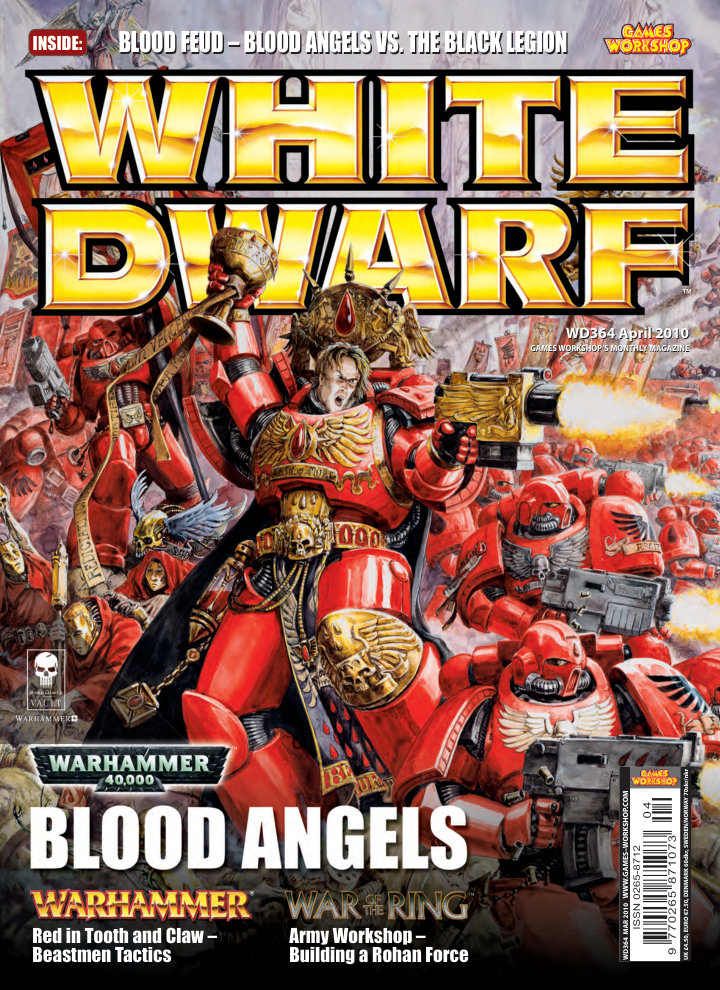
EditorialWD 364 · p. 1
Mark Latham recalls discovering the Studio’s early Blood Angels and copying their bright orange scheme for his first army. An unsuccessful later repaint gives way to a new collection inspired by the latest kits, now built around sprayed red layers and advice from Darren Latham. The editorial connects personal nostalgia with the practical pleasure of beginning again using better models, materials and acquired painting experience.
Warhammer 40,000Blood Angels4 paint colours
CommunityWD 364 · pp. 11–14
Imperial Guard and Eldar vehicle releases are previewed for June, including a new Eldar tank whose rules will appear in White Dwarf. Rob Scott receives his Tempest Guard shoulder pads and Neil Hodgson’s heraldic artwork, while Assault on Ulthuan adds the rival Elf factions to Warhammer: Invasion. Dawn of War II: Chaos Rising, School League painting displays and Games Day plans complete the broader news coverage.
Warhammer 40,000Warhammer: InvasionImperial Guard
InterviewWD 364 · pp. 15–25
Andy Hall explores the Blood Angels as doomed heroes whose nobility exists alongside the Red Thirst and Black Rage. Mat Ward distinguishes those afflictions and explains their influence on the new army, from Death Company to fast vehicles and airborne assaults. Sculptors then describe the ornate visual language of the new kits, linking angelic equipment and artisanal decoration to the Chapter’s history rather than treating them as generic Space Marine upgrades.
Warhammer 40,000Blood Angels
InterviewWD 364 · pp. 22–24
Martin Footitt and Neil Langdown discuss how the Sanguinary Guard and Death Company frames establish an ornate Blood Angels identity while supplying spare parts for the rest of an army. Crosses, chalices and blood drops remain controlled enough to permit reuse, and older Jes Goodwin characters provide visual reference. Oliver Norman’s Baal Predator keeps the familiar tank base but changes its character through insignia and the long flamestorm cannon.
Warhammer 40,000Blood Angels
PaintingWD 364 · p. 25
Nick Bayton uses sprayed Mechrite Red and Blood Red to establish armour quickly, then adds recessed shading, orange and brown edges and a red glaze. A separate black-armour sequence supports Death Company models, while purple-toned purity seals and pale parchment add controlled contrast. Blond hair receives its own three-colour recipe, making the page a compact set of methods for different parts of the Chapter’s collection.
Warhammer 40,000Blood Angels17 paint colours
TacticsWD 364 · pp. 28–33
Mat Ward explains that Rohan’s cavalry must convert speed and charge bonuses into decisive damage before infantry attrition overwhelms it. Might is therefore managed chiefly for timely heroic actions, with foot formations protecting flanks and holding difficult opponents in place. Unit and hero surveys lead into a Westfold army example, showing how mounted striking power depends on supporting bodies and careful selection rather than horses alone.
War of the RingRohan
TacticsWD 364 · pp. 28–29
Heroic Charges help cavalry secure the attack when priority would otherwise expose it, and extra Might may be necessary if a failed charge risks immediate retaliation. Heroic Fights are best spent when the first combat is likely to succeed, extending the damage of a strong charge. Mat distinguishes favourable cavalry and ordinary infantry targets from monsters and especially resilient foes, where enthusiasm can waste both resources and riders.
War of the RingRohan
TacticsWD 364 · pp. 29–31
Riders, Royal Knights, Outriders and the Sons of Eorl provide different combinations of staying power, shooting and offensive reach. Oathsworn Militia and Bowmen supply cheaper bodies and ranged support, while Royal Guard defend important positions. Legendary formations improve these roles further, and the discussion repeatedly returns to protecting cavalry flanks and directing archery at monsters the mounted troops should avoid.
War of the RingRohan
TacticsWD 364 · p. 32
The hero survey distinguishes Théoden’s affordable leadership from Théodred’s defensive tools and Éomer’s concentrated aggression. Éowyn and Merry can engineer a decisive duel, Erkenbrand lends dependable fighting power and Deorwine protects more valuable leaders. Eorl’s potential Might generation supports sustained heroic action, giving players a choice between leading a formation directly and supporting the wider cavalry plan.
War of the RingRohan
TacticsWD 364 · p. 33
The 1,495-point example builds around three large Riders of Rohan formations led by a mix of captains and Epic Heroes. Grimbold’s Helmingas guard flanks and take defensible positions, while Bowmen and Outriders support the advance. Théodred, Éomer and Éowyn supply varied heroic abilities, making the force a plausible response to raiders as well as a practical illustration of the preceding tactical advice.
War of the RingRohan
TacticsWD 364 · pp. 36–41
Phil Kelly’s Beastmen plan combines a cheap central horde with several ambushing units, timing them to close a trap around valuable enemy regiments. He explains how to use imperfect arrival results, how Khazrak improves reliability and how Bestial Surge can accelerate the main advance. Two sample armies contrast this coordinated approach with a monster-heavy force that protects its destructive units until they reach the fight.
Warhammer Fantasy BattlesBeastmen
TacticsWD 364 · pp. 36–39
Several inexpensive ambushing units create enough arrival chances to threaten the enemy’s rear or sides at the same moment the main herd attacks. Late or misplaced units still block escape routes, guard against breakthroughs or hunt isolated artillery. Khazrak’s re-rolls and Bestial Surge improve the timing, but Phil stresses coordination over rushing the first available charge, turning simple numerical pressure into a combined combat-resolution advantage.
Warhammer Fantasy BattlesBeastmen
TacticsWD 364 · p. 40
The 1,998-point ambush list places Khazrak with Bestigors and a Battle Standard Bearer with the central Gors. Four inexpensive reserve herds threaten the flanks and rear, while Centigors and a chariot support the on-table advance. The deployment aims to keep the anvil dependable and the ambushers expendable, so the force can exploit several arrival positions without risking its most valuable unit on one uncertain roll.
Warhammer Fantasy BattlesBeastmen
TacticsWD 364 · pp. 40–41
The 2,997-point brute-force list invests in Minotaurs, Razorgors and a Giant, with Warhounds screening them during the dangerous opening turns. Minotaur leaders spread Frenzy and protection from panic into selected infantry, while the Chalice of Dark Rain suppresses incoming fire. The main task is delivering the heavy hitters intact; a related Steed of Shadows trick sends a strong great-weapon character after vulnerable targets or fleeing enemies.
Warhammer Fantasy BattlesBeastmen
CampaignWD 364 · pp. 42–47
Jeremy Vetock and Dave Andrews explore the work involved in preparing an entire narrative game, including both armies, scenery, objectives and briefing material. Jeremy’s underground Dwarf attack on a Night Goblin lair reverses familiar defensive roles and gives the players personal grudges to pursue. Repeated tests refine the ebb and flow, with Fanatics, a sleeping Giant and arriving Trolls keeping the result uncertain well beyond an ordinary six-turn battle.
Warhammer Fantasy BattlesDwarfs
LoreWD 364 · p. 45
King Burak Grimm’s expanding mines are harassed by Greebo Stuntystabba’s Night Goblins, operating through forgotten passages near Karak Eight Peaks. A mysterious map finally reveals the enemy lair and several tempting objectives, including a captured relative and the Shaman’s fungus cauldron. The paired briefings let each player see the battle through a different motive: restoring honour and security for the Dwarfs, or protecting loot and a profitable raiding base for the Goblins.
Warhammer Fantasy BattlesDwarfs
RulesWD 364 · pp. 46–47
Dwarf victory depends on rescuing a captive, killing the Night Goblin leader and destroying the fungus cauldron, with two objectives sufficient for a lesser success. Goblins counter with fresh Fanatics, a potentially waking Giant and late Troll reinforcements, while Miners threaten unexpected entry points. Jeremy reports repeated revisions and a twelve-turn climax, but directs readers online for the full scenario rather than printing complete army lists and every rule here.
Warhammer Fantasy BattlesDwarfs
TacticsWD 364 · pp. 48–51
Andy Smillie examines ranged armies that destroy enemies before contact, insisting that a gun line still needs movement, march blocking and protected flanks. Deployment and target priority determine how many effective volleys can be fired, while sacrificial units or cleared space offer escapes if attackers close. Dark Elf and Dwarf lists illustrate mobile magical shooting and a more static but exceptionally durable artillery force.
Warhammer Fantasy BattlesDark Elves
TacticsWD 364 · p. 49
The 1,991-point Dark Elf list combines mobile Sorceresses, crossbows, Shades and four bolt throwers with cheap flying Harpies. Its shooting and magic thin threats while fast units delay the advance, and an Assassin either hunts with the Scouts or protects the Warrior block. The deployment spaces artillery, preserves the Supreme Sorceress and positions each element to attack while limiting the damage of one successful enemy charge.
Warhammer Fantasy BattlesDark Elves
TacticsWD 364 · p. 50
The 1,998-point Dwarf force relies on Thorek’s runes to slow threats while six war machines and three missile regiments fire repeatedly. Engineers improve reliability, a Slayer delays selected enemies and Miners threaten opposing artillery from an unexpected edge. Organ Guns protect Thorek himself, while staggered infantry deployment reduces the chance of the whole battle line being charged at once.
Warhammer Fantasy BattlesDwarfs
Battle reportWD 364 · pp. 52–71
Matt Hutson’s Blood Angels assault Christian Byrne’s Black Legion in a 2,000-point Vanguard mission. Death Company and Assault Marines hit hard before Abaddon’s counterattack, while the Sanguinor spends several rounds fighting a Daemon Prince. The unmolested Sanguinary Guard then break the defence, and the Sanguinor kills Abaddon; Christian concedes with the Blood Angels holding two objectives to none, completing their revenge-driven attack.
Warhammer 40,000Blood Angels
RulesWD 364 · pp. 58–59
The defender holds objectives while the Space Marine army enters from its edge on the first turn and automatically acts first. More Marine infantry than normal can claim objectives, encouraging an aggressive elite assault instead of relying entirely on Troops. For this particular game the players consult Jervis and agree to include jump infantry within that permission, an explicit interpretation that makes Matt’s airborne units useful for scoring as well as fighting.
Warhammer 40,000Blood Angels
EditorialWD 364 · pp. 72–73
Jervis Johnson reflects on the appeal of uniforms, banners and vehicle markings even when they have no direct role in the rules. Colour sections and heraldry books provide inspiration and a recognisable visual foundation while leaving individual collectors room to vary shades, details and history. He encourages using background as a creative guide, while considering how borrowed colour associations can change an army’s apparent identity.
PaintingWD 364 · pp. 74–81
Darren Latham paints the Sanguinor as an exceptional golden focal point for the Blood Angels army. Non-metallic armour relies on artificial reflections, strong dark–light contrasts and coloured glazes, while cooler weapons, pale wings and worn parchment distinguish the supporting materials. The feature also compares metallic and non-metallic gold, stressing that the latter is a deliberate artistic challenge rather than the only route to an impressive finish.
Warhammer 40,000Blood Angels27 paint colours
PaintingWD 364 · pp. 76–77
The twelve-stage armour method begins with brown and leather tones, then gradually adds bone to build the light-facing areas. Dark red-brown and black shading create reflection boundaries, while pale spots and a yellow wash establish the impression of gold. Purple recess glazes enrich the result before white accents are restored, making the illusion depend on deliberate placement rather than metallic pigment.
Warhammer 40,000Blood Angels8 paint colours
PaintingWD 364 · p. 78
The Sanguinor’s chalice receives a cooler non-metallic treatment than his armour. Grey layers establish the light areas, while blue-black shadows and restrained white highlights imply a reflective silver surface. Keeping the effect subtle prevents the small ceremonial object from competing with the golden figure, and the finished-model discussion confirms that the same method is reused on the halo and neck chain for consistency.
Warhammer 40,000Blood Angels6 paint colours
PaintingWD 364 · p. 78
Khemri Brown and increasingly pale stone layers produce aged parchment that remains distinct from the clean white wings. Brown-black shading and sepia enrich the folds, while the wax moves from dark red to bone-lightened highlights. Tiny text and Imperial motifs finish the streamers; the neighbouring gemstone demonstration gives a general reflection method but intentionally leaves the gem colours to the painter’s choice.
Warhammer 40,000Blood Angels8 paint colours
PaintingWD 364 · p. 79
Blue-grey and pale grey provide the wings’ foundation, with darker washes restricted to the deepest feather separations. Astronomican Grey and progressively more white then restore the surfaces and sharpen their outer edges. The crisp finish contrasts with the aged parchment and warm armour, while repeated wing emblems elsewhere on the miniature use the same treatment to keep the colour scheme coherent.
Warhammer 40,000Blood Angels5 paint colours
PaintingWD 364 · p. 79
The blade begins from blue, turquoise and bone, with pale layers establishing its reflective edges. Its central fuller receives a stronger blue-green shade and carefully restricted black before tiny white highlights and flecks finish the surface. This cool weapon colour provides separation from the gold hands and armour, applying the masterclass’s reflection logic to a different shape and material.
Warhammer 40,000Blood Angels5 paint colours
PaintingWD 364 · p. 80
The shoulder pads use a red progression shaded around the edges and taken through orange to concentrated white reflections. The vial instead combines cool grey-blue glass with purple-red blood and alternating dark and light vertical lines. Distinguishing these two red areas reinforces their material difference: one is a solid polished armour plate and the other a transparent vessel containing liquid.
Warhammer 40,000Blood Angels11 paint colours
PaintingWD 364 · p. 81
Neil Green explains that published paint ratios are useful guides rather than exact formulas enforced by special equipment. Painters record approximate mixes, compare them against the model and rely on a clean palette, observation and repetition to recreate the result. The answer encourages a consistent personal method without making the numerical precision of a masterclass recipe seem more scientific than the actual painting process.
ModellingWD 364 · pp. 82–83
Chris Peach paints Honoured Imperium statues to match several existing armies and terrain sets, from volcanic black stone to gold and sandstone. Small environmental details such as snow, plants or broken surfaces make the same sculpt belong to different worlds. Examples from Warhammer and Middle-earth extend the principle, while the text points readers online for full step-by-step recipes rather than naming paints for the photographed finishes.
Warhammer 40,000Warhammer Fantasy Battles
ModellingWD 364 · pp. 84–91
Studio hobbyists mix spare Death Company and Sanguinary Guard components into ordinary Space Marine kits to extend Blood Angels character throughout an army. Dynamic poses, selected ornate parts and restrained insignia distinguish Tactical, Assault and Devastator squads without consuming the five core figures from either new box. Honour Guards and officers then use more elaborate combinations, demonstrating how compatibility supports both efficient collecting and individual centrepieces.
Warhammer 40,000Blood Angels
ModellingWD 364 · pp. 86–89
The examples use aligned heads, twisted torsos and carefully placed limbs to make Marines appear to charge, land or swing a weapon. Spare decorated helmets, bolters and shoulder pads establish experienced Tactical and Devastator squads, while a Rhino borrows the Baal Predator’s front panel. Mark Latham’s biker goes further with cut joints, Scout Biker equipment and filled gaps, showing how a strong pose can create a small narrative scene.
Warhammer 40,000Blood Angels
ModellingWD 364 · p. 90
Matt Hutson combines a Command Squad with spare Death Company components and extra jump packs while preserving a complete Death Company unit. The Sanguinary Novitiate retains Apothecary features and chalice markings, the Champion gains an aggressive bare head and the standard bearer carries a converted Sanguinary Guard banner. Abundant purity seals and individually chosen weapons make the squad look like veterans assembled to accompany a Captain into the fiercest fighting.
Warhammer 40,000Blood Angels
ModellingWD 364 · p. 91
Several Captains demonstrate combinations of Commander, Death Company and Sanguinary Guard parts, with masks, ornate torsos and weapons reinforcing their rank. Mark Latham’s Terminator-armoured Sanguinary Priest requires more extensive work, including a Corbulo arm and chalice, resin shoulder detail and guitar-wire cabling. The gallery connects each pose and equipment choice to the character’s intended identity rather than presenting interchangeable decorated figures.
Warhammer 40,000Blood Angels
RulesWD 364 · pp. 94–95
Before the armies begin, secretly nominated champions fight to the death in the centre, each gaining Killing Blow. Every combat round allows selected units to surge forward, and the victorious champion grants first turn but remains exposed in the centre initially. Jervis’s notes explain the dilemma between choosing a powerful duellist and risking a vital general, with the accumulating advance moves potentially creating first-turn charges.
Warhammer Fantasy Battles
PaintingWD 364 · pp. 96–101
Duncan Rhodes builds a Rohan force to capture the visual excitement of Théoden’s charge on the Pelennor. A written test scheme and production-line basecoating make the many horses manageable, while increasing levels of detail distinguish warriors, riders, command and Epic Heroes. Consistent colours unify even the Three Hunters with the army, and the Royal Standard provides a focal freehand project based on film reference.
War of the RingRohan14 paint colours
RulesWD 364 · p. 97
The 1,575-point collection centres on two large Riders of Rohan formations and the mounted King’s Guard. Théoden and Éomer provide Epic Hero leadership, while Grimbold’s Helmingas add an infantry block and the Three Hunters supply a recognisable specialist formation. The list reflects Duncan’s preference for a cavalry spectacle while retaining enough varied units to participate in the continuing Rohan–Isengard campaign.
War of the RingRohan
PaintingWD 364 · p. 98
Duncan begins the force with black undercoat and a sprayed brown base, then uses flat Foundation colours and a combined brown-black wash. Basic foot warriors stop there, riders receive additional highlights and command models gain still more colour and detail. Notes made while painting the prototype preserve the mixes, allowing the method to scale across a large army without pretending that every photographed base colour is specified in print.
War of the RingMiddle-earth Strategy Battle GameRohan7 paint colours
PaintingWD 364 · p. 99
The brown horses share a Scorched Brown base but vary in the lighter colours mixed into their highlights. A combined brown-black wash unifies the coat, tack and detail, after which the earlier highlights are restored. The compact sequence gives enough variation for natural-looking formations while keeping dozens of mounts practical to finish, with Bleached Bone and Bubonic Brown explicitly suggested as useful lightening colours.
War of the RingMiddle-earth Strategy Battle GameRohan5 paint colours
PaintingWD 364 · p. 101
Duncan uses film images to capture the impression of Gamling’s banner rather than reproduce every detail exactly. The green cloth is finished first, then a red border frames the pale horse outlined in brown and highlighted through stone to white. Yellow supplies the gold stitching, while the surrounding King’s Guard receives character-level attention and converted command models to make the formation a visual centrepiece.
War of the RingMiddle-earth Strategy Battle GameRohan6 paint colours
ShowcaseWD 364 · pp. 102–103
Leo Baker and Robert Gogin explain how they plan a doubles army as one coherent project rather than two separate contingents. A shared crimson palette, joint painting sessions and regular progress checks unite units divided according to each painter’s preferences. The award-winning Vampire Counts include playful Skeleton conversions and a Dire Wolf-pulled Corpse Cart, with Mannfred’s contrasting details giving a characterful focal point without abandoning the overall scheme.
Warhammer Fantasy BattlesVampire Counts1 paint colour