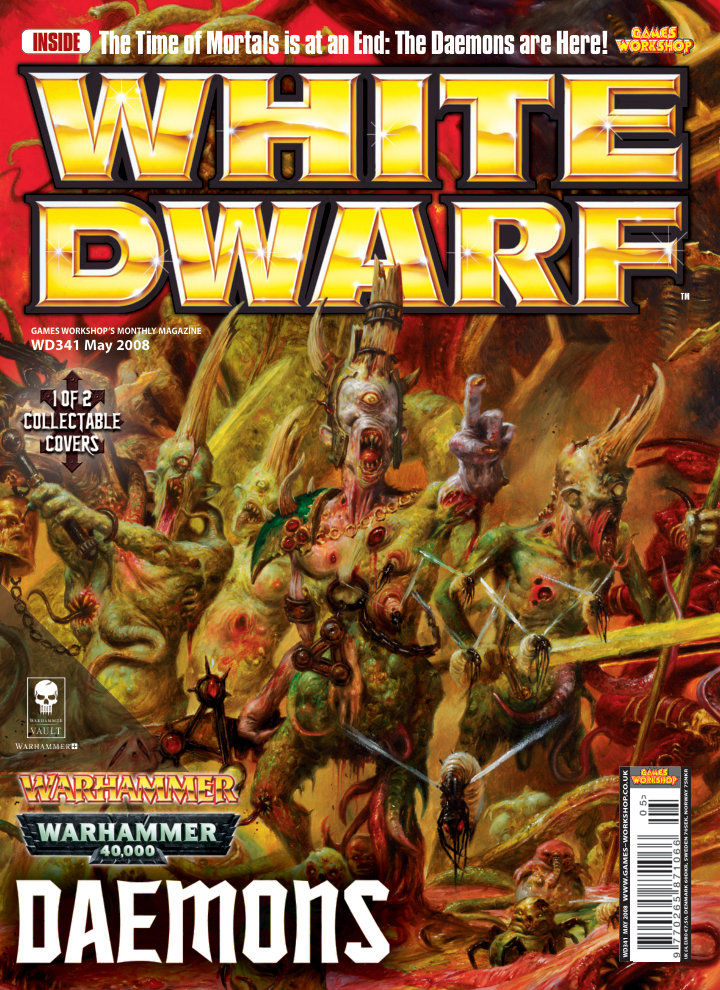
EditorialWD 341 · Inside cover
Grombrindal introduces the simultaneous Daemon releases as an unusual shared project for both major Warhammer settings. Design interviews explain the undertaking, while a Dark Angels battle and an Old World campaign demonstrate the armies in action. The rest of the issue continues the Middle-earth allies tactica, develops a characterful undead collection and examines exceptional painted models. The introduction balances the month’s daemonic invasion with practical collecting and painting projects.
Warhammer 40,000Warhammer Fantasy BattlesChaos Daemons
CommunityWD 341 · p. 12
Stores prepare Daemon-themed gaming and hobby sessions for the May holiday, alongside the launch of a National Painting Competition. The painting programme offers a chance to develop skills before local judging and Golden Demon. Black Library Day adds novel-inspired battles, character conversions and dioramas. The page presents these events as opportunities to join a new army project, defend against it or explore favourite fiction with models.
Warhammer 40,000Warhammer Fantasy Battles
CommunityWD 341 · p. 13
The Oxford Street Plaza staff receive a letter from Karen Buck MP recognising their support for gamers with disabilities. Parents also thank the team with a cake and champagne. The short profile names the staff and celebrates the extra effort involved in making their store’s hobby activities accessible. It records a local example of community support rather than a general claim about all stores.
CommunityWD 341 · p. 13
Cyanide’s forthcoming adaptation offers both a turn-based version of Blood Bowl and a faster real-time mode, with online play planned for both. The preview points readers towards demonstrations at the Blood Bowl Grand Tournament and a development website. It describes a project still in progress, presenting the two play styles as alternative ways to translate the tabletop game rather than reporting on a finished release.
Blood Bowl
InterviewWD 341 · pp. 14–29
Andy Hall explores the return of independent Daemon armies with Alan Merrett, Mat Ward and Alessio Cavatore. The project restores the attention once given to Chaos in Realm of Chaos, develops mythic individual characters and shares a miniature range across two settings. Mat explains a self-contained Fantasy army, while Alessio describes the unusual deployment of its far-future counterpart. Art discussion, a Soul Grinder profile and basic painting recipes show how the shared identity becomes distinct tabletop forces.
Warhammer Fantasy BattlesWarhammer 40,000Daemons of Chaos13 paint colours
LoreWD 341 · pp. 18–19
The four great Chaos Gods are introduced through their domains, appearances and characteristic servants. Khorne embodies bloodshed and martial violence, Nurgle disease and decay, Slaanesh irresistible excess and Tzeentch change and elaborate schemes. Each god’s Greater and Lesser Daemons mirror those qualities, giving the pantheon a recognisable visual and thematic structure. The spread supplies background for the mixed armies and mythic characters discussed elsewhere in the design feature.
Warhammer Fantasy BattlesWarhammer 40,000Khorne
InterviewWD 341 · p. 23
Paul Dainton explains how the artists portray the same creatures against two very different kinds of enemy. Energy and violence remain common requirements, while each book receives individual illustrations rather than repeatedly recycling the same images. Scars, jewellery and other embedded symbols make the gods’ iconography less literal than a background banner. Dainton singles out Nurgle’s mixture of grotesqueness and mischief as especially enjoyable to draw.
Warhammer Fantasy BattlesWarhammer 40,000Chaos Daemons
RulesWD 341 · p. 27
The new Daemon Engine combines a resilient walker chassis with the Daemons’ own special rules and immunity to shaken or stunned results. Its mouth weapon offers flame, piercing tongue and explosive phlegm attacks, backed by a secondary harvester. A background panel places its creation in the Forge of Souls, where daemonic craftsmen fuse powerful entities with corrupted material machinery. The profile explains why this model belongs specifically to the far-future army.
Warhammer 40,000Chaos Daemons
PaintingWD 341 · pp. 28–29
The painting guide develops pale Daemonette flesh by adding white to a purple-and-stone base, while their claws retain a much darker purple foundation beneath bone-tinted highlights. Bloodletters use warm red shading and orange raised details, with related colours giving their Hellblades a fiery edge. Alternative finished examples encourage very different palettes, from intricate pale Slaaneshi skin to John Blanche’s molten-looking Khorne Daemon.
Warhammer Fantasy BattlesWarhammer 40,000Slaanesh13 paint colours
PaintingWD 341 · p. 28
A purple-and-stone base gives the Daemonette’s skin a cool tone, with repeated white additions narrowing the highlights until only the most prominent areas are pure white. The claws begin from a darker purple-black mixture and brighten through added bone rather than the skin’s white sequence. The two related treatments create contrast within a small palette, keeping the creature pallid while its sharp extremities remain dark.
Warhammer Fantasy BattlesWarhammer 40,000Slaanesh6 paint colours
PaintingWD 341 · p. 29
The Bloodletter’s red foundation receives an overall red ink wash and deeper brown shading around scales and recesses. Restored red layers move towards orange on the raised surfaces, preserving the darker areas beneath. Its sword starts darker and gains a brighter tip and edges through red-orange mixtures. Finished examples show how changing the contrast between blade and body can make the same model look shadowy or molten.
Warhammer Fantasy BattlesWarhammer 40,000Khorne8 paint colours
CampaignWD 341 · pp. 32–45
Mat Ward links three battles around a Daemon expedition to rescue Bileflood, a Great Unclean One imprisoned by Clan Pestilens. Phil Kelly’s host breaks through High Elf waystones, defeats its Skaven captors and attacks the Empire town of Elsterweld. Early results alter later forces and Bileflood’s condition. The final battle is much closer, with Ogre mercenaries causing enormous damage, but a minor Daemon victory completes the campaign despite the defenders holding their temple.
Warhammer Fantasy BattlesDaemons of Chaos
RulesWD 341 · p. 34
A thousand-point High Elf garrison confronts Daemons pouring through a broken coastal waystone. The Daemons must move several substantial units through the opposing line and off its deployment edge. Spellcasters near the ruined stone receive compulsory extra magical power, creating both opportunity and risk. Escaping Daemon units can join the next battle freely, while an Elven victory reduces the invaders’ later points allowance.
Warhammer Fantasy BattlesDaemons of Chaos
RulesWD 341 · p. 35
The second battle places Bileflood inside an impassable summoning circle as Skaven ritualists drain his strength. Clan Pestilens gains a required Plague Lord and an extra priest, while earlier escaping Daemons deploy farther forward. Ordinary victory points are supplemented by rewards for weakening or destroying the captive. Bileflood joins the finale without costing points, but his remaining wounds and access to gifts depend on whether the rescue arrived in time.
Warhammer Fantasy BattlesDaemons of Chaos
RulesWD 341 · p. 36
A three-thousand-point Daemon force and the rescued Bileflood attack an Empire town reinforced by Ogre mercenaries. The defenders can garrison buildings and position artillery on roofs, but the town’s devotion to Shallya excludes senior Sigmarite religious commanders. Its temple protects occupants and provides a bonus objective for the invaders. Allowing all Daemons to assault it makes the final defence accessible to the host’s greatest monsters.
Warhammer Fantasy BattlesDaemons of Chaos
Battle reportWD 341 · pp. 38–39
Phil commits to a wholly Khornate vanguard led by Skulltaker, facing Robin’s compact High Elf defence. Failed Fear tests prevent crucial Elven charges and leave elite troops exposed to Bloodcrushers. Skulltaker defeats the Noble, while Flesh Hounds and Bloodletters force repeated retreats and destroy the support units. The High Elves are wiped out by the fourth turn, giving the Daemons a decisive entry into the mortal world and valuable momentum for the next game.
Warhammer Fantasy BattlesDaemons of Chaos
Battle reportWD 341 · pp. 40–41
Reinforcements from the earlier victory let Phil’s mixed Daemon host press hard against the Skaven. Bloodcrushers, Flesh Hounds and Beasts of Nurgle break through several formations, drawing the Plague Priests into fighting instead of their draining ritual. The isolated Slaaneshi Herald survives to run down important enemies, while the Skaven kill Skulltaker as a limited consolation. Their army collapses, though Bileflood is left with only half his wounds for the final battle.
Warhammer Fantasy BattlesDaemons of Chaos
Battle reportWD 341 · pp. 42–44
The Empire’s urban defence proves far stronger than the Daemons’ earlier opponents. Ogre mercenaries hold a barricade against successive attackers, destroy Bileflood and defeat several other dangerous units. Elsewhere Skulltaker and a Bloodthirster cut through the town, forcing the battle towards the Temple of Shallya. Its Greatswords endure the final assault, but the Daemons’ overall casualties inflicted still secure a minor victory and the campaign.
Warhammer Fantasy BattlesDaemons of Chaos
Battle reportWD 341 · pp. 46–65
Alessio Cavatore’s Daemons materialise around Jervis Johnson’s Dark Angels in a struggle for archaeological finds on quarantined Locrus. Daemonic reserves exploit a surviving icon, destroying key vehicles and overrunning the colony. Azrael’s counterattack and a power-fist Sergeant blunt the assault, while a Land Speeder contests loot late in the game. The Fiends’ final charge reduces another scoring unit and turns a potential Daemon defeat into a one-objective-each draw.
Warhammer 40,000Chaos Daemons
TacticsWD 341 · p. 65
Christian Byrne reviews the battle’s decisions, arguing that eliminating the Screamers could have preserved the Land Raider and kept its Terminators involved. He recommends cover for arriving Daemons and proposes an allied Inquisitor unit as an Imperial response. Mystics permit fire at nearby deep-striking enemies, while gun-servitors, a Hierophant and protective equipment support that role. The example makes a specialised counter available without replacing the army’s ordinary strengths.
Warhammer 40,000Daemonhunters
TacticsWD 341 · pp. 66–73
Mat Ward turns from Good’s specialists to the tools an Evil alliance can use: brutal monsters, disruptive spirits and inexpensive hordes. He compares candidate units and their weaknesses, then shows how each role can reinforce the others. Cheap troops provide the numbers to protect fragile spellcasters and keep dangerous heroes occupied while monsters strike. A combined Moria, Corsair and Ringwraith army demonstrates that the tactical mixture can still have a coherent narrative.
Middle-earth Strategy Battle GameMoria
TacticsWD 341 · pp. 67–68
Evil’s Brutes trade the tricks and heroic resources of famous Good characters for strong basic profiles at lower cost. Mordor and Isengard Trolls offer different balances of power and resilience, while a Warg Chieftain provides speed and Half Trolls can be fielded in greater numbers. The comparison encourages commanders to judge the monster against its intended targets rather than the prestige of a named enemy hero.
Middle-earth Strategy Battle GameMordor
TacticsWD 341 · p. 69
Ringwraiths and other undead specialists strip away the advantages of powerful Good heroes through paralysis, movement disruption and reduced fighting effectiveness. Keeping them behind ordinary troops lets their abilities influence the battle without exposing their fragile bodies. A Fell Beast increases a Ringwraith’s reach at a higher price, while Barrow-wights, Shades and Spectres offer different forms of interference. Low Courage or a successful enemy charge can quickly undo their contribution.
Middle-earth Strategy Battle GameNazgûl
TacticsWD 341 · pp. 70–71
Cheap warriors can give an Evil army numerical superiority across the field or in the particular fight that matters. Mat recommends choosing equipment around a clear plan, whether supported combat or massed arrows, rather than buying an unfocused mixture. Haradrim, Moria Goblins and Corsairs each offer different advantages, with mercenary horsemen providing a risky mounted option. Opponents can exploit restricted space and strong defensive anchors to prevent the whole horde contributing at once.
Middle-earth Strategy Battle GameHarad
TacticsWD 341 · pp. 72–73
Durburz and a Shaman lead a large Moria Goblin contingent, joined by a Corsair Bo’sun and enough pirates to add better fighting skill. Two Cave Trolls provide the heavy blows, while a modest Ringwraith supplies selective disruption without consuming too many points. The force totals sixty-two models just below seven hundred points. Its suggested story brings two separate armies together against a shared enemy on the coast of Gondor.
Middle-earth Strategy Battle GameMoria
EditorialWD 341 · pp. 75–77
Jervis uses his long-serving grey Space Marines to question how much fashionable army-list optimisation matters compared with experience. The collection has served under several rules and Chapter lists with only small changes, and familiarity has improved its results more than constant rebuilding. He describes an unpublished analysis of tournament games as further support, while accepting that list construction can be enjoyable in itself. His priority remains an army whose models and methods suit its owner.
Warhammer 40,000Warhammer Fantasy BattlesRevilers
ModellingWD 341 · p. 78
The hobby drill adds mechanical strength to awkward metal joins by making matching holes for a short wire pin. A paint mark on the projecting wire transfers the correct location to the second component, improving alignment before gluing. The guide also uses drilled holes and round files to open weapon barrels. Patient rotation with light pressure gives control, making the tool useful both for structural assembly and small realistic details.
InterviewWD 341 · pp. 79–83
Dave Thomas recalls learning to paint through HeroQuest, joining ’Eavy Metal and leaving temporarily to acquire sculpting skills before returning as a designer. His preferred bright, traditional style favours white undercoat, expressive faces and metallic paint over newer display fashions. The gallery explains the stories and techniques behind models ranging from Yarrick and Creed to Bretonnian outlaws, a Mordheim Ogre and a pale Necron test piece. Repeated practice and personal taste connect his professional and private work.
Warhammer 40,000Warhammer Fantasy BattlesImperial Guard7 paint colours
TacticsWD 341 · pp. 84–90
Gav Thorpe builds an army from a concise background concept, showing how characters, powers and mounts establish a theme that units can reinforce. He considers noble, bestial, spectral and necromantic alternatives, with colour and basing able to tell the same story visually. His worked example follows Konrad’s invasion of Averland, selecting appropriate followers before refining points and equipment. The aim is an effective force whose identity remains clear through every collecting decision.
Warhammer Fantasy BattlesVampire Counts
TacticsWD 341 · pp. 89–90
Gav’s finished force makes Konrad the martial centre while two Necromancers supply the magic he lacks. A Wight standard bearer, Grave Guard and Skeletons preserve the character of an organised Sylvanian army, supported by Zombies, Dire Wolves and bats. Blood Knights reflect Konrad’s historical alliance, and spectral followers add another threat. Equipment and standards fill out the list only after those thematic choices, illustrating how the army’s story can guide its final composition.
Warhammer Fantasy BattlesVampire Counts
FictionWD 341 · p. 91
An Imperial army waits beside the Stir as unnatural darkness and mist announce the approaching undead. Cannon and small-arms fire smash the first Zombies, only for Necromancers to repair the corpses and send them forward again. Bats, Blood Knights, Ghouls and ancient Skeletons assemble into a terrifying host. The final arrival of the Drakenhof Guard reveals its leader: Konrad von Carstein, whose unmistakable madness spreads fear through the soldiers before the assault begins.
Warhammer Fantasy BattlesVampire Counts
PaintingWD 341 · pp. 92–97
Neil Green paints Mannfred and his Nightmare in separate sections, balancing black armour and carefully shaded metal with pale flesh and an elaborate supernatural cloak. Bone, fur and leather receive distinct treatments so the dense model remains readable. A cool procession of spirits contrasts with purple cloth, while green eye light and glossy blood add final focal points. The guide explains both the painting order and the controlled glazes that bring its many layers together.
Warhammer Fantasy BattlesVampire Counts30 paint colours
PaintingWD 341 · p. 93
Darkened steel develops through increasingly bright metallic layers, with a red-black wash tinting the blades near their hilts. The chainmail repeats the same colours by light drybrushing. Gold combines dark recesses, restrained silver highlights and brown glazes to soften the transitions. Black armour takes bone-tinted edges and a green glaze, keeping the plates distinct from the brighter trim without losing their sombre appearance.
Warhammer Fantasy BattlesVampire Counts12 paint colours
PaintingWD 341 · p. 94
Neil completes the messy fur drybrushing before working on the carefully layered face. Warm browns and pale highlights give the cloak texture, unified by an ink glaze. The skin begins from a dark flesh-brown mix, gains increasingly narrow bone and white highlights, and receives blue shading around the eyes. Fine veins and bright facial edges make Mannfred’s head a sharply defined focal point within the dark miniature.
Warhammer Fantasy BattlesVampire Counts8 paint colours
PaintingWD 341 · p. 95
The Nightmare’s skull moves from shaded brown through warm earth tones into ivory and fine white edges. Small painted chips interrupt the smooth bone, while Mannfred’s back spikes use a related earth-colour sequence with darkened tips. The creature’s exposed flesh starts from a Foundation brown and builds towards bone-white highlights, with a darker glaze restoring the recesses. Similar colours therefore distinguish skeletal, horn-like and leathery textures through different handling.
Warhammer Fantasy BattlesVampire Counts9 paint colours
PaintingWD 341 · p. 96
Purple cloth and pale blue spirits are shaded together before separating into their own highlight sequences. Weathering at the cloth’s edges keeps the bright colours from appearing pristine, while blue glazing smooths the ghosts. Red leather, dark bats and a worn tome add smaller material contrasts, and the weapon shaft develops from blackened yellow-brown into a pale edge. The Nightmare’s caparison repeats the cloak colours to unite rider and mount.
Warhammer Fantasy BattlesVampire Counts18 paint colours
PaintingWD 341 · p. 97
After rejoining rider and mount, Neil gives the Nightmare’s eye a green glow through increasingly pale glazes extending onto the surrounding skull. A final white dot marks the light’s source. The sword’s blood begins as irregular thin red dabs, gains concentrated dark-red patches and finishes with gloss varnish for wetness. These small effects provide supernatural light and fresh violence without covering the carefully developed underlying surfaces.
Warhammer Fantasy BattlesVampire Counts7 paint colours
CommunityWD 341 · p. 103
Matt Hobbs describes how Redcar Community College’s gaming club benefits from a continuing relationship with the Middlesbrough store. Staff provide unfamiliar opponents, painting and tactics advice, support the school league and help introduce Warhammer. Donated tables also improve the club’s resources. Store manager Gary Shaw explains how arranged visits combine tuition with friendly games, while Hobbs stresses the value of somewhere students can continue the hobby during holidays and after leaving college.
Warhammer 40,000Warhammer Fantasy Battles