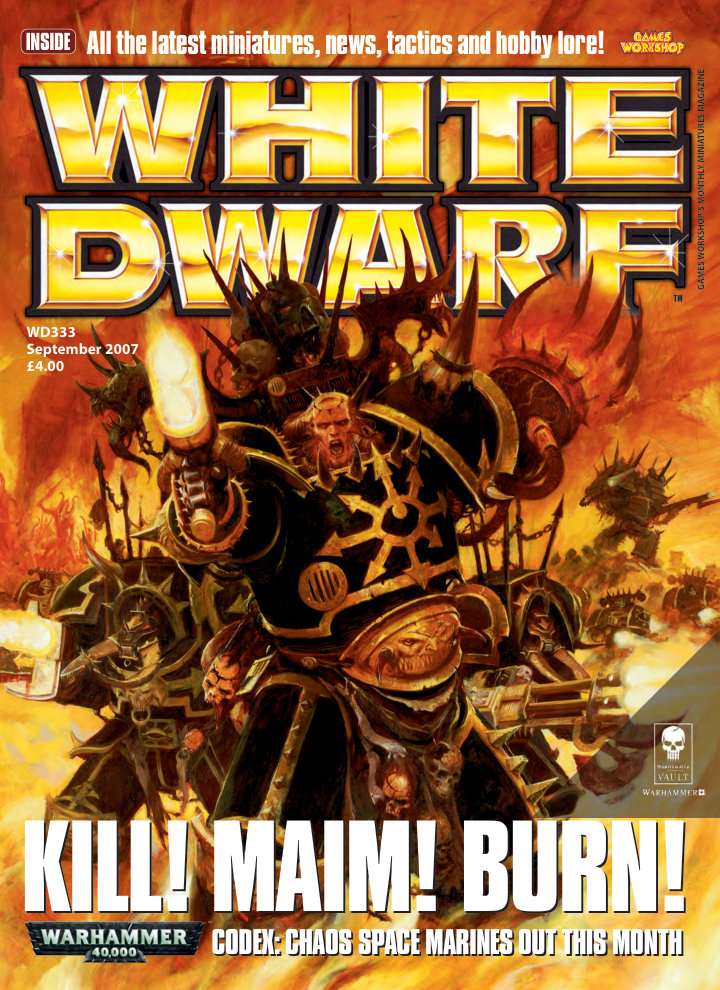
EditorialWD 333 · Inside cover
Grombrindal introduces the new Chaos Space Marines through their treachery, ambition and abundant opportunities for converting plastic miniatures. The issue’s campaign rules, magic tactics and Middle-earth Orc guide offer other ways to develop a collection, while the coming Apocalypse expansion promises battles on a much larger scale. The editorial links those projects through the pleasure of turning new models and background into personal armies.
Warhammer 40,000Warhammer Fantasy BattlesChaos Space Marines
LoreWD 333 · pp. 10–11
The preview sets the High Elves’ enduring military and magical traditions against the rise and fall of younger civilisations. A forthcoming army book accompanies plastic commanders, mages, alternative chariots and a dynamically posed dragon. The range promises both new troop options and returning characters, presenting Ulthuan as a civilisation whose long history continues to shape the armies collectors can assemble.
Warhammer Fantasy BattlesHigh Elves
CommunityWD 333 · p. 12
The magazine’s thirtieth birthday fills stores with beard contests, party games and unusually ambitious cakes, including Manchester’s six-by-four-foot edible gaming table. At Warhammer World, a special game sends Grombrindal against six Giants in defence of the beer, with the Dwarf winning almost every outing. Exclusive birthday models and a gold-plated prize accompany the celebrations, turning the anniversary into a shared weekend across the hobby community.
InterviewWD 333 · pp. 16–29
Gav Thorpe describes replacing overlapping variant lists with a single flexible Chaos Space Marine army, visible unit identities and clearer equipment choices. Mark Harrison then explains how plastic kits expand Jes Goodwin’s established imagery with interchangeable weapons, mutations and icons. Christian Byrne’s sample army and the Studio’s colour schemes demonstrate the result: individual renegades and ancient Legion warriors can share one force without becoming a uniform collection of merely sinister loyalist Marines.
Warhammer 40,000Chaos Space Marines
InterviewWD 333 · pp. 22–23
Mark Harrison builds on the established Terminator silhouette while using plastic frames to add sharper details, optional weapons and varied heads. The Lord’s elevated pose gives a commander the presence of a centrepiece, while the Possessed required repeated experiments before their mutations felt convincing. An upgrade frame spreads the imagery of the Chaos powers through ordinary squads, making it possible to concentrate elaborate parts on champions or distribute them across a warband.
Warhammer 40,000Chaos Space Marines
TacticsWD 333 · pp. 24–25
Christian’s 1,497-point force uses the Battleforce contents as a starting point but replaces its transport with elite reinforcements. Berzerkers and a Defiler lead the advance, supported by ordinary Marines, Possessed and unpredictable Spawn. Deep-striking Terminators and two commanders deliver a later decisive attack. The commentary explains each unit’s contribution, including a Tzeentch Sorcerer’s Warptime and the ability of the revised Marines to combine bolter fire with credible assault support.
Warhammer 40,000Black Legion
PaintingWD 333 · p. 26
The Studio method establishes the Red Corsairs’ red and black armour through simple edge highlights that can be repeated across a squad. Black plates receive progressively lighter grey edges, while the Foundation red base is lifted through bright red to orange. A fine brush supplies the hand-painted Chapter icon, and the gold decoration refers readers to the more detailed Huron masterclass later in the issue.
Warhammer 40,000Red Corsairs5 paint colours
ShowcaseWD 333 · pp. 27–29
Neil Hodgson explains why Chaos heraldry should reveal ten thousand years of changing loyalties rather than copy loyalist uniformity. The gallery ranges from the Black Legion and Night Lords to Hakanor’s Reavers and the Purge, with glowing cracks, lightning and insignia suggesting supernatural armour. A shared emblem or selected coloured plate can unite radically different warriors, and the same visual language can be transferred to Terminators, Possessed and vehicles.
Warhammer 40,000Black Legion
Battle reportWD 333 · pp. 30–51
Alessio Cavatore’s renegades attack Gav Thorpe’s Imperial Guard and Witch Hunter allies in a two-thousand-point struggle over a mine, statue and captured officer. Early artillery and an infiltrating Callidus threaten Chaos, but Possessed and summoned daemons pin the defenders while Terminators close in. The Guard’s officers kill both enemy Lords, yet the surviving Chaos units use their mobility to secure the objectives. The post-battle discussion contrasts that manoeuvrability with Guard firepower spread too thinly across the field.
Warhammer 40,000Chaos Space Marines
TacticsWD 333 · pp. 52–63
Mat Ward surveys the Orc breeds and commanders available to an Evil general, showing how ordinary numbers can combine with specialist troops and supernatural allies. Morannon Orcs and Mordor Uruk-hai offer tougher cores, while trackers, Warg Riders and stalking killers solve different battlefield problems. Two near-seven-hundred-point armies demonstrate contrasting approaches: an almost entirely Orc-led horde and an elite Morannon formation supported by Ringwraiths. Each includes painting advice to turn its narrative identity into a coherent collection.
Middle-earth Strategy Battle GameMordor
TacticsWD 333 · pp. 58–59
The 695-point patrol organises almost sixty Orcs into three bodies led by Gothmog, Shagrat and Gorbag. Gothmog directs the principal attack, Gorbag reinforces it and Shagrat’s Uruk-hai respond where the fighting is hardest. A Siege Bow pressures the enemy to disperse, while a Shaman supplies Fury and a timely Transfix. The example shows how even a themed all-Orc force can include leadership, concentrated muscle and contingencies beyond simply outnumbering the opposition.
Middle-earth Strategy Battle GameMinas Morgul
PaintingWD 333 · p. 59
A rusty brown basecoat is shaded with black ink before metallic drybrushing catches the armour’s exposed surfaces. Keeping the recesses brown and dark gives the Orc equipment a neglected, weathered appearance without lengthy individual highlights. The surrounding examples use a brighter Shaman and a carefully painted banner to create recognisable points of interest within a deliberately ragged horde.
Middle-earth Strategy Battle GameMordor4 paint colours
TacticsWD 333 · pp. 60–61
Ringwraiths neutralise enemy heroes and sap nearby Courage, but need Orc companions to keep them out of prolonged combat. Shades offer a powerful combat penalty when supported by two-handed weapons and a banner, while Shelob benefits from a mounted captain able to direct heroic movement. The Mouth of Sauron supplies an inexpensive mixture of fighting and spellcasting. These partnerships add precise tools to the horde while acknowledging each ally’s vulnerabilities and army-list restrictions.
Middle-earth Strategy Battle GameMordor
TacticsWD 333 · pp. 62–63
Thirty-six Morannon Orcs form the heavily armoured centre of a 696-point army supported by trackers, a Shaman, the Mouth of Sauron and two Ringwraiths. A shallow formation extends the phalanx’s frontage, while spear support and shielding help isolated warriors survive. The heroes can disable dangerous opponents with magic instead of risking unfavourable duels, and the mounted Ringwraith supplies a mobile threat. The force retains substantial numbers despite its emphasis on specialised troops.
Middle-earth Strategy Battle GameThe Black Gate
PaintingWD 333 · p. 63
The elite force uses tidier, repeated colours to distinguish it from the ragged patrol. Ringwraith cloaks begin in black and receive restrained grey drybrushing, keeping the figures dark while revealing their folds. Red uniforms are shaded with ink and highlighted back to a bright red, then extended across other Orc models to create a shared identity for the alliance.
Middle-earth Strategy Battle GameThe Black Gate5 paint colours
RulesWD 333 · pp. 64–69
Jervis replaces open-ended territorial expansion with a campaign designed around a particular story, fixed armies and defined victory conditions. Banners manoeuvre on hexes, forced marches cost strength and Warhammer battles determine retreats and continuing losses. Rivers shape the tabletop, neighbouring armies provide support and sieges threaten settlements. The complete system supplies a framework for refighting the setting’s history, with the Idol of Gork showing how scenario-specific restrictions and rewards can create a recognisable narrative.
Warhammer Fantasy Battles
CampaignWD 333 · pp. 68–69
Grotfang’s Iron Claw tribe attempts to recover lands seized by Rutgar of Wissenland in a two-player campaign drawn from the earlier Idol of Gork setting. Each side commands four differently sized forces, with its leading army initially waiting for reinforcements. Capturing the Orc idols, using Goblin schemes in forests and exploiting Konrad’s fast raiders give particular formations distinct jobs. Victory requires both defeating the enemy commander and taking his stronghold, making manoeuvre and settlement control equally important.
Warhammer Fantasy BattlesOrcs & Goblins
EditorialWD 333 · pp. 70–72
Jervis sees Apocalypse as permission to use a whole collection, revisit neglected miniatures and add models purely because they inspire the collector. Planned multiplayer battles remove the need for ordinary organisation limits, depending instead on friends who value a satisfying shared experience. He compares that freedom with the exuberance of the hobby’s early years, explaining how Apocalypse restores unusual combinations and vast formations while retaining the common Warhammer 40,000 rules that made ordinary games easier to arrange.
Warhammer 40,000
ModellingWD 333 · p. 73
Equal amounts of sand, PVA and water become a textured basing mixture when a little paint is added. Applying it directly gives an army a consistent surface with fewer separate stages, after which flock, grass or snow can establish the intended environment. A practical tip raises metal models slightly above their bases so the mixture can pass beneath their feet, making them appear to stand on the ground rather than sink into it.
3 paint colours
ShowcaseWD 333 · pp. 74–79
Three Studio hobbyists approach the coming expansion through different collecting projects. Christian Byrne adds formations and daemons to existing Chaos Legions, Matt Hutson begins an entire Blood Angels company and Ian Strickland reinforces his Cadians with two Baneblades. Their tight deadlines expose the practical scale of the undertaking, from organising a hundred Marines to obtaining and finishing huge new tank kits. Early progress photographs show how formations can turn an ambitious collection into a manageable painting plan.
Warhammer 40,000Black Legion1 paint colour
TacticsWD 333 · pp. 80–85
Alessio Cavatore compares minimal magical defence, an all-out spell barrage and a balanced allocation of wizard levels. Choosing when to permit a spell matters as much as collecting dispel dice, while offensive armies benefit from bound spells, protective equipment and early pressure on opposing wizards. The closing Studio contributions examine the eight common Lores, relating movement, damage, morale and support spells to the wider army rather than declaring one universally best choice.
Warhammer Fantasy BattlesDwarfs
TacticsWD 333 · pp. 84–85
Eight Studio gamers explain what they value in the rulebook’s magical disciplines. Movement tricks make Shadow dangerous, Metal punishes armour and Fire offers straightforward damage, while Death combines attacks with morale pressure. Heavens, Life, Beasts and Light each supply different mixtures of protection, disruption and combat support. The examples connect specific spells to tactical tasks, encouraging players to choose a Lore that complements their force and the enemy they expect to meet.
Warhammer Fantasy Battles
ModellingWD 333 · pp. 86–92
The component guide and assembled monsters show how the Spawn kit combines bodies, claws, eyes, spines and tentacles into varied creatures. Aly Morrison recommends choosing a visual theme so a conversion feels like one monster instead of an arbitrary heap of parts. Separate tactical advice demonstrates the models’ uses in both Warhammer systems, connecting their unpredictable movement and unsettling appearance with practical roles as disruptive, expendable threats.
Warhammer Fantasy BattlesWarhammer 40,000Hordes of Chaos
TacticsWD 333 · p. 90
Phil Kelly makes Unbreakability the foundation of a Spawn’s value: it can delay an enemy formation regardless of how badly outnumbered it is. Spawn protect expensive warriors from flank charges, create opportunities for supporting troops and threaten vulnerable wizards without issuing or accepting challenges. Even being shot down can help the army by drawing fire away from more important units. The advice treats the creature as a persistent disruption tool rather than a reliable battle-winning attacker.
Warhammer Fantasy BattlesHordes of Chaos
TacticsWD 333 · p. 91
Gav Thorpe uses terrain and friendly vehicles to steer Spawn towards suitable enemies while protecting them from unnecessary fire. Their movement is not slowed further by real difficult terrain, and a Rhino can block sight of unwanted targets. Threatening expendable models may draw shots from the army’s main attack, while small groups of Spawn reduce the uncertainty of their random attacks. The article also warns that they cannot claim objectives under the missions discussed.
Warhammer 40,000Chaos Space Marines
InterviewWD 333 · p. 92
Aly Morrison seeks the variety missing from fixed-pose Spawn without losing the unity absent from earlier collections of loose parts. Interchangeable bipedal bodies preserve a sense of forward movement, while colleagues testing a tub of mock-up appendages reveal a preference for repeating claws or spikes. Those experiments become both the kit’s design direction and his advice to modellers: build an insect, clawed beast or tentacled creature with a recognisable subject.
Warhammer Fantasy BattlesWarhammer 40,000Hordes of Chaos
PaintingWD 333 · pp. 94–99
Fil Dunn paints Huron in subassemblies, beginning with recessed metal and black armour before working through rich red plates and carefully shaded gold ornament. The brighter armour establishes a useful frame for judging the scarred face, whose highlights deliberately preserve a rougher texture. The Hamadrya, liquid-filled vials and scratched weapon edges provide contrasting materials and smaller focal points. Controlled ink washes, thin layers and selective glazes distinguish this display treatment from the simpler squad recipe.
Warhammer 40,000Red Corsairs31 paint colours
PaintingWD 333 · pp. 97–98
Brown mixed into the gold basecoat reduces its yellow brightness before a purer gold mid-tone is applied. Controlled brown and selective purple ink shading enrich the recesses, while increasingly silver highlights pick out scratches and sharp edges. A final dark green glaze subtly changes the overall tone, showing how non-metallic colours can improve the depth and character of a metallic finish.
Warhammer 40,000Red Corsairs6 paint colours
PaintingWD 333 · p. 98
The face is developed from a deep brown base through flesh mid-tones and grey-modified highlights, with a pale exposed skull forming a separate contrast. Ink mixtures shade the damaged features, and green singles out the bionic eye. Fil waits until the surrounding armour is complete before judging the skin’s brightness, since a black surround would make it appear deceptively light. Deliberately uneven highlights reinforce the character’s withered, scarred appearance.
Warhammer 40,000Red Corsairs11 paint colours
PaintingWD 333 · p. 99
Ochre skin receives magenta-and-purple shading before successive pale highlights define the Hamadrya’s hunched anatomy. Bone and grey soften the intermediate stages, with white reserved for the final accents. Purple spots along the spine and contrasting eyes give the small familiar an identity separate from Huron’s red armour, while bone-coloured teeth complete the miniature without overwhelming its unusual skin pattern.
Warhammer 40,000Red Corsairs8 paint colours
CampaignWD 333 · p. 103
James Milne follows a campaign weekend where one hundred and thirteen players build an unfolding story rather than compete for a single champion. The Dark Angels discover a Fallen warrior and coordinate their forces, even when that mission brings them into conflict with Imperial Guard participants. Volunteer storytellers from the Gaming Club Network guide the developing narrative, while players select opponents and contribute through their army themes, decisions and enthusiasm.
Warhammer 40,000Dark Angels