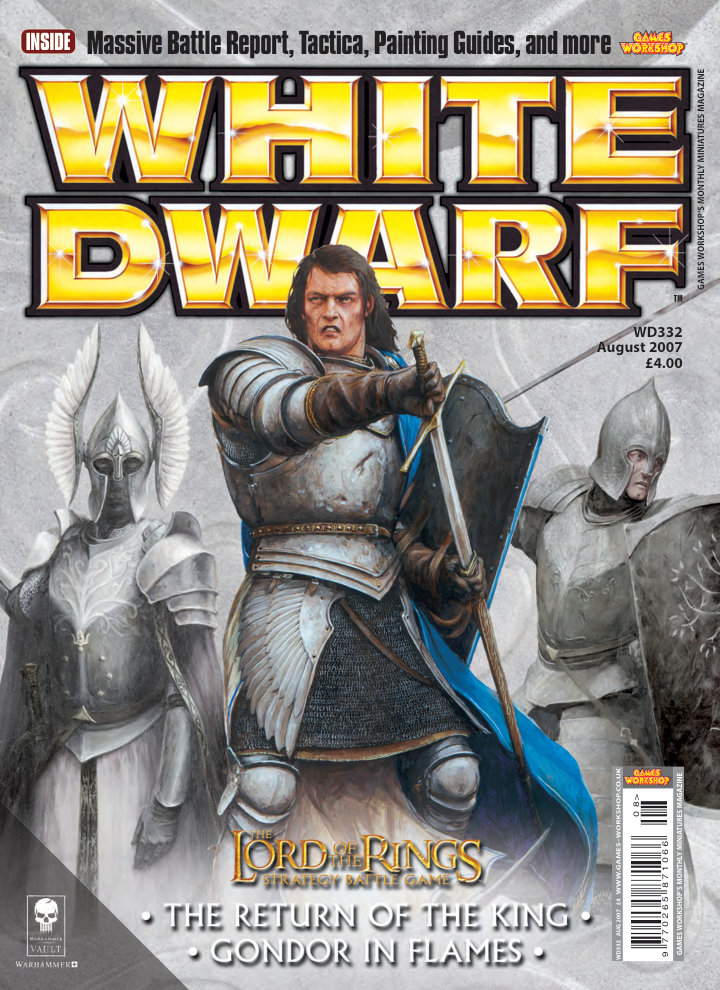
EditorialWD 332 · Inside cover
Grombrindal introduces a month centred on Gondor’s defence against Sauron, with two supplements and a broad release of new warriors. Fiefdoms troops, Woses, cavalry and Morannon Orcs make the setting’s final war more varied on the table. The editorial frames the four-player Pelennor Fields report as the centrepiece, while transport tactics and a Gorbad masterclass maintain the magazine’s wider gaming and painting interests.
Middle-earth Strategy Battle GameGondor
CommunityWD 332 · pp. 18–19
The preview introduces Apocalypse as a way to field collections of at least three thousand points with no stated upper limit. Datasheets organise either huge individual models or complete formations, from super-heavy tanks to entire Marine companies. A plastic Baneblade and new themed releases illustrate the proposed scale, while the text emphasises arranging a spectacular shared game with friends and using models from across an existing collection.
Warhammer 40,000Imperial Guard
InterviewWD 332 · pp. 24–35
Mat Ward explains the different purposes of Gondor in Flames and The Return of the King: one surveys a realm’s armies and history, the other provides flexible narrative scenarios. The Perry twins describe fitting book-inspired figures alongside the film designs, and Alessio Cavatore reflects on maintaining simple core rules while expanding the setting. New Fiefdoms, cavalry, spectral riders and southern enemies make that broader approach visible in the miniature range.
Middle-earth Strategy Battle GameGondor
InterviewWD 332 · pp. 26–27
The sourcebook separates Gondor’s forces by era and region, from the High King’s Númenóreans to Minas Tirith, Ithilien and the Dead. The greatly expanded Fiefdoms list can fight alone or reinforce the city armies with distinctive specialists. Mat Ward also explains the choice to present pivotal historical engagements rather than a continuous campaign, giving the realm a wider playable history than the siege alone.
Middle-earth Strategy Battle GameGondor
InterviewWD 332 · pp. 28–29
The final journey supplement follows both novel and film, covering a broad range of forces as the story converges on Gondor. Mat Ward replaces many rigid participant lists with points-based choices, while preserving essential named heroes where the narrative requires them. Alternative approaches suggest expanding a duel into a larger battle or transplanting a scenario’s structure to different factions, making the book adaptable to an existing collection.
Middle-earth Strategy Battle Game
InterviewWD 332 · pp. 30–31
Alan and Michael Perry explain how brief descriptions in Tolkien guide characters and troops absent from the films. Forlong’s imposing build avoids caricature, shared breastplates unify the Fiefdoms and a range of horse poses gives the new Knights momentum. The Riders of the Dead required careful film inspection, illustrating how both fleeting visual references and a few lines of prose can become fully realised tabletop figures.
Middle-earth Strategy Battle GameFiefdoms
InterviewWD 332 · pp. 32–34
Alessio praises a simple underlying system whose supplements have resisted needless mechanical complication. Legions of Middle-earth provides themed army construction, while sourcebooks and journeys give expansion two complementary purposes. He values the new permission to explore novel material and the range’s grounded appearance, arguing that Tolkien’s brief asides leave ample room for future projects without sacrificing the game’s clear identity.
Middle-earth Strategy Battle Game
TacticsWD 332 · pp. 36–37
Adam Troke’s seven-hundred-point example uses a strong shieldwall for attrition, supporting it with protected archers and hard-hitting Knights. Fountain Court Guard handle objectives and terrifying enemies, while Angbor’s Clansmen and the versatile Axemen anchor flanks or operate independently. The opposing advice is to exploit Gondor’s cost through numbers, breaking its formation and surrounding individual warriors rather than attacking the armour on equal terms.
Middle-earth Strategy Battle GameGondor
PaintingWD 332 · pp. 38–39
Mark Jones creates a coherent warband by giving every Orc the same worn armour and limiting the skin palette to four related treatments. Dark metallic bases and a brown-black wash establish rust before lighter metal picks out the plates. Variations in green or brown flesh prevent uniformity, while a repeated red Eye of Sauron on the shields makes the varied figures read as a single organised force.
Middle-earth Strategy Battle GameMordor17 paint colours
Battle reportWD 332 · pp. 40–59
Four players combine the Pelennor scenarios into one enormous battle, with the Free Peoples trying to relieve several crises before Sauron’s forces can secure three objectives. The Mumakil destroy Rohan, trolls disrupt the Army of the Dead and stubborn enemy heroes delay Dol Amroth’s breakthrough. Evil wins despite several near misses, but Merry’s remarkable survival lets Gandalf intervene against the Witch-king in an extended ending. The reflections emphasise objectives, leadership and cooperation across the separate fronts.
Middle-earth Strategy Battle GameGondor
RulesWD 332 · pp. 42–43
The battlefield divides into four linked actions: Aragorn’s landing, Dol Amroth’s charge, the duel with the Witch-king and Rohan’s struggle against Mumakil. Completing a local objective releases models to influence another action, and the first side to secure three wins the whole game. The players alter participants and reinforcement details to combine film imagery with the scenarios, while treating both sides as single armies for their breaking points.
Middle-earth Strategy Battle GameGondor
PaintingWD 332 · p. 61
The second three-step chart applies dark, middle and highlight colours to metals, wood, skin and bone. Its metallic examples vary the initial shadow and final brightness, while the flesh section includes human, green and more unusual tones. A complete Empire soldier shows how these combinations work together across hair, equipment, clothing and base, offering a practical reference for a coherent gaming miniature.
Warhammer Fantasy BattlesThe Empire41 paint colours
TacticsWD 332 · pp. 62–65
The introduction explains how battleships, cruisers and escorts cooperate in a space-combat game governed by leadership, momentum and weapon arcs. Orders alter a vessel’s behaviour, gravity wells affect manoeuvres and ordnance creates threats beyond the opposing gun line. A survey of xenos fleets and the Armada supplement broadens the setting, showing why planning several moves ahead matters more than treating the ships as infantry on a starfield.
Battlefleet GothicImperial Navy
RulesWD 332 · p. 64
The ancient Ark Mechanicus receives a full battleship profile alongside its uncertain history and exploratory purpose. Its long-range batteries, lances and Nova Cannon accompany fixed technological refits, and it must serve as flagship in a sufficiently large Mechanicus fleet. Restrictions prevent additional initial gifts while permitting normal campaign development, giving the unique vessel a specific place in the fleet rather than an unrestricted super-ship.
Battlefleet GothicAdeptus Mechanicus
EditorialWD 332 · pp. 66–68
Jervis explains why the forthcoming Chaos Space Marines book broadens its attention from the ancient Traitor Legions to later renegades. The original focus reflected the limits of time and space in the early codex, but repeated editions had left other parts of Chaos underexplored. A separate planned daemon book allows both subjects fuller treatment, while generic summoned daemons remain available to Marine armies in the interim.
Warhammer 40,000Chaos Space Marines
TacticsWD 332 · pp. 70–75
Andy Hoare distinguishes transports that support their passengers with fire, deliver an assault or simply move scoring troops to the right place. A mass advance can saturate anti-tank fire, while isolated vehicles work better as protected reserves. Practical examples examine safe disembarkation, rapid-fire attacks, moving passengers’ weapons and late objective claims, ending with mechanised Tau and advice to suppress several enemy transports rather than obsessively destroy only one.
Warhammer 40,000Space Marines
InterviewWD 332 · pp. 76–81
Darren describes progressing from store painting expert to ’Eavy Metal through practice, planning and attention to contrast. His collection demonstrates restrained conversions, elaborate freehand and carefully placed spot colours, from Dark Angels and Eldar to a huge Avatar painted from its brightest inner areas outwards. He also discusses non-metallic metal as an advanced, deliberately stylised technique, presenting it as an optional artistic challenge rather than a necessary standard.
Warhammer 40,000Warhammer Fantasy BattlesDark Angels5 paint colours
PaintingWD 332 · pp. 84–87
The workshop develops drybrushing beyond an introductory texture effect by combining it with layering, washes and detail work. Patient, nearly dry passes suit a tank’s large surfaces, while the Rat Ogre’s fur is completed before cleaner skin and cloth stages. An Ent demonstrates heavily textured bark and foliage, with methods readily transferable to trees or scenery. The choice of when to drybrush matters as much as the brushwork itself.
Warhammer 40,000Warhammer Fantasy BattlesImperial Guard32 paint colours
PaintingWD 332 · p. 85
Broad khaki and green camouflage bands receive progressively lighter, restrained drybrushing that reveals rivets and edges without picking out each one by hand. Metallic tracks and weapons are finished separately, then earthy dust ties the lower vehicle to its base. Painted chips and a brown-orange recess wash supply localised damage and rust, complementing the broad highlights rather than overwhelming the tank’s shape.
Warhammer 40,000Imperial Guard12 paint colours
PaintingWD 332 · p. 86
The Rat Ogre’s fur receives two drybrushed greys before the remaining surfaces are basecoated, keeping the messiest work away from finished details. Skin, green cloth and brass fittings then progress through cleaner layers and highlights. Pale claws, gums, straps and raised welts make the mutated anatomy readable, while a simple earth-and-bone base completes the contrast between rough texture and smoother flesh.
Warhammer Fantasy BattlesSkaven25 paint colours
PaintingWD 332 · p. 87
Different brown and grey sequences distinguish the Ent’s limbs from its rough bark, while green drybrushing picks out moss and foliage. Successive passes become paler and narrower so deep grooves remain dark, retaining the model’s wooden character. The guide explicitly offers the same palette for Warhammer Treemen and woodland scenery, making it a reusable method for natural textures across several settings.
Middle-earth Strategy Battle GameEnts12 paint colours
PaintingWD 332 · pp. 88–93
Neil Langdown paints Gorbad in separate components so the heavily armoured rider and enormous boar remain accessible throughout. Gnarla’s fur, skin and yellow plates receive different textures, while a paler green face keeps the rider distinct from his red armour. Subtle woodgrain, checks, chipped edges and the sun emblem build character through careful detail. The guide combines broad material treatment with fine finishing rather than relying on one technique everywhere.
Warhammer Fantasy BattlesOrcs & Goblins33 paint colours
PaintingWD 332 · pp. 89–90
The boar’s fur begins with warm browns and an ink wash, then receives earthy overbrushing that contrasts with its pale, mottled underbelly. Yellow armour is selectively shaded rather than covered with a general wash. Tusks develop through fine streaks, leather remains warmer and the rock base uses layered grey-earth colours and coloured washes, making each material distinct despite a largely muted palette.
Warhammer Fantasy BattlesOrcs & Goblins22 paint colours
ShowcaseWD 332 · pp. 94–97
Painted leaders and specialist troops illustrate the competing powers of the Skaven Underempire. Grey Seers wield the Horned Rat’s authority, Eshin supplies assassins, Skryre combines magic and machinery, Pestilens spreads disease and Moulder breeds saleable monsters. Banners, war machines and mutated creatures express these different identities visually, while brief background explains the fear and rivalry holding the apparently chaotic society together.
Warhammer Fantasy BattlesSkaven
CommunityWD 332 · pp. 98–101
The preview follows Games Day across its halls, connecting participation battles, hobby activities, Golden Demon and the Studio’s account of designing miniatures. The archive and White Dwarf area celebrate the magazine’s thirtieth year and twenty years of Warhammer 40,000. Club involvement, art competitions and digital-game demonstrations broaden the programme, presenting the event as a gathering of the hobby’s different crafts and communities.
Warhammer 40,000Warhammer Fantasy Battles
CommunityWD 332 · pp. 112–113
Robin Dews traces Warhammer World from an unrealised Nottingham super-store idea through the Lenton headquarters’ early visitors to a purpose-built gaming destination. The courtyard hall, miniatures display and Bugman’s support organised events as well as casual groups. Planned archive displays, original-art exhibitions and painting sessions extend the same ambition: making the headquarters a place where people participate in the hobby together rather than merely view its products.
CampaignWD 332 · pp. 114–117
Richard Sherlock takes his rustic Stirland army into a campaign beneath Karak Eight Peaks. Defeats, reinforcements and shifting alliances lead through Goblin ambushes, Chaos attacks and rumours of a Skaven laboratory before a final raid steals an Ogre gold convoy. The account explains how three linked army sizes and a mounted Warrior Priest supported the story, valuing the consequences and shared narrative of seven games as much as individual victories.
Warhammer Fantasy BattlesThe Empire