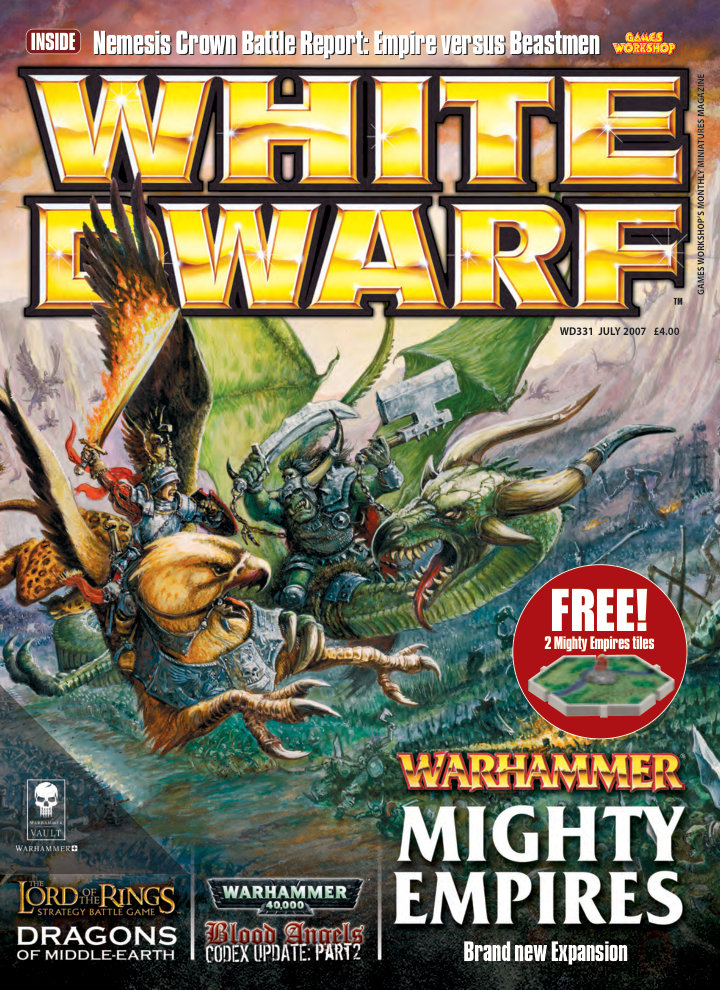
EditorialWD 331 · Inside cover
Grombrindal imagines reclaiming the lost Dwarf realm through the new Mighty Empires campaign kit. Territorial ambitions give each battlefield result consequences for settlements, mines and neighbouring rivals. New Empire wizards, Flagellants and artillery offer the human armies their own means of expansion, and the editorial points to the Nemesis Crown battle report as a test of their destructive potential.
Warhammer Fantasy BattlesDwarfs
LoreWD 331 · pp. 10–11
The coming Chaos Space Marines codex is introduced through the enduring rebellion of the Traitor Legions and later renegades. Cult troops and named leaders accompany a new range of customisable commanders, Terminators, Marines, Possessed and Spawn. The preview highlights a shift towards highly individual corrupted models, with the plastic Possessed supplying especially striking examples of daemonic transformation.
Warhammer 40,000Chaos Space Marines
InterviewWD 331 · pp. 17–25
Jervis Johnson explains why the new Mighty Empires focuses on linking Warhammer battles instead of becoming a separate strategic game. Successful battles create more opportunities to conquer or develop the map, while the short campaign system is deliberately adaptable. Mark Jones describes the double-sided plastic tiles and restrained sculpted textures that allow the same components to represent many landscapes, making map creation a substantial hobby project in its own right.
Warhammer Fantasy BattlesThe Empire
PaintingWD 331 · pp. 20–24
Four maps demonstrate how colour and modest alterations turn the same tiles into Khemri’s desert, Middenland’s forests, Bretonnia’s farmland or the polluted Dark Lands. Rivers become coastlines, marshes become oases or lava fields, and clipped mountains make volcanoes. Painting techniques range from broad drybrushing to fine water highlights, while preparation advice preserves the tiles’ reversibility and keeps ownership pennants visually clear.
Warhammer Fantasy BattlesTomb Kings17 paint colours
RulesWD 331 · p. 25
The suggested random method begins with mountains and adds concealed tile draws in turn. New pieces must connect to the existing land, while rivers continue logically until reaching water-compatible terrain or the edge. Players may instead add mountains or flip an impossible river placement, producing a shared landscape that remains coherent without requiring anyone to plan the whole campaign geography in advance.
Warhammer Fantasy Battles
CampaignWD 331 · pp. 26–28
Six White Dwarf staff members demonstrate how events, challenges, revenue and conquest interact over three campaign turns. Early Dwarf victories create a profitable lead, provoking an Empire-Bretonnian alliance and hostile events that destroy their mine. Goblins recover from a poor start while the Skaven finance further opportunities through raids. The account shows alliances and table results continually changing the map rather than allowing the first successful player an uncontested expansion.
Warhammer Fantasy BattlesDwarfs
RulesWD 331 · p. 29
The magazine’s forked rivers extend the map geometrically, while three special markers can either count as ordinary revenue sources or receive optional race-specific effects. A Dwarf brewery changes a unit’s psychology, a wizard’s tower supplies a random common magic item and an Orc idol permits another Waaagh! call. Restricting each empire to one special marker and destroying captured examples keeps these unusual benefits tied to particular territories.
Warhammer Fantasy BattlesDwarfs
LoreWD 331 · pp. 30–43
The Empire’s new models extend an army whose survival depends on combining professional soldiers, knights, wizardry and engineering. Plastic Battle Wizards, Flagellants and alternative artillery builds let collectors express both disciplined institutions and desperate religious zeal. Background and component guides explain those contrasting roles, while example armies and a complete Flagellant project demonstrate how the additions fit into a larger collection.
Warhammer Fantasy BattlesThe Empire
TacticsWD 331 · pp. 32–35
Two fifteen-hundred-point forces illustrate different Empire plans: weaken the enemy with missiles and spells before counterattacking, or advance aggressively behind strong infantry and cavalry. Adam Troke explains how to expand each approach, deploy without obstructing fire and use Flagellants to delay dangerous units. Redirecting cavalry, inexpensive hunting captains and careful rocket aiming provide practical tools for making the chosen plan work.
Warhammer Fantasy BattlesThe Empire
LoreWD 331 · pp. 36–37
The guide relates the Battle Wizards’ distinctive appearances to the Colleges founded through Teclis’s instruction. Human students master one Wind of Magic rather than the full spectrum, and their valuable service coexists with ordinary people’s fear of corruption. A component key for the new kit shows how staffs, heads and other symbols can identify different orders, tying model customisation to the Empire’s magical institutions.
Warhammer Fantasy BattlesThe Empire
LoreWD 331 · pp. 38–39
The combined plastic kit embodies two dangerous products of Imperial engineering. The Helblaster’s rotating decks of barrels can shred dense infantry, but its crews face the possibility of catastrophic failure. The Helstorm develops from Cathayan fireworks through explosive experimentation into a military rocket launcher, retaining alarming inaccuracy even after improved fins, launch sticks and carriages make it more controllable.
Warhammer Fantasy BattlesThe Empire
PaintingWD 331 · pp. 40–43
Neil Hodgson paints the varied Flagellant figures as individuals within a coherent, weathered band. Different dark cloth basecoats receive a unifying wash before selective highlights restore their character; rust and tinted grey hair add further variation. Flames, parchment, ropes and dirt are treated in separate detail sequences, making a richly accessorised Prophet of Doom stand out without losing the regiment’s ragged common appearance.
Warhammer Fantasy BattlesThe Empire28 paint colours
Battle reportWD 331 · pp. 46–61
Morghur’s Beastmen ambush Karl Franz’s secret council while Adam Troke’s Empire regiments arrive piecemeal along the roads. Andy Hoare’s attacks isolate the defenders, fill the field with Spawn and eventually take the Emperor’s tower, but Franz narrowly survives repeated attempts on his life. The draw preserves an unfinished story: reinforcements and Reiksguard gather for a counterattack, while both players assess blocked entrances, magical support and the scenario’s unusually valuable assassination objective.
Warhammer Fantasy BattlesThe Empire
TacticsWD 331 · pp. 64–69
Mat Ward moves from dragon legends to the practical challenge of commanding an immensely powerful but self-preserving monster. Its best targets are ordinary warriors, since wounds from heroic opponents can trigger courage tests and flight. Optional wings, fire, spells and thicker hide create different roles, and two sample armies show how supporting creatures or Easterling formations can compensate for the dragon’s cost and the vulnerabilities of its remaining troops.
Middle-earth Strategy Battle GameMonsters of Middle-earth
TacticsWD 331 · pp. 68–69
A fast Dol Guldur force uses wargs, spiders and bats to overwhelm a flank while its flying dragon attacks the strongest resistance. An Easterling alternative pairs two compact armoured formations with a flying fire-breather that removes archers and pressures the enemy’s rear. The comparison explains why each force performs differently against hordes, elite troops and balanced armies, making the dragon part of a coordinated plan rather than an independent solution.
Middle-earth Strategy Battle GameDol Guldur
PaintingWD 331 · pp. 70–71
The red dragon’s scales progress from a purple-red foundation to fine orange edges, leaving darker centres and joins for depth. Wings use the same palette through drybrushing, while bone-tipped horns and yellow-glazed eyes create contrasting details. Mark Bedford’s green alternative follows the scale method with a restrained reptilian palette, showing how real animal references can produce a convincing monster without changing the underlying technique.
Middle-earth Strategy Battle GameMonsters of Middle-earth13 paint colours
RulesWD 331 · pp. 72–85
The second instalment completes the official Blood Angels replacement codex with a self-contained army list. Commanders, specialist elites, Assault Marines as Troops, mobile support and vehicles receive their costs, equipment and choices. The introduction explains how ordinary squad prices pay for associated Death Company models, while fixed-size options and Combat Squads organise deployment. A reference sheet and heraldry guide close the feature and connect the rules to a recognisable Chapter collection.
Warhammer 40,000Blood Angels
RulesWD 331 · pp. 74–76
Named heroes and customisable Captains, Chaplains and Librarians offer different ways to lead the army. Honour Guard accompany independent characters without consuming another organisation slot and may add specialist officers, standards or jump packs. The entries make leadership, psychic support and assault mobility explicit list-building choices, while reserving unique figures such as Dante and Mephiston to one example per army.
Warhammer 40,000Blood Angels
RulesWD 331 · pp. 77–79
The Elites section assembles the Chapter’s Death Company, Terminators, Dreadnoughts, Techmarines, Veteran Assault Marines and Scouts. Death Company size derives from selected squads, with optional paid additions and transport choices; splitting a squad does not produce another free model. Equipment and mobility options distinguish assault specialists from supporting machinery, while designer notes explain how existing collections should represent the revised Death Company weapons.
Warhammer 40,000Blood Angels
RulesWD 331 · p. 80
Assault squads occupy Troops alongside Tactical Marines, expressing the Blood Angels’ preference for close fighting without removing their conventional infantry. Both begin at five models with an option to expand, and their sergeants can select specialist combat equipment. Assault Marines may exchange jump packs for a transport, while a full Tactical squad unlocks heavy weapons, linking unit size and mobility directly to the force’s intended role.
Warhammer 40,000Blood Angels
RulesWD 331 · p. 81
Bike and Attack Bike squadrons provide mobile infantry weapons or concentrated heavier fire, while Land Speeders offer several specialised configurations. Their points and upgrade limits let an army support its jump troops without relying on more foot infantry. The accompanying successor guidance permits the same list and named-character rules to represent related Chapters through appropriate paint schemes and newly invented identities.
Warhammer 40,000Blood Angels
RulesWD 331 · pp. 82–83
Devastators and a broad selection of tanks supply the firepower behind the Chapter’s assault units. The list contrasts heavily protected Land Raiders and their transport capacities with configurable Predators, indirect Whirlwinds, Vindicators and the over-charged Baal variant. Weapon choices and vehicle upgrades let collectors specialise each unit, while a brief badge guide connects support vehicles to the campaign markings used across the army.
Warhammer 40,000Blood Angels
RulesWD 331 · p. 84
Rhinos, Razorbacks and Drop Pods provide alternative delivery methods with distinct passenger limits and equipment choices. The Rhino’s modified engine offers a faster advance, the Razorback trades capacity for firepower and the pod uses inertial guidance to limit hazardous landings. Each functions independently without consuming an organisation slot, making its role an integral part of the squad’s deployment plan.
Warhammer 40,000Blood Angels
LoreWD 331 · p. 85
The heraldry reference places the Chapter emblem on the left shoulder and company identity on the right, with squad devices on the knee. Helmet colours distinguish Tactical, Assault, Devastator and Honour Guard roles, while numbered blood-drop vehicle markings identify the relevant company and squad. The compact visual guide turns the list’s military organisation into repeatable details for painting a coherent collection.
Warhammer 40,000Blood Angels
EditorialWD 331 · pp. 86–88
Foundation Paints prompt Jervis and his colleagues to reflect on painting as a central pleasure of the hobby. Miniature collecting predates the games, and a finished figure can reward its maker whether or not it ever reaches a battlefield. Better instruction should build confidence without reducing painting to a mechanical exercise, encouraging practice, experiment and respect for the craft as well as the spectacle it brings to play.
PaintingWD 331 · p. 89
The colour chart reduces a useful gaming finish to three deliberate applications: a dark foundation, a broad middle colour and a restricted highlight on raised surfaces. Separate rich and natural palettes show combinations across reds, greens, blues, cloth tones and greys. The examples preserve the first colour in recesses rather than painting over it, giving newcomers a predictable starting point for later mixing and experimentation.
46 paint colours
ModellingWD 331 · pp. 90–97
Mark Jones builds a reinforced six-by-four-foot board whose textured desert surface can serve three different settings. Changing the removable scenery turns it into Khemri, an Imperial outpost or a Haradrim encampment. Kit conversions and scratch-built tents keep those settings distinctive while matching their bases to the shared ground, demonstrating how one durable table can support several collections without sacrificing atmosphere.
Warhammer Fantasy BattlesWarhammer 40,000Tomb Kings
PaintingWD 331 · pp. 90–91
A timber frame supports the MDF playing surface before sand is glued on in manageable strips. Once dry, an earthy basecoat seals the grains and two broad drybrush stages create a durable desert texture. The guide suggests matching a large household paint quantity to the named Citadel base colour, making a full-size gaming board practical to finish while keeping its appearance compatible with miniature bases.
4 paint colours
ModellingWD 331 · pp. 92–93
Arcane Ruins and gaming hills become the remains of Khemri through matching stonework and a large temple centrepiece. Chad Mierzwa combines two ruin kits with a hill and plasticard, while a converted obelisk borrows a cage, skulls and raven from the Giant frames. Bare trees receive pale drybrushed bark and sand over unwanted foliage, tying every piece to a dead desert landscape.
Warhammer Fantasy BattlesTomb Kings3 paint colours
PaintingWD 331 · pp. 94–95
City-ruin panels, tank traps and supply dumps establish an Imperial presence on the same barren board. Metallic obstacles receive a dark wash and rusty recesses, while grey crates and machinery gain progressively lighter drybrushing. Rocky hills use mixed earth-and-grey tones before pale highlights, making the buildings and battlefield accessories appear exposed to the same sandblasted environment.
Warhammer 40,000Imperium10 paint colours
ModellingWD 331 · pp. 96–97
A nomadic camp gives the desert board a Middle-earth identity through scratch-built tents. Shaped polystyrene establishes the volume, balsa strips suggest the support frame and glue-soaked tissue supplies the covering. Sandy bases and natural hide colours integrate them with the table, while ruined statues and broken masonry can suggest older Númenórean settlements beneath the present Haradrim landscape.
Middle-earth Strategy Battle GameHarad
CommunityWD 331 · pp. 114–115
Brian Aderson and Andy Joyce explain a revised Grand Tournament structure that opens the final to successful generals, outstanding armies, sporting players and wildcard entrants. The top forty from each heat qualify alongside selected Best Army and Most Sporting nominees. A new thirty-point win, ten-point draw and one-point loss scale puts victories first, with victory bonuses resolving ties. The changes aim to reward the several ways hobbyists contribute to an event while making the route to the championship clearer.
Warhammer Fantasy BattlesWarhammer 40,000
CommunityWD 331 · pp. 116–119
The March final brings together one hundred and fifteen players for more than three hundred battles. Alejandro Martín Fernandez remains unbeaten with Iron Warriors to take first place, followed by Dan Fortnum and David Minnis, while Andrew Taylor’s Soul Eaters win Best Army. The report also follows the Flame.On club and a characterful Khorne collection, giving the final’s friendships, army themes and shared experiences attention alongside the standings.
Warhammer 40,000Iron Warriors
InterviewWD 331 · p. 117
Neil Kerr traces Flame.On from four Manchester gamers to a club of around sixty members extending beyond Britain. The group welcomes different experience levels and combines enthusiasm for good-looking armies with competitive play. Members spread themselves between heats to avoid eliminating friends, while their matching red shirts make the final a recognisable team occasion. His account treats companionship, encouragement and a shared event identity as important parts of tournament success.
Warhammer 40,000
ShowcaseWD 331 · pp. 118–119
Andrew Taylor’s Soul Eaters place a strong Khorne theme ahead of a purely efficient tournament list, with Bloodletters, a Bloodthirster and a deliberately evocative allocation of points to the core troops. Winning Best Army rewards the collection’s identity even though its games include several defeats and an ignominious encounter between the greater daemon and a spinegaunt. A final victory against Christian Byrne’s Black Legion rounds out an account of enjoying a distinctive army through both spectacular and disappointing moments.
Warhammer 40,000World Eaters