EditorialWD 325 · Inside cover
Grombrindal welcomes the renewed Empire as the Dwarfs’ longstanding human ally, recalling the debt between their peoples since Sigmar’s time. The editorial contrasts the realm’s wizards, engineers, ambitious nobles and varied war machines with the ordinary infantry at its heart. Supporting detachments and cooperation between regiments are presented as the characteristic strength of its armies.
Warhammer Fantasy BattlesThe Empire
LoreWD 325 · p. 12
A preview of the March Dark Angels release introduces a codex combining the Chapter’s secret history, successors, organisation and heraldry with rules for fielding its forces. The miniature overview highlights Company Masters, a compatible plastic accessory frame and the Master of the Ravenwing on the last remaining Imperial jetbike. The page presents the army’s distinctive identity ahead of its full release.
Warhammer 40,000Dark Angels
CommunityWD 325 · p. 13
The previous global participation campaign’s conclusion is followed by the announcement of a worldwide Warhammer campaign for summer 2007. Its focus will be the Nemesis Crown, an ancient Dwarven magical artefact whose reappearance promises to draw armies into conflict. Readers are encouraged to prepare their collections while further details of the campaign and its website are still to come.
Warhammer Fantasy BattlesDwarfs
RulesWD 325 · pp. 17–27
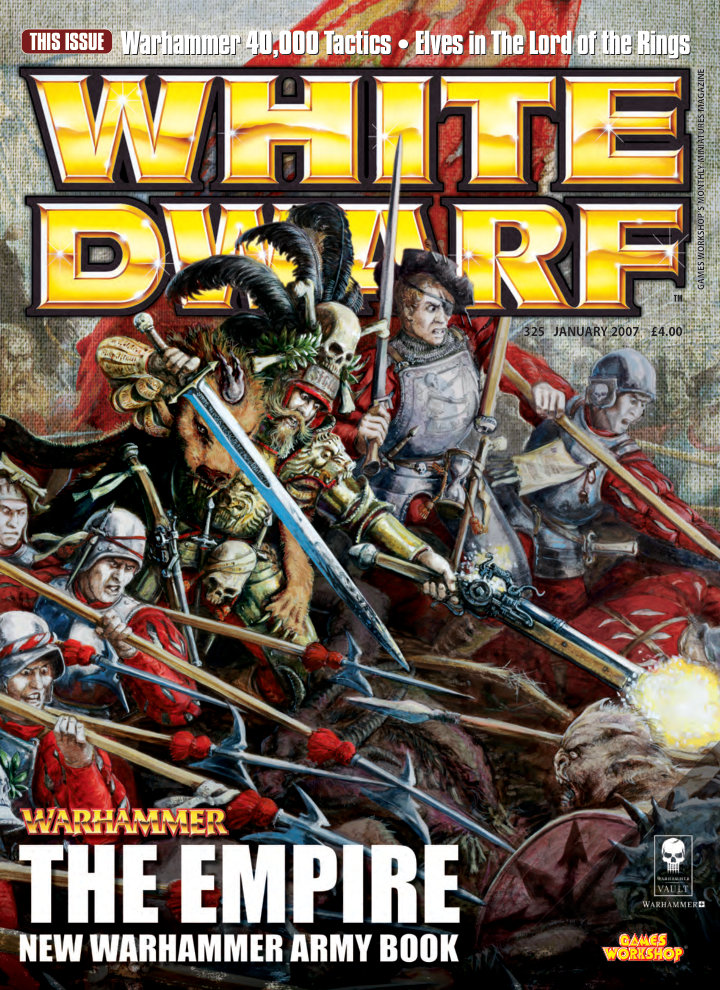
Adam Troke explores the new Empire book with contributions from John Blanche and Gav Thorpe, stressing a realm sustained by ordinary people amid dangerous supernatural surroundings. A fuller history and provincial background accompany a more flexible army list, including characters such as Karl Franz, unrestricted Greatswords and options for religious armies. The review compares leaders, State Troops, cavalry and experimental artillery while showing the richly detailed new plastic kits.
Warhammer Fantasy BattlesThe Empire
TacticsWD 325 · pp. 20–21
The character discussion compares the economical Empire General and Captain with the harder-hitting Templar Grand Master, the Arch Lector’s religious support and the increased cost of Wizards. Warrior Priests now extend Hatred against a wider range of enemies, while Engineers bring eccentric devices such as pigeon bombs and mechanical horses. The feature emphasises choosing leadership and support that strengthen the infantry rather than assuming every hero must be a supreme fighter.
Warhammer Fantasy BattlesThe Empire
ModellingWD 325 · pp. 22–23
Numbered parts charts explain how the new State Troops kit creates Spearmen, Swordsmen or Halberdiers and how the missile kit produces Handgunners or Crossbowmen. Alternative heads, shields, weapons, command parts and small accessories support different regimental characters. Finished examples demonstrate the relationship between the parts and battlefield roles, including the Marksman accompanied by his powder monkey.
Warhammer Fantasy BattlesThe Empire
TacticsWD 325 · pp. 24–25
The Empire’s specialist troops expand an infantry army’s reach through Pistoliers, Outriders, knights and artillery. Pistoliers harass flanks with mobile short-range fire, while Outriders must establish a position before unleashing concentrated repeater-handgun volleys. The discussion also assesses Inner Circle upgrades, the Helstorm’s destructive but unreliable barrage, the Steam Tank’s substantial cost and Flagellants’ refusal to break.
Warhammer Fantasy BattlesThe Empire
ModellingWD 325 · p. 25
A detailed component chart separates the shared cavalry bodies and horses from the weapons and clothing that distinguish Pistoliers and Outriders. It identifies repeater handguns, pistols, a blunderbuss, musician parts and numerous accessories, showing how the same frame supports two different regiments. The breakdown provides a planning reference for selecting a rider’s equipment and decorative details before assembly.
Warhammer Fantasy BattlesThe Empire
FictionWD 325 · p. 26
A wounded Hochland halberdier regains consciousness amid an Empire battle against Beastmen, guided back to his regiment by a Middenland sergeant. Artillery and Bright College magic strike the enemy while a Count on a griffon signals the counterattack. Friedl returns to his place beside his comrades, turning the army’s grand spectacle into the exhausted, frightened experience of one ordinary soldier.
Warhammer Fantasy BattlesThe Empire
Battle reportWD 325 · pp. 30–45
Adam Troke’s new Empire army confronts Pete Foley’s Vampire Counts at three thousand points, led respectively by Kurt Helborg and Mannfred von Carstein. Repeated invocations, dangerous curses and unreliable Imperial artillery make the fight costly for both armies. Helborg’s Reiksguard survive successive Undead combats and defeat Mannfred’s Black Knights in the final clash, while late control of table quarters helps the Empire secure a marginal victory, 2041 points to 1534.
Warhammer Fantasy BattlesThe Empire
LoreWD 325 · pp. 48–49
Mat Ward traces the ancient Elves’ power and decline from the Second Age through the wars caused by Sauron’s deception. The feature introduces Eregion, Rivendell, the Grey Havens and the House of Finrod as distinct backgrounds for collections. Suggested heraldry is explicitly an interpretation influenced by the films, giving players fitting uniforms without claiming Tolkien supplied definitive colour schemes for every realm.
Middle-earth Strategy Battle GameHigh Elves
TacticsWD 325 · pp. 50–51
The guide explains how Elven archery, high Fight, strong Courage and heavy armour compensate for being outnumbered. Diagrammed formations keep protected spear-armed warriors ahead of archers until the line reverses for melee support, adapting to tougher opponents when necessary. A roughly five-hundred-point sample Grey Havens force places Círdan near the main body, with captains enabling Heroic actions and specialised cohorts supporting each other.
Middle-earth Strategy Battle GameHigh Elves
TacticsWD 325 · pp. 52–53
The hero survey distinguishes Gil-galad’s extraordinary duelling strength from Elrond’s mixed martial and magical role and Glorfindel’s resistance to hostile spells. Less expensive options provide different tools: Erestor disrupts enemy leaders, Arwen knocks warriors down with Nature’s Wrath, and Círdan reinforces a battle line through magic. Allied choices such as Legolas, Galadriel and Gildor broaden the possibilities without making every hero interchangeable.
Middle-earth Strategy Battle GameHigh Elves
TacticsWD 325 · pp. 54–55
Legions of Middle-earth allies allow an Elven army to address particular weaknesses while preserving a coherent theme. Thranduil’s Halls offers cheaper warriors and disruptive Sentinels, Wizards can restrain powerful enemy heroes, and Great Eagles supply speed when cavalry is unavailable. Ents add the force needed to confront Trolls, though their high cost makes the problem of being outnumbered more severe.
Middle-earth Strategy Battle GameHigh Elves
RulesWD 325 · pp. 56–57
After Fornost falls, an army of the Witch-king attempts to seize the palantír protected by the Elves of the Grey Havens. A five-hundred-point Elven force faces seven hundred and fifty points of leaderless enemies around a central building and woods. Enchanted defences grant healing saves and recurring magical blasts, while the invaders cannot break; the Elves must defeat them and preserve at least one hero to claim more than a draw.
Middle-earth Strategy Battle GameGrey Havens
EditorialWD 325 · pp. 60–62
Jervis Johnson recalls converting historical soldiers into Orcs and the Grey Company after reading Tolkien as a teenager, long before suitable miniatures existed. Those improvised games taught him to value a hobby that players can adapt to their own interests. He sees the modern Lord of the Rings range, narrative supplements and Legions of Middle-earth as different entrances to that same flexibility, supporting collectors, campaign players and competitive generals.
Middle-earth Strategy Battle Game
PaintingWD 325 · pp. 64–67
The opening instalment of a new painting series begins before the first coloured layer: selecting tools, cleaning mould lines, fitting parts and filling joints. It explains brush choice and care, the purpose of acrylic paints and inks, and the different opportunities offered by black and white undercoats. A spray stick provides a practical way to prime multiple figures while retaining access to awkward surfaces.
5 paint colours
PaintingWD 325 · p. 65
A dated colour chart lists the contemporary Citadel Colour acrylics, metallics, inks and varnishes beside the brush guide. The accompanying explanation presents related lighter and darker colours as a convenient basis for highlighting and shading, using a green progression as its example. This is a reference to the available historical range, useful for identifying period paint names rather than a single miniature’s complete recipe.
67 paint colours
ModellingWD 325 · p. 66
The preparation tutorial distinguishes mould lines on plastic models from metal flash, showing how to remove both before priming. A Great Unclean One’s shoulder joint demonstrates gap filling with a rolled sausage of evenly mixed Green Stuff, pressed into place and smoothed with a damp sculpting tool. Adjacent brush-care instructions explain cleaning, restoring points and avoiding dried paint near the ferrule.
PaintingWD 325 · p. 67
A wooden baton and double-sided tape hold a row of models for spraying, leaving a handle and enough space to reach each figure from different angles. The guide compares a black undercoat’s ready-made shadows and suitability for drybrushing with white’s brighter colours and usefulness for washes. Brushing thinned black paint into missed recesses completes coverage, and alternative mounting methods suit smaller jobs.
2 paint colours
ModellingWD 325 · pp. 68–73
The new Empire General frame supplies mounted and foot characters, a standard bearer and a broad range of weapons and heraldic accessories. Illustrated assembly paths are followed by conversions that mix State Troop, Knightly Order and Outrider pieces to create provincial identities. Dave Andrews’ Helmut Feuerbach demonstrates how scratch-built parts and combined heads can turn the flexible kit into a specific Elector Count.
Warhammer Fantasy BattlesThe Empire2 paint colours
ModellingWD 325 · p. 69
An illustrated sequence constructs an Empire General on his barded warhorse and identifies the alternative weapons, heads, shields and decorative pieces. The component key distinguishes standard and optional parts, allowing the rider’s role and appearance to be planned together. The result can range from an ornate commander to a differently equipped mounted hero without requiring an entirely separate sculpt.
Warhammer Fantasy BattlesThe Empire
ModellingWD 325 · p. 70
The foot-character assembly shows how the same frame can create an Empire General, Captain or Army Standard Bearer. Alternative arms and accessories change the character’s role, while a hatchling griffon can become a scenic-base detail. A numbered parts guide makes the available choices clear and encourages arranging the model before selecting the final weapons and decoration.
Warhammer Fantasy BattlesThe Empire
ModellingWD 325 · p. 71
Three converted leaders use interchangeable Empire frames to express their home provinces. State Troop shields and Knightly Order parts supply Talabheim emblems, an Outrider cloak adds volume, and a White Wolf pelt distinguishes the Middenheim commander. The examples include scraping away existing barding devices and reversing a sword by exchanging its blade and pommel, demonstrating practical alterations beyond simple part swapping.
Warhammer Fantasy BattlesThe Empire
ModellingWD 325 · pp. 72–73
Dave Andrews models Talabecland’s missing Elector Count as he rode out against Chaos, combining plastic components with a scratch-built lance and shield. Reworked heads give him both an eye-patch and elaborate headgear, while red, yellow and white details acknowledge Talabecland and Talabheim. Notes on lacquered armour, the Runefangs and the electoral system connect the conversion to the rank and history of the character.
Warhammer Fantasy BattlesThe Empire2 paint colours
ModellingWD 325 · p. 75
The toolbox compares polystyrene densities before showing how a hot wire cutter shapes terrain without scattering loose foam everywhere. Angled cuts around a crater leave an inner core that can be reused to produce progressively smaller craters from the same block. PVA, sand, drybrushing and protective varnish finish the pieces, while the guide discusses heat and ventilation precautions associated with the tool.
TacticsWD 325 · pp. 76–81
Alessio Cavatore explains how assault units reach combat through speed, transports, special deployment and careful use of cover, supported by the rest of the army’s firepower. Equipment advice balances grenades, power weapons and hidden power fists against over-investment, and warns that shooting can remove the targets needed for a charge. Contributors then show the principles through faction examples, from summoned Bloodletters to Scarab Swarms and an entire Assault Marine force.
Warhammer 40,000Space Marines
TacticsWD 325 · p. 77
Graham Davey uses the general combat ability of Chaos Space Marines to ensure that whichever units survive the advance remain dangerous. Possessed and Berzerkers provide dedicated assault power, while heavily enhanced Aspiring Champions strengthen ordinary squads. Binding Bloodletters to a Daemon Icon extends a threat beyond the apparent front line, turning summoning distance into a sudden opportunity for a charge.
Warhammer 40,000Chaos Space Marines
TacticsWD 325 · p. 78
Andy Hoare demonstrates how an apparently shooting-focused Guard army can build a formidable close-combat command group with a senior officer, Commissar, Priest and Veterans. Power weapons, an eviscerator, leadership support and rerolls combine with the squad’s ordinary attacks, while a medic improves survival. Rough Riders offer another striking option, and concentrated plasma fire remains an alternative when an enemy is better eliminated before combat.
Warhammer 40,000Imperial Guard
TacticsWD 325 · p. 79
Adam Troke recommends cheap, Fearless Scarab Swarms as fast attackers against dangerous enemy fire-support units. Turbo-boost moves them into position while granting protection from the intervening shooting, setting up a second-turn assault on targets such as Devastators or Guard heavy-weapon squads. They can tie down or defeat those guns without contributing to the army’s phase-out threshold.
Warhammer 40,000Necrons
TacticsWD 325 · p. 79
Phil Kelly equips large Hormagaunt broods with toxin sacs so that the first assault wave can inflict serious damage rather than merely hold enemies for bigger organisms. A full brood’s potential mass of Strength-four attacks makes it a threat opponents must recognise early. Leaping and Fleet reduce the time available to shoot the little creatures before they arrive.
Warhammer 40,000Tyranids
TacticsWD 325 · p. 80
Alessio Cavatore presents a 1497-point Crimson Furies force built around three Furious Charge Assault Squads, jump-pack characters and two Scout units. The Scouts locate the enemy before the Eighth Company descends, replacing his usual balanced approach with a close-combat theme. He explains why the small army needs plentiful terrain and especially enjoys Cities of Death, where a Chaplain-led charge becomes devastating.
Warhammer 40,000Space Marines
TacticsWD 325 · p. 81
Gav Thorpe combines an Archon’s defensive wargear and combat enhancements with an Incubi bodyguard’s high Initiative and power weapons. A Raider supplies the speed needed to bring the expensive unit to the right fight, but preserving that transport through the opening turns is essential. The example concentrates on delivering a compact elite assault rather than assuming its excellent combat profile guarantees success.
Warhammer 40,000Drukhari
TacticsWD 325 · p. 81
The Ork discussion compares rapid Stormboyz and Trukk Boyz with harder-hitting Skarboyz, armour-cutting Burna Boyz and a Nob bodyguard. Its preferred solution remains ordinary Slugga Boyz: affordable numbers, choppas and enough cover to reach the enemy. The example argues that large mobs can produce the required combat force without concentrating all the army’s resources in elite specialists.
Warhammer 40,000Orks
InterviewWD 325 · pp. 84–87
Neil Langdown discusses the path from childhood painting and Golden Demon success to ’Eavy Metal and sculptor training. His vivid style reflects the early-nineties palette without copying it wholesale, and he enjoys the contrasting realism of Lord of the Rings subjects. A selection of personal and Studio work explains his use of freehand, scenic additions, hidden conversion supports and strong colour to communicate each model’s story.
Warhammer Fantasy BattlesWarhammer 40,000
PaintingWD 325 · pp. 88–93
Neil Green paints the Master Engineer and Mechanical Steed in a sequence that begins with the large metallic surfaces and works outward to cloth and fine details. A matte grey armour wash, subtly purple-shaded gold and differentiated brass preserve the machinery’s character, while red cloth, green laurels and warm flesh add contrast. Complete colour progressions accompany the stages, with advice on eyes, wood grain, scroll lettering and leaving detachable weapon arms accessible during painting.
Warhammer Fantasy BattlesThe Empire30 paint colours
LoreWD 325 · pp. 94–97
Close photographs of the Studio’s Eldar characters are accompanied by explanations of their weapons, runes, clothing and histories. Prince Yriel’s cursed spear, the Autarchs’ accumulated Aspect equipment, the seers’ psychic tools and the Avatar’s divine violence each express a different kind of authority. The spread is a visual background reference rather than a paint recipe or a set of game profiles.
Warhammer 40,000Aeldari
LoreWD 325 · p. 94
Yriel’s story joins his exile as a Corsair Prince to his return during Iyanden’s desperate war against Hive Fleet Kraken. Using the Spear of Twilight saved the craftworld but bound his soul to a cursed weapon. Details on the model explain the Eye of Wrath, protective forceshield and twin banners, connecting his current command to both Iyanden and the Eldritch Raiders.
Warhammer 40,000Aeldari
LoreWD 325 · p. 95
The Autarch models combine equipment from different Aspect traditions to express the many lifetimes of training that precede the Path of Command. Explanatory callouts identify inherited helms, forcefield protection and craftworld symbols on the Studio examples. Interchangeable weapons and backpacks also permit physical variation, reinforcing the connection between a commander’s individual history and the appearance of the miniature.
Warhammer 40,000Aeldari
LoreWD 325 · p. 96
The seer gallery distinguishes Warlocks on the martial Witch Path from the ancient Farseers whose lives have become committed to foresight. Staves focus psychic powers, witchblades and singing spears answer to Eldar psykers, and robes carry symbols such as the Eye of Isha or the Cosmic Serpent. Craftworld variants show how these shared roles retain local visual traditions.
Warhammer 40,000Aeldari
LoreWD 325 · p. 97
Eldrad’s Staff of Ulthamar, Ghosthelm and robe markings embody the wisdom and psychic protection of Ulthwé’s greatest Farseer. Beside him, the Avatar represents an entirely different power: the awakened physical embodiment of Khaine, bearing the screaming Wailing Doom. Callouts interpret the miniatures’ symbolic details and weapons, including the blood associated with the war god’s nature.
Warhammer 40,000Aeldari
CommunityWD 325 · pp. 98–103
Jon Carter, Rob Macfarlane and Rik Turner report on the Birmingham NEC event through its Forum, Arena and Pavilion halls. New models, the Aeronautica Imperialis demonstration, mass participation battles and a three-times-scale Battle for Skull Pass display share space with painting, conversion and art activities. Golden Demon photographs and the story of the Scrap Demon contest show how visitors’ own work remained central to the spectacle.
Warhammer Fantasy BattlesWarhammer 40,000
CommunityWD 325 · pp. 98–99
The Forum mixes early purchases with practical hobby activity, from scenery and painting tables to visitors assembling their new kits immediately. Forge World shows its completed Tau Manta, Death Korps and the coming Aeronautica Imperialis, while Bring and Battle tables support compact games. The Scrap Demon challenge asks competitors to build a Warhammer General from supplied sprues, rewarding inventive use of components rather than painting.
CommunityWD 325 · pp. 100–101
The Arena’s participation games use elaborate terrain and unusual projects to turn familiar systems into large shared spectacles. Highlights include a folding cross-section of Moria, a Dwarven airship, huge Imperial Guard and Necron forces and a Tau city above the sea. A Cities of Death table with an elevated roadway demonstrates how clubs and store teams can extend the scenery and scale of ordinary games.
Warhammer Fantasy BattlesWarhammer 40,000
CommunityWD 325 · pp. 102–103
The Pavilion brings Studio staff, scenery builders, publishers and computer-game demonstrations together with Golden Demon. Its central display enlarges the entire Battle for Skull Pass game to three times normal size, including dice and rulebooks, while staff discuss upcoming projects and explain their work. The report celebrates the Spanish painters’ success and Albert Moretó Font’s Slayer Sword-winning Black Orc Warboss.
Battle reportWD 325 · pp. 104–108
Joe Wiltshire and Rob West take a Dwarf partnership to Conflict London, selecting compact forces with solid infantry, missile troops and artillery. Early defeats expose delayed reserves and the danger of mobile opponents, but two later massacres recover their standing to forty-sixth place. Their combined collection wins Best Army, balancing a frank account of tournament mistakes with the pleasure of well-painted forces and enjoyable opponents.
Warhammer Fantasy BattlesDwarfs9 paint colours
PaintingWD 325 · p. 108
A compact chart records the orange, green and dark metallic finishes of the award-winning Dwarf collection. Orange progresses from brown through bright orange to bone highlights, green rises from Dark Angels Green toward Snot Green, and armour mixes black, metal and grey before the brightest edges. The surrounding models show how the same palette carries across infantry, a Gyrocopter and a detailed scenic war machine.
Warhammer Fantasy BattlesDwarfs9 paint colours
CommunityWD 325 · p. 113
Dan Abnett, Graham McNeill and James Swallow meet readers at Watford during the September Warhammer launch celebrations. More than a hundred fans attend the signing and questions range beyond upcoming books to how the authors handle moral ambiguity in the Warhammer 40,000 setting. The report records the gathering as a chance for readers to discuss the fiction directly with its creators.
Warhammer 40,000Warhammer Fantasy Battles