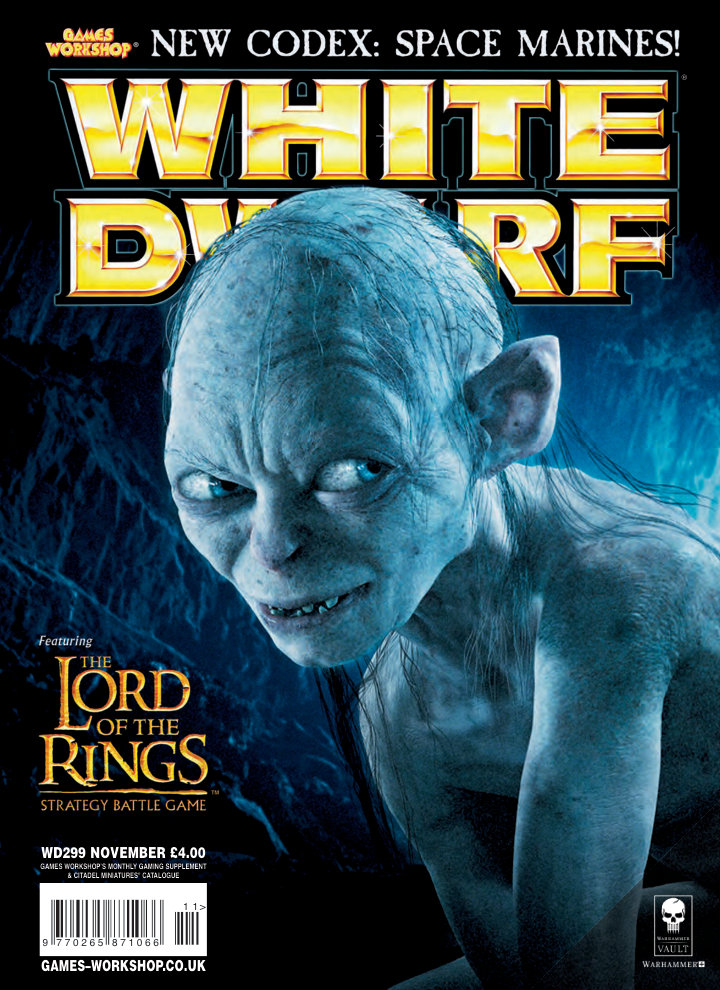
EditorialWD 299 · Inside cover
Paul Sawyer previews the magazine’s three-hundredth issue, explaining why the team settled on a greatly enlarged page count rather than the hoped-for three hundred pages. Posters, new White Dwarf material and a gaming reference sheet form part of a celebration that also revisits classic Adrian Smith artwork.
CommunityWD 299 · pp. 2–5
Designers preview the plastic Eldar Wave Serpent, the Epic Swordwind supplement and the Ogre Kingdoms Scrap Launcher, discussing how the models’ shapes express their roles and cultures. The studio also reports on its website rebuild and personal projects, including the demanding conversions for Bugman’s Lament and a return to loyalist Space Marines.
Warhammer 40,000Warhammer Fantasy BattlesAeldari
CampaignWD 299 · pp. 12–19
Nick Kyme continues the story of the brewery’s destruction with an assault on the watchtower that could warn Bugman of the Goblin plan. The campaign’s second instalment combines a linked scenario, eccentric named characters, explosive specialists and a scratch-built Dwarf tower, keeping the result connected to the coming battle on the River Sol.
Warhammer Fantasy BattlesDwarfs
RulesWD 299 · pp. 14–15
Skeggi’s thousand-point garrison must defend a fortified watchtower against Grabnatz’s larger Goblin force, whose volatile brew can rupture its stone walls. The previous battle affects how close the attackers begin, and the tower’s survival determines how much warning Bugman receives, changing the next scenario’s length and opening turn.
Warhammer Fantasy BattlesDwarfs
RulesWD 299 · p. 15
The elderly Dwarf captain combines exceptional crossbow shooting with a family rune axe and a long history alongside Bugman’s people. His profile makes the one-eyed veteran an accurate defender, while the conversion removes the Ranger model’s peg leg to depict an earlier moment in his life and adds small personal possessions.
Warhammer Fantasy BattlesDwarfs
RulesWD 299 · p. 16
Grabnatz’s experiments have produced both explosive weapons and noxious personal side effects, making nearby models suffer when his stomach acts up. Gulag remains at the Shaman’s side and can intercept attacks intended for him; Guy Haley’s accompanying conversion enlarges the Goblin’s hood and adds a wolfskin cloak to mark his importance.
Warhammer Fantasy BattlesOrcs & Goblins
RulesWD 299 · p. 17
Pairs of deranged Goblins carry barrels of Grabnatz’s volatile brew to the watchtower, light their fuses and abandon them before the unpredictable blast. Independent movement and combined explosions make them unusual scenario specialists, while converted artillery crew, ale barrels and a wheelbarrow show several ways to model the dangerous delivery teams.
Warhammer Fantasy BattlesOrcs & Goblins
Battle reportWD 299 · p. 18
Nick and Guy test the tower scenario, opening with effective Dwarf missile fire before the Goblin Giant and Rock Lobbers bring the defenders under pressure. Both Goblin leaders and artillery are lost, but the tower is left barely standing, producing a draw that keeps the campaign’s next stage uncertain.
Warhammer Fantasy BattlesDwarfs
ModellingWD 299 · pp. 18–19
Paul Rudge builds the Dwarf tower from a foamboard mock-up, layered polystyrene rock and a timber-framed box clad in brick-textured plasticard. Sculptural Dwarf details, a rooftop beacon and small handmade fittings give it character, while grey drybrushing and a brown wash tie the rock and half-buried statues together.
Warhammer Fantasy BattlesDwarfs5 paint colours
TacticsWD 299 · pp. 20–31
John Connor treats artillery as a coordinated element of an army rather than a collection of lucky damage rolls. Practice at guessing ranges, terrain choice, flank shots, defensive screens and target selection all affect its value, while faction-specific discussions show how a machine can shape enemy movement even when it never fires successfully.
Warhammer Fantasy BattlesEmpire
TacticsWD 299 · pp. 22–23
The Empire discussion contrasts cannon shots against hard targets, mortar templates against large light formations and the Helblaster’s powerful but unreliable close defence. It weighs engineers against buying another gun and stresses that the fear of a volley can protect a flank or objective even before the weapon inflicts casualties.
Warhammer Fantasy BattlesEmpire
TacticsWD 299 · pp. 24–25
Dwarf guns are assessed as tools for shaping an enemy advance around a slow infantry core. Flame Cannons and Organ Guns guard likely approaches, engineering runes adjust reliability or hitting power at a cost, and a carefully protected Gyrocopter can delay enemy movement to buy the batteries more shooting time.
Warhammer Fantasy BattlesDwarfs
TacticsWD 299 · p. 27
The Skaven section compares Jezzails, weapon teams and the Warp-Lightning Cannon as differently risky ways to deliver severe ranged damage. Asger Granerud emphasises the cannon’s psychological reach through cover: opponents restrict their own characters and movement because they cannot rely on an unpredictable weapon failing to hurt them.
Warhammer Fantasy BattlesSkaven
TacticsWD 299 · p. 28
The Tomb Kings’ catapult is valued for forcing Panic tests as much as for direct damage. Extra skulls and repeated shooting through an incantation make it threatening, and the advice deliberately spreads shots across vulnerable units rather than always concentrating fire on one target, especially near an enemy’s starting edge.
Warhammer Fantasy BattlesTomb Kings
TacticsWD 299 · p. 28
Cheap Goblin war machines are recommended in numbers to offset unreliable crews and provide enough fire to matter. The article compares Spear Chukkas, Rock Lobbers and Doom Divers, suggests an Orc Bully to improve crew nerve and warns that scattered shots can endanger the very troops the guns are meant to support.
Warhammer Fantasy BattlesOrcs & Goblins
TacticsWD 299 · p. 29
The Bretonnian sidebar considers how an army’s protection from shooting changes target choice and the deterrent effect of artillery. It recommends attacking commoners, concentrating on armour-piercing threats to knights and exploiting opportunities to remove the blessing, but its specific shooting restriction belongs to an older form of that rule.
Warhammer Fantasy BattlesBretonnia
TacticsWD 299 · p. 30
Bolt Throwers trade explosive unpredictability for reliable shots that can pierce ranks and armour, but their lightly protected crews need support. Christian Byrne explains how paired High Elf repeaters use long range and concentrated volleys to clear threats to a fast army, with magical assistance improving their consistency.
Warhammer Fantasy BattlesDwarfs
TacticsWD 299 · pp. 30–31
Illustrated examples show how nearby troops can prevent scouts, flyers and pursuing enemies from reaching artillery crews. Careful wheels redirect overruns, inexpensive missile units add protection and characters can deter attackers, while spacing the machines limits the damage a single terror-causing monster can inflict on the battery.
Warhammer Fantasy BattlesDwarfs
ShowcaseWD 299 · pp. 32–35
Golden Demon winners from the North American Games Days demonstrate the variety of competition painting in 2003. Individual heroes, monsters, squads and a war machine sit together in the gallery, from Adam Rantz’s Slayer Sword-winning Ulthwé Farseer to atmospheric fantasy regiments, without a supplied recipe for the photographed finishes.
Warhammer 40,000Warhammer Fantasy BattlesAeldari
Battle reportWD 299 · pp. 36–57
Pete Scholey’s Khornate Beastmen ambush Joe Sturge’s Dogs of War in a twelve-hundred-point battle shaped by the scenario generator and shifting fog. A lone Warhound disrupts the mercenaries’ planned trap, the Khorngors break through their centre and poor rally tests compound the damage; a late cavalry success cannot recover the game against doubled points for destroyed units.
Warhammer Fantasy BattlesBeasts of Chaos
TacticsWD 299 · pp. 58–61
Alexander Tulloch defends the Lore of Life as a means to control terrain, movement and hidden targets rather than merely compare damage totals. Spell-by-spell examples show how marshes, woods, hills and wind can create charges, protect an army or punish supposedly safe missile troops, with Nick Kyme adding advice for the factions able to use the lore.
Warhammer Fantasy BattlesWood Elves
InterviewWD 299 · pp. 64–69
Graham McNeill and Pete Haines explain a substantial expansion of the Space Marine codex, combining richer background with distinct roles for commanders, Chaplains and Librarians. Veteran skills, revised equipment, independent Techmarines and points adjustments encourage variety, while Chapter Traits and newly developed special characters let players make a force more personal.
Warhammer 40,000Space Marines
FictionWD 299 · pp. 70–71
Captain Agemman’s Ultramarines receive Chaplain Clausel’s blessing before a Drop Pod assault on a Tau air-defence position. The attack presents devotion and destructive force together: severe wounds do not stop the veterans, wasteful fire earns penance, and victory ends with prayers and attention to the warriors’ spiritual condition.
Warhammer 40,000Ultramarines
ModellingWD 299 · pp. 72–77
A heraldry-led checklist builds a Space Marine Chapter through armour colours, name and emblem before turning to company and squad markings. Contrasting colours and several ways to divide armour provide a starting vocabulary, while Codex and non-Codex examples show how organisational identity can remain legible within an original design.
Warhammer 40,000Space Marines
ShowcaseWD 299 · p. 76
Chris Blair’s Chapter contrasts dark purple armour with bone shoulder pads and markings, demonstrating the article’s colour-discord principle. A crescent-and-alpha emblem repeats as a larger squad symbol, while a knee number carries company identity, showing how a small graphic vocabulary can organise an entire force.
Warhammer 40,000Sons of Jaghatai
ShowcaseWD 299 · p. 77
Victoria Lamb uses a black-and-white scheme related to the Black Templars, then adds red, turquoise and details with a samurai influence. Chapter, squad and knee markings repeat the same visual language, demonstrating how a coherent cultural theme can personalise a familiar Space Marine silhouette.
Warhammer 40,000The Emperor’s Shadows
ModellingWD 299 · pp. 78–81
Adi Wood turns multipart Space Marines into small scenes by matching head direction, weapon position and stance to a specific action. Cutting at armour joints, pinning separated sections and replacing damaged detail with putty extends the basic kit’s flexibility, with examples ranging from sentries and reloading troops to running and communicating figures.
Warhammer 40,000Space Marines
PaintingWD 299 · p. 82
Five approaches to armour are compared through finished examples: opaque flat colour, sharp edge highlights, successive layers, ink shading and drybrushing. The guide relates each method to the underlying scheme and desired finish, explaining why a light ink-washed surface behaves differently from a dark suit picked out along its edges.
Warhammer 40,000Space Marines8 paint colours
PaintingWD 299 · p. 83
A short chest-eagle sequence uses a brown foundation, pale overbrush and yellow ink to produce a readable golden emblem without metallic paint. Fine painted writing personalises seals and armour, while the transfer demonstration shows cutting, soaking and placing Chapter symbols as an alternative to freehand insignia.
Warhammer 40,000Space Marines3 paint colours
ModellingWD 299 · pp. 84–87
George Dellapina completes the armoured riders for his Cyboars by mixing Orc and Ork parts, trophies and handmade glyph banners. A widened Warboss and an extensively rebuilt Squiggoth reinforce the nomadic hunter theme, with a removable three-storey howdah providing a practical way to transport and paint the towering beast.
Warhammer 40,000Orks
LoreWD 299 · pp. 104–109
Mat Ward presents Mordor’s Orcs as rival cultures shaped by their strongholds and duties rather than a single uniform horde. Accounts of haunted Dol Guldur, elite Barad-dûr guards, brutal agricultural overseers and quarrelsome Gorgoroth troops accompany optional profiles and conversion ideas, with the article requesting agreement before those variants are used.
Middle-earth Strategy Battle GameMordor
RulesWD 299 · p. 105
The fortress’s ghosts are imagined to harden its Orc garrison and offer dangerous knowledge to its unusually numerous shamans. Rules for a Dol Guldur Shaman focus on stripping courage and will or creating a terrifying aura, while Great Uruks add disciplined pikework to the haunted stronghold’s forces.
Middle-earth Strategy Battle GameDol Guldur
RulesWD 299 · p. 106
The Mouth of Sauron enforces order among the Dark Tower’s competing inhabitants through the elite Dûrghaz-nar. Their profile gives these dedicated guards personal heroic resources and immunity to Courage tests while their master or Sauron remains present, alongside the Mouth’s own mounted and magical options.
Middle-earth Strategy Battle GameBarad-dûr
RulesWD 299 · p. 107
The fertile lands around Lake Nurnen sustain Mordor’s armies through forced labour, overseen by Orcs characterised as cruel but cowardly. The proposed Overseer profile reflects that imbalance with low fighting strength and courage, while a short-ranged whip lets the model carry its oppressive role onto the battlefield.
Middle-earth Strategy Battle GameMordor
RulesWD 299 · p. 108
Gothmog’s disciplined Morgul veterans are contrasted with the stronger, heavily equipped Orcs guarding the Morannon. Separate warrior profiles and equipment options support the distinction, linking their different fighting roles to leadership, scavenged wargear and the demands of the prolonged war around Osgiliath.
Middle-earth Strategy Battle GameMinas Morgul
RulesWD 299 · p. 109
The poisonous plateau produces especially irritable Orcs who need an enemy in view to remain under control. Their Recalcitrant rule temporarily hands a model to the Good side when it cannot see an opponent at the start of movement, turning the background’s infighting into an unusually direct positional problem.
Middle-earth Strategy Battle GameMordor
PaintingWD 299 · pp. 110–113
Paul Rudge finishes his converted Mûmak with an intentionally limited, naturalistic palette, working from the huge skin surfaces outward to tusks, woodwork, ropes and crew. Layered drybrushing brings out the kit’s texture, while earthy warpaint, varied hides and the Mahûd’s face markings supply character without abandoning the restrained colours.
Middle-earth Strategy Battle GameHarad20 paint colours
PaintingWD 299 · p. 111
The tusks’ manually carved grain is emphasised through a pale brown base, an ink-and-paint wash and several increasingly light drybrushes. Paul redefines the attached ropes after the bone effect is finished and applies the same sequence to the toes, keeping the beast’s hard surfaces consistent.
Middle-earth Strategy Battle GameHarad5 paint colours
PaintingWD 299 · p. 112
Leaving the howdah unassembled allows Paul to reach its wicker floor, supports and side panels before the final construction. Different brown mixtures distinguish wood, ropes and weapon spikes, while an earthy red warpaint mix and black symbols introduce Haradrim identity without disrupting the model’s naturalistic setting.
Middle-earth Strategy Battle GameHarad10 paint colours
PaintingWD 299 · p. 113
Paul develops animal-hide markings through irregular dark shapes and drybrushed blending, then gives the Mahûd chieftain a small palette of flesh, muted cloth and gold. Simple white facial markings become the focal detail, and a textured base, highlighted arrow flights and model-boat rigging complete the large display model.
Middle-earth Strategy Battle GameHarad17 paint colours
ModellingWD 299 · pp. 114–115
John Shaffer personalises an Army of the Dead through a mounted King, a reposed Aragorn and a carefully strung Legolas bow. The conversions share an emphasis on readable action, while batch painting and related colours across the living characters and spectral troops make the collected force appear coherent.
Middle-earth Strategy Battle GameArmy of the Dead
PaintingWD 299 · p. 115
Grey and green washes over a white primer establish the spectral warriors, followed by pale mixed highlights and a final green tint. Hair, weathered metal and earthy bases prevent the models becoming featureless ghosts, while repeated leather and cloak colours tie Aragorn, Legolas and Gimli into the same visual group.
Middle-earth Strategy Battle GameArmy of the Dead13 paint colours
ShowcaseWD 299 · pp. 116–119
James Griffin explains the two themed tournament forces that earned a best-painted award: Mirkwood Wood Elves and Moria Goblins. Extensive character conversions, textured bases, strung bows and an armoured Cave Troll distinguish the armies, while his gaming reflections connect each collection’s visual environment to its tactical strengths.
Middle-earth Strategy Battle GameWood Elves of Mirkwood
ModellingWD 299 · pp. 116–117
The Elven force uses resculpted poses and exchanged weapons to create kneeling captains, a younger Legolas and a magical standard bearer. Green Stuff bases and violin-bow hair strings extend the woodland theme, while a statue-like objective marker turns the army’s setting into part of the tournament presentation.
Middle-earth Strategy Battle GameWood Elves of Mirkwood
TacticsWD 299 · p. 117
James stresses numbers, bows, woodland cover and the courage to leave safety when the right moment arrives. Low Defence makes individual Elves vulnerable, but strong Fight values, pre-combat attacks on heroes and protected movement through woods let the army prepare a decisive engagement rather than simply endure incoming blows.
Middle-earth Strategy Battle GameWood Elves of Mirkwood
ModellingWD 299 · pp. 118–119
James gives his Moria force a converted Goblin king, a raised Shaman, individually reworked captains and a heavily armoured Cave Troll. Small changes such as torches and an abandoned-drum objective contribute to the underground setting, while the most ambitious figures combine extensive sculpting with parts from unrelated characters.
Middle-earth Strategy Battle GameMoria Goblins
TacticsWD 299 · p. 119
The tournament model limit reduces the Goblins’ usual numerical advantage, so their low cost instead funds heroes, equipment and a Cave Troll. James combines captain, troll and supporting spears to threaten opposing leaders, and highlights climbing through rocky terrain as a rare chance for the army to reposition faster than its enemies.
Middle-earth Strategy Battle GameMoria Goblins
LoreWD 299 · pp. 120–121
Mat Ward describes Harad through its trade routes, coastal power, ruined former capital and harsh interior rather than treating it as an empty desert. Umbar, Abrakan and the Nafarat each suggest a different setting for games, with optional terrain effects translating unstable sand, oppressive heat and lingering evil into battlefield hazards.
Middle-earth Strategy Battle GameHarad
RulesWD 299 · p. 121
A random table adapts points-match battles to Harad through unstable footing, sandstorms, a wild Mûmak, blazing sun or the shadow of Karna. The hazards affect movement, shooting, heavily equipped troops and Courage, allowing the same armies to face different environmental pressures without changing the main scenario.
Middle-earth Strategy Battle GameHarad
LoreWD 299 · pp. 122–123
A wandering scholar reconstructs the rise of Drózhna from Hasharin trainee to a secret servant of Sauron embedded in Umbar’s politics. Assassination, manipulation and rivalry with Suladân culminate in the destruction of Ratarn, showing how the demand to supply the Dark Lord’s army becomes an excuse for a fanatic’s cruelty.
Middle-earth Strategy Battle GameHarad
RulesWD 299 · pp. 124–125
Haradrim townsfolk attempt to escape Drózhna’s punitive attack while his raiders try to contain them. New warriors are drawn to the fighting, but those who pass a Courage test may reject the atrocity and join the Good side, making the Hasharin’s proximity as important as the surrounding cavalry.
Middle-earth Strategy Battle GameHarad
RulesWD 299 · pp. 126–127
Morathol and a small mounted force launch a night raid on the Corsair camp, trying to burn at least three tents and escape before the defenders gather. Sleeping troops enter gradually and can be lost if their tent burns first, while linked-campaign rules carry the hero’s resources and surviving Knights forward from the defence of Imrath.
Middle-earth Strategy Battle GameDol Amroth