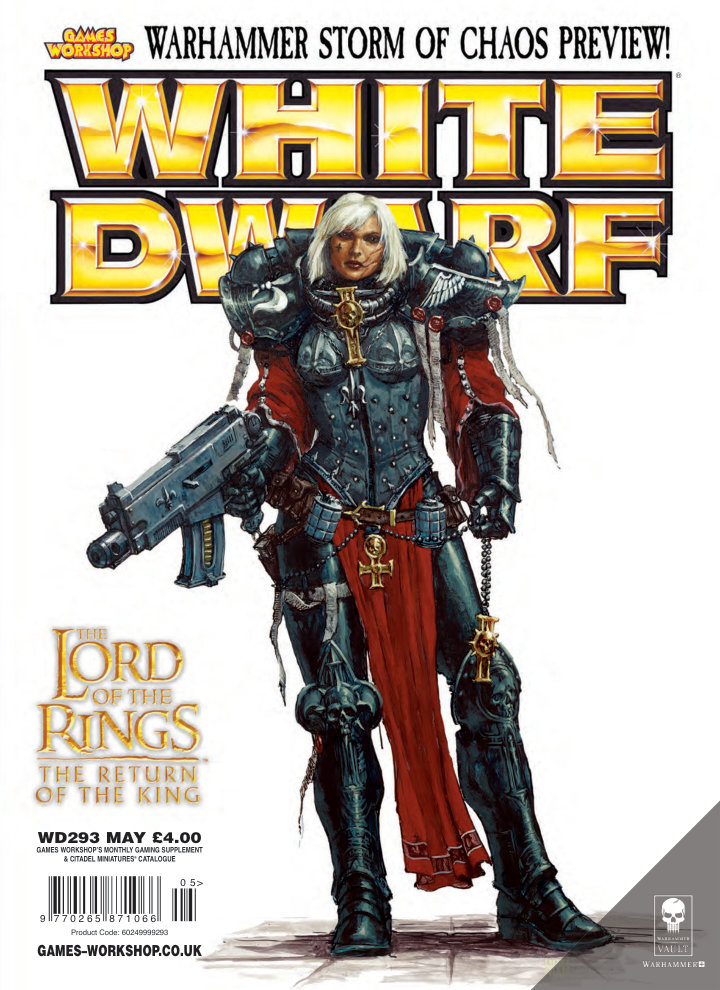
EditorialWD 293 · p. 2
Paul Sawyer introduces the new Fanatic magazine as a home for Specialist Games and explains the sample issue offered to White Dwarf subscribers. He also previews a Dan Abnett novella and coming Storm of Chaos coverage. The editorial places smaller games alongside the main systems, encouraging readers to explore the breadth of the hobby.
CommunityWD 293 · pp. 6–9
The first substantial Dawn of War preview introduces Relic’s real-time strategy game, describing morale, battlefield headquarters, reinforcements and the announced Space Marine, Ork and Chaos forces. Forge World’s enormous Greater Daemon of Khorne, historical army lists in Armies of Chivalry and a revised Warhammer Online website supply further news. The notices record projects as announced in May 2004, including a fourth Dawn of War faction still being kept secret.
Warhammer 40,000: Dawn of WarWarhammer Fantasy BattlesSpace Marines
CommunityWD 293 · p. 9
Andy Hall and Jervis Johnson describe the new magazine’s remit across Specialist Games, with a monthly full-colour format planned from its third issue. The first instalments promise campaigns, new characters, experimental rules and modelling features rather than concentrating on a single system. Examples include an Ostermark Mordheim warband, Pit Fighters, Spyrer leaders, a Vindicare Assassin and Battlefleet Gothic privateers.
WarmasterMordheim
LoreWD 293 · pp. 16–27
Archaon’s invasion gathers strength while Middenheim prepares to defend Ulric’s sacred city. Northern raids, Crom’s advance, Grimgor’s intervention and Morathi’s alliance create several overlapping fronts rather than a simple two-sided war. The account surveys the responses of Empire, Dwarf and Bretonnian leaders and the opportunistic ambitions of other peoples. It sets the narrative context for the Storm of Chaos campaign and its alternative armies.
Warhammer Fantasy BattlesWarriors of Chaos
TacticsWD 293 · p. 19
The Middenheim preview emphasises a provincial Empire army with fewer black-powder troops and a stronger religious identity. Teutogen Guard, wandering Wolf-kin and Knights of the White Wolf embody Ulric’s martial following. Karl Franz’s Reiksguard and Valten’s improving equipment connect the local defence to the larger Imperial response. These are introductory descriptions of the coming list rather than a complete army roster.
Warhammer Fantasy BattlesThe Empire
TacticsWD 293 · p. 21
Archaon’s army concentrates on hardened mortal followers instead of Daemonic allies. Chosen units become more prominent, while the Flayerkin provide a disturbing answer to defensive walls through climbing equipment and Killing Blow. The accompanying campaign idea pitches Archaon or Crom against a smaller defensive force. The page outlines the army’s identity without supplying its complete selection rules.
Warhammer Fantasy BattlesWarriors of Chaos
TacticsWD 293 · p. 23
Garagrim Ironfist’s role as War-mourner offers a way for Ungrim to reconcile his royal duty with his Slayer oath. The resulting army preview makes Slayers the centre of a force reinforced by Doomseekers, Long Drong’s pirates and Malakai Makaisson’s Goblin Hewer. Its unusual structure follows the narrative of Karak Kadrin’s response to the invasion. The text introduces those concepts ahead of the full army list.
Warhammer Fantasy BattlesDwarfs
TacticsWD 293 · p. 25
Grimgor gathers an army shaped around his contempt for weakness and desire to fight the strongest opponents. The preview excludes ordinary Goblin troops, makes Black Orcs and Big ’Uns central, and introduces the Effigy of Gork as a focus for greenskin aggression. Borgut Facebeater and Ruglud’s regiment add recognisable personalities. The resulting theme favours an imposing Orc host rather than the usual mixed greenskin collection.
Warhammer Fantasy BattlesOrcs & Goblins
TacticsWD 293 · p. 26
Pure Daemonic armies return under Be’lakor, with new cavalry and chariots broadening their battlefield roles. Short previews then introduce Aislinn’s Lothern Sea Guard, Bretonnian Errantry War, the Army of Sylvania, Morathi’s Cult of Slaanesh and Clan Eshin. Each connects a distinctive leader or campaign objective to an alternative army concept. These notices describe forthcoming options rather than present the actual army lists.
Warhammer Fantasy BattlesDaemons of Chaos
CommunityWD 293 · p. 27
The campaign invitation explains the three broad allegiances and six fronts converging on Middenheim. Players could report battles during the announced summer campaign, with Warhammer, Skirmish, Siege and Warmaster contributing results. Daily reporting limits and locally organised events were intended to give both individual players and clubs a role. The article is retained as a record of the historical campaign’s participation structure.
Warhammer Fantasy BattlesWarmaster
LoreWD 293 · pp. 32–35
Anthony Reynolds traces Morathi’s renewed alliance with Slaanesh-worshipping northern tribes. The history of the Cult of Pleasure and the Sundering establishes her willingness to conceal or reshape her loyalties. A ritual demonstration of Daemonic power wins over Hung warlords, supplying mortal allies for a new invasion of Lustria. Her promises to Malekith conceal ambitions that serve her own position as much as Naggaroth.
Warhammer Fantasy BattlesDark Elves
RulesWD 293 · p. 35
Morathi receives a complete character entry as a mounted Lord and powerful Dark Magic caster. Her chosen spells and casting bonus combine with protective blessings and an ability that disrupts enemies in close combat. Heartrender rewards a decisive charge, while Beloved of Khaine changes how nearby Witch Elves use Leadership. Sulephet’s separate profile completes the Dark Pegasus-mounted character.
Warhammer Fantasy BattlesDark Elves
InterviewWD 293 · pp. 38–41
Jervis Johnson outlines planned support for Epic: Armageddon after its introductory White Dwarf series. Missing units, character packs, Forge World models and the proposed Swordwind supplement sit alongside plans for additional armies and related scales of warfare. Fanatic, annual reviews and the online experimental rules process are presented as the game’s future support channels. The article records the roadmap as it stood in 2004; it does not establish that every announced project later appeared.
EpicAstra Militarum
TacticsWD 293 · pp. 44–47
Graham Davey builds the Order of the Burning Chalice around Battle Sisters supported by an Inquisitor, specialists and extravagant penitent machines. His printed 1,498-point force combines durable infantry, melta-armed Dominions, Arco-flagellants and Exorcists, with faith and selected equipment helping the army function together. The collection grows out of his enthusiasm for John Blanche’s earlier Sisters artwork. Personal conversions and a restrained colour scheme connect the varied models.
Warhammer 40,000Adepta Sororitas
PaintingWD 293 · p. 46
Graham Davey uses warm bone armour and red robes to unify Sisters, Inquisitorial followers and vehicles. The armour progresses from grey through brown to bone, while the robes build up from dark browns to red. Repeating these colours across otherwise unrelated miniatures makes the force appear coherent. The scheme deliberately balances a strong tabletop appearance with the demands of painting an army.
Warhammer 40,000Adepta Sororitas6 paint colours
ModellingWD 293 · p. 47
Graham Davey turns figures from several ranges into specialist Inquisitorial followers. A Mordheim Dreg becomes a mancatcher-bearing Acolyte, while Bretonnian and Servitor parts help distinguish Crusaders and a Gun Servitor. A Lexmechanic supplies a suitably scholarly Sage, and converted Sister details personalise the Canoness. The examples show how shared colours and selected iconography can make eclectic donor models belong to one retinue.
Warhammer 40,000Inquisition
ShowcaseWD 293 · pp. 48–51
A gallery explores the breadth of the Witch Hunter archetype through reader and studio collections. Priest-like figures, aristocratic investigators, sinister Radicals and heavily converted retinues each offer a different interpretation of the Ordo Hereticus. Captions identify donor miniatures, sculpted details and the ideas behind the colour choices. Together they illustrate how a consistent Imperial theme can accommodate very different personalities and modelling styles.
Warhammer 40,000Inquisition
LoreWD 293 · pp. 52–57
Andy Hoare follows the Sisters from the Daughters of the Emperor on San Leor through Vandire’s rule and the foundation of the Adepta Sororitas. The encounter between Alicia Dominica and the Emperor ends the Reign of Blood, while the Decree Passive and the agreement with the Ordo Hereticus shape the new institution. Organisation, convents and the smaller orders then explain how the Sisterhood serves the Imperium beyond its battlefield role.
Warhammer 40,000Adepta Sororitas
LoreWD 293 · pp. 54–55
The Sisterhood’s specialist orders provide skills that armed forces and Imperial institutions cannot supply for themselves. Dialogous sisters interpret languages and obscure texts, Famulous sisters influence noble bloodlines, and Hospitallers care for the wounded. Sabine sisters prepare isolated societies for Imperial arrival, while Pronatus orders guard dangerous or sacred artefacts. The examples connect apparently quiet vocations to the Inquisition, missionary expansion and the preservation of Imperial authority.
Warhammer 40,000Adepta Sororitas
LoreWD 293 · p. 56
Six short biographies explain the founders behind the major Orders Militant. Dominica, Katherine, Silvana, Lucia, Mina and Arabella acquire distinct reputations through their actions, martyrdoms and relics. Those stories establish the names and visual symbols inherited by their orders. The page also shows how the Sisterhood’s collective history is preserved through devotional accounts rather than a single uniform founding legend.
Warhammer 40,000Adepta Sororitas
LoreWD 293 · p. 57
The office of Abbess combines exceptional authority with a tradition that its holder should not seek personal power. Historical accounts describe the election of a reluctant leader and later customs of pilgrimage and penance. The disappearance of Sabrina on Habren IV leaves the position vacant in this account. Her fate illustrates the uncertainty and religious symbolism surrounding the Sisterhood’s highest office.
Warhammer 40,000Adepta Sororitas
PaintingWD 293 · p. 59
A compact tutorial shows how a textured base gains depth through successive brown and pale drybrushing stages. Sand or gravel provides a stronger surface texture than flock alone, allowing the raised areas to catch lighter paint. The finished example accompanies a basic demonstration of applying basing material. It offers a repeatable way to give a whole army consistent ground beneath its models.
3 paint colours
Battle reportWD 293 · pp. 60–81
Joe Sturge’s Witch Hunters confront Paul Scott’s Tau in a roughly 2,000-point contest for abandoned Imperial relics. Early Tau shooting devastates the advance, but a reversal in the third turn lets the Sisters recover. A Penitent Engine reaches the Ethereal, while the Living Saint’s death undermines the Witch Hunters’ faith reserves. Both armies suffer heavily and the battle ends in a draw, with the post-game discussion examining target selection and the consequences of exposed leaders.
Warhammer 40,000Adepta Sororitas
RulesWD 293 · p. 61
Four scattered relic markers force both armies to divide their attention between combat and occupation. Their variable value remains unknown until the end, while each player also nominates an enemy character as a bonus target. Restricted reserve options and ordinary victory points leave several routes to success. The six-turn mission underpins the Witch Hunters versus Tau report but can be played by other forces.
Warhammer 40,000Adepta Sororitas
CommunityWD 293 · pp. 84–87
Nick Kyme visits Shrewsbury to examine Games Workshop’s dedicated Gaming Rooms. Separate tables, storage space and a relaxed painting area support longer games and a regular community beyond the shop floor. Staff and players explain how clubs, tournaments and themed terrain use the facilities. A short international example describes the related Battle Bunker concept in northern Europe, recording the programme as it existed at publication.
TacticsWD 293 · pp. 88–91
Jeff Leong treats deployment as the first practical test of a battle plan. Comparing movement, shooting, magic and combat power reveals where an army needs concentration, protection or space. Terrain and Leadership then shape the intended line of advance. His examples use timing and a reserve of unplaced units to respond to surprises without abandoning the overall plan, including Dark Elf manoeuvres against a concentrated Dwarf force.
Warhammer Fantasy BattlesDark Elves
ShowcaseWD 293 · pp. 92–95
This selection combines elaborate army pieces with award-winning display models. Kiril Kanajew’s Iron Hands Dreadnought, Neil Hodgson’s Inquisitor-scale Emperor’s Children Marine and Alexander Witkowski’s Death Guard explore distinct power-armoured forms. French Golden Demon entries add Axel de Morenschildt’s Titanork, Christophe Roque’s enthroned Sigmar and Allan Carrasco’s Nurgle Minotaur. The captions identify the painters and award categories without supplying paint recipes.
Warhammer 40,000Warhammer Fantasy BattlesIron Hands
LoreWD 293 · pp. 96–99
Dan Abnett describes a Chaos army whose disciplined military organisation makes it more dangerous than an uncontrolled cult uprising. Ritual allegiance to Urlock Gaur, iron grotesques and blood-red uniforms establish the Pact’s identity. Its campaigns in the Sabbat Worlds reveal careful tactics, captured Imperial technology and specialist Death Brigades. Cooperation with Loxatl mercenaries adds another threat to a force deliberately capable of matching the Imperial Guard’s professional strengths.
Warhammer 40,000Blood Pact
RulesWD 293 · p. 99
Andy Hoare adapts the Lost and the Damned list to represent Blood Pact troops, with Traitors as line infantry and Defilers standing in for Stalk-tanks. A separate Death Brigade squad entry supplies veteran infantry, weapon options, improved assault armour and a squad leader. Purchasing a Veteran Skill moves the squad into Elites. A simple Cadian-and-Raptor-head conversion suggests how to reproduce the distinctive masked soldiers.
Warhammer 40,000Blood Pact
CommunityWD 293 · pp. 100–101
The guide explains how Collectors’ Guides combine parts catalogues with army inspiration. Current and older miniatures appear alongside component codes, colour schemes, conversions, dioramas and Golden Demon entries. Grouping models by familiar army categories helps readers plan a collection or identify a donor part. The feature records the available and proposed volumes at the time, presenting the books as modelling references as well as ordering aids.
Warhammer 40,000Warhammer Fantasy Battles
CommunityWD 293 · pp. 106–111
Nick Kyme reports on the second gathering of northern European Outriders at Warhammer World. Seminars, awards and a compact tournament give volunteers time to compare the introductory games, clubs and large events they organise at home. Interviews describe their work with independent stores and communities beyond local Games Workshop shops. Kai Glerum’s Outrider of the Year award and the participants’ armies highlight the programme’s practical contribution to the hobby.
ShowcaseWD 293 · pp. 109–111
Participant profiles show the variety brought to the Outriders tournament. Wardancer-based Wood Elves, a large Marauder horde, converted Nurgle troops, Blood Dragon cavalry and rapidly painted Night Goblins demonstrate different priorities in building an army. Thomas Krysting’s highly personalised Inquisitor and Techpriest add individual display pieces. Short accounts of time, favourite units and difficult conversions connect the finished models to their makers’ working methods.
Warhammer Fantasy BattlesWarhammer 40,000Wood Elves
RulesWD 293 · pp. 118–119
Matthew Ward expands a Mirkwood army with Thranduil, Captains, ordinary warriors, Sentinels and Taurdirim. Spears can support allies or be used defensively, while cloaks reward careful use of cover. Sentinels supply exceptional archery and a pre-game move; Taurdirim remain steadfast around their chosen hero. Thranduil combines strong combat ability with two defensive spells. The author explicitly requires opponent consent for these optional additions.
Middle-earth Strategy Battle GameMirkwood
TacticsWD 293 · pp. 120–121
Matthew Ward explains how fragile, lightly protected Elves can exploit terrain, spears and cloaks to control an engagement. Sentinels increase bowfire without increasing the number of bow-armed models as quickly, while Taurdirim form a dependable centre. Thranduil’s magic disrupts charges and prepares counterattacks. Two sample forces contrast a small cloaked elite party with a larger border patrol, and the discussion discourages relying entirely on retreating archery.
Middle-earth Strategy Battle GameMirkwood
RulesWD 293 · pp. 122–123
Thranduil’s escort clashes unexpectedly with Orcs and Trolls raiding from Dol Guldur. Both forces enter as divided groups in alternating table quarters, creating a confused battle among dense trees and rocks. Stand Fast is unavailable and heroic actions may fail, making local initiative less reliable than usual. A free opening shot for each Sentinel gives the Elves an initial response before both sides try to break the enemy force.
Middle-earth Strategy Battle GameMirkwood
RulesWD 293 · pp. 124–125
Matthew Ward supplies alternative crews for Mordor siege bows: heavily protected Easterlings and stronger Uruk-hai. Both entries retain the weapon’s ability to hurl a victim through nearby models, with options for additional crew and experienced operators. Conversion notes use existing command figures, modified weapons and simple sculpting to build suitable loaders and commanders. These additions are expressly optional and require an opponent’s agreement.
Middle-earth Strategy Battle GameMordor
RulesWD 293 · pp. 126–127
Adam Troke recreates a surprise coastal raid by Casabar the Grim. Corsairs land while Gondorian sentries patrol unaware; the attackers must burn guardhouses before losing half their force. Detection and the alarm bell determine how quickly the defenders emerge armed from their barracks. Existing Easterling and Dunlending models stand in for the raiders, and an alternative points match lets other forces attempt the same stealth mission.
Middle-earth Strategy Battle GameCorsairs of Umbar
ModellingWD 293 · pp. 128–131
Mark Jones builds a raised wooden watchtower from balsa, card and a textured base. Shaped legs give it Rohan’s horse motifs, while scored planks and carefully reinforced walls make the structure recognisable and sturdy. Diluted glue brushed through fake fur produces thatch. The final painting stages separate weathered timber from the warmer roof and ground, providing a method that can be adapted to other buildings in a Rohan village.
Middle-earth Strategy Battle GameRohan7 paint colours
RulesWD 293 · pp. 132–135
Alessio Cavatore answers accumulated questions about cavalry, weapons, magic, heroic actions and published scenarios. Clarifications distinguish when charge bonuses apply, how monstrous mounts fight and which profiles take precedence. Other answers correct equipment or deployment mistakes and explain why players should agree on one measurement system. The document reflects the Return of the King rules era while addressing material originally printed for the earlier film-based manuals.
Middle-earth Strategy Battle Game
Imprint confirms May 2004, issue 293. Several contents references point two pages later than the actual feature start; the stored page references use the actual pages. Main articles, substantial rules and the basing tutorial are indexed; catalogue material, advertising, store/event directories and art-only pages are excluded.