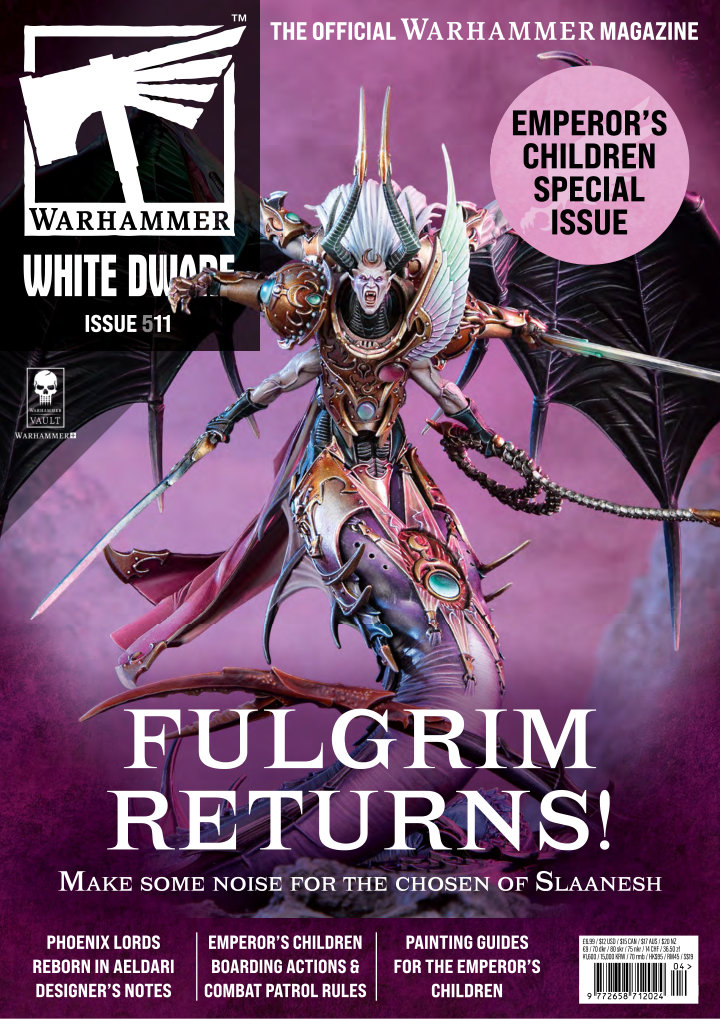
EditorialWD 511 · Inside cover
Lyle Lowery introduces the Emperor’s Children as a fully realised army with their own models and Codex. The issue approaches Slaanesh through background, Fulgrim’s design and painting, a daemon-supported Combat Patrol and Boarding Actions, while the Aeldari supply both a contrasting philosophy and battlefield opposition.
Warhammer 40,000Emperor’s Children
CommunityWD 511 · pp. 2–7
Reader work includes Mark van Aarde’s Chaos Warriors, Gareth Etherington’s Blood Angels Dreadnought, Neil Hetherington’s Norn Emissary and Grey Maixner’s Nurglings. Letters discuss basing tanks, inventing personal units and taking White Dwarf to Mount Teide. A converted Kruleboy cyclops and an illuminated library for Lorgar show two ways readers make the setting their own.
Warhammer 40,000Age of SigmarSlaves to Darkness
PaintingWD 511 · p. 5
Toni Garcia converts his favourite Kruleboyz monster into a cyclops inspired by the Fimir. Cool blue-green armour contrasts with warmer vegetation, while a pink-brown mixture and flesh highlights distinguish the Troggoth’s skin from its pale purple-based rider. Moss and grasses extend the army’s theme of using camouflage to ambush intruders.
Age of SigmarKruleboyz8 paint colours
ModellingWD 511 · p. 6
Kristian Larsson builds Lorgar and his advisers a detailed library using Zone Mortalis walls, older Cities of Death panels and Shrine of the Aquila components. Scratch-built furniture and putty-bound combinations of other parts fill the room, while hidden wires and batteries illuminate lamps and windows. A planned matching half will make the diorama usable for larger narrative games.
The Horus HeresyWord Bearers
LoreWD 511 · pp. 8–13
Dakkbad’s Ironsunz return from Hallost to a strangely subdued Gnashka Plateau. Desecrated monster remains and listless orruk camps reveal a necromantic intrusion, and anger at the violated beasts restores the greenskins’ fighting spirit. After destroying a Vengorian Lord and Vargheists, Dakkbad receives an unmistakable invitation to confront the Avengorii inside his own fort.
Age of SigmarIronsunz
CampaignWD 511 · pp. 14–17
Three linked four-round battles follow the Ironsunz investigating an Avengorii plot, with 1,500 points suggested and ordinary Ironjawz rules permitted if the previous issue is unavailable. Finkin’ Points measure investigation rather than conventional scoring, and each victory grants an advantage in the following scenario. Players can end the campaign after the third battle or carry their rewards into the final confrontation in issue 512.
Age of SigmarIronjawz
RulesWD 511 · p. 15
The Avengorii player places five frightened orruks around the battlefield, and Ironsunz units gain investigation points by approaching and recovering them. The greenskins need at least six Finkin’ Points to win; success offers a later run-and-charge opportunity, while failure lets the vampires impose a control penalty in the next battle. The scenario makes gathering scattered witnesses the central task.
Age of SigmarIronsunz
RulesWD 511 · p. 16
Ironsunz search controlled boneyard objectives for clues, with each site usable only once. Nearby Soulblight heroes can unleash damaging necromantic pulses, reducing investigation progress if they kill enemy models. The result determines whether the following battle begins with an eager orruk advance or a vampire redeployment trick, linking battlefield control to the campaign’s investigation.
Age of SigmarIronsunz
RulesWD 511 · p. 17
The Ironsunz gain Finkin’ Points for destroying invaders but lose progress while Soulblight units remain near the battlefield’s centre. Winning can conclude the campaign immediately, or award a replacement infantry unit or a Waaagh!-powered movement bonus for the finale. Avengorii rewards instead strengthen a vampire ward or a hero’s weapon, establishing the advantages carried into the next issue.
Age of SigmarIronsunz
LoreWD 511 · pp. 18–21
Colin explains why Chaos Gods are presented through mortal perceptions rather than treated as comprehensible people. Aeldari Paths and the Drukhari ban on psychic powers reveal fear of Slaanesh’s reach, while the Emperor’s Children show its opposite through addictive sensation and obsessive perfectionism. Their endless dissatisfaction makes the same god both an existential predator and an apparently liberating patron.
Warhammer 40,000Aeldari
LoreWD 511 · pp. 22–27
The Emperor’s Children survive as rival warbands whose vanity and hunger for sensation repeatedly fracture large alliances. Surgical changes, chemical stimulation, sonic weaponry and daemonic bargains turn superb warriors into distorted expressions of their obsessions. Profiles of Noise Marines, Lucius, Flawless Blades and corrupted engines show how martial talent persists beneath the degeneration, making even their anarchic raids terrifyingly effective.
Warhammer 40,000Emperor’s Children
LoreWD 511 · pp. 28–31
Fulgrim’s victories over figures such as Ferrus Manus, an Aeldari Avatar and Roboute Guilliman establish the Daemon Primarch as a devastating but capricious threat. The article traces his descent from Chemos’s ambitious saviour through wounded pride, allegiance to Horus and the corrupting Blade of the Laer, showing how the desire for recognition became an opening for Slaanesh.
Warhammer 40,000The Horus HeresyEmperor’s Children
InterviewWD 511 · pp. 32–37
Miniature designer David and ’Eavy Metal painter Anja describe Fulgrim as an aquatic, almost mermaid-like horror rather than a conventional scaled snake. His coiled body, spreading wings and four arms frame the face, while traces of power armour connect the daemon to his former identity. Pristine Imperial gifts, raw scarification and five alternative heads make the contradictions visible, and Anja’s shifting blue-green and purple glazes contrast with opulent gold.
Warhammer 40,000Emperor’s Children
PaintingWD 511 · pp. 36–37
Anja establishes broad mid-tones and smooth transitions before refining small details on Fulgrim. Purple-shadowed rich and pale gold contrast with cooler flesh, while the underside and leather remain dark enough to frame the figure. Separate purple and turquoise body recipes use repeated glazes and pale highlights to create a changing aquatic sheen, with pink cloth tying the palette together.
Warhammer 40,000Emperor’s Children23 paint colours
PaintingWD 511 · pp. 38–39
Harvey builds a studio Noise Marine from a Chaos Black spray, adding a separate Abaddon Black base so later corrections match the armour. Pink plates, pale green weapon casings and tassels contrast with the dark body, while selective washes finish a Battle Ready model. The Parade Ready stage sharpens black armour, deepens pink recesses, adds flesh and leather highlights, and defines the sonic weapon and metallic trim.
Warhammer 40,000Emperor’s Children30 paint colours
PaintingWD 511 · pp. 40–41
Harvey explains the studio army’s hierarchy of pink and black: Flawless Blades have more pink, ordinary Tormentors and Infractors balance the colours, and Noise Marines wear mostly black. Tanks reverse that emphasis, using a Wraithbone undercoat and airbrushed Pink Horror with Blue Horror, shaded towards the lower panels with Screamer Pink. Tormentor icons are deliberately designed for vehicle use.
Warhammer 40,000Emperor’s Children4 paint colours
RulesWD 511 · pp. 42–49
Sybastis Luxx leads five Tormentors, ten Daemonettes and three Fiends in a mixed Slaaneshi Combat Patrol. The precision shooting of the Marines supports fragile, fast daemons, and the Sorcerer can hamper enemy infantry movement with psychic attacks. Tactical notes recommend coordinated target selection and exploiting Battle-shock rather than relying on brute durability.
Warhammer 40,000Emperor’s Children
RulesWD 511 · pp. 50–53
The Emperor’s Children boarding detachment concentrates on elite Flawless Blades and Terminators, with Lord Kakophonists or Lucius as possible leaders. Musk of Torpidity keeps units effective after falling back, and Dark Radiance lets them pass through models during movement. Enhancements provide a lethal duelling weapon or a shout that forces hatchways open, while stratagems maintain momentum, protect fighters and secure objectives.
Warhammer 40,000Emperor’s Children
Battle reportWD 511 · pp. 54–71
Matt’s Craftworld Telennar force tries to keep an Inquisitorial bunker’s daemon sealed away while Colin’s Emperor’s Children force tries to release it. They adapt Void the Ship into a contest over containment hatchways, using Jain Zar, Warlocks and three Aspect units against two Flawless Blade units and Terminators. Speed, Overwatch and control of doors matter as much as casualties.
Warhammer 40,000Aeldari
RulesWD 511 · pp. 72–75
This optional variant divides the battlefield into a randomly selected hazard pattern and warns players one round before an effect arrives. Alternating areas may slow movement, reduce Toughness, prevent Stratagems, strip defensive modifiers, grant Stealth or improve attacks. Worked examples explain how the warning round gives both commanders time to escape danger or trap opponents in it, so the environmental effects become tactical information rather than wholly unexpected punishment.
Warhammer 40,000
InterviewWD 511 · pp. 76–93
Jes and a group of miniature designers explore the Aspect Warriors as distinct expressions of Khaine, linking each martial role to armour, ritual weapons, poses and shrine imagery. The discussion moves from infantry to jetbikes and aircraft, then considers Phoenix Lords as heightened embodiments of their disciplines. The Avatar concludes the feature by joining a largely unchanged iconic silhouette to new weapon options, living flame and the sinister sacrifice behind its awakening.
Warhammer 40,000Aeldari
InterviewWD 511 · p. 78
Jes connects the Aspect concept to comparative mythology and distinct martial disciplines, while Mark explains how Dire Avengers refine Guardian design into heavier ritual armour. Long scoped catapults, shoulder targeting systems and tall blank helmet fronts distinguish the unit and leave space for shrine markings. Their shrine draws directly on an illustration from the 1994 Eldar Codex.
Warhammer 40,000Aeldari
InterviewWD 511 · p. 79
Nick gives the Banshees an inverted-triangle composition: close-set sprinting legs lead into wide slashing arms and aggressively projected masks. Uneven armour protects the sword side, while split toe armour evokes sandals. Jes links their shrine to Morai-Heg’s severed hand and the bargain that gave Khaine the power of her daughters.
Warhammer 40,000Aeldari
InterviewWD 511 · p. 80
Sergi explains the Dark Reapers’ emphasis on stability through supported missile launchers, flared leg armour and targeting vanes. Spare missile pods and a reloading option make the weapon’s operation visible, while skull masks and rib-like armour reinforce their identity as Khaine the Destroyer. The design combines austere Aeldari proportions with an unusually morbid role.
Warhammer 40,000Aeldari
InterviewWD 511 · p. 81
Nick contrasts the Scorpions’ broad, low triangular stance with the Banshees’ open, rapid movement. Reinforced armour, held-low weapons and patient poses suggest a stalking martial artist; the familiar helmet carries mandiblasters and a sensory array often mistaken for hair. Jes explains the shrine’s scorpion as Murehk, the disguise Khaine used to sting Vaul’s hand.
Warhammer 40,000Aeldari
InterviewWD 511 · p. 82
The new Fire Dragons preserve the original Aspect’s planted firing stance, with bulkier shaped armour and powerpacks echoing their fusion ammunition. Fanged helmets and bladed crests carry the dragon theme, while different belt containers distinguish thrown grenades from vehicle-killing charges. Their shrine invokes the Cosmic Serpent’s destructive offspring and Fuegan’s future role at the Rhana Dandra.
Warhammer 40,000Aeldari
InterviewWD 511 · p. 83
Daz explores height and lightness by raising Swooping Hawks on ruined architecture and extending their wings upward around the head. Concealed grenade packs keep the front clean, and each feather-like wing panel is described as vibrating to provide lift rather than flapping. Shrine imagery connects their aerial vengeance to the Great Hawk and the myth of a murdered soul marking its killer.
Warhammer 40,000Aeldari
InterviewWD 511 · p. 84
Neil uses a springy, forward-leaning pose to keep the heavily equipped Warp Spiders looking like rapid assault troops. Raised jump generators read as separate equipment, and the rear of the helmet hints at psychic protection during dangerous travel through the Warp. Jes connects their shrine to Ahnakh-Yth, the spider daughter of Morai-Heg and a weaver of fate.
Warhammer 40,000Aeldari
InterviewWD 511 · p. 85
Nick explains the hierarchy of Aeldari jetbike shapes, giving Shining Spears the longest, sleekest canopies and extra engine and control surfaces. Their knightly role appears in protective left collars, right-hand laser lances, lance rests and riders leaning into a strike. Crested helmets connect these futuristic cavalry to classic Warhammer elves.
Warhammer 40,000Aeldari
InterviewWD 511 · pp. 86–87
Jes and Ed distinguish the Nightshade Interceptor’s cobra-like raised cockpit and manoeuvrable X-shaped arrangement from the flat, fast Drukhari Razorwing. Eight control vanes and rounded pods suggest an agile hunter with little exposed machinery. Its pilot’s stripped armour, reclined seat and slightly reduced size accommodate the clear canopy, whose magnification and targeting line influence the sculpt.
Warhammer 40,000Aeldari
InterviewWD 511 · pp. 88–91
The designers modernise the Phoenix Lords by preserving defining weapons, helmets and silhouettes while removing details that no longer fit the Aeldari aesthetic. Asurmen commands in profile, Jain Zar becomes an exaggerated acrobat, Baharroth forms a rising Y and Maugan Ra a grim X. Fuegan’s planted power pose and Lhykhis emerging through a broken web of Warp energy express two further fighting identities without relying on extra ornament alone.
Warhammer 40,000Aeldari
InterviewWD 511 · pp. 92–93
Jes recalls the Avatar as a deliberately disturbing last resort, animated by the sacrifice of a Young King. Neil combines earlier molten and armoured designs while retaining the tall helmet, hair and dripping hand that make the character immediately recognisable. Sword, spear and axe versions of the Wailing Doom accompany different heads, allowing the living shard of Khaine to reflect different craftworld temperaments.
Warhammer 40,000Aeldari
InterviewWD 511 · pp. 94–97
Duncan and David explain the new Codex’s shift from dominant Fate dice to Battle Focus tokens and movement options across several phases. Reworked Aspect Warriors have clearer specialisations: Banshees threaten elite infantry, Scorpions combine volume with board control and Shining Spears hunt vehicles and monsters. Phoenix Lords change their units’ tactical possibilities rather than simply increasing damage.
Warhammer 40,000Aeldari
FictionWD 511 · pp. 98–109
Sergeant-at-Arms Vasily Ivanov must escort Commander Senyavina to the auxiliary bridge as the battleship Vexation is overrun. Enginseer Astulax guides them through plague-filled bilges, but the surviving first officer Vitko prevents Senyavina from assuming command and intends to destroy the ship. Rival Chaos attackers turn the vessel into a battlefield, and a radiant serpentine demigod makes ordinary resistance seem meaningless.
Warhammer 40,000Imperial Navy
CommunityWD 511 · p. 110
The Bunker moves from its Car Show to a studio Kill Team league and a solo or cooperative narrative mission against procedural opponents. It also confirms that clubs can award Bunker points for events of their own invention, including painting competitions or other game leagues. The monthly painting theme is psykers, sorcerers and the supernatural.
Kill Team
CommunityWD 511 · p. 111
The recurring tracker turns scenarios, club games and painting into achievement points, with monthly limits and ranks up to Castellan. This edition includes the May 2025 challenge log and points readers towards downloadable resources. Clubs can use it alongside the issue’s new league or their own locally organised activities.
CampaignWD 511 · pp. 112–113
Leila introduces a weekly league for the new Kill Team edition, pairing players herself according to standings so opponents have comparable results. A loss earns one point, a draw two and a win three, rewarding regular participation while encouraging new match-ups. A roster chart shows the variety of teams, and snapshots of Farstalker Kinband fighting Fellgor Ravagers illustrate the early games.
Kill TeamFarstalker Kinband
RulesWD 511 · pp. 114–119
A solo or cooperative kill team intercepts Ecclesiarchal pilgrims carrying the Great Gun’s targeting coordinates through Volkus. Brawlers, marksmen and a protected Scroll Bearer follow procedural behaviour and a shuffled activation deck that alternates attacks, reinforcements and procession movement. If the bearer falls, other pilgrims switch priorities to recover the scroll, keeping the mission focused on the objective.
Kill TeamAdeptus Ministorum
ShowcaseWD 511 · pp. 120–123
Reader entries range from Christopher Mills’s Arkhan to Librarians, a Spiritseer, Kyria Draxus, a Sylvaneth Arch-Revenant, Skragrott and two Guardians of Souls. Studio examples add a non-metallic Infernal Master, Festus, a camouflage-cloaked Librarian, a Jade Wizard, an alien Psychophage and two Middle-earth spellcasters. Together they show a broad interpretation of the supernatural painting challenge.
Warhammer 40,000Age of SigmarOssiarch Bonereapers
PaintingWD 511 · p. 122
Sophie experiments with non-metallic gold on an Infernal Master, starting with XV-88 and brown shadows before glazing ochre and yellow highlights. Rhinox Hide and Gal Vorbak Red deepen the darkest areas, with Dorn Yellow providing a final bright edge. The sequence aims to create reflective contrast with ordinary opaque colours rather than metallic pigments.
Warhammer 40,000Thousand Sons9 paint colours
PaintingWD 511 · p. 122
Timothee treats Festus’s diseased flesh as the centre of the miniature’s story. Pallid Wych Flesh mixed with Carroburg Crimson makes the base, then wet blends of that mixture with varying red and black create sickly shifts across the skin. The method favours irregular colour variation rather than a uniform healthy complexion.
Age of SigmarMaggotkin of Nurgle2 paint colours
PaintingWD 511 · p. 122
Scott’s Angels Eradicant Librarian uses Ultramarines Blue armour, a Militarum Green camouflage cloak and Wyldwood leather. Mournfang Brown adds warmth and depth to both armour recesses and cloth folds, then lighter blue and green stippling creates highlights. The earthy shadows connect otherwise distinct materials without replacing their separate base colours.
Warhammer 40,000Space Marines4 paint colours
PaintingWD 511 · p. 123
Steve introduces a newly spawned creature for his personal Hive Fleet Karkinos. Seraphim Sepia over White Scar establishes the pale base, with Ratskin Flesh and Bestigor Flesh used for the patterned chitin and carapace. Unspecified Contrast paints finish the details, leaving the distinctive spotted body as the unifying fleet feature.
Warhammer 40,000Tyranids4 paint colours
PaintingWD 511 · p. 123
Adam’s Saruman belongs to an Isengard collection themed around the Assault on Helm’s Deep. Ushabti Bone, Screaming Skull and Pallid Wych Flesh produce layered pale robes, with thinned Wyldwood supplying shadows. Mechanicus Standard Grey and Administratum Grey give the hair a separate cool value range so it remains readable against the cloth.
Middle-earth Strategy Battle GameIsengard6 paint colours
CommunityWD 511 · pp. 124–125
Ben’s Acolyte Hybrids become maintenance workers for a shipping conglomerate, Matt finishes his Dominion-era Praetors and Lyle adds a Ballistus Dreadnought to the Tome Keepers. Team portraits and updated painting and gaming boards connect these finished models to ongoing projects. Matt’s misty bases and Lyle’s stippled bone armour supply practical examples within the progress report.
Warhammer 40,000Age of SigmarGenestealer Cults
ModellingWD 511 · p. 124
Matt completes his remaining Stormcast models from Dominion as Celestial Warbringers to accompany a Lord-Imperatant. To place them in the Realm of Shadow, he flattens cotton wool in an envelope, sprays it Chaos Black and teases the dried material into wisps attached to the bases. The addition gives an existing unit a clear environmental identity with a simple household material.
Age of SigmarStormcast Eternals1 paint colour
PaintingWD 511 · p. 125
Lyle adds a Ballistus to the Tome Keepers in preparation for a narrative event, building on their close relationship with Dreadnoughts. He stipples Baneblade Brown over a Chaos Black undercoat, then adds Ushabti Bone and Screaming Skull before glazing Skeleton Horde for an aged tint. The layered texture gives the large armour plates character without requiring a perfectly smooth bone finish.
Warhammer 40,000Tome Keepers5 paint colours
ShowcaseWD 511 · p. 126
Dan expands his Stygies VIII collection towards 2,000 points with a Skorpius Dunerider and additional Kastelan Robots. The transport is intended to carry Skitarii Vanguard and a Marshal onto objectives, while the robots join an existing pair as a large unit. Mottled red armour with black and white details marks the additions as part of the same force.
Warhammer 40,000Adeptus Mechanicus