EditorialWD 495 · p. 1
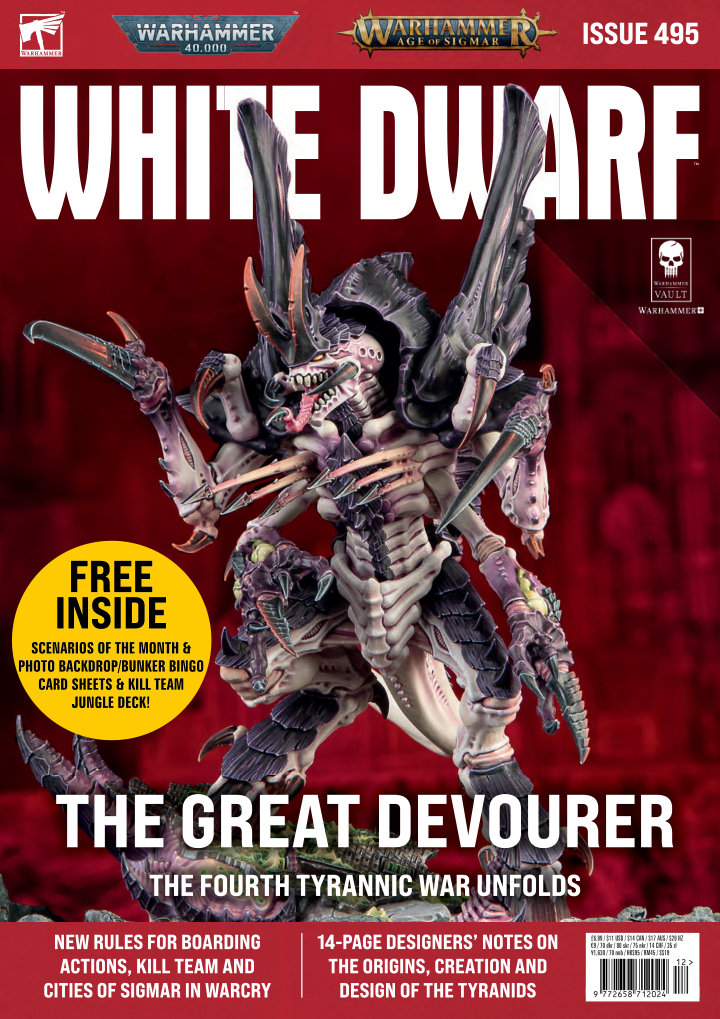
The editorial introduces an issue centred on the Tyranids, joining the new invasion narrative to a detailed examination of the creatures’ miniature designs. It also points readers towards the continuing Bunker campaign and the varied collections, painting projects and smaller games elsewhere in the magazine.
Warhammer 40,000
CommunityWD 495 · pp. 4–7
James Crawford explains how painting Beornings helped him through demanding work as an NHS surgeon, while the letters pages also answer a question about the webway. Sam Davies presents a festive Bugmansson scene, a reader requests a metallic-red Deimos scheme, and Lawrence’s Snagaphon combines an orruk rider with a substantially rebuilt Carnosaur.
Middle-earth Strategy Battle GameWarhammer 40,000Adeptus Mechanicus11 paint colours
LoreWD 495 · pp. 8–11
Leila Appleton considers how names communicate a culture before its history is explained. Stormcast titles, hissing Seraphon syllables, blunt orruk sounds, glottal grot names and the clipped terminology of the Ossiarch Bonereapers each suggest different societies; the essay also explores the contrasts between Nurgle’s familial language, Slaaneshi elegance and the traditions preserved by Soulblight bloodlines.
Age of SigmarStormcast Eternals
CommunityWD 495 · pp. 12–13
The Bunker explains its shared gaming and hobby activities and reviews the progress of the Slidecrown Sundering. Leila discusses finishing a campaign with awards that recognise creativity, enjoyable opponents and favourite armies as well as wins, giving a club several ways to celebrate the people who kept its games running.
Age of SigmarWarcry
ShowcaseWD 495 · pp. 14–15
December’s Gods of War challenge gathers imposing leaders and centrepiece creatures painted by the studio and readers. The accompanying hobby bingo material encourages participants to record a broad range of achievements, treating a finished project and a memorable game as parts of the same year of hobby activity.
Age of SigmarWarhammer 40,000
CampaignWD 495 · pp. 16–21
The campaign moves through its second stage with rules for carrying forward the results of battles and acquiring unusual relics. Studio updates show how contested discoveries turn allies against one another: a disastrous expedition sends Lethis’s Stormcast towards destroying the dangerous artefacts, while Nurgle-tainted deception and rival claimants complicate the fighting. Short fiction and hobby contributions give the campaign’s competing forces their own motives and visual identities.
Age of SigmarWarcryStormcast Eternals
PaintingWD 495 · pp. 20–21
Andy Thomas-Clark develops Narkit’s Stikkas around the grotesque Manky Eye and their unwholesome origins in the Foetid Crack, accompanying the background with recipes for their dark clothing, green flesh and yellow details. Lyle’s Mancrusher Gargants demonstrate a different finishing problem: masking warpaint before spraying the flesh leaves clear blue patterns, which receive lighter blue highlights afterwards.
Age of SigmarGloomspite Gitz11 paint colours
RulesWD 495 · pp. 22–23
This mission rewards an army for steadily establishing control of a defence nexus rather than simply rushing the centre at the last moment. Progressive scoring checks control of one, two and three objectives, while a substantial final award goes to the player with the greater combined Objective Control around the central point. An underdog command-point provision helps the weaker force stay involved.
Warhammer 40,000
RulesWD 495 · pp. 24–25
An expedition into Ulgu searches six terrain sites for treasure hidden by supernatural fog. Repeated searches improve the chance of discovering riches, but the prize must then be carried safely: melee attackers can seize it and ranged deaths leave it on the ground. Uncertain arrivals and the need to protect a successful search party make the mission a contest of exploration and extraction.
Age of Sigmar
RulesWD 495 · pp. 26–27
Six jungle-event cards turn plants, predators and traps into active problems for a kill team. Brainleaf interferes with activation order, a Catachan Devil threatens unwary operatives, and hazards such as spikers, hanging creepers and ptera-squirrels punish different movements or attacks. Players can reveal hazards together or keep selections secret, and the article suggests combining them with earlier deception cards for a more treacherous operation.
Kill Team
TacticsWD 495 · pp. 28–31
Jimbo Warth examines the charge phase as a sequence of decisions about targets, order and final positions. Sacrificial units can absorb Unleash Hell, support characters must remain close enough to help, and careful contact with the end of an enemy unit can limit its pile-in. The tactical exercise asks whether Hobgrots and Gutrippaz can claim an objective held by Kurnoth Hunters, emphasising that winning the position may matter more than killing the defenders.
Age of SigmarOrruk Warclans
PaintingWD 495 · pp. 32–34
Emily Ridding explains how a light undercoat sprayed over black can establish the direction of illumination before coloured paint is applied. Thin Contrast colours preserve this gradient, while more opaque layers obscure it; short bursts and restoring black to the deepest shadows help control the result. The demonstrations deliberately compare different light directions rather than treating zenithal spraying as a single fixed recipe.
5 paint colours
PaintingWD 495 · p. 33
A Flesh Hound receives light from below, reversing the usual overhead zenithal pattern to create an infernal glow. Red and purple Contrast colours preserve the undercoat’s shadows, with separate treatments for claws, teeth, the collar and the rocky base. Selected conventional highlights strengthen the face and raised details without flattening the unusual lighting.
Age of SigmarWarhammer 40,000Daemons of Khorne18 paint colours
PaintingWD 495 · p. 34
The Infiltrator demonstration uses an overhead grey-to-white undercoat beneath green Contrast armour. Dark equipment and pale straps are blocked in separately, then metallics, lenses and restrained edge highlights restore definition where needed. An alternative white drybrush offers another way to produce the underlying gradient when spraying is less convenient.
Warhammer 40,000Space Marines16 paint colours
PaintingWD 495 · p. 35
Stuart Nicholls applies the same lighting principle to a large Stormdrake Guard mount. Successively smaller white airbrush highlights establish the dragon’s highest surfaces before translucent blue, green and brown colours tint the scales and membranes. Masking different areas keeps the lighting coherent while preventing overspray from contaminating adjoining colours.
Age of SigmarStormcast Eternals7 paint colours
CommunityWD 495 · pp. 36–41
Julien Breney introduces Qui Commence?, the Besançon gaming community whose league and hobby bingo kept dozens of players active through the change of Warhammer 40,000 edition. Studio and reader centrepieces include Adam’s corroded Knight Desecrator, Jimbo’s striking blue-skinned Morathi, Angron and Alarielle, illustrating the issue’s Gods of War challenge through very different palettes and projects.
Age of SigmarWarhammer 40,000Chaos Knights13 paint colours
CampaignWD 495 · pp. 44–49
A compact three-battle campaign sends rival armies through the Slidecrown Isle towards its inner sanctum. Battles are capped at 1,500 points and replace the usual battlefield framework with sacred sites whose magical effects can injure, heal, empower spellcasters or disappear altogether. Victories and favoured warriors carry advantages between games, making the final contest the culmination of a short expedition.
Age of Sigmar
RulesWD 495 · p. 46
The first campaign battle contests three sites in an overgrown glade. Its four-round duration and straightforward rewards for holding each site encourage immediate commitment, while the sacred-site effects introduced with the campaign can make apparently safe positions hazardous or unexpectedly valuable. The result establishes which army enters the next stage with the initiative.
Age of Sigmar
RulesWD 495 · p. 47
One force attacks four ancient statues while the defender tries to preserve them and hold the centre. Toppling a monument earns a large reward, surviving statues score for their guardian, and monsters are particularly effective at bringing the stone figures down. The asymmetrical objectives force the defender to decide how widely to spread protection against an attacker able to concentrate on a single ruin.
Age of Sigmar
RulesWD 495 · pp. 48–49
The campaign’s final battle places two increasingly valuable sites around the Slidecrown’s resting place. Later rounds award more points and destroying enemies also matters, but an uncontested claim to the crown can settle the result outright. A restorative underdog benefit helps the trailing army contest the last approach rather than arrive with no plausible chance of recovering.
Age of Sigmar
LoreWD 495 · pp. 50–53
A Ghurish observer compares the institutions that try to order magic with the elemental practices that resist such classification. The account moves from the Collegiate Arcane’s hierarchy and Lumineth disciplines to Sylvaneth, duardin runes, Stormcast souls and blood rites, before examining Waaagh! energy, fungal brews and ogor gastromancy. The Everwinter remains a particularly unsettling example of magic behaving like a living force.
Age of SigmarCities of Sigmar
FictionWD 495 · pp. 54–57
Admiral Imoda Barrasdottr and Brokk Grungsson help a Dawnbringer expedition drive skaven away from a promising settlement site in Gallet. Victory gives way to a much worse discovery: the geomantic veins themselves have been poisoned with warpstone and even the expedition’s dead are beginning to change. The duardin must abandon a costly triumph as they realise the ratmen were sacrificing troops to corrupt the land rather than simply defend it.
Age of SigmarKharadron Overlords
CampaignWD 495 · pp. 58–65
Cities of Sigmar warbands adapt their shield formations, scouts and improbable Gargoylian companions to the Gnarlwood. Background tables establish a crusade’s identity, while six sites of power change how warbands generate or manipulate ability dice. Two quests reward successful expeditions with unusual artefacts or a growing Dawnbringer Strongpoint, giving small patrols a practical route towards building a permanent settlement.
WarcryCities of Sigmar
RulesWD 495 · p. 65
A questing warband defends a construction site against attackers arriving unexpectedly from any battlefield edge. The attacker wins by concentrating at least three fighters near the centre after four rounds, while the defender must keep the building work clear. Completing the surrounding quest unlocks a strongpoint that improves renown rolls and can raise its points allowance as successive games reinforce the defences.
WarcryCities of Sigmar
ShowcaseWD 495 · pp. 68–69
The four collectors expand their projects with allied contingents, adding twenty-seven units and ninety-nine models between them. Chaos Space Marines, Ingeniators, traitor guardsmen and an inventive Adeptus Mechanicus force each have to fit an existing army’s story and appearance. Their progress totals lead into another challenge: creating a distinctive converted character.
Warhammer 40,000
ModellingWD 495 · pp. 70–71
James Ashbey adds the Iron Butchers to his Gore-forged World Eaters. A reposed Helbrute and a Dark Apostle assembled from several kits extend the army’s chainaxe-heavy identity, while masked disciples become blood-soaked duellists. The conversions give the allied force shared visual cues without reducing every model to the same kit or silhouette.
Warhammer 40,000Chaos Space Marines
ShowcaseWD 495 · pp. 72–73
Joe Naber brings his practical-minded Ingeniators into the project, stripping away some of the Imperial skulls and chest emblems from the new Space Marines. Their orange armour and dark shoulders require patient, thin layers, but distinguish them strongly from the Votann they accompany. Joe also reflects on taking his existing collection to organised games while continuing the new force.
Warhammer 40,000Space Marines2 paint colours
PaintingWD 495 · pp. 74–75
Rhuairidh James assembles traitor guardsmen from Blooded and Blackstone Fortress models to accompany his Death Guard. Worn black armour, green fatigues and limited red and yellow accents connect the new contingent with its patrons while retaining a recognisable military appearance. The converted Sentinel Tin Leg Tam adds riot-shield plating and improvised chemical rockets to the same battered theme.
Warhammer 40,000Traitor Guard7 paint colours
PaintingWD 495 · pp. 76–77
Andy Barlow’s Mechanicus salvage expedition searches the wrecks around a dangerous warp anomaly on Dykurnos VI. Servitor Ogryns become Kataphron substitutes, Ash Waste Nomad components reshape his priesthood, and a converted Manticore represents a reconnaissance Hippogriff. Bone-coloured armour, darkened mechanisms and rich red cloth give these unusual constructions a coherent expeditionary palette.
Warhammer 40,000Adeptus Mechanicus10 paint colours
RulesWD 495 · pp. 78–81
Defence Systems Active sends boarding patrols into a ship whose automated security grows more dangerous as the battle progresses. A branching threat chart changes the risks of operating doors, attacking, charging, using stratagems and moving near the control stations, while the Prime objective shifts between marked sites. Players must balance progressive control against a final opportunity to flood the network with conflicting data.
Warhammer 40,000
LoreWD 495 · pp. 82–91
The campaign account follows the Nautilon, Promethor and Grendyllus tendrils as they isolate Imperial systems and threaten the approaches to Terra. Leontus’s anchor-world strategy, rapid Solblade responses and the desperate defence of Sanctum sit alongside sector maps of Kastyl, Pyremoat and Formidyre. Trajann Valoris’s intervention offers a reprieve, but conflicting plans involving bioweapons, Exterminatus and an immense unidentified Tyranid vessel show how uncertain the wider war remains.
Warhammer 40,000Tyranids
InterviewWD 495 · pp. 92–105
Sam Dinwiddy, Jes Goodwin and Mark Harrison explain the visual rules that make very different Tyranids belong to one range. Six limbs, hoof-like feet, organic weapons, overlapping armour and heat-dissipating vents create a consistent anatomy, while each organism’s battlefield purpose determines its special adaptations. A history of the miniatures shows how this vocabulary developed from the first alien creature through the current invasion.
Warhammer 40,000Tyranids
InterviewWD 495 · pp. 104–105
Mark Harrison discusses the Norn Emissary as an enormous but unusually focused extension of the Norn Queens’ will. Its divided brain, subordinate Neurocyte, spinal processor and long grasping limbs combine psychic authority with physical menace; contrasting head shapes distinguish it from the DNA-harvesting Assimilator. The explanation connects individual sculpted details to the creature’s role rather than presenting its size alone as the design’s achievement.
Warhammer 40,000Tyranids
LoreWD 495 · pp. 106–111
A Grey Knight’s dossier assembles reports of machines behaving with terrifying independence and bodies becoming indistinguishable from corrupted mechanisms. Witnesses describe self-modifying engines, metallic infestations, monstrous warships and technological growths spreading through servitors and living flesh. Brother Hwartan links the incidents to Vashtorr and fears that Humanity’s periods of rapid invention may themselves have nourished the daemon’s power.
Warhammer 40,000Grey Knights
ShowcaseWD 495 · pp. 112–121
Chris Lewis’s lockdown project grows from a thousand-point Crusade force into a carefully marked Lamenters collection. Yellow armour, purple Seventh Company details and hand-painted checks give the army its identity, while quartered black-and-yellow Death Company acknowledge the Chapter’s returning curse. Impulsor interiors, faux-Latin banners and increasingly skull-strewn bases make individual units part of the same unlucky campaign.
Warhammer 40,000Space Marines
PaintingWD 495 · pp. 119–120
The Lamenters recipes build yellow armour over a black undercoat with thin brown recess shading and progressively pale highlights. Separate guides cover blue-green highlighted black, purple company markings, gun casings and grey urban bases. Chris also explains constructing the checked Chapter badge a line at a time and placing dark marks inside pale scuffs to suggest chips through the paint.
Warhammer 40,000Lamenters24 paint colours
ShowcaseWD 495 · pp. 122–129
Rodrigo Lucas Frías explains how a miniature’s pose suggests the story and composition of a diorama. His scenes range from a Pied Piper-like Necron patrol and a reclining Nagash receiving a book to a mine defence, a vehicle chase, airborne Stormboyz and a trapped Escher fighter. Foam landscapes, cotton-wool dust, expanding-foam exhaust and tinted resin are chosen to communicate movement, atmosphere or danger, with unfamiliar techniques tested before they reach the final scene.
Warhammer 40,000Age of SigmarNecrons
CampaignWD 495 · pp. 130–133
Rob Crouchley recounts House Goliath’s assault on the Riftways and Adina’s destruction of the approaches to Ash Gate 17. The studio campaign recreates this as a rolling-road attack that becomes a conventional ash-wastes fight at the gate, then reports the gangs’ sharply different results. A propagandistic Tribune page presents the catastrophe as routine maintenance while denying the rebellion that caused it.
NecromundaHouse Goliath
ShowcaseWD 495 · pp. 134–135
Jesse Perrett presents a Tzeentch-worshipping fellowship assembled from veterans, scavengers and wildly converted vehicles. Repeated failed Bottle checks and the early death of Bones have left the cult struggling, but the campaign provides an excuse for distinctive models such as a bobble-headed Warp Horror built with a ballpoint-pen component. Jesse hopes a final dark blessing will turn the much-blamed leader Juna into a Chaos Spawn.
NecromundaChaos Cults
FictionWD 495 · pp. 136–141
Alexander Dan Vilhjalmsson tells the story of Carnevale in the starving reclaimed city of Eldfell. Beneath its streets, Marquess Termina and her supposed noble household distribute a miraculous abundance of meat, while Marshal Erika Dertessa tries to keep the surface festivities peaceful. As the feast changes what its victims remember and perceive, a returning king reveals how the defeated Flesh-eater court has found a new way to recover its people.
Age of SigmarFlesh-eater Courts
CommunityWD 495 · p. 142
The team sets its intentions for the 2024 hobby bingo sheet. Matt looks towards Wood Elves and more games, Dan has tanks, Necrons and skaven in mind, Adam plans World Eaters, and Sophie continues her Custodes; other contributors discuss quick Tyranid schemes and Boarding Actions collections. Their conversation emphasises achievable gaming goals and continuing personal narratives alongside the painting challenges.
Warhammer 40,000Age of Sigmar
TacticsWD 495 · p. 143
The solution uses Hobgrots to draw Unleash Hell before the Gutrippaz attack the opposite end of the Kurnoth Hunters. Rather than maximise immediate attacks, the orruks position as many models as possible near the objective. Enemy coherency then limits the middle Hunter’s pile-in, leaving too few effective defenders to remove the models claiming the site.
Age of SigmarOrruk Warclans
ShowcaseWD 495 · p. 144
Matt Hutson reviews a year focused on Aeldari, adding an Autarch, Dark Reapers and Warlocks after finishing his Combat Patrol. Adam Barnes highlights his converted World Eaters Rampagers and their Gutrippa weapons, while Sophie Bostock’s Custodian Wardens continue a force enriched with carefully selected Stormcast parts. The three collections demonstrate how a year’s goals can produce both finished units and new directions.
Warhammer 40,000The Horus HeresyAeldari