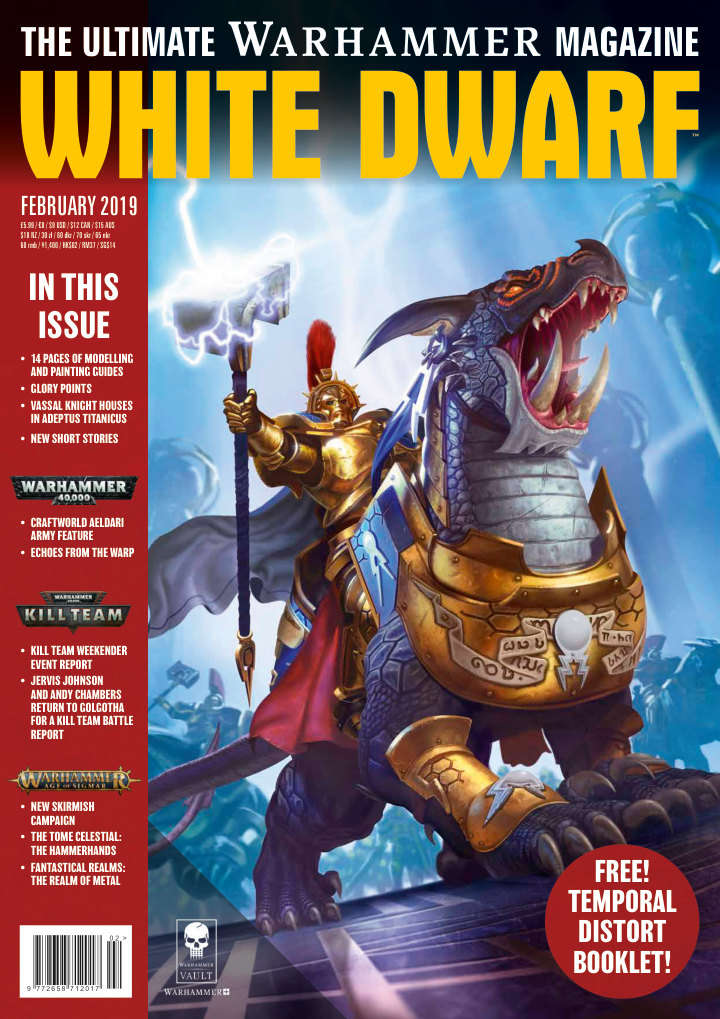
EditorialWD 439 · p. 1
Guest editor Jervis Johnson introduces an issue shaped by the games people enjoy and the stories they create together. His return to Golgotha with Andy Chambers anchors a programme that also includes Knight households, Stormcast history and interviews with collectors and writers.
CommunityWD 439 · pp. 6–7
Readers discuss army points, veteran markings and the practicalities of looking after painted miniatures. The replies connect Red Scorpions honours to experience on campaign, explain the Fyreslayers’ search for Grimnir’s scattered substance, and recommend a soft brush for removing dust without damaging a model.
Warhammer 40,000Age of Sigmar
PaintingWD 439 · p. 6
Rik Turner explains how he painted a Chaos Spawn with recognisable human flesh interrupted by raw, bloodied mutations. A conventional layered skin recipe establishes the body; shaded red limbs, a wet blood effect and black extremities then make the transformation look painful and incomplete.
Warhammer 40,000Chaos Space Marines9 paint colours
ShowcaseWD 439 · pp. 8–11
The reader gallery ranges from individual infantry to a Raven Guard Land Raider and a Mechanicum Domitar. Its contrasting examples include the Yncarne, Rotigus, a Fungoid Cave-Shaman and Kurnoth Hunters, illustrating how a strong focal colour or carefully staged base can give very different armies a convincing centrepiece.
Warhammer 40,000Age of Sigmar
PaintingWD 439 · p. 11
Dion Kerr gives his Harvestboon Treelord a lively green finish rather than treating the bark as ordinary brown wood. Pale highlights and blended washes keep the branching silhouette readable, while spare Dryad components and small forest spirits make the base feel like part of a woodland moving with the creature.
Age of SigmarSylvaneth7 paint colours
LoreWD 439 · pp. 12–15
Phil Kelly examines how invented names communicate character before any background is read. He contrasts research and linguistic patterns with spontaneous invention, showing how long vowels, hard consonants, titles and deed-names suggest different cultures; the examples range from Space Marine Chapters and Aeldari to the unpleasant sounds of Nurgle’s followers.
Warhammer 40,000Age of Sigmar
InterviewWD 439 · pp. 18–21
Robin Cruddace describes the cycle of developing rules, publishing provisional changes and responding to games played outside the Studio. Battle Brothers, Psychic Focus and Tactical Reserves illustrate three different outcomes: accepting an experiment, revising its details, or replacing its underlying approach when feedback exposes unwanted effects.
Warhammer 40,000
RulesWD 439 · p. 21
This provisional rule expands when Space Marines can fire twice with Rapid Fire bolt weapons. Stationary infantry and specified heavily equipped or mounted models gain alternatives to the usual half-range requirement, with the accompanying explanation covering unusual bolt weapons and combined profiles. It is presented here in its February 2019 beta form.
Warhammer 40,000Space Marines
ShowcaseWD 439 · pp. 22–29
Lee Bates presents Craftworld Eridanus, a matriarchal Aeldari force developed through converted leaders and a carefully organised range of star-like colours. The collection grew from Corsair ideas into a full Craftworld army; disciplined early-morning painting sessions and event deadlines helped turn it into an extensive, coherent display.
Warhammer 40,000Aeldari
PaintingWD 439 · pp. 24–29
Bates builds luminous vehicle colours over a light foundation, using translucent blue and transitions through purple, pink and red to suggest different stars. Masked planets and individually painted points of light carry the celestial theme across the hulls, while black cockpit panels and fine white horizon lines keep the vehicles’ forms clear beneath the decoration.
Warhammer 40,000Aeldari8 paint colours
FictionWD 439 · pp. 30–33
Lieutenant Danzek must escort a frightened Imperial official across Vigilus with too few soldiers, failing vehicles and dwindling supplies. An ambush and a catastrophic force-field incident expose how little control the Cadians have over their route; the party’s next obstacle is an Ork speedway that they can neither safely cross nor afford to wait beside.
Warhammer 40,000Astra Militarum
CommunityWD 439 · pp. 36–37
The first Warhammer World Kill Team Weekender combines Studio contact, a small campaign and painting with a day of competitive games. Players explain how experience changed their plans: numbers and objectives matter alongside killing power, and terrain, cover and faction abilities reward attention even in a small battle.
Kill Team
PaintingWD 439 · p. 38
Ewan Osborne’s Avenging Sons use restrained conversions and a bright white finish to make their Primaris strike team distinctive. The article describes a simple light-grey and white process with controlled shading, while a veteran’s sword, trophies and damaged armour introduce individual histories without disrupting the squad’s clean appearance.
Kill TeamWarhammer 40,000Space Marines4 paint colours
ModellingWD 439 · pp. 38–39
Peter McMullin combines Escher bodies with Genestealer Cult parts to produce a distinctive band of female cultists. Pale faces and darkened eye sockets establish an unhealthy appearance, while red cloth and chitin tie the unusual hybrids together; the conversion discussion also points towards extending the idea with Van Saar components.
Kill TeamWarhammer 40,000Genestealer Cults1 paint colour
ShowcaseWD 439 · p. 39
Adam Langton’s return to the hobby becomes a Deathwatch team built around the idea of Primaris warriors proving themselves on difficult missions. Converted weapons and a distinctive Watch Sergeant help differentiate the specialists, while the painter describes using online demonstrations to rebuild the skills needed for a neat, readable squad.
Kill TeamWarhammer 40,000Deathwatch
PaintingWD 439 · p. 40
James Richardson uses Mark III armour to give his Iron Warriors an older, heavily armoured character, then reinforces it with metallic surfaces and precisely laid hazard stripes. Converted Bloodreaver cultists supply the support troops, including improvised heavy weapons; the recipe explains the metal and brass before moving to pencilled guides for the yellow and black chevrons.
Kill TeamWarhammer 40,000Iron Warriors8 paint colours
ShowcaseWD 439 · p. 40
Will Bayford makes the members of Crimson Team Heta visibly distinct through Chapter origins, skin tones and personalised equipment. Red details and a shared knee marking unite the team, while an energetic Black Shield conversion and a hand-painted Death Spectres badge show how small changes can preserve each Marine’s identity within Deathwatch black.
Kill TeamWarhammer 40,000Deathwatch
ModellingWD 439 · p. 41
Andy Cook turns Scouts into an urban reconnaissance team using extra armour, altered heads and silenced-looking weapons. Green Stuff details and Cadian components create a consistent appearance, supported by a crisp black and white scheme; a commandeered Sentinel contributes to the force’s display story rather than being presented as a Kill Team unit.
Kill TeamWarhammer 40,000Space Marines
ModellingWD 439 · p. 41
Andy Cook combines Grimghast Reapers with Sicarian components to create an unsettling, almost spectral Mechanicus team. A surviving human leader contrasts with the surrounding machines, while aged pale cloth and brown shading suggest a force maintained for years on a remote frontier rather than a polished forge-world procession.
Kill TeamWarhammer 40,000Adeptus Mechanicus7 paint colours
Battle reportWD 439 · pp. 42–61
Jervis Johnson and Andy Chambers revisit the capture of Commissar Yarrick through three linked Kill Team games. The rescue begins with an attack on an Ork-held bunker, continues through a prison extraction and ends in a desperate dash for a Taurox, with the results of each stage determining Yarrick’s condition in the next.
Kill TeamAstra Militarum
InterviewWD 439 · pp. 43–45
The players look back to their original Golgotha encounter in White Dwarf 154, when a Space Marine battle produced the story of Yarrick’s capture. Returning to the setting in a different game shows how an unexpected result can outlive its rules and inspire both further scenarios and published fiction.
Kill TeamEpicAstra Militarum
Battle reportWD 439 · pp. 48–51
The rescuers must reach the bunker doors before the Orks can halt their advance. Jervis pushes forward aggressively, but corners and close-range charges prevent the Guard from making full use of their guns; the team breaks, and the defeat leaves Yarrick with only a single wound for the subsequent escape attempt.
Kill TeamAstra Militarum
Battle reportWD 439 · pp. 52–55
Inside the bunker, the rescue party must locate Yarrick while Orks emerge from rooms around them. Orders and a sacrificial diversion let Guardsman Kova reach the prisoner, winning the stage and recovering his equipment, but the team suffers heavily and the earlier loss means Yarrick still begins the final game badly wounded.
Kill TeamAstra Militarum
Battle reportWD 439 · pp. 56–61
Only four escorts remain as the Imperials attempt to deliver Yarrick to their waiting transport. Medical aid, armour and scarce Command Points repeatedly keep the Commissar alive, but the converging Orks cut down his companions at the Taurox; the last duel ends with Yarrick knocked unconscious rather than rescued.
Kill TeamAstra Militarum
InterviewWD 439 · pp. 62–67
Jervis Johnson explains his favourite games through the decisions and social experiences they create. Blood Bowl’s precise spaces and calculated risks, Blackstone Fortress’s character stories, Underworlds’ cards and Kill Team’s developing fighters illustrate different ways to combine uncertainty with agency; his wider point is that enjoyable play depends on the agreement between the people at the table.
Blood BowlWarhammer Quest: Blackstone Fortress
TacticsWD 439 · pp. 68–71
Dave Sanders builds a strategy around keeping Mollog alive and extracting more useful actions from the warband’s strongest fighter. Defensive upgrades, healing, movement tricks and extra attacks make the troggoth difficult to contain, but the article also explains how an inspired Bat Squig and the other smaller creatures can support him or force the opponent to respond elsewhere.
Warhammer UnderworldsMollog’s Mob
InterviewWD 439 · pp. 72–75
Phil Moss and John Michelbach discuss the cold, sharp and oppressive imagery used to establish Shadespire. Symmetry, masks and shadeglass express the vanished Katophranes’ unsettling legacy, while Nightvault’s exposed faces and the Briar Queen’s aggression make the horror less restrained; even Stormcast gold is subdued by the city’s pervasive jade light.
Warhammer Underworlds
CampaignWD 439 · pp. 78–81
John Bracken links six Skirmish battles through an alchemical expedition in Chamon. Warbands gain rewards and advantages between games, with spells and campaign events reinforcing the Realm of Metal setting, but victory in the final confrontation determines the overall result: an army that has lost every earlier encounter can still claim the tomb.
Age of Sigmar
Battle reportWD 439 · pp. 82–85
Matt Hutson’s Fyreslayers defeat Dan Harden’s Skaven in the first five games of this short campaign, yet the last battle overturns the apparent pattern. The account highlights the danger of a costly mortar, the effectiveness of throwing axes and the importance of controlling the final engagement, where the Skaven secure the campaign despite their earlier losses.
Age of SigmarFyreslayers
LoreWD 439 · pp. 86–87
The Chamon feature presents a realm of alchemy, change and industry whose landscapes are stranger than an expanse of shiny metal. Inverted mountains, mercurial waters and the contrast between relatively stable central regions and dangerous outer reaches offer ideas for armies and battlefields; the accompanying hobby theme allows corrosion, mineral colours and transformed flesh as readily as gold.
Age of Sigmar
PaintingWD 439 · pp. 88–89
Examples from several Grand Alliances show how a Realm of Metal origin can connect very different miniatures. Metallic skin, alchemical markings, corroded equipment and industrial conversions suggest a shared environment without forcing every army into the same scheme; the Kharadron example uses coloured washes and verdigris to distinguish its steel and bronze surfaces.
Age of SigmarNighthaunt2 paint colours
ModellingWD 439 · pp. 90–91
Three character projects translate alchemical ideas into miniature conversions. Matt Hutson builds crystalline supports beneath a Tzaangor Shaman from shaped sprue; Martyn Lyon depicts Thostos Bladestorm with living-metal skin and a molten base; Dan Harden surrounds a masked Darkling Covens sorceress with floating blades inspired by Chamon’s magical weapons.
Age of SigmarDisciples of Tzeentch
PaintingWD 439 · pp. 92–93
The Herdstone becomes a mass of different ores through separate bronze, brass, copper and gold recipes. A shared bronze drybrush brings the facets together, while bright corrosion and a green flame suggest an unnatural metallic landscape; the iron chains receive their own restrained silver and rust treatment to preserve the distinction between materials.
Age of SigmarBeasts of Chaos15 paint colours
PaintingWD 439 · p. 93
The molten-metal base is painted separately from Thostos so broad drybrushing cannot spoil the finished character. Coppery, weathered rocks contrast with a flatter opaque silver pool: the change in texture, rather than a complicated liquid pattern, makes the quicksilver appear heavy and viscous beside the crumbling shore.
Age of Sigmar6 paint colours
FictionWD 439 · pp. 94–97
Ergut and his Goretide warriors breach a mountain temple exposed by the upheavals of the Necroquake. Killing its Stormcast defenders and disturbing their warding blades opens the way to a hidden sword, but the apparent prize is a trap: the entity within consumes Ergut’s soul and takes his body as the means of its release.
Age of SigmarBlades of Khorne
LoreWD 439 · pp. 98–109
The Hammerhands are examined as warriors carrying both Sigmar’s hopes and the burdens of repeated reforging. The article places Vandus Hammerhand’s chamber within the Hammers of Sigmar, explains its organisation and public role, and follows its campaigns from the first assaults into the Mortal Realms through confrontations with Archaon and the wars of souls.
Age of SigmarStormcast Eternals
LoreWD 439 · pp. 102–104
The chamber’s structure is set out through its commanders, conclaves and named formations. Red chamber details and variations in tabards, belts and other markings distinguish retinues within the familiar gold and blue, giving collectors a way to organise a large Hammerhands force while keeping its members visually connected.
Age of SigmarStormcast Eternals
LoreWD 439 · pp. 105–107
Vandus and his fellow officers retain fragments of mortal lives that shape their new duties, even as reforging changes them. The profiles connect Ionus’s deathly voice, Liminus’s sight and other developing traits to specific histories, presenting the chamber’s heroes as increasingly altered individuals rather than interchangeable immortal warriors.
Age of SigmarStormcast Eternals
RulesWD 439 · pp. 110–111
Four battalions translate the chamber’s organisation into linked battlefield benefits. The Warrior Chamber and Lords of the Storm reward nearby heroes and coordinated formations, while Thunderhead Brotherhood and Hammerstrike Force encourage the supporting fire and target selection of their constituent units; these are the published second-edition Hammerhands rules.
Age of SigmarStormcast Eternals
InterviewWD 439 · pp. 112–117
Martin Morrin describes an army built to be played, with event deadlines encouraging quick, neat painting and new additions. He treats every Stormcast as a hero, using an extensive set of scenic bases to give ordinary warriors presence; his gaming advice favours clear roles, useful support heroes and an aggressive general positioned close enough to help the main force.
Age of SigmarStormcast Eternals
PaintingWD 439 · p. 114
Morrin uses the Shattered Dominion basing range to give his army a shared architectural setting. Working on the bases separately makes the grey drybrushing straightforward, while warm brown weathering breaks up the stone and helps the sculpted ruins frame the warriors instead of competing with their gold armour.
Age of SigmarStormcast Eternals4 paint colours
PaintingWD 439 · p. 117
Morrin combines efficient gold armour, shaded blue cloth and red accents with a green and orange Dracoline. He thins his shades with an equal amount of Lahmian Medium to make transitions gentler, and uses an airbrushed gradient on shields; the result is a repeatable army method that can be refined after models have already reached the gaming table.
Age of SigmarStormcast Eternals15 paint colours
PaintingWD 439 · pp. 118–119
A short sequence establishes the Hammers of Sigmar scheme before the more detailed recipes begin. Gold armour provides the starting surface, followed by the principal cloth, metal and parchment colours; controlled washes create enough separation and depth for a coherent force that can later receive further layers and highlights.
Age of SigmarStormcast Eternals10 paint colours
PaintingWD 439 · p. 119
The accompanying basing recipe uses a grey texture paint, a dark wash and a pale drybrush to produce a simple rocky surface. A brown rim gives the finished miniature a clean boundary, while optional tufts supply small patches of vegetation without obscuring the texture or distracting from the Stormcast above it.
Age of Sigmar4 paint colours
PaintingWD 439 · pp. 120–121
The full guide develops the gold, blue and white scheme through separate material recipes, including red plumes, the hammer grip, metal weapons and parchment. It also explains when a gloss shade can make polished armour more convincing, how to keep cloth shading controlled, and how simple heraldic marks distinguish units without changing the army’s underlying colours.
Age of SigmarStormcast Eternals31 paint colours
PaintingWD 439 · pp. 122–123
A Gryph-charger is painted in cool green and blue tones chosen to complement its gold-armoured rider. The recipes separate skin, belly, radiant feathers, beak, claws and dark scales, then use the same pale final highlight across several materials to make the fantastic creature feel coherent; painting mount and rider separately keeps the contrasting undercoats manageable.
Age of SigmarStormcast Eternals17 paint colours
RulesWD 439 · pp. 124–127
Jervis Johnson designs a raid around a defended Warscryer Citadel and portable loot. The attacker must decide how much effort to spend on the garrison and how much to devote to carrying treasure away, while the defender balances an immobile initial force against arriving reinforcements; the commentary explains how these asymmetries create decisions beyond simply destroying the enemy army.
Age of Sigmar
LoreWD 439 · pp. 128–133
Andy Hoare describes Knight houses whose allegiance to a Titan Legion goes beyond a normal alliance. These large, dependent formations provide scouting, screening and sacrificial support, gaining forge-world resources at the cost of autonomy; examples such as Coldshroud, Perdaxia and Morbidia show how rescue, conquest or punishment can produce very different forms of servitude.
Adeptus TitanicusThe Horus HeresyQuestoris Knights
RulesWD 439 · p. 131
Owen Barnes presents a combined formation of Titans and supporting Knight banners. The rules let Knights interfere with enemy targeting and absorb attacks intended for nearby Titans, turning their protective role into a concrete tactical choice: a commander can preserve a major engine by accepting the much greater danger to its smaller escorts.
Adeptus TitanicusQuestoris Knights
LoreWD 439 · pp. 132–133
An annotated Cerastus Knight shows how Coldshroud’s colours and markings express its subordination to Legio Gryphonicus. Its grey and yellow scheme, campaign honours and identification details place the machine within a collective military history, contrasting with the more personal heraldic display associated with independent noble houses.
Adeptus TitanicusThe Horus HeresyHouse Coldshroud
InterviewWD 439 · pp. 134–139
Nick Kyme, Cavan Scott and Tom Huddleston discuss introducing younger readers to Warhammer through vulnerable, resourceful protagonists. The books retain danger and strange settings while letting children solve problems through cooperation and ingenuity; illustrations, glossaries and clear explanations help readers encounter unfamiliar worlds without requiring prior knowledge of their histories.
Warhammer 40,000Age of Sigmar
InterviewWD 439 · pp. 134–137
Cavan Scott introduces children whose differing backgrounds become strengths after an attack forces them to flee their home. An explorer’s daughter, a boy escaping military expectations and a technically minded Martian must learn to trust one another; their viewpoint allows the story to explore Imperial society and alien threats through discovery rather than a soldier’s campaign.
Warhammer 40,000Necrons
InterviewWD 439 · pp. 136–139
Tom Huddleston explains a Mortal Realms adventure centred on a group of children and a missing mentor. Their different realm origins, temperaments and skills offer ways into the setting, while the comparatively recognisable environment of Ghyran grounds its stranger elements; the discussion stresses peril, clever escape and friendship as alternatives to treating the children as battlefield combatants.
Age of Sigmar
RulesWD 439 · p. 140
The release of Honourbound and its accompanying miniature introduces Commissar Severina Raine as a named Kill Team commander. Her profile carries the weapons Evenfall and Penance and rewards active leadership: nearby Imperial soldiers become steadier when she is personally engaged with the enemy, matching the article’s emphasis on her example at the front.
Kill TeamAstra Militarum
PaintingWD 439 · p. 142
Nathan Trolley’s Goblin team takes its identity from a banana-yellow armour scheme. A pale undercoat, yellow base, coloured wash and bright highlight provide an economical route to a very visible team, while the accompanying account of its poor scoring record keeps the showcase firmly in the comic spirit of Goblin Blood Bowl.
Blood BowlGoblins4 paint colours
PaintingWD 439 · p. 142
Sam Pearson paints the Darkoath warband after enjoying its playtesting, putting most of his effort into the exposed skin. Warm flesh is shaded with both a reddish wash and dark brown before progressively lighter highlights restore the prominent muscles and faces, giving the small group a consistent finish without losing the individuality of its members.
Warhammer UnderworldsGodsworn Hunt5 paint colours
ShowcaseWD 439 · p. 143
John Michelbach’s Stygies VIII army combines sombre black and red with a cooler blue accent, alongside a House Taranis Knight whose pale shoulders stand apart from the infantry. Scrap-built bases and mixed texture paints place the force on a battered industrial world, while weathering powders on the feet connect the figures to the ground beneath them.
Warhammer 40,000Adeptus Mechanicus2 paint colours
CommunityWD 439 · pp. 144–145
Studio writers prepare a Dominion campaign with an arbitrator, all six principal House gangs and room for a larger unfolding story. The showcased Delaque, Van Saar, Goliath, Escher and Orlock gangs demonstrate the participants’ starting forces, while practice games and possible cult activity give the campaign a narrative direction before its first formal round.
NecromundaHouse Delaque
InterviewWD 439 · p. 145
The White Dwarf team responds to Jervis’s discussion by explaining the games that keep drawing them back. Their choices connect enjoyment to particular experiences: immense guns and deep background, narrative freedom, tense adventure games, quick warband encounters and the chance to field machines at a scale ordinary battles cannot accommodate.
Warhammer 40,000Age of Sigmar
All substantive articles, named hobby features and game additions in the magazine are indexed. Letters and reader photographs are grouped, with named recipes separately searchable. Covers, contents, section dividers, advertisements and the Black Library product catalogue are excluded. The advertised free Temporal Distort booklet is not present in this copy and has not been reconstructed.