EditorialWD 425 · p. 1
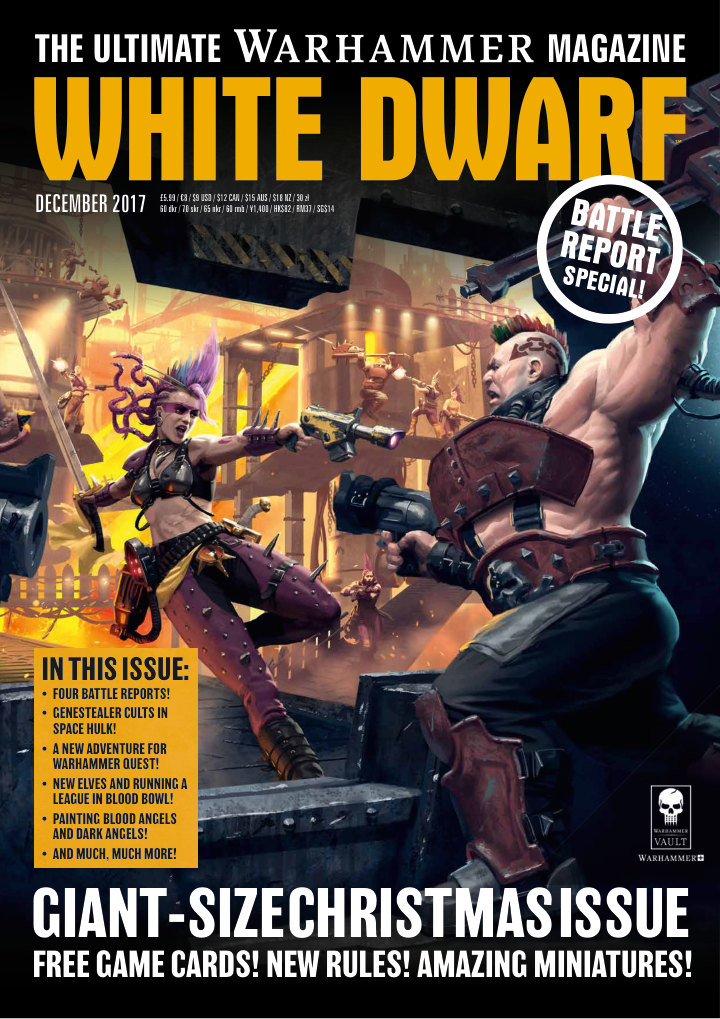
The Christmas issue celebrates gaming through four substantial battle reports and additions for several smaller systems. The editorial introduces the accompanying cards, a Hammerhal adventure, a Space Hulk mission and advice for Blood Bowl leagues, explaining how the month’s unusually broad selection of games came together.
CommunityWD 425 · pp. 4–27
The release roundup pairs new Dark Angels and Blood Angels material with Chapter Approved’s expanding gaming options. Push-fit kits, returning characters, Elven Union players and Red Scorpions miniatures appear beside licensed games and Black Library books, providing the news context for the issue’s unusually extensive set of gaming features.
RulesWD 425 · p. 5
The magazine introduces its Christmas cards for three games: an alternative-art Healing Potion for Shadespire, a festive Blood Bowl Special Play card and twelve additions to Shadows over Hammerhal. The latter mix skills, treasures and campaign support, with instructions later in the issue distinguishing cards shuffled into decks from special rewards earned during adventures.
Warhammer QuestBlood Bowl
ReviewWD 425 · pp. 6–7
Wade Pryce describes the annual supplement as a toolbox that groups can draw from according to their preferred kind of game. Land Raider construction, Apocalypse, expanded assault campaigns and updated matched-play material sit together, while revised points and terrain rules offer a way to respond to the new edition without waiting for every army’s next codex.
Warhammer 40,000
InterviewWD 425 · p. 7
Andy Smillie explains how tournament and player feedback informs changes to the matched-play experience. Restrictions on aircraft claiming objectives, the importance of Troops and a revised first-turn procedure encourage a broader range of decisions, while twelve additional missions expand the selection rather than replacing the existing ones.
Warhammer 40,000
ReviewWD 425 · pp. 8–11
The two Chapter codexes bring the Dark Angels and Blood Angels into the era of the Great Rift and Primaris reinforcements. Their distinctive histories, psychic traditions and specialist formations accompany the expanded model ranges, with new Lieutenant miniatures and upgrade components demonstrating how the newer armour can retain each Chapter’s established character.
Warhammer 40,000Dark Angels
InterviewWD 425 · p. 9
Wade Pryce contrasts the Chapters’ reactions to the same reinforcements. The Blood Angels see a possible reprieve after their losses, while the Dark Angels remain guarded about admitting outsiders to their secrets; the discussion deliberately leaves open whether Primaris warriors will eventually share older curses or enter the most trusted circles.
Warhammer 40,000Dark Angels
ReviewWD 425 · pp. 12–15
Four Easy to Build releases reduce assembly complexity while retaining the subjects’ characteristic detail. Aggressors and a Redemptor face Lord Felthius’s corrupted retinue and the Myphitic Blight-hauler, with the annotated examples explaining how fixed weapons, fewer components and push-fit joins make a force quicker to assemble.
Warhammer 40,000Space Marines
ReviewWD 425 · p. 16
The new Sly Marbo miniature is introduced through his simple weapons, compact equipment and jungle-world base. Short accounts of his reputed exploits emphasise the solitary fighter’s ability to turn terrain and ordinary objects into weapons, while the text distinguishes the miniature’s accompanying rules from the descriptive material printed in the magazine.
Warhammer 40,000Astra Militarum
ReviewWD 425 · p. 17
Gavriel Sureheart’s miniature is presented as an openly heroic Stormcast commander, with an unhelmeted head, lion imagery and an enormous runeblade. The description connects its decorative armour and equipment to other Stormcast designs, positioning the character as another leader collectors can place within a Hammers of Sigmar force.
Age of SigmarStormcast Eternals
LoreWD 425 · p. 17
Examples of reforging show both salvation and unsettling transformation among Sigmar’s warriors. Torglug becomes Tornus, hardened veterans withstand Tzeentch’s magic and Thostos acquires a living-metal nature, but the final observation questions what repeated remaking may eventually cost an immortal warrior’s identity.
Age of SigmarStormcast Eternals
ReviewWD 425 · p. 18
The new physical card game resolves short battles across melee, shooting and psychic lanes. Its introductory description explains how players can begin with a single kind of confrontation before combining them, while the sixty-card collection supplies opposing Imperial and Chaos fighters drawn from several recognisable Chapters, Legions and daemon forces.
Warhammer 40,000 Combat Cards
ReviewWD 425 · p. 19
Returning character miniatures contrast the Dwarven rulers Thror and Thrain with Lake-town’s wealthy Master and his calculating adviser Alfrid. The annotated photographs draw attention to clothing, jewellery and weapons that express their positions, while directing players to the separate supplement containing their gaming profiles.
Middle-earth Strategy Battle GameErebor
ReviewWD 425 · pp. 20–21
The Elven Union team is introduced through exceptional passing, fragile players and the professional background of its members. Swappable heads and pads personalise the twelve-model set, while the adjoining Almanac and accessory coverage explains the growing support for league play and team-specific presentation.
Blood BowlElven Union
RulesWD 425 · p. 21
This optional ball lets Elven Union players draw on the abilities of teammates already removed from play. A carrier can temporarily borrow an eligible skill from the Dead and Injured box, or gain an unsettling presence when no such teammate is available, turning casualties into an unusual tactical resource without permanently changing the player.
Blood BowlElven Union
ReviewWD 425 · p. 22
The Red Scorpions’ former commander returns inside a Leviathan chassis after being mortally wounded by the Great Beast of Sarum. The model’s weapons, honours and Chapter details honour his earlier campaigns, illustrating how the new Dreadnought continues a named character’s story while adapting an ancient machine for warfare in the current era.
Warhammer 40,000Red Scorpions
ReviewWD 425 · p. 23
Casan Sabius and Ancient-Invigilus Karagon take contrasting roles in the Red Scorpions’ leadership after Culln’s fall. Tradition and scrutiny make them an uneasy political pairing, but their battlefield presentation emphasises shared resolve, with a prestigious blade and the Banner of Sacrifice linking their authority to the Chapter’s uncompromising ideals.
Warhammer 40,000Red Scorpions
LoreWD 425 · p. 23
The Red Scorpions’ rigid orthodoxy is examined alongside their unusually prominent Apothecaries and obsession with genetic purity. Their rejection of aliens and abhumans, preference for open battle and suspicion of allies make them steadfast yet difficult partners, showing how a Chapter can revere the Codex while developing highly distinctive institutions.
Warhammer 40,000Red Scorpions
ReviewWD 425 · pp. 24–25
The historical software roundup previews Deathwing’s Enhanced Edition, including a Chaplain and additional combat options, beside new weapons and a competition-inspired appearance for Freeblade. It also reports the Mac and Linux version of Dawn of War III, recording the announcements made in this issue rather than describing the games’ present-day availability.
Space Hulk: DeathwingWarhammer 40,000: Freeblade
ReviewWD 425 · pp. 26–27
The magazine previews Gaunt’s return to Urdesh in The Warmaster and Vulkan’s competing obligations in Old Earth, then introduces further stories of Fabius Bile and the Hallowed Knights. Two introductory anthologies offer routes into the settings through novellas and short fiction, with the descriptions outlining premises rather than reproducing the books.
Warhammer 40,000Age of Sigmar
CommunityWD 425 · pp. 28–29
Readers ask for more competitive analysis, share enthusiasm for Age of Sigmar and discuss practical outdoor gaming. Replies point to expanding terrain support and clarify the relationship between Gravis armour, Terminator honours and Dark Angels colours, while the magazine considers how explanatory battle reports can serve readers who do not collect the featured armies.
InterviewWD 425 · pp. 30–31
The retrospective returns to Mordheim’s launch, the Aenur cover miniature and the first Town Cryer. Ork space hulks, a converted Wave Serpent and experimental fantasy rules show how the same magazine combined a new skirmish setting with modelling and additions for established games, with Blanche’s art helping establish Mordheim’s unsettling atmosphere.
MordheimBattlefleet Gothic
CampaignWD 425 · pp. 33–35
The Hammerhal expansion adds hireable companions, fresh surface activities and a hidden temple beneath Cinderfall. Its instructions separate player-facing hero options from gamesmaster material and explain how special treasures connect adventures across issues, allowing a party to explore new branches without abandoning progress in the original dungeon.
Warhammer Quest
RulesWD 425 · p. 34
Mercenaries provide temporary help rather than becoming permanent, fully developing heroes. They cannot use destiny dice or gain normal advances, leave on the next return to the surface and generally retain their own earnings, with specific exceptions for campaign artefacts and excess gold keeping important rewards in the party’s hands.
Warhammer Quest
RulesWD 425 · p. 34
Three new destinations extend the choices made between expeditions. A bastille offers bounties, Conran’s contest trades risk for possible advancement and the Guild of Blades supplies paid allies; additional instructions let a party move between available dungeons while preserving its progress in each.
Warhammer Quest
CampaignWD 425 · p. 34
The bastille gives adventurers reasons to investigate cult activity, vermin and an unexplained fortification around Cinderfall. Hidden completion conditions produce renown rewards, while the gamesmaster is told to reveal only bounties for adventures whose rules are available, keeping future instalments distinct from the temple included here.
Warhammer Quest
RulesWD 425 · p. 34
Conran offers a diversion in which an experienced adventurer has better odds of gaining another skill. Failure can inflict a lasting injury, while outstanding success brings money as well as learning, making the activity a compact decision about how much danger a hero should accept before returning to the dungeon.
Warhammer Quest
RulesWD 425 · p. 34
A hero can bargain for one companion to join the party’s next expedition, with the asking price reflecting the fighter’s current misfortune. The selection depends on owning the relevant miniature and profile, and the limit of one mercenary keeps the choice focused on what the existing adventurers most need.
Warhammer Quest
CampaignWD 425 · p. 34
The temple adventure sends heroes through a bloodstained, increasingly unstable complex with hidden stairs, hostile rituals and floors warmed by magma. A seemingly minor choice about a ritual dagger can help uncover Hezerek’s Belt, while escalating ambushes and linked chambers reward careful exploration rather than a simple rush towards the largest enemy.
Warhammer QuestBlades of Khorne
RulesWD 425 · p. 34
The card instructions separate ordinary additions from treasures awarded only by specific adventures. New skills and common treasures enter their normal decks, while the Hezerek artefacts and Enchanted Eye must be earned; an achievement and replacement Cinderfall card support the expanding campaign without changing when those special discoveries become available.
Warhammer Quest
RulesWD 425 · p. 34
A short addition changes the familiar gambling activity once a hero carries certain Hezerek artefacts. The extra guess offers a practical benefit, but Red Yugol’s cryptic reaction also connects the surface encounter to the new treasure hunt, giving the gamesmaster a clue to reveal only when the stated conditions have been met.
Warhammer Quest
RulesWD 425 · p. 35
The Freeguild General combines a fast blade with a heavier weapon and leadership that can redistribute unused hero dice. Successful close defence can create a counterattack, while exploration earns renown, giving the character a supporting role that remains active in combat and useful as the party discovers new rooms.
Warhammer QuestFreeguild
RulesWD 425 · p. 35
The Gunmaster brings several ranged options alongside a sword, with paired pistols and a powerful long rifle serving different moments. Taking the rifle shot before other actions improves its effect, and difficult kills can earn additional renown, rewarding a player who plans position and action order around a specialist marksman.
Warhammer QuestIronweld Arsenal
ShowcaseWD 425 · pp. 38–39
Gareth Nicholas combines highly reflective blue armour with real metallic details and a deliberately textured loincloth. Blending on the miniature and later thin glazes create the transitions, while understated damage and a tired face support the veteran character; the judges praise consistent attention across surfaces rather than a single spectacular focal effect.
Warhammer 40,000Blood Angels
ShowcaseWD 425 · p. 40
Sten Frödin uses Jensus Natorian for a first sustained experiment with non-metallic metal, adding a reliquary and sculpted candles for height. Bright reflective edges, repeated red accents and a restrained base keep the figure clear, with the judges particularly noting the face and the separation of dark armour from the surrounding details.
Warhammer 40,000Deathwatch
ShowcaseWD 425 · p. 41
Tomáš Pekar keeps richly detailed armour convincingly black through dark blue glazing and differentiates several metals with changes to their highlight colours. An airbrushed cloak, aged face and carefully placed lightning effect contribute to the impression of an experienced commander, while the base supports the atmosphere without overpowering him.
Warhammer 40,000Deathwatch
PaintingWD 425 · pp. 42–43
Karol Rudyk narrows and reposes a Knight around a daemon pilot, then covers its armour with freehand battle imagery and controlled weathering. Thin red reflections connect the pale flesh to the dusty base, while sponged chips and streaks age even the painted artwork, producing contrasts between hard armour, living tissue and the surrounding landscape.
Warhammer 40,000Chaos Knights7 paint colours
ShowcaseWD 425 · p. 44
Richard Gray reshapes a Knight’s shield into an immense eye and removes sculpted details to make room for freehand work. Turquoise armour and orange-brown corrosion create the main contrast, with damage concentrated where it is most plausible; the judges emphasise the strength of the colour choices as much as the precision of the decoration.
Warhammer 40,000Chaos Knights
ShowcaseWD 425 · p. 45
Omar Dodgeson builds his Gorkanaut’s finish from rust beneath masked, airbrushed colour, then adds layers of grime before reducing the shine. Working in separate assemblies makes the large machine manageable, while individually masked checks and carefully balanced weathering give it the battered character of an Ork engine without losing its readable shape.
Warhammer 40,000Orks
PaintingWD 425 · pp. 46–47
Robin McLeod contrasts a hot-skinned, powerful Wrathmonger with a pale agile Witch Aelf and poses them at a decisive instant. Layers and glazes smooth the figures, glossy shading gives metal a polished finish and a small weathered banner suggests the wider battle, while judges stress how clearly the two characters interact.
Age of SigmarDaughters of Khaine2 paint colours
ShowcaseWD 425 · p. 48
Martin Peterson places two immaculate opponents in a worn Ecclesiarchal setting, contrasting polished figures with a chalky backdrop. A shared red accent connects otherwise different palettes, and consistent lighting makes the confrontation convincing; the determined Seraphim and opulent sorcerer remain readable as both individual characters and parts of the same scene.
Warhammer 40,000Thousand Sons
ShowcaseWD 425 · p. 49
Vivien Chesnel suspends a Callidus above an unsuspecting cultist, hiding the supporting rod behind a small accessory. Warm work clothes make the victim stand apart from the cool Assassin and industrial setting, creating an immediately understandable story whose tension comes from the brief moment before the strike.
Warhammer 40,000Officio Assassinorum
Battle reportWD 425 · pp. 52–61
Adam Troke commands an Iron Hills army against Jay Clare’s Gundabad force in a large Fog of War game. Hidden objectives require each player to protect a hero, eliminate a chosen opponent and secure terrain, making apparent battlefield success an unreliable guide to the final result.
Middle-earth Strategy Battle GameIron Hills
Battle reportWD 425 · pp. 62–73
Martyn Lyon’s Beastclaw Raiders must move enough units into a mountain pass before the advancing winter catches them. Jonathan Stapleton’s Kharadron form a defensive gun line, using ships and infantry to delay the migration in a large custom scenario inspired by a photograph of the ogors bringing snow with them.
Age of SigmarBeastclaw Raiders
Battle reportWD 425 · pp. 74–87
Ben Humber’s Escher attempt to rescue Nokomi from Stuart Edney’s Goliaths on a vertical industrial board. A quiet approach allows the attackers to position their fighters, but an ill-judged shot sounds the alarm before their opening volley has achieved the intended result.
NecromundaHouse Escher
Battle reportWD 425 · pp. 88–99
Michael Wieske attacks the Urdek Refinery with Iyanden constructs while Matt Hutson defends with Dark Angels and powerful fortifications. The Planetfall mission gives the larger attacking force an orbital bombardment and close reserve arrivals, but the defender controls a heavily armed battlefield built around an older magazine display.
Warhammer 40,000Aeldari
TacticsWD 425 · pp. 102–105
The deck-building guide connects a warband’s objective cards to the ploys and upgrades that make those objectives achievable. Examples contrast reinforcing natural strengths with repairing weaknesses, concentrating resources in one fighter and disrupting an opponent, while the commentary warns that a larger deck reduces the reliability of drawing a desired combination.
Warhammer Underworlds
TacticsWD 425 · p. 103
The Ironjawz example seeks attacks without exhausting a fighter’s normal charge opportunity. Moving enemies into reach, using ploys for additional blows and timing Gurzag’s disabling attack can deny an opponent useful activations, so the deck supports a fighting plan rather than relying only on the warband’s naturally strong profiles.
Warhammer UnderworldsIronskull’s Boyz
TacticsWD 425 · p. 104
A Sepulchral Guard example arranges fighters and cards so one attack can lead into another without spending a separate activation. The Harvester’s area threat and the Warden’s reach are considered together, demonstrating that useful combinations depend on positioning as well as putting individually powerful cards in the same deck.
Warhammer UnderworldsSepulchral Guard
TacticsWD 425 · p. 105
The Bloodreaver example turns early combat glory into upgrades for Blooded Saek. Movement and enemy displacement place him near several targets, while improved accuracy and a multi-target attack exploit that position, illustrating the reward and risk of committing much of a warband’s plan to one exceptionally dangerous fighter.
Warhammer UnderworldsGarrek’s Reavers
RulesWD 425 · pp. 106–108
Cultists add shooting, psychic support and several kinds of hybrid to Space Hulk while retaining its streamlined action system. Blip values become recruitment points, simplified weapon categories avoid importing the full complexity of Warhammer 40,000 and special rules distinguish leaders, shield interactions, heavy-weapon failures and the resilience of Aberrants.
Space HulkGenestealer Cults
RulesWD 425 · p. 109
Two Terminator squads must plant thermal charges before an inhabited space hulk reaches another Imperial system. The first charges increase the enemy response and awaken progressively more dangerous cult leaders, forcing the Marines to balance speed with survival as they seek all three access chutes rather than simply clearing the board.
Space HulkBlood Angels
CampaignWD 425 · pp. 110–115
James Hewitt explains league organisation as a sequence of manageable tasks: establish interest, agree realistic dates, collect rosters and communicate results. He recommends starting simply, keeping statistics current and celebrating the finish, then using feedback to shape a later season; most of the practical principles also apply to campaigns in other systems.
Blood Bowl
CommunityWD 425 · pp. 113–115
The Studio league tests the organisational advice with a short season, slightly advanced starting teams and four small divisions. A wild-card route keeps more coaches interested late in the competition, while the final’s mistaken interpretation of overtime becomes a memorable example of how shared decisions and recorded results can matter as much as identifying the error afterwards.
Blood Bowl
CommunityWD 425 · p. 114
Hewitt’s weekly newsletter turns match results and administrative mishaps into an in-world sports report. A wrongly purchased fan total becomes a story about mis-sold tickets, showing how a simple repeated format can maintain enthusiasm and give players a shared account of the league without requiring a professionally designed publication each week.
Blood Bowl
InterviewWD 425 · pp. 118–123
Paul Dainton explains how descriptions became atmospheric paintings of six Free Cities, using colour, architecture and ordinary inhabitants to distinguish them. Industrial Greywater, magical Hallowheart and humid Anvilgard challenge simple assumptions about their realms, while the Phoenicium, Tempest’s Eye and Living City share Sigmarite influences without losing their separate identities.
Age of SigmarCities of Sigmar
ModellingWD 425 · pp. 124–129
White Dwarf’s photographers describe a repeatable setup for recording a painted miniature clearly. Background, lighting and viewing angle come before camera settings, with examples showing why the whole figure needs to remain sharp and why the camera should reveal its principal details; a separate phone discussion applies the same aims to the equipment available in 2017.
ModellingWD 425 · p. 125
The lighting section prioritises the painted figure rather than a perfectly white background. Two soft, consistent sources reveal the miniature’s intended shadows and highlights, while comparisons show how high lamps, hard shadows and direct flash can misrepresent the finish that the painter worked to create.
ModellingWD 425 · pp. 127–128
The camera-setting examples connect depth of field, exposure time and sensitivity to the practical problem of keeping a small three-dimensional object sharp. A stable support and timer allow longer exposures, while moving back from the miniature can improve focus across its extremities without sacrificing a usable final image.
PaintingWD 425 · pp. 130–131
James Littler paints an extensive hero-led Stormcast force through a small number of efficient techniques. Repeated drybrushing and carefully chosen contrasts carry most of the work, while the Stardrake and Celestant-Prime receive the attention needed for major centrepieces, demonstrating that a coherent army does not require elaborate methods on every surface.
Age of SigmarStormcast Eternals4 paint colours
PaintingWD 425 · p. 130
Littler gives the display ruins a green cast distinct from the grey ground, then ties the whole board together with a thinned brown wash and pale drybrush. Removing excess wash with tissue keeps the large surfaces controlled, creating depth and a weathered setting through broad operations suited to scenery.
Age of Sigmar6 paint colours
ModellingWD 425 · p. 131
A Shattered Dominion feature is cut apart and connected with plasticard rings to become floating celestial machinery. Littler imagines the ancient device reactivating as the Stormcast arrive, giving the display a strong narrative centre while its worn finish contrasts with the living army and the ruins below.
Age of Sigmar
ShowcaseWD 425 · pp. 132–133
Luke Blick returns to Aeldari painting through an ambitious Ynnari project organised around models he particularly wants to paint. A demanding deadline focuses the collection, shared runes and crests connect traditional Aspect colours to the new allegiance and the Visarch and Yvraine become the central rewards of completing the army.
Warhammer 40,000Ynnari
PaintingWD 425 · p. 132
Blick develops the Ynnari’s red from a purple foundation with airbrushed layers and violet shading. Returning to a bright red highlight creates an iridescent impression rather than a flat primary colour, allowing the same visual identity to work across armour, vehicles and the varied surfaces of the reborn warhost.
Warhammer 40,000Ynnari2 paint colours
ModellingWD 425 · p. 133
Blick’s first display board builds height over a Realm of Battle tile with foam and custom alien ruins. Painting the architecture separately before attaching it and blending its edges with texture paint makes the pieces belong to the same landscape, with an older modelling book providing guidance for a new kind of project.
Warhammer 40,000Ynnari
ShowcaseWD 425 · pp. 134–135
Dan Harden’s third interpretation of a D’yanoi army updates a long-standing blue and purple theme. He chooses favourite models rather than a narrowly competitive list, using infantry to establish the scale of the larger battlesuits and imagined night-world camouflage to connect their colours to a campaign setting.
Warhammer 40,000T’au Empire
PaintingWD 425 · p. 134
The Stealth Suits and Ghostkeel receive a compact black-to-blue treatment that contrasts with the army’s more time-consuming edge work. Grey and pale blue highlights establish the panels before repeated blue glazing ties them back into the dark surface, producing a clear technological finish with relatively few stages.
Warhammer 40,000T’au Empire4 paint colours
ModellingWD 425 · pp. 134–135
Harden designs T’au equivalents of the incidental equipment found around Imperial battlefields. Plastic pipes become containers and processing devices through added drones, weapons and spare fittings, while Tidewall parts help form a deployable tower; removable pieces let the display tile remain useful for storage and future games.
Warhammer 40,000T’au Empire
ShowcaseWD 425 · pp. 136–137
Melissa Holland enters Armies on Parade by building a board for an existing army rather than beginning another force. Familiar grass and ruins connect it to the models’ bases, while increasingly fantastical colour around the Realmgate suggests centuries of absorbed magic and gives the Seraphon’s return a place in a larger history.
Age of SigmarSeraphon
PaintingWD 425 · p. 137
Holland builds depth across the board through repeated light drybrushing rather than one heavy pass. Shared blue-tinted stone links the trees to the surrounding landscape, while the magical colours express prolonged exposure to the Realmgate; the technique keeps an ambitious display manageable in short painting sessions.
Age of SigmarSeraphon3 paint colours
ModellingWD 425 · pp. 138–141
Jake Ozga combines the characterful conversion approach of his Inquisitor projects with an isolated aelven warband trapped in a corrupted swamp. Degraded forms, masks and contrasting pale flesh replace conventional elegance, while varied textures and natural hues create an oppressive atmosphere at the boundary between Ghur and Shyish.
Age of SigmarWanderers1 paint colour
ModellingWD 425 · p. 139
A Death Korps mount becomes a foreboding fantasy steed after technological fittings are removed or concealed with texture. A Wrack torso, altered helmet and bare lower legs form the rider, demonstrating how changing context and silhouette can make components from very different ranges belong to the same bleak warband.
Age of Sigmar
ModellingWD 425 · p. 140
A malicious forest spirit grows through the remains of a Stormcast, turning the armour into a prison rather than a symbol of immortality. Dryad branches, paper foliage, sponge and textured paste create several kinds of decay, supporting the disturbing story through physical surfaces rather than relying only on a dark colour scheme.
Age of Sigmar
ModellingWD 425 · p. 140
Harlequin movement, aelven limbs, Wrack bodies and unfamiliar skull masks create fighters whose origins are difficult to identify at a glance. Sculpted hair and crude markings unify the models, while the contrast between fluid dancers and more static spearmen preserves their different roles within the same corrupted culture.
Age of Sigmar
ModellingWD 425 · p. 141
Ozga replaces the graceful idea of a Treeman with a creature assembled from a Greater Chaos Spawn and an elemental head. Its body appears built from rotten matter and recovered bones, making the result both sinister and diminished; the accompanying painting discussion values atmosphere, varied texture and colour over a literal naturalistic finish.
Age of Sigmar
InterviewWD 425 · pp. 142–146
Gavin Beardsmore assembles a Masque of the Silent Shroud for an event, using common weapons and different hair colours to identify its troupes. Magnetised leaders, altered scenic bases and the challenge of repeated diamond patterns make it both a painting and gaming project; finishing on time earns a best-painted award even as the battles reveal the force’s limitations.
Warhammer 40,000Harlequins
PaintingWD 425 · pp. 143–144
A pale undercoat supports the Silent Shroud’s bright orange, yellow and bone, with darker reds reserved for particular roles. Beardsmore lays out a fine grid before filling the diamonds and limits complex fades to selected models, keeping an elaborate-looking army repeatable without depending on colour mixes that would be difficult to reproduce consistently.
Warhammer 40,000Harlequins22 paint colours
LoreWD 425 · p. 145
The masque’s silence extends from its performers to the distorted sounds of its weapons, creating confusion before the killing begins. Its impromptu appearances and secretive behaviour explain the collection’s identity, while the thorn-entangled stave recalls Kurnous’s silent hunt and gives its insignia a place in Aeldari myth.
Warhammer 40,000Harlequins
PaintingWD 425 · pp. 148–149
Paul Norton’s Dark Angels guide keeps the green armour dark through narrow, carefully controlled highlights. Bone insignia, red casings, bright plasma coils and softly highlighted leather are treated as distinct materials, with optional mixed gloss shading giving metals an oiled finish while the rest of the model remains appropriately subdued.
Warhammer 40,000Dark Angels28 paint colours
PaintingWD 425 · pp. 150–151
Norton’s Blood Angels scheme contrasts bright red power armour with black details, polished gold and purple gems. Broad highlights suggest flexible leather or undersuit material where crisp edges would imply hard armour, while the accompanying face recipe shows where a squad-level finish can stop and where extra stages add character to a leader.
Warhammer 40,000Blood Angels30 paint colours
ShowcaseWD 425 · pp. 154–159
The gallery includes character studies, aircraft, Legion machines and a Blood Bowl team, with returning contributors shown across several subjects. Its varied finishes demonstrate how the photography principles discussed earlier can present both large vehicles and small figures clearly, while the model-of-the-month tank receives a separate explanation of its striking colours.
Warhammer 40,000Age of Sigmar
PaintingWD 425 · p. 158
Damien Tomasina extends his Sons of Asurmen collection with a Scorpion whose blue moves from deep tones towards pale turquoise. Airbrushed transitions, sharply defined panel lines and freehand symbols give the huge hull structure, while a sculpted-over cockpit and fiery gem imagery connect the tank to the army’s imagined wrath.
Warhammer 40,000Aeldari7 paint colours
CommunityWD 425 · pp. 160–164
The Studio’s gaming continues around the issue’s formal reports, with Shadespire, Necromunda and Hammerhal spilling onto spare tables. New Imperial Fists, an experimental Witch Aelf and a finished Doom Legion Dreadnought show the painting work between games, while the Firestorm campaign provides further short accounts of rival armies developing over time.
PaintingWD 425 · p. 160
Matt Hutson adds Primaris Intercessors from Dark Imperium to the Imperial Fists’ Fifth Company. A desert-coloured foundation and sepia shading establish the yellow before brighter layers and a final highlight, while black shoulder trims identify the new company choice within a familiar Chapter scheme.
Warhammer 40,000Imperial Fists4 paint colours
InterviewWD 425 · p. 161
Matt Hutson and Dan Harden recall the reports that first drew them into particular armies and their own earliest appearances as players. Their ambitions range from revisiting Glazer’s Creek to fantastical Mortal Realms scenery and the Siege of Terra, showing how a battle report’s setting and story can remain influential long after its immediate result.
Battle reportWD 425 · p. 162
Dan’s Skryre force and Jonathan’s Kharadron fight an evenly resourced Firestorm encounter around four objectives. The Endrinriggers damage the Stormfiends and are destroyed in reply, while a prolonged struggle eventually brings down the Ironclad; despite losing his main vessel, Jonathan wins by securing objectives that the Skaven cannot hold.
Age of SigmarSkaven
ModellingWD 425 · p. 162
Dan Harden expands his Skryre options by turning Clanrats into Globadiers. Spare masked heads from the Plagueclaw kit and small spheres from artillery or wizard components communicate their role, showing how a focused conversion can supply a missing unit while retaining the visual language of the wider collection.
Age of SigmarSkaven
Battle reportWD 425 · p. 163
Jonathan’s smaller Firestorm game begins well as the Kharadron destroy Saurus and flying attackers. Melissa Holland’s Bastiladon then closes the distance and its repeated waves of serpents overwhelm the remaining duardin, producing a Seraphon victory that demonstrates the danger of a durable unit allowed to reach its preferred range.
Age of SigmarKharadron Overlords
PaintingWD 425 · p. 163
Jonathan paints an Endrinmaster to keep his frequently targeted Ironclad operational. The miniature repeats the collection’s warm metal treatment, using a violet wash and progressively lighter drybrushed metals to maintain consistency while adding a character whose gaming role responds directly to experience in the campaign.
Age of SigmarKharadron Overlords4 paint colours
ShowcaseWD 425 · p. 164
Michael Wieske completes the first model for his Doom Legion in unusually little time, using washes and drybrushing to establish the large metallic surfaces. The efficient foundation leaves more attention for Chapter markings and other non-metal details, giving the finished Dreadnought a clear identity through a mixture of transfers and freehand.
Warhammer 40,000Space Marines
All substantive features and supplied rules are indexed from the supplied magazine. Free loose cards are pictured and discussed but are not separate scanned card sheets. Covers, contents, advertisements and pure price listings are excluded. Apparent source numbering and paint-name errors are identified in individual notes.