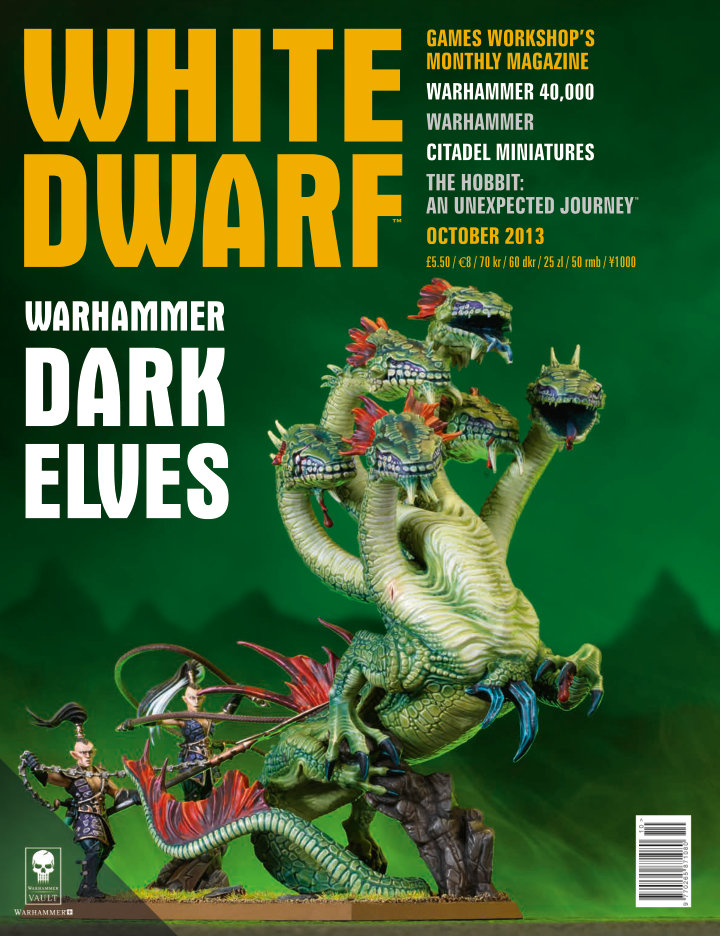
EditorialWD 406 · p. 1
Jes Bickham introduces the Dark Elves as a counterpart to the High Elf release earlier in the year. New infantry, shrines and monsters give the army a broad visual renewal. Their first battle in the issue tests that force against greenskins. Completed display projects and a return to the Horus Heresy add other major collecting themes.
Warhammer Fantasy BattlesDark Elves
ReviewWD 406 · p. 6
A towering Khaine statue rises above a magical basin and its curving staircases. Witch Elves and a Death Hag create a symmetrical ceremonial crew around the sacrifice. Crone Hellebron can replace the Hag and occupy different positions on the structure. Compatible figure fittings also connect the centrepiece to the new infantry kit.
Warhammer Fantasy BattlesDark Elves
ReviewWD 406 · pp. 7–9
A Medusa rises from a bowl beneath a mirror intended to protect the Dark Elves from her own gaze. Mirrored masks serve the same purpose for her attendants. Serpents, an ancient spear and a painfully distorted body express Atharti’s curse. Shared components also allow a Medusa or shrine characters to stand separately when the other main assembly is chosen.
Warhammer Fantasy BattlesDark Elves
ReviewWD 406 · pp. 10–11
Ten plastic devotees of Khaine leap and lunge from scenic supports. Long separate hair pieces and paired blades convey their frenzy. The kit includes a full command group and alternative banner details. Andrew emphasises the contrast between those moving figures and the disciplined ranks elsewhere in the army.
Warhammer Fantasy BattlesDark Elves
ReviewWD 406 · pp. 12–13
The alternative Witch Elf build creates arena fighters with whips and small bladed shields. Shaven heads and grotesque masks give them a different identity from the flowing-haired devotees. The same leaping bodies suit their gladiatorial background. Eight mask designs allow variation within the ten-model unit.
Warhammer Fantasy BattlesDark Elves
ReviewWD 406 · pp. 14–17
One ten-model kit provides three kinds of conventional Dark Elf infantry. A common body receives spears and shields, swords or repeater crossbows. Integrated heads and legs keep assembly manageable for large formations, while a separate champion offers more personalisation. The review explains how those simple weapon changes produce visibly different regiments.
Warhammer Fantasy BattlesDark Elves
ReviewWD 406 · pp. 18–19
The sea monster combines webbed feet, multiple feeding limbs and a disturbing central face. Long necks curl forward like a breaking wave. Small eyes and a ring of teeth make the head particularly unsettling. Dan finds its unusual anatomy a distinctive alternative to the more familiar dragon-like monsters in the range.
Warhammer Fantasy BattlesDark Elves
ReviewWD 406 · pp. 20–21
The alternate monster rears on a fallen rock beneath six individual heads. Scars, damaged eyes and different crests suggest a long life of regeneration and combat. Two lightly protected handlers drive it forwards with weapons and whips. Its fins and coiled shape distinguish it clearly from the Kharibdyss despite the shared kit.
Warhammer Fantasy BattlesDark Elves
ReviewWD 406 · p. 22
Shadowblade twists into an attack with cloak and blades following the movement. Plain equipment keeps attention on the pose rather than elaborate ornament. His eyes appear beneath a concealing hood. Dan sees the figure’s controlled dynamism as an effective way to represent the otherwise unseen master assassin.
Warhammer Fantasy BattlesDark Elves
ReviewWD 406 · p. 23
The established cavalry and raiders remain available beside the new infantry. Five Knights include a command group and the heavy equipment of Dark Elf nobles. Ten Corsairs offer close-combat weapons or repeater handbows beneath sea-dragon cloaks. The paired notices identify their modelling choices and continuing place in a collection.
Warhammer Fantasy BattlesDark Elves
ReviewWD 406 · pp. 24–27
Mat Ward’s book recounts the Elven division from the Dark Elves’ perspective. Historical passages and a gazetteer connect Naggaroth’s geography to its wars and intrigues. The bestiary and distinctive artwork reinforce that culture throughout. A varied miniature gallery suggests regional and religious army themes as well as individual colour schemes.
Warhammer Fantasy BattlesDark Elves
ReviewWD 406 · p. 28
The hardback supplement follows O’Shovah from a celebrated Tau commander to the leader of a breakaway empire. Worlds, campaigns and the Eight receive their own background and illustrations. Galleries and army rules connect the history to collecting. An accompanying scenario pits the famous commanders against Tyranids.
Warhammer 40,000T’au Empire
ReviewWD 406 · p. 28
The limited army book pairs a glossy illustrated sleeve with a separate Witch Elf image on the hard cover. A black envelope contains its numbered certificate. The packaging extends the army’s dark visual theme beyond the pages. The notice records the restricted historical edition rather than adding another set of rules.
Warhammer Fantasy BattlesDark Elves
InterviewWD 406 · p. 29
Camille Lisoir describes a tactical team-building game in which seven-player rosters compete online. A playbook determines their approach rather than requiring direct control of every moment. Better results develop both players and tactical possibilities. Cabalvision replays show how the chosen plan works during the match.
Blood BowlOrcs
ReviewWD 406 · p. 30
Mark Clapham follows Hool from a crowded Mordian hive into the 114th Regiment. Adam is particularly drawn to the convincing civilian setting and wishes the transition through training were longer. Once deployed, the regiment faces renegades and stranger night-time threats. Sergeant Essler and Commissar Tordez give the disciplined formation memorable individual characters.
Warhammer 40,000Mordian Iron Guard
ReviewWD 406 · p. 31
David Guymer takes the pair into a bleak Ostermark and a deeply unsettling lost city. Felix’s growing weariness contrasts with Gotrek’s familiar headstrong nature. Dan finds some early description heavy but praises the atmosphere once the pursuit reaches its destination. Fragments of the city’s past make the adventure partly an investigation into earlier disasters.
Warhammer Fantasy BattlesDwarves
ReviewWD 406 · p. 32
Jes praises the novel’s mirrored relationships between Angron and Lorgar, and Khârn and Argel Tal. Angron’s enslavement and the Butcher’s Nails make the World Eaters’ violence tragic rather than uncomplicated. Lorgar’s apparent concern for his brother adds uncertainty to his larger schemes. Large battles and consequential revelations grow from those relationships rather than replacing them.
The Horus HeresyWorld Eaters
ReviewWD 406 · p. 33
The Tome of Fire novels and associated short stories appear together in a large collection. Dak’ia and the Third Company face renegades who mirror their own Legion’s heritage. Mutual revenge drives the conflict, while the Salamanders’ compassion gives it a distinct character. Andrew recommends the series as an expression of the Chapter qualities that first attracted him.
Warhammer 40,000Salamanders
ReviewWD 406 · p. 33
The compilation joins the earlier Fall of Damnos with a new account from Sergeant Chronus’s perspective. Different viewpoints range from civilians caught in the awakening to senior Ultramarines. The new story promises armoured warfare alongside the original invasion narrative. Andrew values the resulting sweep across the conflict rather than only one heroic unit.
Warhammer 40,000Ultramarines
ReviewWD 406 · p. 34
Dark Elves receive an interactive army book and a separate painting guide. Sisters of Battle are announced as a standalone digital codex updated for sixth edition. Blood Angels also gain an electronic version with miniature galleries and references. The feature describes the available formats without including their additional digital content in the print archive.
Warhammer Fantasy BattlesWarhammer 40,000Dark Elves
ReviewWD 406 · p. 35
The ebook range extends beyond the Space Marine codex to collections of focused background articles. Index Astartes covers units and institutions, while Munitorum explores weapons. Index Chaotica turns to corrupted troops and Daemon Engines. Individual Warlords entries follow figures such as Ahriman and Huron, offering more specialised reading across several device formats.
Warhammer 40,000Space Marines
ReviewWD 406 · p. 36
The second campaign book recounts the betrayal at Isstvan V and the forces involved. Artwork and uniform guides accompany the account of three shattered loyalist Legions. New rules and scenarios extend Betrayal’s foundation. Mechanicum organisations and their machines receive additional attention alongside the Marines.
The Horus HeresyIron Hands
ReviewWD 406 · p. 37
Trish Carden’s sea creature coils over rocks and a wrecked ship. Barnacles, gills and an anemone-like dorsal feature make it unusual even among Warhammer monsters. Its mixture of serpentine and mammalian forms creates a disturbing silhouette. Adam also notes that Trish paints the displayed example herself after a long break from painting.
Warhammer Fantasy Battles
CommunityWD 406 · pp. 42–43
The international Games Day programme continues with competitions and opportunities to meet creators. Armies on Parade rewards complete themed displays, while Golden Demon focuses on painting entries. Exclusive models and the wider product ranges form other parts of the event. The preview provides context for the completed War Diary armies shown later in the issue.
ShowcaseWD 406 · pp. 44–51
Gareth’s longest-running collection grows into two and a half companies. Completing formations gives him manageable goals without preventing the painting style from evolving. A Thunderhawk requires months of construction and finishing, while adapted Space Hulk Terminators become favourite veterans. The army also sees large games, including an appropriately doomed defence against Tyranids at Macragge.
Warhammer 40,000Ultramarines
EditorialWD 406 · pp. 52–53
Jervis applies his design principles to an Altar of War battle in vacuum and low gravity. Familiar rules supply dangerous breaches, jumping infantry and limited visibility without demanding specialised scenery. Difficult Conditions balances environmental penalties with compensation and exemptions. Reviewing the draft later leads to a simpler way of representing unpredictable asteroid strikes.
Warhammer 40,000Space Marines
RulesWD 406 · p. 53
The example reduces the weapon and shooting skill of enemy troops and allied forces exposed to the unfamiliar environment. Several Marine armies and Necrons are exempt. The opposing player receives extra victory points unless their main army is one of those exceptions. Jervis uses the finished wording to illustrate a deliberate compromise between a detailed fictional environment and a rule manageable during play.
Warhammer 40,000Space Marines
Battle reportWD 406 · pp. 54–71
Adam’s Dark Elves intercept Dan’s greenskins near sacred monuments in northern Naggaroth. A Manticore and Cold One Knights destroy the Orc flank while the Dragon battles an Arachnarok. The Cauldron-supported Witch Elves then massacre the Savage Orc centre. Remaining units are hunted down for a major Dark Elf victory, with the report emphasising combined charges and the shrine’s devastating support.
Warhammer Fantasy BattlesDark Elves
RulesWD 406 · pp. 60–61
Dawn Attack scatters both armies’ units between the centre and flanks. That disruption separates support pieces and complicates the intended battle plans. An Arcane Fulcrum becomes a Sorcerous Portal and is treated as an obstacle so the main regiments can reach one another. Ordinary victory points determine the result rather than control of the sacred monument.
Warhammer Fantasy BattlesDark Elves
ShowcaseWD 406 · pp. 72–79
The second gallery from April’s event brings together regiments, monsters and characters. Conversions range from Zombies and Wolf Riders to unusual Skaven weapons and older Beastman figures. Wood Elves and Chaos Dwarfs broaden the selection beyond the previous instalment. Painter credits make the spread useful as a record of the event’s modelling community.
Warhammer Fantasy BattlesWarriors of Chaos
ShowcaseWD 406 · pp. 80–81
Nick completes the cinematic Blood Ravens display after a demanding final burst. Trenches, weathering and an Ork strongpoint recreate the familiar charge from Dawn of War’s opening. Older Forge World scenery and plaster integrate the terrain into the board. Despite the sleepless finish, the shared challenge immediately encourages another army idea.
Warhammer 40,000Blood Ravens
ShowcaseWD 406 · pp. 82–83
Carl’s Ogres advance beside an icy river and Skullvane Manse. A blue Giant adds a cruel narrative joke among the scenery. Removable trees make the detailed board easier to transport. Written colour notes and small nightly sessions let the project reach completion alongside family commitments.
Warhammer Fantasy BattlesOgre Kingdoms
ShowcaseWD 406 · pp. 84–85
Dan’s force musters in a snow-covered Empire village. Distinct regiments, wizards and mounted nobles turn a large army into a detailed scene. Books and fiction supply histories for the units and ideas for later additions. Finishing the board leaves him already thinking about the following year’s display.
Warhammer Fantasy BattlesThe Empire
ShowcaseWD 406 · pp. 86–87
Dominic’s reconnaissance force secures a crashed Aquila Lander. Buried wreckage, ruins and a homing beacon tie the troops to the scene. Shared progress and friendly competition help sustain the painting effort. He plans to extend both the army and the board’s visual style into a complete battlefield.
Warhammer 40,000T’au Empire
ShowcaseWD 406 · pp. 88–89
Jon completes a Daemon horde moving through a ruined and infected Empire settlement. The windmill and Plague Hulk supply large focal points above the troops. Small details include a corpse cart, a neglected statue and mouldy hay made from teddy-bear fur. The finished project gives him a new army for games after many years of relying on the same Empire collection.
Warhammer Fantasy BattlesDaemons of Chaos
ShowcaseWD 406 · pp. 90–91
Chris’s undead gather around heavily altered towers and a central Mortis Engine. Ghostly light draws attention to the relic above the ranks. The scenery represents his first substantial terrain project, extending his normal nightly painting routine. With the display complete he turns immediately towards Heresy models and another possible future board.
Warhammer Fantasy BattlesVampire Counts
ShowcaseWD 406 · pp. 92–93
Eddie fills an elaborate checked setting with converted Harlequins and ghost constructs. A Temple of Skulls becomes an interdimensional gateway, while a clear-filled pit creates a sinister pool. Wraithlords remain his favourite conversions. The completed board teaches him to plan scenery earlier so the models and focal pieces are certain to fit.
Warhammer 40,000Harlequins
InterviewWD 406 · pp. 94–95
Oliver Norman connects Badrukk to the old imagery of Ork Freebooter pirates. Martin Footitt layers weapons, face and banner to give the figure depth. Wealth appears through teef, medals and an ammunition chest rather than conventional treasure. Jokes in the bionic eye and accompanying Grots preserve the humour within the threatening character.
Warhammer 40,000Orks
InterviewWD 406 · pp. 96–101
Alan Bligh explores the three disastrous hours on Isstvan V through the rivalries that bring the armies together. Ferrus Manus and Fulgrim’s broken bond helps explain the loyalists’ vulnerability. Four more Legions receive detailed histories, units and personalities, while previous forces continue to develop. The account also follows how the Heresy divides the wider Imperium and its military alliances.
The Horus HeresyIron Hands
InterviewWD 406 · pp. 102–103
Will Hayes and Mark Bedford develop the Mechanicum through older robots, Titan shapes and John Blanche’s imagery. Curved armour and backward-jointed legs connect Thallax and Castellax to a common family. Human remnants inside the machines express the organisation’s disregard for ordinary flesh. Specialised weapons suggest that those manufacturing the Imperium’s equipment keep unusual technology for themselves.
The Horus HeresyMechanicum
ShowcaseWD 406 · pp. 104–109
Dan presents a selection from April’s Amsterdam painting event. Large creatures, squads and dioramas demonstrate different kinds of composition and finish. Pascal Rooze’s work appears in several categories, while Gert D’Hollander wins overall with a converted duel. Close attention to Captain Korvidae’s face and the Ork’s flesh shows the detail behind that result.
Warhammer Fantasy BattlesWarhammer 40,000Warriors of Chaos
PaintingWD 406 · p. 110
Dan separates the chassis, two statues and three Elves before painting. Black supports the structure while white makes the pale figures easier to finish. A warm brass sequence uses drybrushing and washes for the large metal areas. Completing those broad surfaces first keeps later fine detail cleaner.
Warhammer Fantasy BattlesDark Elves7 paint colours
PaintingWD 406 · p. 111
Five guides distinguish the shrine’s wooden, stone and supernatural surfaces. Warm wood sits beside pale marble and glossy blood. The Khaine figure receives a jade finish with intensely bright runes. Completing wood and brass before those details helps preserve the contrast between material and magical effects.
Warhammer Fantasy BattlesDark Elves20 paint colours
PaintingWD 406 · p. 112
A white foundation and diluted washes make the pale flesh relatively quick to establish. Light layers restore the skin and hair after shading. Tattoos, dark leather and bright blades provide contrasting small details. The explanation of medium shows how to reduce staining without changing a shade’s intended behaviour.
Warhammer Fantasy BattlesDark Elves12 paint colours
PaintingWD 406 · p. 113
Cool turquoise skin and dark scales reinforce the creature’s aquatic strangeness. Pale blue highlights define the surfaces before a diluted wash helps unite them. A sidebar compares the behaviour of medium and water. Matt’s handlers follow his established black-and-red army recipe on the next referenced page.
Warhammer Fantasy BattlesDark Elves18 paint colours
PaintingWD 406 · p. 114
Dan uses pale flesh and green scales to suggest a creature living beneath wet mountains. Thin green glazes blend the torso into the tail and add light around the eyes. Allowing a shade to thicken produces controlled mottled markings. A green-blue wash over the weapons suggests weathered bronze, with a separate note offering the same thickening approach for tiny text.
Warhammer Fantasy BattlesDark Elves9 paint colours
PaintingWD 406 · p. 115
Matt adapts his established black-and-red Dark Elves to the current paint range. Flesh colour also highlights armour tips, saving a separate stage. A red glaze tints the black and settles the brighter edges. Eight stages allow a unit to be completed within two evenings while retaining a coherent army appearance.
Warhammer Fantasy BattlesDark Elves8 paint colours
PaintingWD 406 · p. 116
Gareth’s evolving scheme uses thin coats to create smooth blue armour. Darker blue is then placed deliberately in the recesses. Green Fourth Company trim and separate metallic sequences distinguish the equipment. Restrained highlights on the upper edges keep the figures clean without outlining every surface equally.
Warhammer 40,000Ultramarines15 paint colours
PaintingWD 406 · p. 117
Gareth prefers hand-painted insignia that match the surrounding miniature’s finish. Repeated grey stages establish shapes before pale paint completes the symbols. Separate guides cover green lenses and parchment with red wax. Patiently controlled, thinned paint lets him fit markings into areas and sizes a transfer might not suit.
Warhammer 40,000Ultramarines11 paint colours
EditorialWD 406 · pp. 118–119
Jeremy plans seasonal games around the frightening elements already present in the settings. Small groups escaping zombies, corrupted freighters and rival Inquisitors offer different formats. Simple individual traits and unpredictable movement create tension without complex new systems. A short Harckam asylum story demonstrates scene-setting, while borrowed collections make ambitious one-off games more practical.
Warhammer Fantasy BattlesWarhammer 40,000Space Marines
CommunityWD 406 · p. 128
Voices from a besieged mountain settlement describe breached sewers, burning stores and hard-pressed Dwarf defences. The city’s prized Troll Brew gives the campaign a distinctive local concern. Players are invited to decide whether Grey Slab survives through varied games and an unfolding story. The feature introduces the January 2014 event’s background without printing its full missions.
Warhammer Fantasy BattlesDwarves
CommunityWD 406 · pp. 138–139
Jes earns painting and sportsmanship recognition despite losing every game at his event. Dan’s new Empire force then wins its first office battle against Ogres. Mel Roberts joins the team with a Cauldron project, while Adam settles on Minotaurs for his next army. Andrew’s orange-weathered Renegades and other ongoing collections keep the hobby room busy.
Warhammer Fantasy BattlesWarhammer 40,000The Empire1 paint colour
CommunityWD 406 · pp. 140–141
Five-hundred-point forces make the rulebook’s short mission suitable for lunchtime games. Jes’s Tau and Matt’s Thousand Sons split their first two encounters. Erik prepares Iron Hands while Andrew develops Renegades to match his Death Guard. The feature also gives Jes’s red-and-pink Tau recipe, showing how a compact gaming project can become a growing army.
Warhammer 40,000T’au Empire4 paint colours
InterviewWD 406 · pp. 142–145
The design team recalls a large collaborative effort to renew the Dark Elves. Seb’s sketches and runes guide the shrine’s shapes and the army’s weapons. Dynamic Witch Elf bodies demand careful hair and ranking solutions, then become distinct gladiators through changed heads and equipment. Simpler core infantry retain their own hierarchy, leaving the most elaborate forms to nobles and centrepieces.
Warhammer Fantasy BattlesDark Elves
InterviewWD 406 · p. 146
Trish Carden turns the Hydra into a heavier, more serpentine beast with six distinct personalities. A raised pose keeps the necks coordinated without making the model too front-heavy. The Kharibdyss instead draws on ancient sharks, squid limbs and encrusted crabs. Shared underlying anatomy gives both monsters plausibility despite their very different faces.
Warhammer Fantasy BattlesDark Elves
BackgroundWD 406 · p. 147
Seb’s lexicon connects the transfer sheet to cities, gods and military identities. Spiked forms express a harsher view of the same pantheon recognised by other Elves. The annotated symbols identify places such as Har Ganeth and Ghrond alongside creatures used in their heraldry. Sizes are chosen for banners and shields, translating background directly into army decoration.
Warhammer Fantasy BattlesDark Elves
InterviewWD 406 · pp. 148–149
Mat Ward develops the High Elf and Dark Elf histories together so their opposing accounts remain connected. Malekith’s rejected claim shapes Naggaroth’s jealous political culture. Worship of the Cytharai makes gods active sources of fear and reward rather than distant symbols. The Medusae’s curse illustrates those interventions, while Neil Hodgson’s mandala maps the pantheon from a Dark Elf perspective.
Warhammer Fantasy BattlesDark Elves
ModellingWD 406 · p. 150
Blake Spence and volunteers build an Isstvan V battlefield for the Heresy Weekender. Fortified ruins form the position against which the loyalists attack. Large painted Legion collections populate the display and reveal only part of the studio’s available forces. The team plans a later battle on the terrain, which is not yet included in this feature.
The Horus HeresyIron Hands
InterviewWD 406 · p. 151
Alfonso Giraldes’s early Forge World work brings Cthonian raiding traditions into a Legion squad. Glyphs and the Eye of Horus personalise the armour. Their imagined tactics favour rapid outflanking and close-range attack from transports. The preview connects those battlefield habits to the gangs of their homeworld.
The Horus HeresySons of Horus
InterviewWD 406 · p. 151
Trish Carden develops a gigantic female River Troll as a matriarch for the familiar greenskin companions. Seaweed hair and a loaded fishing net extend the creature’s watery character. Bones, treasure and an octopus make the equipment both useful and absurd. The brief preview presents a sculpt in development rather than a complete released unit.
Warhammer Fantasy BattlesOrcs & Goblins
All substantive new-release reviews, features, seven completed War Diary displays, painting guides, interviews, galleries, battle material, campaign background and staff projects in the supplied October 2013 issue are indexed. Source inconsistencies such as the Damnos novella title and Santar’s Legion are noted. Advertised electronic content, routine prices, store notices, event calendars, directories and the closing quotation are excluded.