EditorialWD 398 · p. 1
Jes Bickham welcomes another wave of Warriors of Chaos miniatures and the prospect of painting their large monsters. Andrew Kenrick has already expanded his army for a battle against visiting designer Jeremy Vetock. Golden Demon and Armies on Parade provide a substantial selection of readers’ work. Bickham invites more submissions to the magazine’s showcase and conversion features, presenting the issue as a shared celebration of the hobby.
Warhammer Fantasy BattlesWarriors of Chaos
ReviewWD 398 · pp. 6–7
Two builds from one plastic kit embody different kinds of Chaos horror. The Slaughterbrute combines immense limbs and an expressive head with the blades of a binding ritual embedded in its back. The Mutalith replaces ordinary anatomy with tentacles and a conspicuous orb of raw magic. A fold-out display introduces the creatures in more detail, noting alternative heads and the unused vortex’s potential as an objective or conversion component.
Warhammer Fantasy BattlesWarriors of Chaos
ReviewWD 398 · pp. 8–11
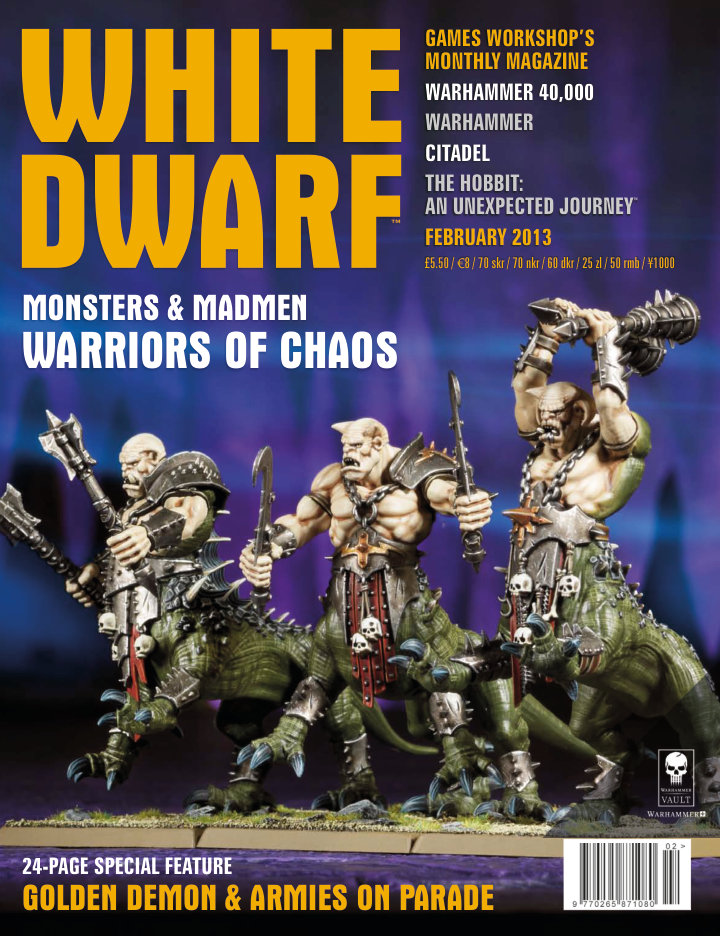
The new plastic Dragon Ogres combine heavy upper bodies with three distinct reptilian forms. Weapon choices range from paired hand weapons to enormous two-handed blades and hammers. Scarred faces, fins, scales and spines create variation while retaining the creatures’ shared identity. The review highlights their imposing size and the parts that distinguish a Shartak from the rest of the regiment.
Warhammer Fantasy BattlesWarriors of Chaos
ReviewWD 398 · pp. 12–15
A single kit produces either a horse-drawn Chaos Chariot or its heavier Gorebeast counterpart. Alternative yokes, front panels and impact weapons change the vehicle’s silhouette as well as its draught creature. Numerous heads and weapons allow the crew to show allegiance to particular gods or suggest a character mount. The review draws attention to the armour, scars and blades that make both versions look built for violence.
Warhammer Fantasy BattlesWarriors of Chaos
ReviewWD 398 · pp. 16–17
The Forsaken kit depicts warriors whose gifts have overwhelmed both body and armour. Tentacles, extra eyes, grasping limbs and emerging homunculi supply a wide range of possible mutations. Ten multipart figures can retain conventional weapons or use their altered anatomy instead. God-specific components let collectors give the regiment a chosen allegiance without sacrificing its uncontrolled variety.
Warhammer Fantasy BattlesWarriors of Chaos
ReviewWD 398 · pp. 18–19
Seb Perbet’s plastic Lord rises above ordinary warriors on a pile of shattered rock and skulls. Organic-looking armour, daemonic faces and an intensely posed weapon mark his exalted status. The review examines how parts passing behind the cloak create convincing depth despite a straightforward assembly. His commanding silhouette makes the figure an obvious focal point within a regiment.
Warhammer Fantasy BattlesWarriors of Chaos
ReviewWD 398 · pp. 20–21
The Troll King combines physical enormity with a surprisingly regal stance. Mutated mouths, embedded weapons and a cloak of trophies show his violence and resilience. His magical crown sits on a tusk because it is too small for his head. The review connects these details to a creature capable of ruling other monsters rather than merely following them.
Warhammer Fantasy BattlesWarriors of Chaos
ReviewWD 398 · pp. 22–23
The Curseling’s fused bodies turn his bargain with Tzeentch into a visible story. A muscular, enslaved warrior stands beneath the small whispering form of Vilitch himself. Ornate armour, a feathered spine and disturbing facial details distinguish him from a conventional Chaos champion. The review emphasises how the contrast between the two brothers communicates power and dependence.
Warhammer Fantasy BattlesWarriors of Chaos
ReviewWD 398 · pp. 24–27
Robin Cruddace’s army book presents Chaos through the personal ambitions of its champions. The illustrated bestiary expands the army’s monsters while linking their service to powerful warlords. An updated Eye of the Gods table gives challenges and divine attention a stronger place in play. The review combines examples of art, background and new unit abilities to explain the book’s emphasis on power sought at any cost.
Warhammer Fantasy BattlesWarriors of Chaos
ReviewWD 398 · pp. 28–29
The Chimera returns as another large plastic monster for Chaos armies. Three heads and a serpent-like tail give it a particularly overtly mutated appearance. Alongside it, the Battle Magic pack collects the spells of Tzeentch, Nurgle and Slaanesh for easier reference at the table. These short notices complete the release survey with a monster kit and a practical companion to the army book.
Warhammer Fantasy BattlesWarriors of Chaos
ReviewWD 398 · pp. 30–31
The six plastic Knights charge on running horses with their cloaks swept backwards. Elaborate armour, lances and shields retain the visual language of Rivendell. Spare components allow a Captain and banner bearer to be identified within the warband, and fallen Knights add scenic possibilities. The review highlights both the movement of the figures and their straightforward construction.
Middle-earth Strategy Battle GameRivendell
ReviewWD 398 · pp. 32–33
Twelve Dwarf veterans wear overlapping armour that almost completely conceals their bodies. Pick-hammers and throwing axes reinforce their identity as heavily equipped fighters. Individual poses range from a raised two-handed strike to a quiet, brooding stance. The review treats the austere figures as a visually durable centre for a Dwarf collection.
Middle-earth Strategy Battle GameErebor
ReviewWD 398 · pp. 34–37
Four Finecast releases develop the film’s very different characters. Elrond appears both mounted and on foot, while Radagast’s untidy clothes and hedgehog companion reinforce his life in the wild. Yazneg’s scars, bone armour and Fell Warg present a threatening hunter. The Goblin King instead combines menace and black humour in the act of throwing a terrified follower at his enemies.
Middle-earth Strategy Battle GameRivendell
ReviewWD 398 · p. 38
Andrew Kenrick reviews Josh Reynolds’ return to a relatively stripped-back Gotrek and Felix adventure. Karak Kadrin faces a Chaos siege tied to the legendary road Grimnir cut into the northern realm. The enemies’ viewpoints introduce a memorable supporting cast, alongside Ungrim and Garagrim Ironfist. Kenrick finds the combination of heroic action and dark humour reminiscent of William King’s early stories.
Warhammer Fantasy BattlesDwarfs
ReviewWD 398 · p. 39
Adam Troke examines David Annandale’s account of Yarrick’s failed pursuit of Ghazghkull. Shifts between the Commissar’s own perspective and the soldiers around him convey both his resolve and his inspiring reputation. Ghazghkull emerges through his decisions as an intelligent opponent rather than a merely powerful brute. The review praises this treatment of their rivalry without revealing the novella’s concluding turn.
Warhammer 40,000Astra Militarum
ReviewWD 398 · p. 40
Dan Harden recommends William King’s first two Gotrek and Felix omnibuses for their mix of adventure, supporting characters and black humour. Adam Troke turns to a very different narrative voice in David Annandale’s Mephiston novella. The transformed Librarian’s perspective makes the prose deliberately strange and demanding. Troke describes how attentive reading reveals the effectiveness of that approach and points to a related short story.
Warhammer Fantasy BattlesWarhammer 40,000Dwarfs
ReviewWD 398 · p. 41
A paired audio release sends the Blood Angels against a rebellious world and the Space Wolves against Dark Eldar raiders. Adam Troke praises their tactical action, characterisation and performance. Jes Bickham reviews the latest Ciaphas Cain novel, in which a Tau alliance and Tyranid attack complicate Imperial affairs. His discussion focuses on how Cain’s self-serving memoirs and Amberley Vail’s annotations sustain humour within the setting.
Warhammer 40,000Blood Angels
ReviewWD 398 · pp. 42–43
The Voss-pattern Lightning offers an angular Imperial fighter whose history reaches back to the Great Crusade. Detailed intakes, pipes and vents distinguish it within the established aircraft family. Two Legion officers provide a different scale of release: a poised Champion and a sensor-equipped Master of Signals. The latter deliberately revisits a classic early Space Marine design.
Warhammer 40,000The Horus HeresyAstra Militarum
ReviewWD 398 · p. 44
The digital Warriors of Chaos book adds navigable entries and rotating miniature galleries to the printed material. The iPad White Dwarf edition similarly expands photographs and release views. A battle-report video and additional army pictures give contemporary readers content beyond the paper issue. This notice describes those extras without treating them as material present in the supplied magazine.
Warhammer Fantasy Battles
ReviewWD 398 · p. 45
Fantasy Flight’s releases extend three different games. The City adds new cards, characters and urban opportunities to Talisman. Ark of Lost Souls sends Deathwatch characters into the Mortis Thule and includes tools for creating further space hulks. Final Testament gives Only War groups a military campaign on Hervara, broadening the issue’s coverage beyond miniature battles.
TalismanDeathwatch
ShowcaseWD 398 · pp. 50–55
Paul Gayner builds a custom chapter around worn equipment, urban bases and an ongoing hunt for a renegade Techmarine. Named characters and converted specialists make the Crimson Heralds more than a repeated colour scheme. Freehand markings extend from individual warriors to vehicles, while games and tournaments suggest the next additions. Apocalypse particularly appeals because it lets him deploy the growing collection together.
Warhammer 40,000Space Marines
EditorialWD 398 · pp. 56–57
Questions at Games Day prompt Jervis to examine the restrictions hobbyists sometimes impose on one another. He encourages collectors to choose models, colours and invented backgrounds that suit their interests. Published armies and schemes offer examples rather than exhausting the available possibilities. He also recognises that a particular club or event can impose practical restrictions, while the wider collecting hobby remains far more varied.
Battle reportWD 398 · pp. 58–73
Andrew Kenrick tests the new Chaos monsters and infantry against Jeremy Vetock’s massed Night Goblins in ruined Glumhof. Fanatics disrupt the advance, while a chain of challenges keeps Khan Kul busy killing Goblin leaders. The Slaughterbrute and Gorebeast cause substantial damage, but late reversals destroy key Chaos units. Jeremy captures four objectives to Andrew’s one, winning with only a small remnant of either army left; the debrief compares the newcomers’ performance and the importance of cheap counters.
Warhammer Fantasy BattlesWarriors of Chaos
RulesWD 398 · p. 64
The two armies fight over five remaining features of a ruined Empire town. At the end, each objective belongs to the player with the nearest non-fleeing unit. Hidden deployment prevents either commander from matching every threat with an obvious counter before the battle begins. The short scenario illustrates how terrain, a shared story and one simple objective system can produce a distinctive game.
Warhammer Fantasy Battles
ShowcaseWD 398 · pp. 74–77
Peter Hudson introduces the followers of Monodominant Inquisitor Callydia Benadice. An executioner converted from a Nurgle Lord first suggested the group, and other figures draw on priests, crusaders and penitents from 40K imagery. Naming each model and developing its background guide the choice of parts. The finished warband is intended for play, but its creator places equal value on the lengthy process of making distinctive characters.
Warhammer 40,000Inquisition
InterviewWD 398 · pp. 78–79
Paul Dainton nominates Juan Diaz’s Sternguard Veteran because it closely matches his own mental image of a Space Marine. The forward shoulder, readiness for action and restrained detail communicate experience without needing a named character. Diaz recalls developing varied poses across the Sternguard and Vanguard squads in 2008. He finds the recognition especially satisfying because it honours the successful expression of a familiar concept in an ordinary squad member.
Warhammer 40,000Space Marines
ShowcaseWD 398 · pp. 80–95
The second instalment of competition coverage selects entries from the 2012 UK Golden Demon. Detailed photographs examine freehand armour, weathered vehicles, living ammunition and elaborate scenic work. The selection includes entrants and winners across individual models, squads, monsters, duels and Young Bloods. Karol Rudyk’s Vampire on Zombie Dragon closes the gallery as Slayer Sword winner, with non-metallic armour, a glowing vial and narrative banners supporting the main figure.
Warhammer Fantasy BattlesWarhammer 40,000
ModellingWD 398 · p. 96
Dan Harden changes both the heads and posture of his bodyguard Battlesuits. The rear ends of spare seeker missiles supply a recognisable alternative to the standard heads. Recut knees and scenic rubble make the figures appear to leap across the battlefield. Older upgrade parts and saved components demonstrate how a modest bits collection can give a small unit a common visual identity.
Warhammer 40,000T’au Empire
ModellingWD 398 · p. 97
Duncan Rhodes combines Forge World Legion parts with plastic components and a repurposed Sicarius body. Small adhesive half-beads help construct the Eye of Horus, while purity seals become period-appropriate oaths of moment. A Grey Knight head and stripped-down Warp Talon claws reinforce the ancient, threatening character of the officers. The result shows how later kits can support a Heresy collection through selective use of their details.
The Horus HeresySons of Horus
ModellingWD 398 · p. 98
Adam Troke gives his converted Company Master a bodyguard representing several parts of the chapter. Ravenwing and Deathwing spare components distinguish specialists within a conventional Command Squad. A trimmed hooded head changes the Company Champion’s identity, while a winged helmet marks the Veteran leader. The article shows how a few carefully chosen parts connect the unit to the Dark Angels’ wider organisation.
Warhammer 40,000Dark Angels
ModellingWD 398 · p. 99
Matt Hutson adapts the limited anniversary Crimson Fists banner for his Imperial Fists. Filled lettering, chapter components and abundant purity seals turn a basic Command Squad into an ornate veteran unit. A spare Dreadnought head gives the Captain an individual face. The selected conversions rely on the breadth of compatible Space Marine parts, with the unusual banner providing the strongest focal point.
Warhammer 40,000Imperial Fists1 paint colour
ModellingWD 398 · p. 100
Jon Flindall expresses his custom chapter’s White Scars ancestry through blades, hairstyles and other small details. Parts from White Scars, Dark Angels, Blood Angels and Space Wolves kits give the officers varied silhouettes. Sculpted moustaches, a chapter badge and a distinctive banner complete the shared identity. The unit demonstrates how a successor can retain visible family traits while developing its own character.
Warhammer 40,000Space Marines
ModellingWD 398 · p. 101
John Bracken follows up his previously featured Captain with a matching command unit. Compatible Space Marine kits supply most changes through straightforward swaps of weapons, heads and armour parts. Grey Knight legs, Sanguinary Guard components and Death Company details create variety without heavy sculpting. Removing existing banner text leaves room for the new chapter’s own freehand work.
Warhammer 40,000Space Marines
ShowcaseWD 398 · pp. 102–103
Lee Barber’s qualifying Armies on Parade display places a converted Kult of Speed on a road through its scenic base. A Stompa and several aircraft extend the action above the vehicles. One plane has crashed, while another rests high on a landing pad and combines scavenged parts. The photographs emphasise movement, checkerboard markings and the use of vertical space.
Warhammer 40,000Orks
ShowcaseWD 398 · pp. 104–105
A snowbound Empire town provides the setting for Owen Patten’s Ogre display. Slush and a frozen stream link large monsters to the surrounding buildings. Mutations and a tentacled standard bearer give the force a clear Chaos allegiance. A carefully constructed water wheel and other scenic details make the settlement an active part of the army’s presentation.
Warhammer Fantasy BattlesOgre Kingdoms
ShowcaseWD 398 · pp. 106–107
Simon Cairns places heavily weathered Dark Angels before a substantial Imperial building. Scenic bases repeat its marble floor so the units sit naturally within the display. A Deathwing Contemptor supplies the main centrepiece, while a converted Belial evokes the Piscina campaign with an Ork trophy. The army records a version of the character made before the official release.
Warhammer 40,000Dark Angels
ShowcaseWD 398 · pp. 108–109
The winning UK Armies on Parade display presents Tyranids emerging through a jungle-covered setting. A Tyrannofex towers from a balcony and a Lictor blends into the vegetation. Tervigon and Swarmlord models give the massed creatures several strong focal points. Close photographs connect the placement of individual organisms to the impression of an advancing swarm.
Warhammer 40,000Tyranids
PaintingWD 398 · p. 110
Dan Harden gives a Dragon Ogre leathery green scales and contrasting flesh. Drybrushing the scales first keeps the roughest work away from later details. The flesh gradually shifts from green towards warmer skin and pale highlights. Dirty armour, gore and an earth-coloured wash complete a deliberately weathered creature.
Warhammer Fantasy BattlesWarriors of Chaos7 paint colours
PaintingWD 398 · p. 111
A vivid colour transition makes the Mutalith’s magical orb stand out from the army around it. Dan first tests the sequence on a small area, then blends from dark blue through turquoise into green and yellow. A violet wash is the final listed stage. Keeping the paint slightly diluted helps the successive colours merge without drying into chalky patches.
Warhammer Fantasy BattlesWarriors of Chaos6 paint colours
PaintingWD 398 · pp. 112–113
A sprayed dark basecoat and large drybrush make this scenery project quick to complete. Separate grey, brown and green sequences distinguish rocks, columns and carved skulls. The brighter central icon suggests stored energy without requiring a complex glow effect. Repeated applications of modelling snow finish the base and connect the piece to the team’s Chaos battlefield.
Warhammer Fantasy Battles10 paint colours
PaintingWD 398 · p. 114
Five recipes give mutated flesh different identities without imposing a single correct scheme. Warm Khornate tones contrast with pale Slaaneshi skin, stained Nurgle flesh and blue Tzeentchian mutations. A fifth brown sequence provides a more bestial alternative. Painting exposed flesh after the armour and weapons helps manage the figures’ many overlapping areas.
Warhammer Fantasy BattlesWarriors of Chaos19 paint colours
PaintingWD 398 · p. 115
Paul Gayner explains the freehand text and scrolls seen throughout his Crimson Heralds. Looking at small-scale document text supplies a useful pattern for convincing miniature writing. He recommends practising designs at their intended size and working outwards from the middle when placing letters. Dan demonstrates the method on a vehicle door, with a shaded parchment sequence supporting the black lettering.
Warhammer 40,000Space Marines4 paint colours
PaintingWD 398 · p. 116
Dan’s Grim Hammers combine silver armour with sombre red cloth. Gold details add variation to the metal, while pale drybrushed beards distinguish the figures’ faces from their enclosing helmets. Brown weapon hafts and a neutral base keep the palette restrained. The parallel stage tables allow each material to be completed systematically across a group of Dwarves.
Middle-earth Strategy Battle GameErebor16 paint colours
PaintingWD 398 · p. 117
The Fellowship of the Ring’s opening Elves inspire dark robes and burnished armour for the new cavalry. Dan begins with the cloak, then paints the horse before completing clothing, metal and leather. Blue-grey mixtures provide subdued highlights while turquoise shades the brass-coloured armour. Small changes to the horse’s nose and sock add character within the otherwise restrained scheme.
Middle-earth Strategy Battle GameRivendell16 paint colours
EditorialWD 398 · pp. 118–119
A request to borrow terrain reveals how mismatched and worn Jeremy’s everyday hills have become. He replaces them in one concentrated project, mixing plastic terrain with a few homemade additions. Batch painting and flocking keep the new collection visually consistent across different table layouts. The experience persuades him that ordinary battlefield features deserve attention alongside elaborate centrepieces.
CommunityWD 398 · p. 122
The School League introduces a new season of shared collecting, painting and gaming. Regional heats lead towards Warhammer World finals for school-age participants. Clubs in schools, libraries and Scout groups can use the same structure. The feature stresses sportsmanship and exchanging skills alongside tournament progress.
CommunityWD 398 · p. 124
A large feature table combines two Forge World fortresses with wrecked heavy machines and an Eldar webway gate. Its twelve-foot length supports battles beyond an ordinary gaming surface. A separate display brings Dark Angels artwork, miniatures and archival objects together. The notices record two attractions at Warhammer World during this issue’s publication period.
Warhammer 40,000Dark Angels
CommunityWD 398 · pp. 138–140
The team reports on painting projects and games in the White Dwarf bunker. Beth’s Lizardmen defeat Adam’s Orcs, while Jes’ Ogres gain revenge against Andrew’s Chaos army. The report also reveals the screen used for the issue’s hidden deployment. A converted Stonehorn, an Imperial Fists Librarian and new Ravenwing knights show how individual projects continue between the magazine’s larger features.
Warhammer Fantasy BattlesWarhammer 40,000Lizardmen
Battle reportWD 398 · p. 141
Jeremy runs a five-player Chaos Space Marine game built around teams competing for altars. Individual rewards complicate cooperation, and a secret Warp-worship phase introduces curses, gifts and betrayal. A traitorous Maulerfiend briefly attacks its own side, illustrating the intended uncertainty. Jes and Andrew tie on their personal objectives, while the account emphasises the social spectacle rather than supplying a complete scenario.
Warhammer 40,000Chaos Space Marines
InterviewWD 398 · pp. 142–144
Mark Harrison explains the Slaughterbrute’s bestial proportions and the Mutalith’s disturbing symbiosis with its vortex. Alex Hedström develops younger Dragon Ogres from the established Shaggoth design, using anatomy and raised poses to emphasise weight. Seb Perbet gives Throgg a kingly silhouette despite severe mutations. His Vilitch instead relies on complementary eyes, mouths and posture to make the brothers’ unequal relationship visible.
Warhammer Fantasy BattlesWarriors of Chaos
InterviewWD 398 · p. 145
Robin Cruddace describes the champion-centred background of his Warriors of Chaos book. Followers gather around a powerful warlord in the hope of attracting some of the same divine attention. Madmen, mutants and monsters form the organising image of the army. Collaboration with the sculptors lets details such as the Slaughterbrute’s embedded daggers become the basis of new background rather than mere decoration.
Warhammer Fantasy BattlesWarriors of Chaos
PaintingWD 398 · p. 146
Simon Adams explains the colour logic of the studio Mutalith’s vortex. He treats it as malevolent energy drawing light inward and expelling it again as Chaos power. Blues, pinks and greens deliberately depart from the established army palette to attract attention. The article supplies three named reference colours for that transition rather than a complete staged recipe.
Warhammer Fantasy BattlesWarriors of Chaos3 paint colours
InterviewWD 398 · p. 146
Alex Boyd discusses the icons created for the Warriors of Chaos book. Their starting point is crafted human wargear, subsequently altered by Chaos, which differs from objects conjured directly from magic. He admires Paul Dainton’s ability to preserve that material character within warped shapes. Small, relatively simple emblems can therefore communicate something unsettling about the army’s changing nature.
Warhammer Fantasy BattlesWarriors of Chaos
ShowcaseWD 398 · p. 147
Duncan Rhodes adds a pale, supernatural Green Knight to an ongoing Bretonnian campaign collection. Jeremy Vetock turns a plastic hill into a mine with a cut opening, filler and natural rock. Andy Clarke begins an Ogre army and recommends a rapid textured-base method. Together the projects connect personal gaming plans to both detailed character work and practical time-saving techniques.
Warhammer Fantasy BattlesBretonnia2 paint colours
InterviewWD 398 · pp. 148–149
Work in progress includes Simon Egan’s Abaddon and Loken, posed for their confrontation on Isstvan III. Blake Spence develops a Necron battlefield tile compatible with several existing weapons and a Monolith. Legion Breachers introduce shield-bearing siege infantry, while staff collections show converted Ork bikers and a Sons of Horus Terminator force. The report presents these as current projects and previews rather than completed releases.
Warhammer 40,000The Horus HeresySons of Horus
InterviewWD 398 · pp. 150–151
Adam Troke asks David Annandale about writing Yarrick and Mephiston. The Commissar’s imprisonment provides a contained story within the larger Armageddon conflict, while Mephiston calls for a stranger and more unsettling narrative voice. Annandale discusses the appeal of their mythic personalities and rivalries. His own route into the hobby began with fiction, eventually leading to a Black Dragons collection and individual characters bought for their personal appeal.
Warhammer 40,000Astra Militarum
All substantive articles, release reviews, painting guides, interviews, scenarios and showcases in the supplied February 2013 issue are indexed. Release-price listings, store directories, routine event notices, subscription forms, cover imagery and the closing quotation are excluded. Advertised digital-only extras are not assumed present. Substantive School League, terrain-display and campaign background features within the back matter are included where present; routine calendars and venue details remain excluded.