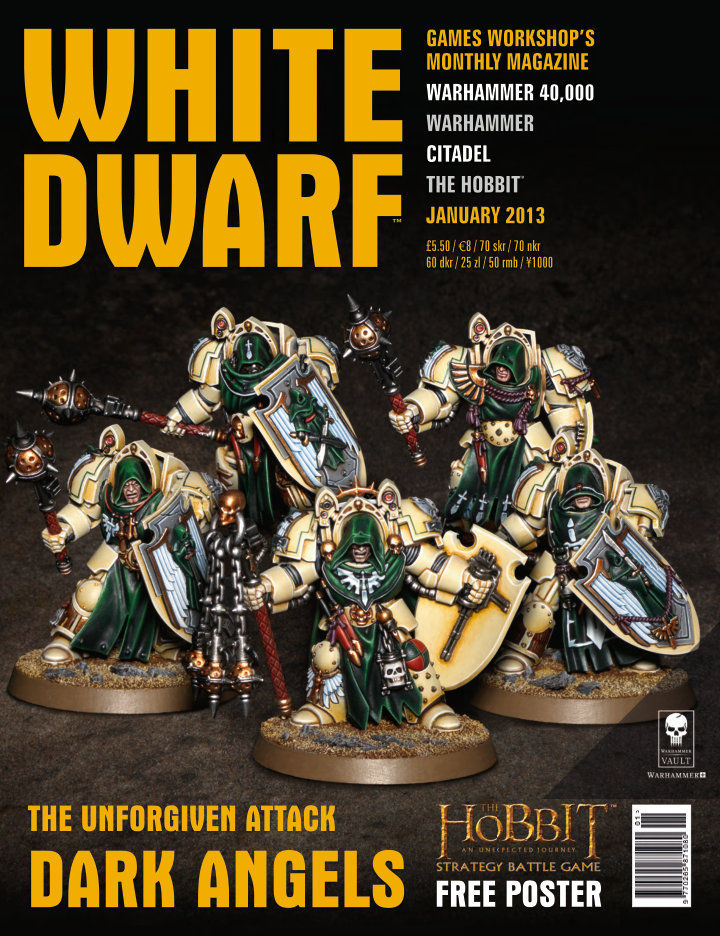
EditorialWD 397 · p. 1
Jes Bickham introduces the Dark Angels as a collision of monastic imagery, advanced weapons and ten thousand years of concealed tragedy. He connects the new codex’s history to a battle report built around hunting the Fallen, presenting background as material players can turn into their own narratives. A large international Golden Demon gallery supplies the other main attraction, showing the variety of work produced by readers around the world.
Warhammer 40,000Dark Angels
ShowcaseWD 397 · pp. 4–31
The release showcase examines how the Dark Angels’ specialist formations receive distinct models and equipment. Gothic Dark Talons and businesslike Nephilim fighters contrast with the enormous plasma battery of the Vengeance and the Caliban relic aboard the Darkshroud. Deathwing and Ravenwing command kits combine detailed banners, specialist weapons and personal heraldry, while Belial, Asmodai and the standard bearer give the Chapter’s hierarchy individual faces. The feature also revisits enduring leaders and the new codex’s visual identity.
Warhammer 40,000Dark Angels
ShowcaseWD 397 · pp. 26–29
Adam Troke reviews a codex whose artwork, borders and stories reinforce the Chapter’s tension between heroic warfare and concealment. Jeremy Vetock expands the relationship with successor Chapters and folds the new units into existing history, while the timeline combines glorious achievements with ominous events. Individual model portraits and battle scenes serve both as inspiration and colour references, with Alex Boyd’s large illustration highlighted as a particularly strong expression of the army.
Warhammer 40,000Dark Angels
ShowcaseWD 397 · pp. 32–39
The Hobbit range expands with Great Eagles and Gwaihir, whose detailed feathers, talons and contrasting flight poses give painters different large subjects. Fell Wargs supply six bodies and interchangeable heads to vary a pack, with poses emphasising their lean, dangerous nature. Riddles in the Dark instead focuses on a small dramatic scene: a nervous Bilbo confronts a lurking Gollum beside his coracle, with fine character detail supporting a standalone diorama.
Middle-earth Strategy Battle GameGreat Eagles
LoreWD 397 · p. 40
Adam reviews Gav Thorpe’s return to the Dark Angels through three viewpoints: newly promoted Ravenwing biker Annael, Tactical Marine Telemenus and Grand Master Sammael. Their different access to the Chapter’s secrets turns a series of vivid battles into questions about orders, motives and the pursuit of the Fallen. The novel begins a new Legacy of Caliban arc while rewarding familiarity with Angels of Darkness, yet is also presented as an effective standalone action story.
Warhammer 40,000Dark Angels
LoreWD 397 · p. 41
Andrew’s initial indifference to Neferata changes when Josh Reynolds frames her history through a confrontation with Arkhan at the Silver Pinnacle. Ambition drives the queen and the surrounding Vampires more powerfully than simple bloodlust, while appearances by ancient progenitors reveal the scale of their abilities. The review finds this combination of political desire, intertwined histories and spectacular violence makes a supposedly faded ruler newly compelling.
Warhammer Fantasy BattlesVampire Counts
LoreWD 397 · p. 42
Dan surveys Mike Lee’s collected trilogy as the rise of a villain who was never a fallen innocent. Its shifting chronology moves from a desert war back through Nagash’s earlier ambitions, with Arkhan’s newly developed history a particular strength of the first book. Increasing power and declining sanity make the later story disturbing, while its depth inspires Dan to consider a Tomb Kings project led by Arkhan.
Warhammer Fantasy BattlesTomb Kings
CommunityWD 397 · p. 43
The digital Dark Angels codex combines the complete army book with linked navigation, bestiaries and rotating miniature galleries. The accompanying magazine note describes battle-report video discussions, high-resolution pictures and additional gallery material beyond print. The feature presents these formats as both practical gaming references and ways to inspect models closely while planning a collection.
Warhammer 40,000Dark Angels
ShowcaseWD 397 · pp. 44–47
The revised Imperial Armour Volume One gathers Guard vehicles into a larger illustrated reference with technical profiles, history and an armoured battle-group list. New Death Guard and World Eater Contemptors display Legion-specific damage and heraldry, while command upgrades add crested helmets, communications equipment and squad vexillae to early armour marks. A final Mourngul model turns endless hunger into a disturbing floating creature clutching an Outrider’s horse, providing a very different Fantasy subject.
Warhammer 40,000The Horus HeresyImperial Guard
InterviewWD 397 · pp. 48–49
Graeme Davis and Dave Allen discuss a new Enemy Within campaign that retains the original’s themes while telling a different conspiracy story. Characters move from dirty streets and aristocratic politics to war and the Chaos Wastes, with familiar locations rewarding older players without requiring previous knowledge. The writers describe background hooks, a variable narrative device and new player resources as ways to sustain a long campaign whose exact experience differs between groups.
Warhammer Fantasy RoleplayThe Empire
ShowcaseWD 397 · pp. 54–59
Jes traces Hive Fleet Eumenides from fascination with Rogue Trader’s alien biology through successive generations of Tyranid miniatures. An original Lictor survives as Deathleaper, while converted Primes, Old One Eye and the Doom of Malan’tai fill gaps or renew favourite creatures. His clean green skin and striped brown carapace take time because they use successive layers rather than washes, but the unified army’s appearance is the lasting reward. The collection remains open-ended, driven by delight in the models as much as battlefield use.
Warhammer 40,000Tyranids
EditorialWD 397 · pp. 60–61
A young reader discouraged by comparisons with studio painting prompts Jervis to draw a parallel with Olympic athletes. People cannot control the achievements of others, but they can practise, improve their own technique and take pride in doing their best. He argues that exceptional painted models should reveal possibilities rather than invalidate a beginner’s work, and that enthusiasm and steady progress matter more than immediately reaching an elite standard.
Battle reportWD 397 · pp. 62–77
Adam Troke and Jes Bickham use their full collections in a bespoke Hunt the Fallen scenario without normal points or organisation restrictions. The Ravenwing absorb a brutal opening volley but guide a precise Deathwing arrival, while the Dark Talon supports a strike into the Chaos centre. Adam pursues the wrong characters until the hidden Biker Champion attempts to escape; a failed charge leaves him exposed, and a Chaplain captures the quarry with the final roll. Their review centres on combined Dark Angels roles and the drama generated by a small narrative rule.
Warhammer 40,000Dark Angels
RulesWD 397 · p. 68
One randomly selected Chaos character secretly represents the Fallen, known only to the defender. Dark Angels identify suspects by challenging them in melee, with a greater reward for taking the actual quarry in close combat than for shooting him anonymously. The mission adds familiar secondary objectives and a defiled aquila to an assault on a defended position, making concealment, bluffing and the choice of targets central to an otherwise straightforward battle.
Warhammer 40,000Dark Angels
TacticsWD 397 · pp. 78–81
Matt’s thunder-hammer Imperial Fists and Glenn’s halberd-equipped Grey Knights run a four-enemy gauntlet. Grey Knights kill Orks and power-armoured Marines more efficiently, while storm-shield Assault Terminators weather Lychguard attacks better; the Swarmlord destroys both. Adam then tests Deathwing Knights as another option, stressing their powerful but limited Smite mode. The results support different battlefield roles rather than a universal winner, with the Ork horde proving especially difficult for every unit.
Warhammer 40,000Imperial Fists
ModellingWD 397 · pp. 82–83
John Blanche presents models by hobbyists whose shared fascination with 40K’s stranger inhabitants has become an expanding circle of friends. Jakob Nielsen’s converted adept leads him to Peter Hudson and Mikael Silvanto, while a chance encounter reveals Scott Weightman’s Necron-infused techno-wraith. Parchment, cables, trophies and moonlit pale colours link the models to a common imaginative world without making them identical, showing how discovery and exchange can stimulate new work.
Warhammer 40,000Inquisition
InterviewWD 397 · pp. 84–85
Alan Perry nominates Brian Nelson’s Karl Franz and Deathclaw for bringing a heraldic creature and familiar Blanche image into a majestic physical form. Nelson explains the deliberate difference between the Empire’s puffed, imposing Griffon and the sleek High Elf beast, while retaining echoes of Michael Perry’s earlier rider. Sculpting at three times normal scale makes the work unusually large and detailed, particularly the individually formed feathers, before reduction to the finished kit.
Warhammer Fantasy BattlesThe Empire
ShowcaseWD 397 · pp. 86–101
A sixteen-page gallery selects winners from the German, American, Spanish and Australian Golden Demon competitions. The range spans single characters, converted vehicles, monsters, duels and whole scenes, including Sascha Buczek’s heavily weathered Dreadnought and John Shaffer’s elaborate Blood Axe Mega Dread. Category and award captions credit each painter, while the Australian section includes Mark Soley’s Slayer Sword-winning single miniature. The feature is a photographic celebration rather than a set of paint recipes.
Warhammer 40,000Warhammer Fantasy Battles
ModellingWD 397 · pp. 102–105
Dan’s Arbites precinct house combines several city kits into a tall ruined stronghold with consistent battle damage and a usable internal stair. Andrew’s Wall of Pestilence instead corrupts Imperial trenches with Chaos railings, Plaguebearer parts and textured Liquid Green Stuff to receive a rusty finish. Reader Paul Gayner contributes a Mek workshop built around a Stompa body and workshop detritus, showing how buildings can express army identity as strongly as troops.
Warhammer 40,000Adeptus Arbites
ModellingWD 397 · pp. 106–109
Dave Andrews and Mark Jones construct a ruined Dwarf hold as a reminder of lost engineering glory. Converted fortress towers, a PVC gateway, carved ancestor faces, cork cliffs and broken viaducts turn the board’s edges into a mountain stronghold, inspired by Dave Gallagher’s artwork and discussions of old grudges. The centre remains relatively open and colours stay neutral, balancing the monumental theme with a practical surface for fighting battles.
Warhammer Fantasy BattlesDwarfs
PaintingWD 397 · pp. 110–117
Eight pages of guides establish the three principal Dark Angels armour finishes, then add robes, censers, stone and bike details. A Fortress of Redemption receives separate architectural and metallic treatments, while Jes’s Tyranids show how clean successive highlights produce green skin and striped carapaces. The section ends with lightly drybrushed Eagle feathers and dark Warg fur, connecting its techniques to the featured collections and releases.
Warhammer 40,000Middle-earth Strategy Battle GameDark Angels32 paint colours
PaintingWD 397 · p. 110
The classic green armour begins with Caliban Green, receives Nuln Oil shading and then has the main plates restored with the base colour. Warpstone Glow and Moot Green define successively smaller bright edges, preserving the overall dark finish. The completed model adds Mephiston Red to the boltgun and Tactical marking, providing a controlled contrast against the green suit.
Warhammer 40,000Dark Angels5 paint colours
PaintingWD 397 · p. 111
Dan gives a Terminator sun-bleached bone armour with brown recesses and sharper white highlights than the usual warm scheme. Rakarth Flesh is shaded with Seraphim Sepia, restored, mixed with White Scar and finally edged with pure white. Stormvermin Fur stippled damage breaks up the pale plates, connecting the model’s worn surface with the background tradition of warriors painting themselves as ghosts on a death quest.
Warhammer 40,000Dark Angels4 paint colours
PaintingWD 397 · p. 112
The Ravenwing guide addresses the balance between flat black and armour highlighted so heavily it reads as grey. Dan begins with an Abaddon Black and Eshin Grey mix, darkens it with Nuln Oil and then defines the surfaces through Eshin Grey, Mechanicus Standard Grey and Dawnstone. Narrow, controlled highlights preserve the sinister black impression while revealing the rider and bike’s shapes.
Warhammer 40,000Dark Angels5 paint colours
PaintingWD 397 · p. 113
Five compact guides complete materials that recur across Dark Angels models. Cream robes develop through earthy browns into Rakarth Flesh, with red linings shaded and progressively brightened. Bronze censers acquire a turquoise stain after metallic drybrushing, stone icons move through washed greys and pale edges, and bike fairings receive a crisp off-white finish. Each sequence is also suggested for similar materials elsewhere in a collection.
Warhammer 40,000Dark Angels16 paint colours
PaintingWD 397 · pp. 114–115
Dan and Kris prepare a large Dark Angels terrain piece and divide its finish into four manageable materials. The monumental angel receives stippled pale stone and carefully drawn warm lines, while the walls use subdued grey-brown drybrushes. Decks combine shaded steel with bright drybrushing, and stippled gold tones build the brass details. The methods let varied textures remain distinct across a very large, heavily ornamented model.
Warhammer 40,000Dark Angels11 paint colours
PaintingWD 397 · p. 116
Jes’s bright Tyranid flesh uses no washes. Caliban Green forms the darkest layer, then Warpstone Glow, Warboss Green and Skarsnik Green are applied successively to smaller raised areas. The sequence builds a clean, vivid finish by controlling the placement of each highlight, matching the long-term Hive Fleet Eumenides collection shown in Army of the Month.
Warhammer 40,000Tyranids4 paint colours
PaintingWD 397 · p. 116
The carapace method mirrors Jes’s skin layering but makes each highlight narrower to suggest striated natural armour. Rhinox Hide is followed by Mournfang Brown, XV-88 and Zamesi Desert, leaving the dark base visible between the brighter marks. The brown-to-ochre progression creates a warm shell that contrasts with the green flesh while keeping repeated organisms visually consistent.
Warhammer 40,000Tyranids4 paint colours
PaintingWD 397 · p. 117
Dan uses a large drybrush with very little paint to reveal the sculpted feather texture gradually. Rhinox Hide provides the base, then Mournfang Brown, XV-88 and Baneblade Brown lighten the raised barbs without flooding the recesses. The method makes the dense surface manageable while retaining a natural brown finish across the wings.
Middle-earth Strategy Battle GameGreat Eagles4 paint colours
PaintingWD 397 · p. 117
The Warg example uses a deliberately dark palette, starting with Rhinox Hide over the whole creature and a Nuln Oil wash. The exposed skin is then restored with Rhinox Hide and highlighted with Mournfang Brown, distinguishing it from the darker coat without introducing a bright colour. The short sequence suits the dirty, sinister character of the beasts shown in the release feature.
Middle-earth Strategy Battle GameFell Wargs3 paint colours
EditorialWD 397 · pp. 118–119
Jeremy compares the pleasures of a dedicated home gaming room with visiting friends, shops and clubs. Home gives him time to prepare elaborate narrative scenarios, build specific terrain and leave large games in progress; away games require less preparation and offer a wider variety of opponents. He finds value in both carefully staged special events and straightforward battles, with the next game’s company and possibilities ultimately mattering more than its location.
CommunityWD 397 · p. 123
The local news announces new Chiswick, Enfield and Putney stores opened in the months before Christmas. Each is described as a local hub for collecting, painting and games, with staff-led activities intended to support new projects. The accompanying launch note directs attention to the returning Dark Angels and to learning how to field or oppose their new units.
CommunityWD 397 · pp. 138–141
The team’s month combines large painting projects, event preparation and informal battles. Adam expands his Dark Angels, Andrew corrupts fortifications and adds Chaos cavalry, Dan paints the tutorial models, and Erik grows his Skaven while considering Orks. Alongside doubles reports and a cave photography trip, a matched Imperial-versus-Chaos game ends in a draw when Plaguebearers hold the objective, illustrating the staff’s varied routes from collecting work to actual play.
Warhammer 40,000Warhammer Fantasy Battles
CampaignWD 397 · p. 139
Jes, Adam and Glenn explain the simple design decision behind the issue’s battle: make the Dark Angels’ defining hunt the purpose of the scenario. Drawing a character token at random creates uncertainty for the attacker, while the defender’s knowledge allows bluffing and deliberate distractions. The behind-the-scenes account describes how this limited extra information turned routine character kills into repeated moments of expectation and frustration.
Warhammer 40,000Dark Angels
CommunityWD 397 · p. 140
Matt and Glenn take their Imperial Fists and Ultramarines to another Doubles Weekend and achieve their best placing yet, with a close Iron Hands-and-Salamanders game their highlight. Robin Cruddace and Stu Black also pair Marine forces, combining Howling Griffons and Iron Hawks after a late burst of painting. All four armies receive best-force nominations, and the report emphasises preparation, enjoyable opponents and renewed collecting plans rather than providing a full tournament result table.
Warhammer 40,000Imperial Fists
InterviewWD 397 · pp. 142–145
The Dark Angels sculptors explain how Chapter organisation and battle roles drive the new range as much as monastic decoration. Deathwing and Ravenwing imagery supplies a coherent language across armour, banners and vehicles, drawing from Blanche and Gallagher artwork. Different aircraft roles, independent fire support, Caliban relics and increasingly elite equipment become visible in silhouettes and details, so the models communicate both their tactical jobs and their place within the Chapter.
Warhammer 40,000Dark Angels
InterviewWD 397 · p. 143
Dale Stringer separates the air-superiority Nephilim from the Fallen-hunting Dark Talon before defining their shared visual language. Stormtalon design cues keep them recognisably Marine, but sculpted badges, winged-sword shapes and Chapter ornament make them distinctly Dark Angels. The practical gun-and-missile fighter contrasts with the Dark Talon’s reliquaries and arcane weapons, showing how purpose changes the same underlying aircraft kit.
Warhammer 40,000Dark Angels
InterviewWD 397 · p. 144
Tom Walton explains the Vengeance as mobile fire support for Ravenwing operating beyond the main force, while the Darkshroud expresses their reverence for a surviving Caliban statue. Oliver Norman discusses how Black Knights’ rare plasma weapons, corvus hammers, elaborate armour and individual heraldry establish their enhanced status. Together the designs turn the Company’s speed, independence and secret mission into physical equipment and ornament.
Warhammer 40,000Dark Angels
InterviewWD 397 · p. 145
Martin Footitt gives the Deathwing Knights a distinct Gothic silhouette through robes, arched vents and censer-like maces. Torture tools and shrouded faces signal their place near the Chapter’s hidden centre, while a small Watcher adds a uniquely Dark Angels character. Sculpted Company banners carry visual stories too: a classic Deathwing image recalls Caliban’s fall, and the new Ravenwing design turns the hunt for treachery into an angel slaying a serpent.
Warhammer 40,000Dark Angels
InterviewWD 397 · p. 146
Jeremy Vetock presents the Dark Angels’ secrecy as a lasting wound from the Heresy rather than a superficial mystery. Levels of trust and the Inner Circle arise because the Chapter conceals its past even from its own warriors. He argues that this burden coexists with sincere heroism: the Dark Angels’ defence of humanity and their troubling willingness to pursue the Fallen are inseparable aspects of the same tragic identity.
Warhammer 40,000Dark Angels
PaintingWD 397 · p. 146
Kornel Kozak discusses a studio colour decision rather than a numbered recipe. Red robes initially seemed appropriate, but were replaced by green because the bright splash dominated the army and drew attention away from its cohesion. Brass mace heads, aged-looking shield stone and slightly lighter highlights on Belial reinforce individual status while retaining the Deathwing’s shared bone armour; no exact paint names are given.
Warhammer 40,000Dark Angels
InterviewWD 397 · p. 147
Alex Boyd describes creating illustrations around a central story rather than simply placing an army in battle. His Dark Angels-versus-Tyranids image shows Tactical Marines as the firing line, Ravenwing in motion and Deathwing symbolically at the heart. Other artwork by Mark Holmes extends the Chapter’s brooding identity into opening images and aerial combat, making pictures another means of explaining how the force operates.
Warhammer 40,000Dark Angels
ShowcaseWD 397 · pp. 148–149
The Forge World visit previews character and command sculpts for the planned Blackfire Pass project, including a Flagellant, Dwarf standard bearer and a Night Goblin Shaman lifted by a vomiting magical cloud. Work on an enormous Games Day Heresy display occupies much of the studio, with building construction and mass painting happening together. The feature records the models and display as contemporary work in progress.
Warhammer Fantasy BattlesThe Horus HeresyThe Empire
ModellingWD 397 · p. 149
Blake Spence and the studio construct a vast display of Angron’s World Eaters assaulting loyalists in ruined Choral City. Shrine of the Aquila parts form the fortress wall, with insulation foam providing structure and deep carved battle damage. Hundreds of models require widespread painting help, and Mark Bedford contributes weathered, gore-splashed Assault Marines to make the force look already immersed in the fighting on Isstvan III.
The Horus HeresyWorld Eaters
InterviewWD 397 · p. 150
Gav Thorpe explains Ravenwing as both a pursuit story and the foundation for Legacy of Caliban. The Chapter’s lie has grown so extensive that the Fallen threaten the legitimacy of everything done to conceal it, driving increasingly costly choices. Telemenus provides a lower-ranking Marine’s view of apparently arrogant Ravenwing actions, while readers with more background knowledge can recognise questions and clues that remain hidden from the characters.
Warhammer 40,000Dark Angels
InterviewWD 397 · p. 151
Josh Reynolds describes Neferata through what she wants: dominion justified by absolute belief in her own right to rule. Mike Lee’s earlier novels supply relationships and consequences for Blood of Nagash, with the Great Necromancer remaining a presence across centuries. Reynolds contrasts her subtlety with the blunt brutality of Vorag Bloodytooth and discusses favourite violent scenes, showing how individual desires keep the ancient Vampires distinct within a shared history.
Warhammer Fantasy BattlesVampire Counts