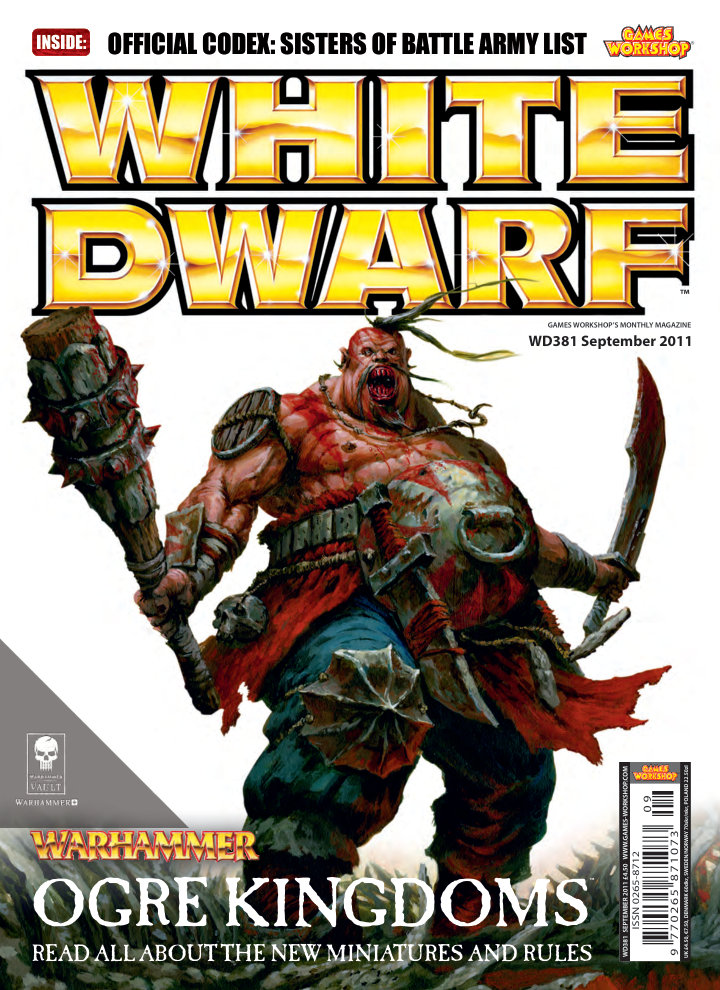
EditorialWD 381 · Inside cover
Andrew Kenrick introduces the revamped Ogre Kingdoms, whose new cavalry and enormous beasts dominate the issue’s design coverage and first battle report. The Sisters of Battle Codex concludes with its army list and a second battle against Tyranids. The editorial also points to Storm of Magic terrain, a Garden of Morr scenario and new additions to the studio’s Vampire Counts collection.
Warhammer Fantasy BattlesWarhammer 40,000
CommunityWD 381 · pp. 18–19
News announces the Shanghai Hobby Centre and further Ogre releases in Finecast, alongside previews of the Space Marine and Kill Team video games. Black Fire Pass expands Warhammer Fantasy Roleplay’s Dwarf material, while The Achilus Assault brings Deathwatch campaigns into the Jericho Reach’s active warzones. The game announcements describe their playable roles and connections without supplying tabletop rules.
Warhammer Fantasy BattlesWarhammer 40,000
InterviewWD 381 · pp. 20–29
Andy Hall talks to Jeremy Vetock, Jervis Johnson and Seb Perbet about an Ogre army rooted in a fantastical ice age. The writers expand nomadic culture and the Great Maw while the sculptors distinguish shaggy monsters through silhouette, scavenged possessions and bone construction. Rules development translates that imagery into cheaper monstrous infantry, powerful charges, varied magic and monsters with different battlefield jobs.
Warhammer Fantasy BattlesOgre Kingdoms
RulesWD 381 · p. 22
The preview supplies the Stonehorn’s full profile and principal special rules. Earth-shattering Charge replaces its normal attacks with 3D3 Impact Hits, enhanced by an especially long charge, without removing its later Thunderstomp or rider attacks. Stone Skeleton halves wounds from Multiple Wounds attacks, and the entry explains how the shared beast-rider profile differs when a Hunter takes it as a mount.
Warhammer Fantasy BattlesOgre Kingdoms
RulesWD 381 · p. 23
The Thundertusk’s preview combines two riders and a substantial monster profile with a six-inch aura that gives enemy models Always Strikes Last. Its smooth gait removes the moving-and-shooting penalty for the riders, while its sphere of ice acts as a mobile short-ranged stone thrower. A misfire simply prevents that attack for the turn, distinguishing its ranged support role from the Stonehorn’s charge.
Warhammer Fantasy BattlesOgre Kingdoms
InterviewWD 381 · p. 24
Seb Perbet explains how a prehistoric theme shaped the new Ogre kits and the designs passed to Martin Footitt and Colin Grayson. Shared parts do not prevent the Stonehorn and Thundertusk from having clearly different silhouettes, and their baggage suggests tribes taking everything with them as they migrate. Spare Hunter components can also be combined with Ogre legs to create another complete character.
Warhammer Fantasy BattlesOgre Kingdoms
InterviewWD 381 · pp. 25–28
Jervis Johnson describes making an army of large creatures coherent and balanced while preserving its intimidating appearance. Reduced infantry costs encourage substantial units, whose Ogre Charge gains strength from ranks and more impact on a long charge. He contrasts the Stonehorn’s violence with the Thundertusk’s support aura, discusses the Great Maw’s augmentations and alternative magical traditions, and gives Maneaters flexible special rules to reflect their travels.
Warhammer Fantasy BattlesOgre Kingdoms
TacticsWD 381 · p. 29
Kevin Chin’s 2,000-point force follows a frosty theme through Ironguts with the Dragonhide Banner, Yhetees and a Thundertusk. The banner and the monster’s chill help Ogre units strike effectively after their crushing charge. A Slaughtermaster supplies Great Maw magic, an exceptionally strong Bruiser threatens hard targets, and Leadbelchers add unpredictable shooting against elite troops.
Warhammer Fantasy BattlesOgre Kingdoms
Battle reportWD 381 · pp. 32–33
Andrew Kenrick and Matt Hutson compare two powerful characters through three duels, each using a different equipment combination under a 300-point ceiling. The Chaos Lord wins in Lustria, but the Oldblood’s defensive modifiers and counterattack level the contest in the north. A prolonged final fight eventually favours the Saurus, illustrating how equipment, potion timing and sustained resilience alter a supposedly simple comparison of profiles.
Warhammer Fantasy BattlesWarriors of Chaos
TacticsWD 381 · pp. 34–39
Simon Grant divides Middle-earth’s monsters into bulwarks, monstrous heroes, flyers and monstrous mounts, noting that some creatures combine several roles. Each category needs more than a strong profile: protection from being trapped, support from Might and careful target selection can preserve an expensive model’s usefulness. A final section considers when ordinary troops should kill a monster and when the scenario makes delaying or ignoring it the better choice.
Middle-earth Strategy Battle Game
TacticsWD 381 · p. 35
Trolls, Ents and Cave Drakes can spearhead an attack, reinforce a weak line or hunt a lesser hero, but their flanks must be protected against trapping. Supporting warriors prevent the enemy wrapping around them, while a cheap captain can lend a Heroic Combat or Heroic Move. The illustrated Troll attack shows how nearby Orcs can screen the monster even when they cannot themselves charge.
Middle-earth Strategy Battle GameMordor
TacticsWD 381 · p. 36
Monstrous heroes can operate independently but rapidly spend Might and Fate if unsupported, so Simon Grant recommends treating them as better-protected bulwarks where possible. Superior Fight values make opposing heroes and monsters attractive targets, and personal magic such as Transfix can improve the matchup. The Ringwraith example combines Compel, flight and a later Heroic Move to isolate a cavalry leader and then disrupt his followers.
Middle-earth Strategy Battle GameMordor
TacticsWD 381 · p. 37
Flying monsters can bypass a battleline to attack banners, fragile supporting heroes and exposed archers. A Heroic Combat may provide either a second strike or a route back to safety, but powerful enemy Wizards remain risky targets. Dragons and resilient Ringwraiths can sustain independent attacks, whereas Ghûlavar needs cover on the approach because wounds also diminish his offensive power.
Middle-earth Strategy Battle GameAngmar
TacticsWD 381 · p. 38
A charging monstrous mount can knock down cavalry as well as infantry, removing both an enemy’s immediate fighting advantage and its horse. Spider Queen and Shelob combine comparable pounce bonuses with venom, while inexpensive Khandish chariots provide another way to counter riders. The Mûmak example recommends trampling vulnerable warriors beside Dáin instead of allowing his exceptional resilience to stop the entire charge.
Middle-earth Strategy Battle GameHarad
TacticsWD 381 · p. 39
Before committing troops, Simon Grant asks whether killing a monster is actually necessary for victory. If it is, shooting offers low-risk damage and numerical pressure can trap the creature, while breaking its army may force a poor-Courage monster to flee. Immobilise followed by a lance charge gives a controlled attack; Adam Troke’s example also traps a terrifying enemy with nearby models that never enter combat and therefore avoid Courage tests.
Middle-earth Strategy Battle Game
TacticsWD 381 · pp. 40–41
Simon Grant examines the alien entourage that an Archon trusts more readily than fellow Dark Eldar. A minimal court and Archon can ride a Venom, while a larger Raider-borne group gains durability and hitting power. Lhamaean poison, Medusae template attacks, resilient four-armed Sslyths and charging Ur-Ghuls supply different functions, with background explaining why each finds a place at the heart of Commorragh’s treacherous politics.
Warhammer 40,000Dark Eldar
Battle reportWD 381 · pp. 42–61
Robin Cruddace’s Tomb Kings pursue Jeremy Vetock’s Ogres in a 3,000-point battle over a sacred dagger that a Maneater has turned into a replacement tooth. Exploding lava pits complicate a brutal contest between sphinxes and the new Ogre monsters. Early Undead successes give way to Golgfag’s destruction of the Necrosphinx and Hierophant, the Tomb King’s death against an Ironblaster crewman and the army’s subsequent collapse. The Ogres retain the relic and win 3,508 victory points to 2,335.
Warhammer Fantasy BattlesTomb Kings
RulesWD 381 · p. 48
Jeremy Vetock’s scenario adds five impassable lava pits and a portable relic to a six-turn victory-point battle. A randomly selected pit hurls a flaming template each player turn, while the stolen object grants 500 extra points to its final owner. The page explains how the objective passes when its bearer dies or flees and how other armies can replace the Ogre thief with a suitably named ordinary Hero.
Warhammer Fantasy Battles
ModellingWD 381 · p. 48
Chad Mierzwa turns Moonscape craters into bubbling volcanic terrain with filler, impressions made by different brush handles and half-beads from a modelling shop. The combination produces depressions and raised bubbles before the piece is painted in volcanic colours. This is a construction method rather than a named colour recipe.
Warhammer Fantasy Battles
ShowcaseWD 381 · pp. 62–65
Studio painters emphasise the Ogres’ scavenged equipment, crude tattoos, rust and appetite while giving individual figures distinct focal points. Joe Tomaszewski’s Butcher uses a pale apron to frame gore, Anja Wettergren studies reflected fire on a Firebelly, and Neil Green repeats banner designs on gut plates. Mark Holmes experiments with translucent-looking ice, Darren Latham contrasts bronze artillery with grey fur, and a red Stonehorn follows Kevin Chin’s artwork. No named paint recipes accompany the showcase.
Warhammer Fantasy BattlesOgre Kingdoms
ModellingWD 381 · pp. 68–73
The Hobby Team combines scenery kits to show buildings and fulcrums torn apart by a magical storm. A Dreadfire Throne mixes two fulcrum kits, a Balewind Vortex rises from a crater, and stacked stairs or a throne emerging from ruins stretch their silhouettes. Broken Temple of Skulls pieces and Chris Peach’s towering battlefield extend the approach into a complete landscape, with construction captions explaining the components rather than giving paint recipes.
Warhammer Fantasy Battles
ModellingWD 381 · pp. 72–73
Chris Peach’s Storm of Magic board uses unusually tall towers and a central magic circle to create a whole battlefield in upheaval. Dreadstone Blight and Witchfate Tor components are stacked or inverted to balance battlements, Garden of Morr walls form courtyards and a Fortified Manor section provides a firing platform. Although only four pieces are designated fulcrums, the surrounding terrain offers several convincing alternatives for larger games.
Warhammer Fantasy Battles
RulesWD 381 · pp. 74–75
Jervis Johnson’s scenario asks an attacker to seize a graveyard before delayed defenders can reinforce it. Victory depends on the number of models inside the Garden when a variable-length game ends, encouraging determined entry and sacrificial delaying tactics. A free Priest of Morr supports the defenders with Stubborn and bound Death prayers, while Death or Vampire Wizards gain stronger channelling inside the grounds and Raise Dead produces extra Zombies there.
Warhammer Fantasy Battles
ShowcaseWD 381 · pp. 76–81
Chad Mierzwa expands the studio’s Vampire Counts army with a Terrorgheist, a Tomb Banshee and four Cairn Wraiths. The blue-grey and bone palette continues the previous force, while miniature dioramas hidden within multi-bases reward close inspection. A new Ghoul King displaces Malochai as army leader, turning a change in legal army composition into the story of Braellion the Usurper and suggesting future additions through that rivalry.
Warhammer Fantasy BattlesVampire Counts
PaintingWD 381 · p. 78
Chad Mierzwa builds the Terrorgheist’s bone from Khemri Brown through progressively lighter Bleached Bone mixtures. A flesh-and-brown wash is placed in the recesses, then fine pale lines along the bones give their large surfaces texture without flattening the shadows. The accompanying Ghoul King uses three grey stages, keeping its flesh tied to the army’s subdued blue-grey scheme.
Warhammer Fantasy BattlesVampire Counts8 paint colours
PaintingWD 381 · p. 79
A Chaos Black cloak receives increasingly pale blue-grey line highlights, with Badab Black restored to the recesses to keep the overall appearance dark. A different grey-brown edging and bronze studs separate the hood’s details. Bleached Bone, a flesh wash and a white-bone highlight make the skull and hands a bright focal point within the cowl.
Warhammer Fantasy BattlesVampire Counts10 paint colours
PaintingWD 381 · p. 79
The scythe begins with Scorched Brown, then receives uneven stippling of Bestial Brown and an orange-brown mixture to build corrosion. A fine Mithril Silver edge suggests exposed metal beneath the rust, while Charadon Granite establishes the staff. The method deliberately uses a broken surface rather than smooth coverage to distinguish decayed iron from the Wraith’s cloth and bone.
Warhammer Fantasy BattlesVampire Counts5 paint colours
RulesWD 381 · p. 81
The expanded collection is presented as a 2,660-point army led by Braellion on his Terrorgheist, with Malochai reduced to a supporting Vampire. Skeletons, Ghouls and Zombies supply the core, alongside Grave Guard, a Varghulf and four Cairn Wraiths. The accompanying explanation uses the Lords allowance to justify the change of commander and develops the consequences as a narrative for later collecting.
Warhammer Fantasy BattlesVampire Counts
RulesWD 381 · pp. 82–93
The concluding instalment turns August’s unit rules into a playable army with points, equipment options and Force Organisation categories. It covers characters, infantry, transports and support vehicles, then defines the Sisterhood’s distinctive wargear and supplies reference profiles. The text explicitly directs readers to issue 380 for the background and special rules, so the two parts together form the replacement Codex.
Warhammer 40,000Adepta Sororitas
RulesWD 381 · p. 84
The selection guide explains how a scenario’s Force Organisation chart controls compulsory and optional choices, and how each unit entry separates composition, profile, equipment and upgrades. Unique characters are limited to one, while dedicated transports act independently without using their own chart slot. The page also clarifies exchanges phrased as and/or, which may replace either weapon or both when the appropriate cost is paid.
Warhammer 40,000Adepta Sororitas
RulesWD 381 · pp. 85–87
The headquarters list prices Celestine, a configurable Canoness, Kyrinov, Jacobus and a generic Confessor. Each Canoness can unlock a Command Squad outside the normal HQ allocation, while the clerical leaders can bring a mixed Battle Conclave of Arco-flagellants, Crusaders and Death Cult Assassins. Their equipment and transport options allow a force to emphasise faith support, close combat or specialist firepower.
Warhammer 40,000Adepta Sororitas
RulesWD 381 · pp. 87–88
Up to five Ecclesiarchy Preachers can be included without occupying Force Organisation slots, but remain separate Elite units. Celestian squads can grow from five to ten models and mix special and heavy weapons, while Repentia expand their eviscerator-armed body around a Mistress of Repentance. The listed costs and upgrade limits distinguish the two fighting units from their August rules descriptions.
Warhammer 40,000Adepta Sororitas
RulesWD 381 · p. 89
Battle Sister squads begin at ten models and may expand to twenty, with separate allowances for special or heavy weapons and a simulacrum. The same page prices the ten-seat Rhino and six-seat Immolator, including vehicle upgrades and alternatives to the Immolator’s standard twin-linked heavy flamer. It supplies the practical transport and equipment choices needed to turn the core infantry entry into a legal selection.
Warhammer 40,000Adepta Sororitas
RulesWD 381 · p. 90
Seraphim and Dominion squads both expand from five to ten models but spend their upgrade allowances differently. Seraphim may equip paired hand flamers or inferno pistols, while Dominion special-weapon capacity scales with squad size. Superior equipment, faith-support items and transport access complete the entries, allowing players to choose between jump-infantry mobility and a Scout unit’s concentrated fire.
Warhammer 40,000Adepta Sororitas
RulesWD 381 · p. 91
Retributors can field up to four heavy weapons within an expandable squad, supported by optional faith equipment and a transport. The Exorcist is priced as an individual tank, while Penitent Engines may be bought in a group of up to three. Their profiles, standard gear and optional vehicle upgrades complete the army’s ranged and assault support choices.
Warhammer 40,000Adepta Sororitas
RulesWD 381 · pp. 92–93
The wargear page defines faith-support relics and distinctive weapons: a laud hailer can recover a Faith point, a simulacrum repeats failed Acts of Faith and a Hospitaller’s tools grant Feel No Pain. It also explains the condemnor boltgun’s psychic stake, neural whips, banners, eviscerators and vehicle equipment. The reference page gathers weapon statistics, including the Exorcist launcher’s variable missile output, alongside infantry and vehicle profiles.
Warhammer 40,000Adepta Sororitas
Battle reportWD 381 · pp. 96–103
Robin Cruddace’s Sisters of Battle defend a Fortress of Redemption against Tom Hutchings’ Tyranids in a 1,500-point Seize Ground battle. An early Seraphim mishap and a Trygon appearing within the defence strain the Sisters, but Acts of Faith and Exorcist missiles restore their firing line. Delayed Genestealers arrive against troops already protected by cover and Jacobus, while late moves contest Tyranid-held ground. The Sisters finish with two objectives against one, and Robin credits the fortress, faith and favourable saves rather than an effortless victory.
Warhammer 40,000Adepta Sororitas
CommunityWD 381 · pp. 106–107
Rik Turner gathers final previews of Games Day’s reading, gaming and creative activities. Black Library plans author appearances and a larger anthology, while Warhammer World staff describe Storm of Magic art contests, timed Scrap Demon conversions, campaign tables, demonstrations and an archive exhibition. The feature links organised participation with the chance to see older miniatures and original artwork, rather than merely listing ticket details.