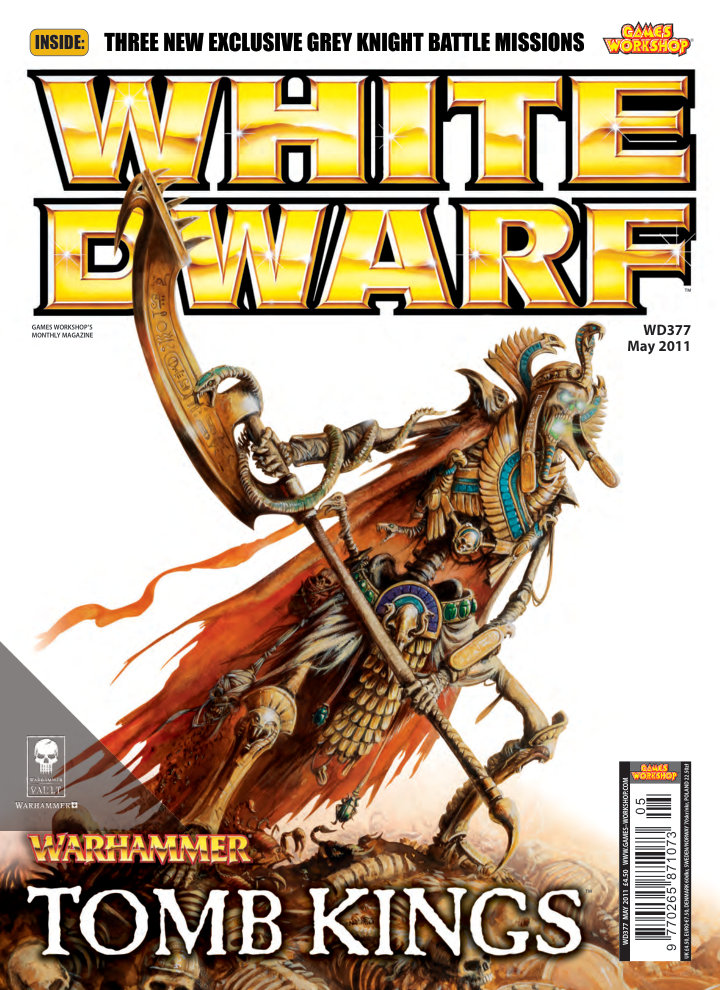
EditorialWD 377 · Inside cover
Andrew Kenrick introduces the Tomb Kings as an army that combines two defining Warhammer pleasures: magic and enormous monsters. Their new book and kits shape the design interviews, battle and painting features, while three Grey Knight missions and ideas for greenskin tribes broaden the issue. As a Tomb Kings collector himself, Kenrick admits that choosing between the alternate builds may simply lead him to acquire both.
Warhammer Fantasy BattlesWarhammer 40,000Tomb Kings
CommunityWD 377 · pp. 12–13
Age of Darkness moves the Horus Heresy anthology series beyond the opening betrayals, spotlighting Guilliman, the Lion and other less-covered characters and Legions. The roleplaying previews introduce Rogue Trader’s Battlefleet Koronus and Warhammer Fantasy Roleplay’s The Witch’s Song. Armies on Parade, international store expansion and the Miniatures Hall refurbishment provide a snapshot of the wider hobby in May 2011.
Warhammer 40,000Warhammer Fantasy Battles
InterviewWD 377 · pp. 14–27
Andy Hall asks Robin Cruddace, Mark Harrison and Mike Anderson how they rebuilt the Tomb Kings around the clear idea of skeletons and statues. Unlike mindless undead, the soldiers retain fragments of their former selves and the mummified rulers preserve bitter ambitions. New constructs add height and variety to the army, while the sculptors draw on several ancient cultures, stylised anatomy and shared carved motifs to create flexible sphinx and serpent kits.
Warhammer Fantasy BattlesTomb Kings
RulesWD 377 · pp. 16–17
The Warsphinx combines an enormously tough animated statue with separately attacking Tomb Guard crew. Its optional Thundercrush replaces ordinary attacks with a template strike that can flatten infantry and inflict a particularly powerful hit beneath the central hole, while still allowing a Thunderstomp. The full howdah rules explain the combined model’s characteristics and how a mounted Tomb King or Prince changes shooting allocation.
Warhammer Fantasy BattlesTomb Kings
LoreWD 377 · p. 22
Veteran Tomb Guard whose bloodlust threatens their discipline can offer themselves to Qu’aph rather than suffer exile. Their embalmed remains rest beneath Necroserpent statues, and the same warrior spirit later animates mount and rider as one. The accompanying account of Sepulchral Stalkers describes forgotten border guardians emerging from the sand to turn intruders into drifting grains.
Warhammer Fantasy BattlesTomb Kings
TacticsWD 377 · p. 25
Andrew Kenrick explains how his existing skeleton army benefits from the new book without abandoning its core. Multiple Liche Priests and a Casket of Souls fuel augment spells whose lore attribute also restores casualties, while Kings and Princes lend their Weapon Skill to otherwise unimpressive infantry. The result is a battleline supported by both repeated magical repair and the personal authority of its rulers.
Warhammer Fantasy BattlesTomb Kings
TacticsWD 377 · p. 26
Khalida’s 2,496-point army puts more than 160 Skeletons into a durable force intended to win through attrition. Two Liche Priests replenish the ranks, while multiple bound spells and a Casket provide an unusually broad magical toolkit. Khalida can move from her archers into a combat unit when her personal attacks matter more, allowing the Hierophant to withdraw into relative safety.
Warhammer Fantasy BattlesTomb Kings
TacticsWD 377 · p. 27
This 2,498-point legion concentrates on mobile chariots, cavalry, flying models and animated monsters rather than a slow infantry mass. Disruptive horse archers and Carrion prepare the enemy for the main hammer blow, while a mounted Death wizard threatens vulnerable targets with powerful spells. The list aims to close quickly despite the army’s inability to march and uses its magic to support an aggressive, unconventional Tomb Kings force.
Warhammer Fantasy BattlesTomb Kings
InterviewWD 377 · pp. 28–33
Andy Hall discusses Tomb Kings art with Paul Dainton, Alex Boyd and Kevin Chin, showing how illustration adds context beyond the models. John Blanche’s earlier monsters helped inspire the new range, while later paintings combine recognisable kits with mysterious silhouettes and disturbing desert life. Gold, ancient equipment and visible sorcery distinguish this resplendent undead civilisation; open skeletal mouths add a silent, unnatural sense of menace.
Warhammer Fantasy BattlesTomb Kings
InterviewWD 377 · pp. 34–35
Mark Harrison nominates the Eldrad model that drew him into the hobby in 1994, praising both its enduring detail and striking silhouette. Jes Goodwin explains how a triangular composition compensated for the shallow depth required by a one-piece mould, and how the figure introduced more elaborate surfaces to the Eldar range. A companion gallery places Eldrad beside Goodwin’s other famous Eldar characters.
Warhammer 40,000Eldar
RulesWD 377 · pp. 37–43
Three official missions express the Grey Knights’ need to prevent incursions with small, decisive forces and their readiness to perform ruthless containment afterward. Players can substitute these missions for the Space Marine results in the Battle Missions selection methods. Each creates a different pressure: killing an increasingly powerful host, timing a prepared teleport ambush or exterminating every surviving witness before time expires.
Warhammer 40,000Grey Knights
RulesWD 377 · pp. 38–39
Grey Knights enter from the long edges or teleport into a centrally deployed enemy army to kill a secretly designated HQ Daemonvessel. The target becomes stronger every turn and gains supernatural protection, so delay makes the task progressively harder. Killing it grants bonus kill points but is also mandatory: if it survives, the Grey Knights lose regardless of the wider casualty count.
Warhammer 40,000Grey Knights
RulesWD 377 · pp. 40–41
Half the Grey Knight force prepares an ambush while the remainder waits to arrive together on a secretly chosen early turn. Four teleport beacons allow precise reinforcement placement but can be destroyed as immobile artillery pieces. Ordinary kill points decide the battle, making the timing and preservation of the beacon network central to preventing an unwitting commander from triggering a future daemonic disaster.
Warhammer 40,000Grey Knights
RulesWD 377 · pp. 42–43
A valuable world is spared Exterminatus only at the cost of eliminating its population and defenders. The enemy deploys centrally while the Grey Knights surround them, and every non-HQ Grey Knight unit destroyed returns to reserve to sustain the attack. The defenders need only retain a model on the board when time runs out; the attackers must achieve complete extermination.
Warhammer 40,000Grey Knights
LoreWD 377 · pp. 44–45
A respected Catachan battalion unknowingly carries a dormant daemonic virus after a successful mission on Vangol III. Brother-Captain Tromos attacks before the corruption can mature, destroying the soldiers’ evacuation attempt and bringing Paladins directly against Colonel Mager. The officer dies resisting enemies he never understands, while Interceptors hunt down escapees in the jungle to complete the grim quarantine.
Warhammer 40,000Grey Knights
LoreWD 377 · pp. 46–51
Jeremy Vetock describes greenskin society as a hierarchy of mobs, tribes and Waaaghs! held together through violence, tests of strength and shared pride. Tribal markings identify allies without necessarily preventing them from fighting, and reputations can grow through great victories or spectacular incompetence. Naming conventions and examples from his own collection show how players can make a changing army list feel like a persistent tribe with remembered leaders and grudges.
Warhammer Fantasy BattlesOrcs & Goblins
LoreWD 377 · p. 49
Da Krawlas haunt the Forest of Shadows, emerging without warning on their spiders with piercing warcries and distinctive black-and-white feathers. Their overgrown, many-eyed Shaman Garlobbo rides the Arachnarok Black Deff, treated as a living god. The destruction of Glumhof and the slaying of the Ghorgon Marrowfeast establish the tribe’s terrifying local reputation.
Warhammer Fantasy BattlesOrcs & Goblins
LoreWD 377 · p. 51
Snazgit Nosepicka’s nomadic traders combine deceptive deals with outright theft, carrying their spoils between distant tribes. Savage Orcs are favoured victims because bright dyes and trinkets distract them while other Goblins steal everything available. Their overloaded chariots and scavenged equipment offer a distinctive collecting theme based on dishonest commerce rather than a single battle speciality.
Warhammer Fantasy BattlesOrcs & Goblins
ModellingWD 377 · pp. 54–61
Duncan Rhodes and Chad Mierzwa adapt Arcane Ruins and Temple of Skulls kits into a coherent Nehekharan battlefield. Buried masonry, obelisks, ruined temples and a desert gameboard suggest a lost civilisation, while matching turquoise and gold details connect the terrain to the Tomb Kings army. Practical construction and painting sequences lead into a short battle story showing how a central monument can supply a setting and reason for conflict.
Warhammer Fantasy BattlesTomb Kings16 paint colours
PaintingWD 377 · p. 55
Chad turns a few Arcane Ruins components into a half-buried fallen arch and uses colour to link it to both army and battlefield. Dark stone receives successive grey drybrushes and a brown wash; brown sand is overbrushed and highlighted toward pale yellow. Turquoise panels and shaded metallic gold provide small accents, while dusty earth and bone around the lowest recesses imply centuries of wind-blown sand.
Warhammer Fantasy BattlesTomb Kings14 paint colours
PaintingWD 377 · p. 56
The eight-stage board method establishes a brown foundation before separately developing grey-brown rocks, yellow sand and dark skull pits. Uneven overbrushing avoids a uniform surface, then pale mixtures unify the sand and exposed stone through weathering. The pits receive progressively brighter brown, bone and white skulls above black recesses, retaining contrast within an otherwise sun-bleached desert.
Warhammer Fantasy BattlesTomb Kings10 paint colours
ModellingWD 377 · p. 57
Leftover pillars become broken obstacles and paired horned-skull decorations crown a new obelisk, making useful scenery from otherwise spare components. Sand applied over parts of the columns suggests burial and desert erosion rather than freshly placed ruins. Additions from the Giant kit give another monument the character of a Nehekharan Bane Stone or Sinister Statue.
Warhammer Fantasy BattlesTomb Kings
ModellingWD 377 · p. 58
Duncan creates a temple centrepiece from two Arcane Ruins sets and a Temple of Skulls, using one ruin base as the upper structure and another as its roof. Plasticard and filler bridge mismatched shapes, while trimmed stairs become a second entrance. Replacing spiked Chaos pillars and adding Tomb Kings shields, banners and fallen heroes’ skulls changes the structure’s cultural identity.
Warhammer Fantasy BattlesTomb Kings
ModellingWD 377 · p. 59
Chad conceals a Temple of Skulls’ Chaos star beneath a carefully cut movement-tray floor, blending the new surface with filler. An obelisk, banner ornament and extra skulls establish the ruin as Nehekharan. Brown skulls and tiles, turquoise checks, pale drybrushing and dusty recess washes give the converted monument an aged desert finish.
Warhammer Fantasy BattlesTomb Kings5 paint colours
LoreWD 377 · pp. 60–61
Skaven Warlord Stabitt Lashtail seeks warpstone beneath a sacred monument near Numas, obtaining Clan Skryre machinery to help seize it. The defenders answer his bombardment with emerging Tomb Scorpions before King Rhamotep challenges the Warlord atop the ruins. Neither leader’s remains are found, leaving the Council uncertain whether the expedition failed or its commander escaped with the prize.
Warhammer Fantasy BattlesTomb Kings
Battle reportWD 377 · pp. 62–83
Adam Troke’s 2,998-point High Elves challenge Robin Cruddace’s 2,997-point Tomb Kings in Battle for the Pass. Drinking from a Wyrding Well disables both Elf Mages at a critical moment, and resurrection, tough war statues and delayed but deadly Stalkers gradually unravel the Elven line. Temakador’s Dragon eventually defeats the Necrosphinx but spends too long trapped in the struggle; the Tomb Kings win 2,525 to 1,714, prompting Adam to reconsider unnecessary risks and the absence of a battle standard.
Warhammer Fantasy BattlesTomb Kings
EditorialWD 377 · pp. 84–85
Inspired by Desert Island Discs, Jervis Johnson chooses miniatures linked to important periods of his hobby and working life. A bone-armoured Chaos Warrior recalls Citadel’s early identity, modern Tactical Marines inherit RTB01’s revolutionary flexibility, and Goblins evoke the risk and success of the first fully equipped Warhammer starter box. Morg ’N Thorg represents his maturation as a designer through third-edition Blood Bowl; the remaining choices are deferred to the next issue.
Warhammer Fantasy BattlesWarhammer 40,000
ShowcaseWD 377 · pp. 88–93
Joe Tomaszewski explains the team’s aim to depict ancient splendour rather than the grime of other undead. Burnished gold, muted red, pale bone and neutral blue support intricate hieroglyphs, varied shields and differently coloured stone constructs. Anja Wettergren’s Warsphinx and Joe’s Necrosphinx receive elaborate marble finishes, while real ancient weapons provide reference for verdigris and careful material contrasts keep the army richly varied.
Warhammer Fantasy BattlesTomb Kings
PaintingWD 377 · pp. 96–103
Duncan Rhodes takes a short army-book story as the foundation for a force from Numas, adopting its disciplined regiments, crimson banners and scarlet Warsphinx. He builds infantry directly on planned movement trays and paints one stage across a complete unit at a time. Simple bone-and-bronze recipes leave room for more individual shield work, while a movable King, separate chariot components and a mounted Priest’s bodyguard support the army’s practical use.
Warhammer Fantasy BattlesTomb Kings11 paint colours
LoreWD 377 · p. 97
Imrathepis wins fame beside Alcadizaar and later resumes his conquests as the Crimson King of Numas. His arrogance leads him into an Ogre ambush in Daggertooth Valley, where stampeding Rhinoxes destroy his legion and the isolated king is overwhelmed. His heir Rakaph III later avenges him by sending a dozen Warsphinxes to trigger an avalanche over the Thunderhoof tribe’s lair.
Warhammer Fantasy BattlesTomb Kings
PaintingWD 377 · pp. 98–99
Dheneb Stone sprayed over the assembled models forms the foundation for a rapid bone recipe, with Tin Bitz metal and Mechrite Red details. A generous Devlan Mud wash gives definition before pale bone mixtures, silver edges and brighter red restore the highlights. Numbered positions keep the regiment easy to reassemble, while repeated scorpion or serpent motifs unify individually decorated shields painted before removal from their frames.
Warhammer Fantasy BattlesTomb Kings7 paint colours
PaintingWD 377 · p. 100
Twenty Tomb Guard form the King’s bodyguard and use the Skeleton Warriors’ painting method, with a final khaki edge making their crimson details more vivid. Regimental bases simplify deployment of the completed unit. A pin in the King’s foot fits matching holes in his base and the Warsphinx howdah, allowing the same figure to represent either the heir on foot or the mounted Crimson King.
Warhammer Fantasy BattlesTomb Kings8 paint colours
PaintingWD 377 · p. 101
Duncan interprets the story’s scarlet flanks by extending red across the Warsphinx’s stone body. Raised areas begin in Scab Red, receive two substantial Baal Red washes, then gain sharper red and orange highlights. Dull bronze fittings contrast with the vivid stone, distinguishing this named dynasty’s beast from the marble and obsidian of the studio army.
Warhammer Fantasy BattlesTomb Kings5 paint colours
ModellingWD 377 · p. 102
Duncan builds the horses, chariot bodies and crew separately so that difficult undersides remain accessible and messy skeletal work cannot spoil finished panels. Alongside this practical approach, Chris Peach develops an opposing Ogre force inspired by the same Crimson King story. Borrowed Tomb Kings components decorate its bases and equipment, while pink skin suggests the tribe’s exposure to the desert sun.
Warhammer Fantasy BattlesTomb Kings
PaintingWD 377 · p. 103
A mounted Liche Priest receives a dedicated cavalry bodyguard, while a second Priest on foot serves as Hierophant. Duncan paints riders and steeds together because both use the same bone method as the infantry. A recurring eye motif links the shields, with the champion distinguished by a sword and a more elaborate arrangement of hieroglyphs.
Warhammer Fantasy BattlesTomb Kings7 paint colours