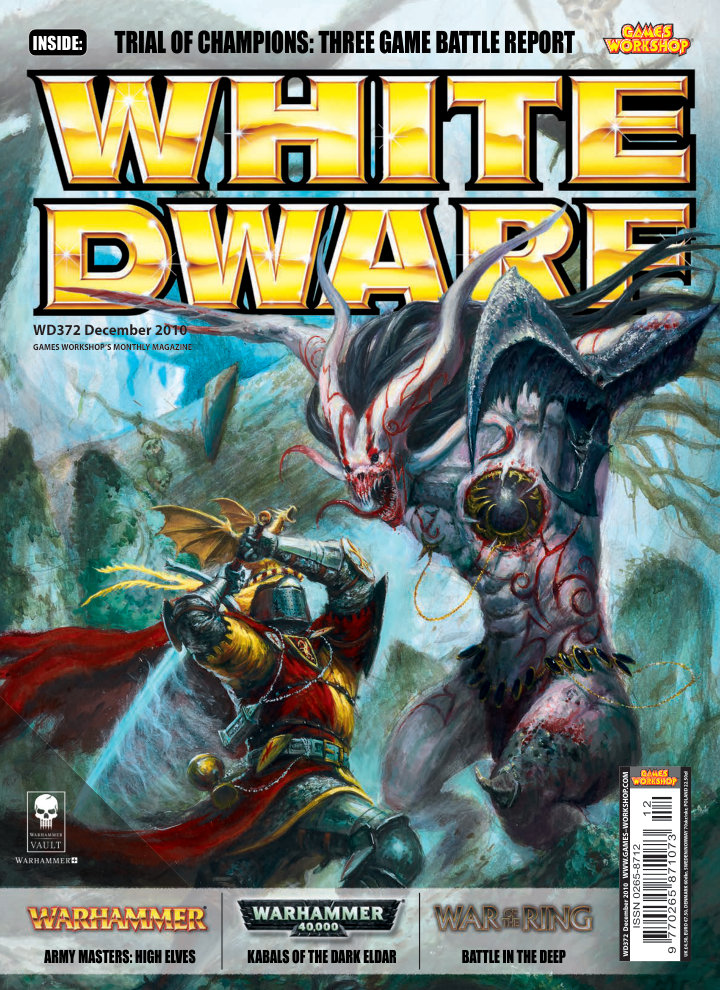
EditorialWD 372 · p. 1
Andrew Kenrick describes the large Christmas battles that reunite his family and gaming friends, from early white-tablecloth battlefields to a purpose-built winter board. He treats the December issue in the same spirit, bringing together new terrain, Dark Eldar background, Spearhead formations and the magazine team’s contest against the games developers.
CommunityWD 372 · pp. 10–13
News celebrates the Ultramarines animated film, the arrival of downloadable Black Library books and audio dramas, and the new digital short-fiction anthology Hammer & Bolter. It also previews Calixis-sector roleplaying supplements and the Horus Rising audiobook. Returning Hall of Fame miniatures and the website’s Season of Strife articles round out a month focused on enjoying fiction and preparing new battles.
Warhammer 40,000The Horus Heresy
Battle reportWD 372 · pp. 14–47
White Dwarf and the games developers select a champion for each of three systems, turning their studio rivalry into a best-of-three contest. Jeremy Vetock gives the developers an early lead against Andrew Kenrick’s Rohirrim, but Matt Hutson’s Dwarfs hold Witchfate Tor and Adam Troke’s Necrons narrowly survive to win the decider. The introductions and post-game reflections stress the different pressures of each objective and the friendly competitive atmosphere behind the team victory.
Warhammer Fantasy BattlesWarhammer 40,000
Battle reportWD 372 · pp. 16–25
Andrew Kenrick’s Rohan and Dwarf alliance attacks Jeremy Vetock’s Isengard force in a roughly 2,500-point War of the Ring battle using all three Field of Swords objectives. A disastrous first charge kills Éowyn, Éomer, Théoden and much of the army’s elite cavalry, leaving the Dwarves and remaining formations to recover what they can. The King’s Champion eventually kills the Cave Drake and the defenders fight back stubbornly, but Jeremy’s 17–8 victory reflects the first turn’s decisive losses. The report and later analysis show why a spectacular cavalry assault needs an answer to pikes, monsters and countercharges.
War of the RingRohan
Battle reportWD 372 · pp. 26–35
Matt Hutson’s Dwarfs defend the watchtower against Phil Kelly’s Warriors of Chaos in a 3,000-point battle. After withdrawing depleted Longbeards, Matt uses Organ Guns to drive the occupying Chaos Warriors out and installs his Hammerers, Lord and battle standard inside. Shadow magic and repeated elite assaults destroy much of the Dwarf army outside, but the tower’s defenders persist through an unusually long eight-turn game. Their survival secures the objective and ties the contest, illustrating why control of the scenario’s prize matters more than casualties elsewhere.
Warhammer Fantasy BattlesDwarfs
Battle reportWD 372 · pp. 36–45
Adam Troke’s Necrons surround Robin Cruddace’s Imperial Guard convoy in a 2,000-point Battle Missions Ambush, only for Robin to seize the initiative and unleash devastating opening fire. Resurrection orbs and We’ll Be Back restore enough of the army to counterattack, while the Monolith destroys tanks and supports the infantry. Robin nearly forces Phase Out late in the battle, but Adam hides his remaining Warriors behind the Monolith and survives one casualty above the limit to win on kill points. The post-game discussion credits both the vehicle’s firepower and its use as cover.
Warhammer 40,000Necrons
LoreWD 372 · pp. 50–57
Phil Kelly explores how Kabals impose a measure of security on Commorragh while competing through raids, assassination and political intrigue. Vect’s overthrow of the old aristocracy replaces birthright with organised martial ambition, though the former noble houses retain their resentment. Distinct Kabal histories show the range within that society, from ritual preservation and forbidden experiments to terror campaigns, master craftsmanship and obsessive beauty. Advice on creating a personal Archon, home territory and identity turns the background into material for an army.
Warhammer 40,000Dark Eldar
LoreWD 372 · p. 51
The Last Hatred’s pain-farms and expertise at prolonging suffering lead it into experiments that permanently bind souls to corpses. Its apparent interest in necromancy masks much larger, uncertain ambitions to transcend death or transform the fate of the Eldar themselves. The Kabal’s furious wars against Craftworld and Exodite kin and its hidden gardens of posed undead give it a particularly morbid identity.
Warhammer 40,000Dark Eldar
LoreWD 372 · p. 52
The Black Heart is vast enough to contain several rival Archons, each competing for Vect’s patronage within the same hierarchy. Their ambitions stop short of openly destroying one another because Vect treats them as useful tools and tolerates no threat to his supremacy. Its internal rivalries therefore illustrate both the scale of the oldest Kabal and the restraint imposed by its ruler’s power.
Warhammer 40,000Dark Eldar
LoreWD 372 · p. 53
Sythrac retains Vect’s attention by targeting the Imperium’s beloved heroes rather than merely conquering replaceable territory. His aim is to extinguish hope and weaken command across an empire, using the huskblade and soul-traps to enslave prestigious victims’ spirits. A shadow field and mastery of webway portals let him emerge at the heart of an enemy force, isolate the chosen prey and convert the kill into both personal vitality and political favour.
Warhammer 40,000Dark Eldar
LoreWD 372 · p. 54
Lord Xerathis’s Kabal deliberately announces its approach with disturbing propaganda, hallucinogenic bombardment and hijacked communications. Rivals consider such predictable terror tactics crude, but the Broken Sigil believes the resulting fear enriches the eventual feast of suffering enough to justify warning its victims. Its emblem and name express a shared purpose: shattering harmony wherever order and prosperity flourish.
Warhammer 40,000Dark Eldar
LoreWD 372 · p. 55
Aestra Khromys escapes monotonous slave labour by making weapons so exceptional that her craftsmanship earns better workshops and influential buyers. Once her team enters the Obsidian Rose’s service, she supplies exquisite arms while secretly preparing disguised weapons and sabotaging the court’s equipment. Her lethal coup turns technical skill into political power, and the Kabal thereafter thrives under a ruler whose inventive mastery is its strongest asset.
Warhammer 40,000Dark Eldar
LoreWD 372 · p. 56
Lady Malys leads a Kabal renowned for misdirection, verbal traps and shifting the costs of battle onto its supposed allies. Even failure becomes useful when blame can be redirected toward someone else. The account links their high standing to Malys’s extraordinary foresight and hints at a hidden patron through reports of a second voice in her otherwise solitary chambers.
Warhammer 40,000Dark Eldar
LoreWD 372 · p. 57
Lady Llanthei’s followers have risen from Commorragh’s lowest depths and refuse ever to return to their former hunger and degradation. Their hard-won beauty is both an obsession and a reminder of what failure would cost. Control of Blighthaven Docks and uncompromising determination make them respected opponents, even as fear of losing their appearance drives them toward increasingly extreme acts.
Warhammer 40,000Dark Eldar
TacticsWD 372 · pp. 58–62
Andy Hall explains how fighting along the table’s length changes the value of weapon range, mobility and objective-taking in Spearhead. He recommends selecting each formation to strengthen a clear role, taking advantage of split fire and movement rather than trying to make every vehicle universal. Contributions examine ramming Rhinos, massed Daemon Princes and the strengths and risks of super-heavies. Infantry still matter as protected objective holders or specialist tank hunters, supported by transports and carefully chosen equipment.
Warhammer 40,000
RulesWD 372 · p. 63
Up to three skimmer transports and their passengers form a reserve assault group. On arrival, a special high-speed move lets the vehicles cross a large distance, fire a weapon and unload troops who may immediately assault. The formation turns the skimmers’ imagined dive from high altitude into a means of delivering a coordinated attack deep behind the opposing line.
Warhammer 40,000
RulesWD 372 · p. 63
Up to three Heavy Support units gain a preparatory barrage after deployment and pre-battle movement, firing all their weapons before ordinary turns begin. If both armies bring the formation, the side taking the first turn resolves its barrage first. The rule creates a clear supporting role for concentrated heavy fire: weaken or pin the opposition before the main attack advances.
Warhammer 40,000
CampaignWD 372 · pp. 66–71
Adam Troke returns to the tragedy of Khazad-dûm to create an underground battle between Durin’s full household and the Balrog’s gathering hordes. A large scenario, dedicated Dwarf Battlehost and optional terrain rules make the halls, bridges and mine workings meaningful parts of the conflict. The account presents the Dwarves’ doomed determination as inspiration for a dramatic War of the Ring game rather than simply using an open battlefield beneath an underground label.
War of the RingDwarf Holds
RulesWD 372 · pp. 68–69
Two roughly 3,000-point armies fight for Khazad-dûm, with Durin and the Balrog serving as leaders for combined Kingslayer and To the Death scoring. The Dwarves deploy their entire household, while the Evil force can recycle destroyed common formations to represent an unending tide. Durin’s death threatens army-wide panic, whereas the Balrog sustains nearby creatures’ courage, giving each leader an influence beyond the points earned by killing it.
War of the RingDwarf Holds
RulesWD 372 · p. 70
Optional underground terrain rules give formations reasons to contest precarious bridges and elevated mine structures. Bridge defenders are more likely to remain steadfast, but losing a fight risks extra casualties from the drop; fragile mine workings provide broad firing opportunities and may collapse under a sufficiently powerful strike. Rocky outcrops offer useful height while remaining difficult to climb, adapting studio scenery into tactical features.
War of the Ring
RulesWD 372 · p. 71
A scenario-specific Battlehost gathers Durin’s Guard, Dwarf Warrior Kinbands, Vault Wardens and a King’s Champion for the defence of their home. Its oath forces a hero in a formation fighting the Balrog to challenge it without spending Might. Dwarves who pass a Courage test also make retaliatory strikes for casualties suffered, representing kin fighting to avenge one another against overwhelming odds.
War of the RingDwarf Holds
EditorialWD 372 · pp. 74–75
Jervis Johnson and Mark Farr revisit Rick Priestley’s 1986 Terror of the Lichemaster campaign with the new Warhammer rules. They find that most of its scenarios and story still work, requiring only small adjustments to obsolete characteristics, magic and Fear. The experience reassures Jervis that the hobby’s enduring pleasures outlast rules changes and shows how an old scenario pack can supply engaging narrative games with surprisingly little preparation.
Warhammer Fantasy Battles
RulesWD 372 · pp. 76–77
Armies race along the table toward a three-level tower, with uncertain initial deployment and delayed reinforcements complicating the approach. Each floor is treated as a separate connected building, allowing assaults between levels and special access for flyers and large targets. Victory depends on holding more floors, while the ground floor doubles a garrisoned wizard’s casting and dispelling contribution. Jervis’s tactical notes stress occupying and screening the tower instead of being distracted by destroying the opposing army.
Warhammer Fantasy Battles
ModellingWD 372 · pp. 78–89
Chad Mierzwa creates three distinct scenery sets for the Trial of Champions games: ruined Angmar, a red industrial dead world and a blood-haunted Warhammer Badlands. He explains how light, dark and spot colours organise each set, and how repeating colours between terrain and board creates a unified landscape. Kit combinations, scatter ruins, matching craters and selective static grass enrich the settings while leaving room for future games in different regions.
Warhammer Fantasy BattlesWarhammer 40,000
PaintingWD 372 · pp. 79–81
Chad derives the board’s grey-brown palette from existing Osgiliath ruins, repeating the lighter stone on rocky outcrops and using warm recesses and trees as a spot colour. Layered drybrushing ties the ground together. Raised ruins, loose statues and Osgiliath elements embedded in a Citadel Wood make the place feel like a fallen realm rather than a generic grey battlefield.
War of the RingAngmar5 paint colours
PaintingWD 372 · pp. 82–85
Red-orange ground evokes Mars while dark grey rocks, black buildings and gold ornament prevent the colour from overwhelming the models. Chad expands Dave Andrews’s original Basilica scheme across a Manufactorum and Sanctum Imperialis and matches craters to the board so they look embedded in it. The setting remains flexible enough to suggest volcanic Mordor or the Chaos Wastes in a different game.
Warhammer 40,0004 paint colours
PaintingWD 372 · pp. 86–89
Witchfate Tor supplies the focal point and red accents for a grey Badlands board imagined as earth saturated by centuries of battle. Charadon Granite and pale flesh-coloured drybrushing establish the ground, while bloody skull pits, menacing woods and bone-coloured giant skulls make the setting unmistakably Warhammer. Testing patches of static grass before gluing them adds controlled colour and life without weakening the macabre theme.
Warhammer Fantasy Battles5 paint colours
ShowcaseWD 372 · pp. 92–97
Matt Hutson’s Tale of Four Gamers collection grows from a Battalion into Prince Korhedron’s warhost through monthly reinforcements, model swaps and the new Island of Blood figures. Two related blues, bright metal, pale wood and restrained green bases give it an individual identity that contrasts with his other Elven armies. Photographs and notes cover the infantry, grey horses, heraldic banners, Chracian white-lion Griffon and expanding elite units, showing how repeated colours connect different miniatures.
Warhammer Fantasy BattlesHigh Elves15 paint colours
PaintingWD 372 · p. 97
Matt paints the prince and Griffon in sub-assemblies so the rider’s details remain accessible. The creature’s hindquarters take the pale colours of a white lion of Chrace, while its falcon front alternates dark and light feather sequences built from related browns and bone highlights. The choice connects the army’s centrepiece to a recognisable region of Ulthuan rather than using an arbitrary animal pattern.
Warhammer Fantasy BattlesHigh Elves7 paint colours
EditorialWD 372 · pp. 98–99
Adam Troke defends enjoying competition while insisting that winning must respect the opponent and the shared experience. He compares making a genuine tactical effort to bringing a painted army, then describes the dangers of arrogance, rules arguments and resentment when a game turns. Remembering the imagined battle, accepting correction and sharing an opponent’s exciting successes help keep that competitive impulse enjoyable for both players.
ShowcaseWD 372 · pp. 100–101
Andy Hall looks back over almost two years of nominations, explaining why designers, painters and artists can draw attention to virtues that collectors might overlook. A gallery recalls figures ranging from the Imperial Guard commander and plastic Marines to Bilbo, the Giant and Bretonnian classics. The accompanying news establishes a physical Hall of Fame display at Warhammer World, allowing readers to see the miniatures behind the articles.
InterviewWD 372 · pp. 102–103
Darren Latham chooses Seb Perbet’s Deathmaster Snikch for the beauty of its silhouette, flowing cloak and the challenge it offers a painter. Seb explains how the familiar equipment and triangular arrangement of blades preserve Jes Goodwin’s original identity while a larger cloak gives the small-based character an imposing presence. Studio and Keith Robertson display versions demonstrate how different colours and settings can interpret the same dynamic miniature.
Warhammer Fantasy BattlesSkaven