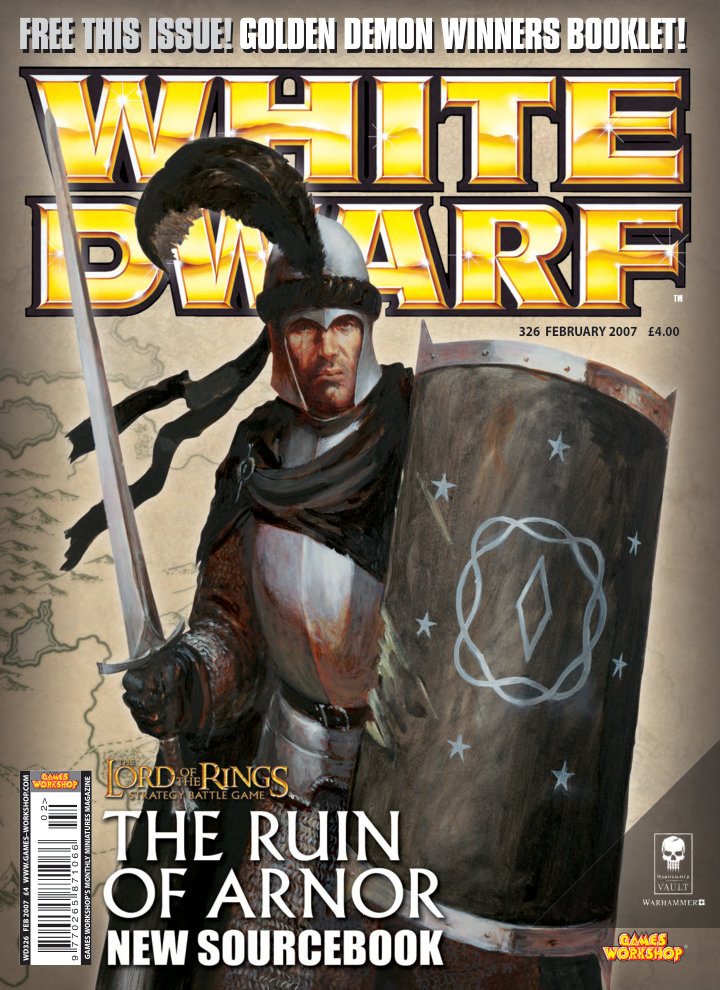
EditorialWD 326 · Inside cover
Grombrindal introduces Arnor as a ruined counterpart to Gondor, using its lost greatness to evoke the melancholy of Tolkien’s setting. The remaining Rangers defend people who scarcely know what protects them, while the new sourcebook returns to the kingdom’s earlier struggles. The editorial presents those doomed battles as stories of courage rather than merely another set of army releases.
Middle-earth Strategy Battle GameArnor
LoreWD 326 · pp. 14–15
The returning Harlequins are introduced as travelling performers who move between craftworlds, Exodite settlements and Commorragh through the webway. Their artistry conceals formidable martial skill and a mysterious allegiance to the Laughing God. Jes Goodwin’s forthcoming models emphasise elaborate costumes and wargear, giving the faction a visual identity that invites particularly ambitious painting.
Warhammer 40,000Eldar
InterviewWD 326 · pp. 19–25
Mat Ward explains how a new sourcebook format combines the region’s history, complete profiles, army lists and flexible scenarios. The Grey Company’s skilled Rangers contrast with Arnor’s armoured but beleaguered soldiery, while Angmar brings beasts and spectral threats. New heroes such as Malbeth, Buhrdûr and Gûlavhar turn that history into distinct battlefield roles rather than a collection of interchangeable profiles.
Middle-earth Strategy Battle GameArnor
RulesWD 326 · p. 23
Armoured Warriors of Arnor provide a strong spear-and-shield core, but leadership remains important to a kingdom under constant pressure. Arvedui supplies Might and a wider Stand Fast presence, while Malbeth’s foresight can cancel wounds to nearby allies. Rangers and Hobbit archers support the infantry, creating a force whose resilience depends on positioning its particular heroes effectively.
Middle-earth Strategy Battle GameArnor
RulesWD 326 · pp. 24–25
Angmar’s varied army supports ordinary orcs and wargs with trolls and dangerous spirits. A Shade makes nearby enemies struggle to win fights, while Buhrdûr adds a troll’s strength to a hero’s resources. Gûlavhar offers a different monster archetype: flight and vampiric recovery balance attacks and courage that decline as he loses wounds.
Middle-earth Strategy Battle GameAngmar
TacticsWD 326 · pp. 26–27
The Grey Company substitutes a Ranger-to-hero ratio for the usual bow limit, combining extensive accurate archery with capable close combat. Mat discusses powerful heroes, cheaper alternatives and thematic allies that supply armour or cavalry. Opponents can exploit the company’s light protection and low numbers, so ranged superiority alone does not remove the need to preserve troops and manage the decisive fighting.
Middle-earth Strategy Battle GameGrey Company
Battle reportWD 326 · pp. 28–43
Mat Ward’s Rangers and Elven twins are trapped by Graham Davey’s orcs, wargs and three trolls. Early Ranger resistance cannot prevent Arathorn exhausting his Might and dying surrounded by enemies, after which failed courage tests unravel the force. Elladan nearly kills Buhrdûr, but the surviving troll’s presence keeps Evil steady and completes a decisive victory, leaving both players to assess terrain use and concentration of force.
Middle-earth Strategy Battle GameGrey Company
RulesWD 326 · p. 29
Arathorn’s force begins around a ruined hilltop settlement with enemies both nearby and on opposing table edges. Evil must kill the chieftain and reduce his force below a quarter, while Good must inflict the equivalent numerical collapse on the attackers. Buhrdûr prevents the Evil force breaking while he lives, making the troll both a powerful hunter and a strategically valuable target.
Middle-earth Strategy Battle GameGrey Company
LoreWD 326 · pp. 44–57
The Empire’s uniforms and banners reveal a federation of proud provinces and self-governing cities rather than a culturally uniform nation. Provincial histories, local gods and remembered victories explain colours and symbols that might otherwise seem decorative. The guide follows these meanings from state troops and knightly orders into shrines and buildings, showing how a collection can communicate its regional loyalties through heraldry.
Warhammer Fantasy BattlesThe Empire13 paint colours
LoreWD 326 · pp. 46–47
The Emperor’s wealthy province fields disciplined troops in off-white, while Altdorf uses red and blue and celebrates resistance to the undead in its banner. Bögenhafen’s purple advertises commercial wealth. The Carroburg Greatswords’ dark red recalls a siege in which their original white uniforms became bloodstained, making regional variations records of particular histories.
Warhammer Fantasy BattlesThe Empire7 paint colours
PaintingWD 326 · p. 47
A white undercoat receives an earth-coloured wash to create the shaded fawn-white associated with Reikland troops. Several white overbrushes restore the raised areas quickly, preserving darker recesses. The remaining equipment is then re-undercoated black, allowing pale uniforms to be completed efficiently before the flesh, weapons and smaller details.
Warhammer Fantasy BattlesThe Empire3 paint colours
LoreWD 326 · p. 48
Middenland’s blue-and-white soldiers defend a forested province shaped by danger and the worship of Ulric. Wolf imagery reflects that older faith, while fortress and gate symbols celebrate Middenheim atop the Ulricsberg. The cult’s separate electoral voice adds political weight to a region whose military and religious identity are closely intertwined.
Warhammer Fantasy BattlesThe Empire2 paint colours
LoreWD 326 · p. 49
Averland’s warm plains produce crops and fine horses, but its position at Blackfire Pass also demands soldiers experienced in siege warfare. Its yellow-and-black troops combine ostentation with a dependable martial reputation. Heraldry inherited from displaced Solland nobles has given way on the main provincial banner to symbols of unity with the Emperor.
Warhammer Fantasy BattlesThe Empire2 paint colours
LoreWD 326 · p. 49
White and dark-grey uniforms distinguish Wissenland, a province whose rivalry with the Reikland is sharpened by mutual contempt. Its incorporation of ruined Solland preserves the sun emblem as a memory of loss. Taal and Rhya receive greater prominence than Sigmar in local heraldry, reflecting a regional religious character beneath nominal Imperial unity.
Warhammer Fantasy BattlesThe Empire2 paint colours
LoreWD 326 · p. 50
Nuln combines art, learning and industry, with its Imperial Gunnery School training crews for armies throughout the Empire. Verena’s scales and other learned symbols accompany cannon and bridge motifs on its banners. Black uniforms have a practical purpose as well as a visual identity: they conceal the soot generated by fighting beside so much artillery.
Warhammer Fantasy BattlesThe Empire2 paint colours
LoreWD 326 · p. 51
Hochland’s forest communities are dismissed as rustic by richer neighbours, but their hunting traditions produce highly respected marksmen. Red-and-green uniforms accompany heraldry filled with horns, bows and signs of the Jaegerkorps. The provincial skeleton with its sword and hunting horn joins regional skill to the Empire’s broader fascination with mortality and defiance.
Warhammer Fantasy BattlesThe Empire2 paint colours
LoreWD 326 · p. 51
Coastal roads, tolls and naval service define Nordland’s importance. Its blue-and-yellow troops include mariners trained to deploy unexpectedly by sea, and war-galley imagery recalls fighting against Norse raiders. Myrmidia’s eagle grasps the Imperial cross on the provincial banner, expressing a belief that the Empire’s unity depends upon effective soldiers.
Warhammer Fantasy BattlesThe Empire2 paint colours
LoreWD 326 · p. 52
Ostland’s black-and-white troops come from a harsh region of forest and mountains that rewards stubborn endurance. Its bull emblem has grown from a simple head into an elaborate rearing animal, celebrating the population’s reputation for strength. Connections to Kislev and the Count’s Dragon Bow further shape the province’s military identity.
Warhammer Fantasy BattlesThe Empire2 paint colours
LoreWD 326 · p. 52
Agricultural Ostermark stands beside Kislev and sends experienced troops north against Chaos. Haunted woods, Mordheim and nearby undead threats produce a sombre local culture whose banners celebrate survival against terrible enemies. Yellow and purple uniforms vary in shade because the expensive purple dye is difficult to make fast, giving individual soldiers plausible differences within one scheme.
Warhammer Fantasy BattlesThe Empire2 paint colours
LoreWD 326 · p. 53
The Great Forest and worship of Taal shape Talabecland’s red-and-yellow regiments, whose banners may be dipped in the sacred Talabec. Antlered trees and keen-eyed eagles express the wild god’s protection. Talabheim’s white-and-red troops instead emphasise the city’s unusual crater setting and twin-tailed comet, placing a local interpretation beside the wider province.
Warhammer Fantasy BattlesThe Empire3 paint colours
LoreWD 326 · p. 54
Poor Stirland’s green-and-yellow soldiers inherit both pride in Hel Fenn and the burden of neighbouring Sylvania. Its warrior-maiden banner recalls a forgotten ruler from Sigmar’s time. The white-and-green River Patrol guards crossings against enemies and rival provinces, while the Moot’s separate status records an Imperial decision that still complicates the region’s history.
Warhammer Fantasy BattlesThe Empire4 paint colours
LoreWD 326 · p. 55
The Empire’s knightly brotherhoods preserve their own ancient traditions despite serving the same realm. Reiksguard heraldry associates crowns, crosses and laurels with the Emperor, while its skulls honour the rulers the order has protected. Grand Masters of the White Wolf and Blazing Sun demonstrate how the same armoured cavalry ideal can express different religious and institutional loyalties.
Warhammer Fantasy BattlesThe Empire
LoreWD 326 · pp. 56–57
The heraldic language used by soldiers extends into ordinary buildings, roadside shrines and public warnings. A reused fishing boat seeks Manaan’s blessing, comet motifs invoke Sigmar, and revered bones make death less threatening under Morr’s protection. Even displayed criminals carry protective charms, reflecting a society whose punishments cannot ignore the practical danger of restless corpses.
Warhammer Fantasy BattlesThe Empire
EditorialWD 326 · pp. 60–61
Jervis argues that named characters give armies personality and deserve a place in ordinary games and tournaments when properly designed. He then clarifies his earlier comments about consulting rules as written. The book should be the first reference for a dispute, but exploiting loopholes at the expense of common sense was never the intention, linking both subjects to a more generous approach to play.
Warhammer Fantasy BattlesWarhammer 40,000
TacticsWD 326 · pp. 64–69
Phil explains reserves through three purposes: capturing ground, protecting valuable units and reinforcing a developing battle. Mission objectives and Escalation restrictions determine whether holding troops back is worthwhile, while speed matters once they finally arrive. Deep striking demands support or a deliberately expendable target strike, and selected units can manipulate arrival rolls or repeatedly threaten objectives without committing the entire army at deployment.
Warhammer 40,000Eldar
ModellingWD 326 · p. 70
A hand drill adds convincing depth to gun barrels and strengthens joints between heavy metal components. The guide starts barrels with a centred pilot mark and aligns pins by transferring a dot of wet paint between the parts. Gradually enlarging holes and keeping pressure controlled makes the tool useful for precision work rather than relying on force.
ModellingWD 326 · pp. 72–79
Careful subassembly and small alterations personalise the classic tank kit while retaining moving weapons and an opening commander’s hatch. Brass-wire hooks, irregular track spacing, reinforced vision ports and sculpted welds add credible mechanical detail. A two-colour masked camouflage scheme then receives company markings, transfers and selective wear, turning basic assembly into a complete battlefield vehicle project.
Warhammer 40,000Imperial Guard
ModellingWD 326 · pp. 72–76
The workshop first improves component fit and seams before adding more ambitious details. Card strips vary the track spacing, a wire hinge lets the hatch move and fine putty sausages imitate repaired welds. Repositioned lights, handles, stowage and antennae give the tank a working crew’s equipment while avoiding glue on the parts intended to pivot.
Warhammer 40,000Imperial Guard
PaintingWD 326 · pp. 77–79
Adhesive putty masks diagonal bands between desert yellow and dark green, followed by separate drybrush highlights for each colour. Red-and-white company bands and glossy transfer preparation establish identification before wear is added. Grey chips, earth on the lower hull, dark muzzle staining and orange-brown rust give the completed tank a used appearance, with a final protective varnish reducing the transfer gloss.
Warhammer 40,000Imperial Guard15 paint colours
ShowcaseWD 326 · pp. 82–85
Close views of Ludwig Schwarzhelm, the Steam Tank, Karl Franz and Volkmar connect ornate modelling to their roles in Imperial society. Banners and equipment express justice, authority, faith and technological pride. Alternative provincial tank colours demonstrate how a famous machine can join different state armies, while the heroes’ relics and heraldry make their identities legible without a rules explanation.
Warhammer Fantasy BattlesThe Empire
PaintingWD 326 · pp. 86–91
Chad completes a five-hundred-point Arnor force by painting similar models together through each stage. A test Ranger establishes the palette, while a twelve-step infantry sequence moves from broad drybrushing to more precise details. Heroes receive extra attention and raised slate bases, showing how efficient batch painting can produce a coherent playable army while retaining clear visual leaders.
Middle-earth Strategy Battle GameArnor
PaintingWD 326 · p. 86
The chosen Arnor illustration becomes a practical map of flesh, cloth, leather and metal recipes. Matching those materials first gives the army a consistent direction before individual miniatures are painted. The example also shows that a shaded or highlighted colour can be a mixture rather than a pot used directly, preserving the muted atmosphere of the reference image.
Middle-earth Strategy Battle GameArnor13 paint colours
PaintingWD 326 · p. 87
A broad brown drybrush provides an initial foundation before green cloak and tunic colours are applied. Leather, skin and weapons follow, with light mixed highlights picking out useful details without slowing the whole batch. Cork, slate or foam add varied rocky bases, then grey rock and warm earth drybrushes connect the Rangers to one terrain setting.
Middle-earth Strategy Battle GameArnor16 paint colours
PaintingWD 326 · pp. 88–90
The warrior batch begins with broad brown and metallic work, followed by repainting the recessed green cloth and shields. Flesh, spear shafts and leather receive more careful applications only after the large areas are complete. Alternating colours on the headdress and a pale shield emblem supply the final definition, leaving the repeated process quick enough to finish a full regiment together.
Middle-earth Strategy Battle GameArnor10 paint colours
InterviewWD 326 · pp. 92–96
Mike describes a painter’s approach rooted in mood, restrained palettes and the influence of Realm of Chaos. Static poses become portraits through facial expression, subtle details and evocative scenic bases. The gallery follows those principles across an Empire militiaman, radical Inquisitor, feral Kroot and a wholly rebuilt Azazel, while shared last-minute Golden Demon sessions explain how friendly rivalry helped develop his techniques.
Warhammer Fantasy BattlesWarhammer 40,000The Empire8 paint colours
ShowcaseWD 326 · pp. 98–99
Eighteen months after opening, the hall gives visitors close access to studio miniatures previously seen mainly in books and magazines. Permanent cabinets hold the principal ranges and historical dioramas, while central displays rotate new releases and individual painters’ work. Visitor-book feedback and the new guidebook connect the exhibition to an international audience eager to examine the models beyond printed photographs.
ShowcaseWD 326 · pp. 100–102
Selected painted teams from the 2006 Grand Tournament demonstrate how a common sporting format supports very different visual identities. Skaven, Lizardmen, Wood Elves, orcs and ogres receive coordinated uniforms and display settings. Marco Pinamonti’s winning ogre team combines blue-and-white stars, characterful conversions and a pitch-like presentation, extending the joke through both hulking players and their tiny companions.
Blood BowlOgre teams
ShowcaseWD 326 · p. 103
The winning Blood Bowl painter’s broader collection reveals a similar appetite for characterful conversion work. Space Marines and Terminators appear beside a varied ogre group, with trophies, altered equipment and individually posed figures breaking up the units. Their shared finish makes the selection feel like work from one painter even though its subjects belong to different scales of warrior and different settings.
Warhammer 40,000Warhammer Fantasy BattlesSpace Marines
CampaignWD 326 · pp. 104–109
The Arnor events are framed as a linked history from Arathorn’s fatal ambush to Aragorn’s return against Buhrdûr and the hunt for Gûlavhar in ruined Fornost. Historical participant lists give collectors concrete forces for those episodes, while a larger Fornost battle recalls the kingdom’s earlier fall. The feature also explains how the same Ranger box can serve several regional armies and alliances.
Middle-earth Strategy Battle GameArnor