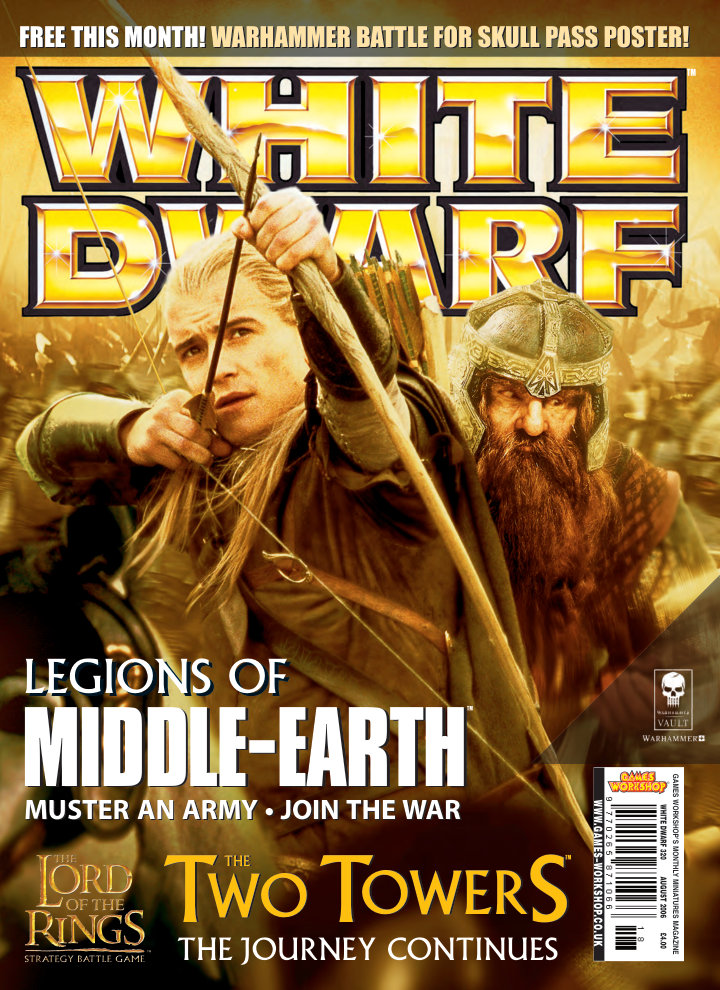
EditorialWD 320 · Inside cover
Grombrindal welcomes a month offering two complementary ways to play in Middle-earth. Legions of Middle-earth supplies themed armies and competitive battles, while The Two Towers follows the story through prepared encounters and new characters. The same growing collection can therefore support large contests and intimate narrative moments, with a return to the urban struggle for Medusa V elsewhere in the issue.
Middle-earth Strategy Battle GameWarhammer 40,000
CommunityWD 320 · pp. 24–25
The forthcoming Orcs & Goblins book and miniature range are previewed through returning characters, new Forest Goblin Spider Riders and expanded plastic character options. New rules, spells and magic items are promised to express the greenskins’ unruly character rather than simply repeat the previous army. The feature points ahead to the following book-focused issue, so it provides an announcement and visual introduction rather than the final army rules.
Warhammer Fantasy BattlesOrcs & Goblins
InterviewWD 320 · pp. 29–33
Jervis Johnson explains how visits to clubs and stores exposed a demand for clearer structure in battles between collected armies. Legions answers that demand with forty-nine themed lists, historically appropriate combinations and an allies system, supported by twelve symmetrical scenarios and terrain generators. He stresses that this deepens the existing game rather than displacing journey scenarios: a player can still alternate a carefully prepared story encounter with a balanced game using the army and terrain already available.
Middle-earth Strategy Battle Game
TacticsWD 320 · p. 34
Graham McNeill builds a Rohan force around the speed and impact that made the cinematic charge of the Rohirrim so memorable. Erkenbrand and mounted Royal Guard support the Riders, while a Captain leads a solid infantry body with higher-Fight Royal Guard placed where a tied combat matters. The army is intended to react quickly and combine its mounted and dismounted elements rather than assume every problem can be solved by a lone cavalry charge.
Middle-earth Strategy Battle GameRohan
TacticsWD 320 · p. 35
Mat Ward uses cheaper Uruk-hai Scouts to preserve numbers in an army whose elite troops can consume points rapidly. Shielded warriors lead the advance, a banner supports the attack and crossbows first remove dangerous opponents before joining the fighting if needed. Berserkers are sheltered until the moment of contact, while the Captain reinforces a stalled assault and avoids heroes whose superior abilities would waste him.
Middle-earth Strategy Battle GameIsengard
TacticsWD 320 · p. 36
The Army of Lhanzaghad uses two compact shield-and-spear formations as a dependable centre. Concentrated archery prevents the enemy’s fast units or heroes from disrupting that line, and the small Kataphrakt contingent then strikes foes already held in place. Captains and banners support both groups, giving this durable army the Heroic actions and rerolls needed to turn a simple combined-arms plan into effective battlefield control.
Middle-earth Strategy Battle GameEasterlings
TacticsWD 320 · p. 37
Mark Latham chooses Boromir and Beregond to give the Tower Guard both a strong narrative identity and considerable practical staying power. Spearmen, swordsmen and a banner hold important areas, while the archers advance in support and the Knights threaten a flank. Boromir is kept free to intervene where the line needs help, making his exceptional Might a flexible reserve instead of trapping the army’s strongest hero in a routine assignment.
Middle-earth Strategy Battle GameGondor
TacticsWD 320 · p. 38
Alessio Cavatore trims the battlehost contents into a 500-point force led by Gorbag. Numerous ordinary Orcs provide the bodies needed to surround opponents, Warg Riders isolate small groups, and a Troll with Mordor Uruk-hai forms the hard centre the weaker troops lack. The army offers a recognisable shock force on its own and a clear route for expansion through allied Mordor lists.
Middle-earth Strategy Battle GameMordor
RulesWD 320 · p. 39
Four ruined buildings represent valuable supplies and strategic positions in Osgiliath. Once an army breaks, the possibility of the game ending after each turn makes occupation as important as killing power; the side with the most models inside a building controls it. Capturing all four gives a major victory, three a minor victory, and fewer a draw, encouraging several coordinated thrusts rather than a single consuming melee.
Middle-earth Strategy Battle GameGondor
Battle reportWD 320 · pp. 39–48
Alessio Cavatore’s Gondorians meet Graham McNeill’s Cirith Ungol army in a 750-point contest for four buildings. Good’s shooting wounds Shelob and eventually kills the Troll, while a long cavalry stand-off and a grinding infantry fight delay both players’ progress. The decisive move comes when two Knights slip towards an inadequately guarded forge as Evil breaks and its occupants flee. Alessio takes the victory, with both players recognising that excessive caution and diverted monsters had made the result much closer than the final objectives suggested.
Middle-earth Strategy Battle GameGondor
ModellingWD 320 · p. 49
The guide compares painting beneath a clear water layer, tinting the fluid itself and stirring ink into an applied layer to produce unmixed swirls. Its waste-pipe example allows yellow-tinted fluid to disperse naturally into a pool, suggesting a fresh discharge. Testing on white-backed plastic palettes is recommended because the wet mixture looks milky, dries more strongly coloured and can take longer to set once paint or ink is added.
2 paint colours
InterviewWD 320 · pp. 51–59
Adam Troke explains how the second journey supplement follows the three separated strands of the Fellowship through seventeen scenarios. Painting and terrain projects become more ambitious as hobbyists’ skills grow, culminating in work such as Helm’s Deep, while the games remain useful to experienced players. New Rohan heroes, Uruk-hai leaders, Dunlendings, Ents and more sinister Mordor troops expand the possibilities for telling the story and for building themed collections beyond its specific encounters.
Middle-earth Strategy Battle Game
EditorialWD 320 · pp. 62–63
Jervis Johnson explains the organising principle behind the forthcoming Warhammer rulebook. Instead of beginning with abstract movement and combat rules and postponing setup, the new presentation teaches how to collect an army, establish the battlefield and play a complete game in a useful sequence. He presents the focused core game as a foundation for future army books and expansions, with room for players who enjoy exploring different styles of battle.
Warhammer Fantasy Battles
LoreWD 320 · pp. 66–67
The Lizardmen’s different castes are introduced through the duties left to them by the Old Ones. Saurus provide the army’s force and resilience, Skinks supply stealth, speed and poisoned harassment, and Chameleon Skinks take concealment further still. The ancient Slann combine immense magical ability with the memory of service to their vanished creators, giving the host a purpose beyond a collection of reptilian warriors.
Warhammer Fantasy BattlesLizardmen
TacticsWD 320 · p. 68
Pete Foley’s 1,998-point force uses a mass of Skinks, four lesser spellcasters and a set of powerful monsters to frustrate an opponent’s preferred fights. Poisoned missiles threaten even tough targets, while skirmishers and Terradons work around the flanks and flee through ground the enemy cannot negotiate as easily. Kroxigors and the Stegadon remain the solid threats that punish an attempt to force a conventional combat, making the army especially demanding to pin down.
Warhammer Fantasy BattlesLizardmen
TacticsWD 320 · p. 69
Mark Havener concentrates leadership, magic and the battle standard in a heavily equipped Slann protected by Temple Guard. Scar-Veterans add reliable combat power, including a fast character able to leave a unit and strike a vulnerable target, while Skinks screen the Kroxigors. The plan combines a formidable central regiment with supporting threats, but the commentary acknowledges the danger of putting so much of the army’s value into one protected formation.
Warhammer Fantasy BattlesLizardmen
Battle reportWD 320 · pp. 71–78
Alessio Cavatore’s Ultramarines rush Matt Hutson’s Necron power hub in a 1,500-point Urban Assault. The Marines reach their objective early, but Resurrection Orbs keep restoring the defenders and the Monolith repeatedly extracts units from combat so they can fire again. A determined final Terminator briefly sustains the attack before the Necron Lord reduces the surviving Marines below scoring strength. Both sides retain their own building for a draw, prompting reflections on premature exposure, unused mobile units and the central importance of the Monolith.
Warhammer 40,000Ultramarines
PaintingWD 320 · pp. 82–85
High Elf characters demonstrate a palette of pale cloth and hair contrasted with richer jewels, carefully shaded metal and decorative patterns. Close views of Tyrion, Teclis, Eltharion and Imrik highlight the fine lines, runes and small motifs that make the models distinctive. The final banner and shield gallery connects freehand designs with Elven heraldry, showing how a restrained army palette can still accommodate phoenixes, dragons, stars and the emblems of different realms.
Warhammer Fantasy BattlesHigh Elves16 paint colours
PaintingWD 320 · p. 83
The gem tutorial places most of the colour towards the lower part of a black-based stone, building from dark red through a bright orange crescent. A tiny white mark on the remaining dark area supplies the apparent reflection and makes the flat painted surface read as glossy. Two faster alternatives use repeated red ink over white or a simpler white highlight, allowing the modeller to choose the detail level appropriate to a character or an entire army.
Warhammer Fantasy BattlesHigh Elves6 paint colours
ModellingWD 320 · p. 86
Eric van den Broek creates the Sea Patrol’s Merwyrm from Imrik’s Dragon because no dedicated model exists. Altering the base places the creature against a rock, while filling the spine between the spikes and adding a fin to the bent tail gives the dragon a more aquatic outline. The changes retain the striking original body but make its relationship to the scenic setting and the intended sea creature convincing.
Warhammer Fantasy BattlesHigh Elves
LoreWD 320 · pp. 88–91
The Rangers are explored as Eldar who seek freedom from the discipline of Craftworld life, accepting danger and isolation on the Path of the Outcast. An Imperial dossier studies their weapons, armour and camouflage through a mixture of grudging technical recognition and institutional prejudice. Examples from Biel-tan, Saim-Hann, Alaitoc and Telennar then show how independent wanderers return to serve their homes as scouts and ambushers, including operations against the Orks on Medusa V.
Warhammer 40,000Aeldari
InterviewWD 320 · pp. 96–98
The Nottingham Castle exhibition brings original artwork, preparatory studies and miniatures together after years in which most illustrations were seen only as printed reproductions. John Blanche describes the Northern European artistic influences behind the company’s coherent visual language, from medieval and romantic art to the developed Games Workshop Gothic style. The article also follows the practical path from archived images to a public exhibition and explains the ambition to show concept work beside the finished objects it inspired.
TacticsWD 320 · pp. 99–102
Paul Evans gives his Speed Freeks a campaign mission through Mad Mek Git Stix’s scheme to steal the power needed for Nazdreg’s escape. Rather than replace the force with a more obvious infantry army for Cities of Death, he keeps its character and adapts its tools: Deth Koptas bypass crowded terrain and a looted Demolisher threatens buildings and opens routes around Tank Traps. The roster and conversion-rich collection tie that tactical adjustment to a deliberately extravagant Ork story.
Warhammer 40,000Orks
PaintingWD 320 · p. 102
Paul Evans’s recipe gives the Orks contrasting red and yellow armour plates while keeping the underlying metal and green skin suitably worn. Inks enrich the metal and shade the skin before pale flesh highlights bring back definition. A separate selection of muted greens and greys lets equipment and clothing vary across the army without competing with the brighter vehicle and armour markings.
Warhammer 40,000Orks17 paint colours
ShowcaseWD 320 · pp. 104–107
Nicola Taylor’s Hive Fleet Apophis won Best Painted Army with a coherent force of clawed, winged predators. Dark Pegasus wings and brass supports vary the heights of the airborne Warriors, while the Hive Tyrant’s altered limbs, extended tail and forward head suggest a creature landing at speed on a wrecked Land Speeder. Scythes of the Emperor victims connect the display to Tyranid background and to a friendly rivalry with her husband’s collection.
Warhammer 40,000Tyranids
CommunityWD 320 · pp. 108–110
The preview describes Games Day as a place to try conversions and terrain work, play participation battles, display painting and meet the people behind the games. The design area follows miniatures from concept drawings to production, while the archive revisits older Warhammer products and the Golden Demon stands present the competition entries. The focus is the breadth of hands-on hobby activity and shared creative work surrounding the event.
CommunityWD 320 · p. 111
Jonathan Carter recalls the move to a larger venue through his dual interests in photographing the event and pursuing a Golden Demon. Expanded gaming, more accessible painting displays and early looks at miniatures made the day feel less constrained, although popular activities still attracted queues. His memories of designers, books and Forge World displays lead back to the practical challenge of finishing his own next entry, a Space Wolves Dreadnought.