EditorialWD 286 · Inside cover
Paul Sawyer reports on the enormous response to the Eye of Terror campaign at its halfway stage. Participation at events and online makes the fictional war feel like a shared undertaking. He also corrects an illegal combination in an earlier Chaos battle report and explains the issue’s free Warhammer reference sheet, looking ahead to a Kislev supplement rather than treating every announcement as a new standalone game.
Warhammer 40,000Warhammer Fantasy Battles
CommunityWD 286 · pp. 2–3
Campaign notices and upcoming events place the issue in the closing weeks of the Eye of Terror summer. Black Library’s Ambassador release offers another route into the Warhammer setting, while competition and retail news describe opportunities to meet other players. A notice of the forthcoming White Dwarf price change accompanies the previews, recording the practical publishing context alongside the hobby announcements.
Warhammer 40,000Warhammer Fantasy Battles
RulesWD 286 · pp. 12–15
A Beastmen raid becomes a small Warhammer scenario through the story of a cobbler seeking help for his village. By the time the Empire’s relief force arrives, Sternburg has already suffered, and its defenders must withstand repeated attacks until mounted reinforcements reach them. The scenario uses a modest Empire battalion against returning Beast herds, making survival and the timing of the Knights of the White Wolf more important than an equal-points pitched battle.
Warhammer Fantasy BattlesBeastmen
ModellingWD 286 · pp. 16–19
Steve Cumiskey and Mark Jones turn Nuala Kennedy’s sketch into an animated tree held down by chains and heavy rocks. Combining several wire armatures creates a large trunk and root-like legs, while filler, embedded skeletons and a restrained facial expression suggest something alive inside the wood. The guide follows the construction through bark texture, anchors and painting, with successive brown and bone drybrushes distinguishing the creature from its grey stone restraints.
Warhammer Fantasy BattlesWarriors of Chaos10 paint colours
LoreWD 286 · pp. 22–24
Mordia’s permanent darkness and tightly controlled resources produce a regiment whose parade-ground appearance conceals exceptional discipline. Its defence against a Chaos invasion shows soldiers holding a line long enough for another form of resistance to work. Campaign accounts against Orks and Eldar extend that identity beyond the home world, while the accompanying doctrine selection translates the Iron Guard’s reputation into the contemporary Imperial Guard army system.
Warhammer 40,000Astra Militarum
LoreWD 286 · pp. 25–27
Tallarn’s desert regiments emerge from a world devastated by virus bombing and a vast armoured war during the Horus Heresy. Survival in that environment shapes their raiding traditions and their reliance on mobility. Later accounts follow the discovery of the Cursus of Alganar and an uneasy alliance with Eldar against its daemonic threat, then illustrate cavalry and mechanised actions by particular commanders. Regimental doctrines connect that background to a usable army identity.
Warhammer 40,000Astra Militarum
LoreWD 286 · pp. 28–29
A comet strike and an Ork invasion transform Valhalla into an icebound world where food, shelter and stubborn resistance determine survival. Fighting around the subterranean food vats becomes the foundation of the Ice Warriors’ reputation. A later campaign follows the Polar Guard in an expensive mountain assault against the Demiurg on Poretta, showing the casualties behind the regiment’s celebrated endurance. The profile includes a contemporary doctrine selection for representing that character in play.
Warhammer 40,000Astra Militarum
ShowcaseWD 286 · pp. 32–35
Jesper Hausen converts a Blood Dragon Vampire Counts army from High Elf miniatures, creating an undead host that retains its former elegance. Phoenix Guard become Grave Guard, Silver Helms become Black Knights, and familiar Elven characters receive skeletal or ghostly transformations. Notes on Tyrion, the Alarielle-based Banshee and a planned chariot-derived Black Coach explain how repeated visual choices make the army coherent, while its tournament painting award demonstrates the effect of the completed force.
Warhammer Fantasy BattlesVampire Counts
FictionWD 286 · pp. 36–39
Graham McNeill brings Eldrad Ulthran and Lord Castellan Creed into a precarious alliance during the assault on Cadia. Imperial troops struggle to contain the invasion while events in space reveal why the Eldar have intervened. A rescued frigate, the threat of the Blackstone Fortress and Admiral Quarren’s fleet draw the separate fronts together. The story ends with Abaddon committing to another attack, leaving the confrontation unresolved for its continuation rather than reporting the campaign’s final results.
Warhammer 40,000Astra Militarum
LoreWD 286 · pp. 40–43
Phil Kelly explores the farseer whose attempts to preserve his people often redirect catastrophe onto other civilisations. Eldrad’s interventions against Orks and Chaos establish the scale of his foresight, while his encounter with Abaddon shows the personal danger behind it. His staff, relationship with the infinity circuit and gradual crystallisation connect individual power to the dead of Ulthwé. Reflections on Ynnead and his own approaching fate give the profile a sombre conclusion.
Warhammer 40,000Aeldari
RulesWD 286 · p. 43
Eldrad’s contemporary profile combines the familiar farseer powers with divination that adjusts the army’s deployment before battle. The Staff of Ulthamar offers a choice between additional psychic activity and a dangerous close-combat attack, making his use more involved than simply buying a stronger ordinary seer. Army-size and character-agreement conditions place the entry within the source’s Ulthwé framework, while a Warlock bodyguard and reserve benefit reinforce his role as a commander.
Warhammer 40,000Aeldari
CampaignWD 286 · pp. 44–47
Dylan Owen adds terrain and naval movement to the map campaign, turning rivers, mountains, forests and swamps into strategic choices. Different peoples have advantages in particular environments, while pillaging, deforestation and regrowth affect both income and access. Fleets depend on suitable settlements and docks, transport armies between regions and contest patrol zones through a simple combat system. The option of resolving encounters with Man O’War offers a more detailed alternative to those campaign-level naval rules.
Warhammer Fantasy Battles
CampaignWD 286 · p. 45
Phil Kelly recounts his Tomb King’s ambitions in the Bloodlands campaign through the voice of an increasingly self-important ruler. A golden idol, a bitter duel and the subjugation of neighbouring lands make each campaign action part of King Phat’s personal mythology. Poisoned emissaries and unreliable alliances show diplomacy becoming another weapon, while the account’s humour rests on the gap between an undead monarch’s glorious claims and the opportunism of the players around him.
Warhammer Fantasy BattlesTomb Kings
PaintingWD 286 · pp. 48–49
Shaun Murphy explains the split pink-and-black scheme on Aly Morrison’s Emperor’s Children, using purple outlines and carefully placed pale highlights to keep the armour legible. Separate recipes tackle aged metal, flayed skin, tassels, tubing and faces, adding variety without overwhelming the main colour division. The treatment extends to the base and smaller ornaments, showing how an intricate Slaaneshi model can retain a clear silhouette and a consistent finish.
Warhammer 40,000Chaos Space Marines24 paint colours
PaintingWD 286 · pp. 54–55
Tammy Haye explains why effective miniature camouflage needs a simpler, bolder pattern than its full-sized counterpart. Contrasting dark, middle and light colours break up a uniform without dissolving the figure’s shape, while plain armour can balance patterned clothing. The guide advises highlighting the underlying fabric and interrupting patterns at seams, then uses a sniper example to show how a small palette can suggest environmental concealment.
Warhammer 40,000Astra Militarum3 paint colours
PaintingWD 286 · p. 56
A grey base and irregular lighter and darker marks produce an urban pattern that remains readable at miniature scale. The steps develop the cloth through highlights before adding the camouflage, avoiding the need to shade every separate spot. An accompanying colour key offers a related muted palette for varying the effect across city-fighting troops while keeping the same balance of light and dark shapes.
Warhammer 40,000Astra Militarum6 paint colours
PaintingWD 286 · p. 56
Pale grey cloth, white highlights and darker blue-grey markings suggest a winter uniform without making the model a featureless white shape. The pattern is built in distinct stages over the highlighted fabric. Additional colours in the accompanying key show how to vary the cold tones, giving painters an alternative for an ice-world regiment or a force operating among snow and rock.
Warhammer 40,000Astra Militarum7 paint colours
PaintingWD 286 · p. 57
A deep green foundation receives a lighter green treatment before brown and pale marks break up the cloth. The result applies the article’s emphasis on contrast to a jungle uniform, using a few recognisable shapes rather than a dense realistic pattern. The colour key supplies further dark green and yellow-brown choices for related schemes, allowing the method to suit more than one regiment.
Warhammer 40,000Astra Militarum6 paint colours
PaintingWD 286 · p. 57
Earth-coloured clothing is highlighted before darker patches and pale accents create a dry-land camouflage pattern. The warm browns and bone tones distinguish it from the greener jungle scheme while preserving the same sequence of preparation and patterning. A separate key adds desert and khaki alternatives, offering a useful basis for a regiment fighting among dust, rubble or scrub.
Warhammer 40,000Astra Militarum8 paint colours
PaintingWD 286 · pp. 60–61
Jason Foley’s Black Templar guide previews the Painting Citadel Miniatures book through a complete power-armoured figure. Grey edge highlights define the black armour, while warm bone on parchment and the chest ornament separates those materials from the white shoulder pads. Red eyes and seals add small focal points. Metal, scripture and transfers complete a scheme whose clarity depends on controlling the placement of highlights rather than covering the black base.
Warhammer 40,000Space Marines13 paint colours
ShowcaseWD 286 · pp. 62–65
Award-winning entries from the 2002 Australian, Canadian and Baltimore Golden Demon competitions range from individual characters to large monsters and narrative scenes. Converted leaders, regiments and humorous dioramas demonstrate how modelling, composition and painting work together. Captions identify the makers and awards, making the spread a record of the period’s competition work rather than a step-by-step painting recipe.
Warhammer Fantasy BattlesWarhammer 40,000
LoreWD 286 · pp. 66–71
A mid-campaign account follows the Space Marine chapters defending the Cadian Gate against Abaddon’s Thirteenth Black Crusade. Boarding actions, fortress sieges, armoured battles and desperate delaying attacks give each chapter a different place in the war. The report also exposes divisions within the Imperial response: the Dark Angels pursue the Voice of the Emperor, the Relictors follow a suspicious private objective, and Logan Grimnar struggles to coordinate forces whose traditions and priorities do not always align.
Warhammer 40,000Space Marines
PreviewWD 286 · pp. 72–75
The preview introduces Kuju and THQ’s first-person shooter through Kais’s mission to rescue an Ethereal from an Imperial prison. Fighting then moves into boarding actions, with the scale and machinery of Imperial ships providing a different view of the setting. Development notes describe Games Workshop’s input into the environments and animation, and explain how the handheld rail rifle crossed from the video game into tabletop rules. Multiplayer modes, voice actors and the accompanying novel complete the launch overview.
Warhammer 40,000Warhammer 40,000: Fire WarriorT’au Empire
TacticsWD 286 · pp. 76–81
Jeff Wilson builds Wood Elf tactics around movement, bait and coordinated attacks rather than a conventional ranked battle line. Fleeing bait or a resilient holding unit draws enemies into positions where cavalry, Wardancers and forest creatures can strike exposed flanks. Concentrated archery removes vulnerable targets, while march blocking, woodland movement and supportive magic create time to arrange those attacks. Diagrams show the traps in sequence, stressing escape routes and a plan for several turns ahead.
Warhammer Fantasy BattlesWood Elves
ShowcaseWD 286 · pp. 82–85
Jeff Wilson’s army combines classic Wood Elf sculpts with elaborate conversions that reinforce its forest identity. A leader draws on Orion and Archaon, while other characters incorporate High Elf models, a Truthsayer and an Empire Griffon. Miniature trees and foliage reshape Treemen and Durthu into more natural woodland creatures. The captions explain the component choices and small alterations that make familiar models belong to the same distinctive force.
Warhammer Fantasy BattlesWood Elves
ModellingWD 286 · pp. 86–91
Steve Cumiskey shows how the revised Imperial Guard doctrines encourage players to develop a regiment’s appearance and battlefield identity together. Examples range from well-equipped hive-world soldiers and gravity-chute troops to converted warrior women, youthful conscripts and a religious army from Macharia. Equipment, heads, damaged clothing and small markings communicate those backgrounds with different amounts of conversion work. Each contributor’s doctrine list makes the link between the models and the intended army explicit.
Warhammer 40,000Astra Militarum5 paint colours
CommunityWD 286 · pp. 92–93
Jervis Johnson explains how reader requests helped bring female Inquisitor characters, additional Warmaster Daemons and a T’au space fleet into the Specialist Games range. Lady Jena Orechiel and a Sister Repentia illustrate the expansion of Inquisitor’s cast, while Khorne units and Tim Adcock’s spacecraft answer other long-running requests. The question column explains where new rules appear in magazines, annuals and free downloads, including how the online archive distinguishes official, experimental and house rules.
InquisitorWarmasterT’au Empire
Battle reportWD 286 · pp. 96–113
Pete Haines tests the revised Cadians in an unusual role: attacking Orks who occupy an Imperial strongpoint. Alex Boyd’s defenders rely on bunkers, lobbas and a dangerous reserve, while the Guard brings massed infantry, supporting weapons and infiltrating Kasrkin. The report follows the sentry phase and a short, intense assault in which poor early shooting threatens to stall the advance before the Cadians recover the initiative.
Warhammer 40,000Astra Militarum
EditorialWD 286 · p. 120
Alessio Cavatore returns from New Zealand with an account of the design team’s visit to Weta and the film production. Seeing material from The Return of the King prompts reconsideration of fell beasts and reveals where the game’s scenarios may differ from the finished film. He explains that later supplements will help cover a story too large for one boxed release, while a photograph of a game with Peter Jackson connects the miniature project to its cinematic inspiration.
Middle-earth Strategy Battle Game
TacticsWD 286 · pp. 122–125
Matthew Ward compares the roles of Middle-earth’s spellcasters rather than treating magic as a single offensive tool. Gandalf and Radagast support and protect allies, Saruman disrupts distant opponents, and Nazgûl wear down courage and magical resistance. Shamans sustain ordinary troops, while Barrow-wights threaten powerful heroes through paralysis. The advice repeatedly matches each caster to a particular job and warns against wasting fragile or expensive figures in unsuitable combats.
Middle-earth Strategy Battle GameThe Fellowship
RulesWD 286 · pp. 126–127
David Smith begins a linked scenario series with the Nazgûl’s attempt to cross Osgiliath on their search for the Ring. Gondor’s defenders hold the western bank while Boromir and Faramir arrive as uncertain reinforcements. Darkness and surprise help the attackers, but the Ringwraiths must use the bridge while supporting Orcs can risk boats. Victory depends on enough wraiths escaping, turning the crossing, barricade and approaching defenders into connected tactical problems.
Middle-earth Strategy Battle GameGondor
PaintingWD 286 · pp. 128–129
Tammy Haye explains the ’Eavy Metal schemes for Radagast, mounted and foot Glorfindel, and Elladan and Elrohir. Warm layered browns and small green leaves give Radagast a woodland character, while Glorfindel’s grey-white robes, cool blue lining and bright metal create a more formal appearance. The same framework extends to Elrond’s sons with different hair, and a grey horse completes the mounted version. Faces, the raven, staff, sash and ornaments receive separate finishing instructions.
Middle-earth Strategy Battle GameRivendell25 paint colours
PreviewWD 286 · pp. 131–133
The third film-based rules manual is introduced through its larger selection of scenarios and profiles from across the trilogy. New material includes monstrous creatures, banners and a War of the Ring section covering battles beyond the central story. The preview also outlines forthcoming miniatures and White Dwarf support, presenting the release as both a new entry point and an expansion for players already using the earlier manuals.
Middle-earth Strategy Battle Game
InterviewWD 286 · pp. 134–135
Stephen Grant asks Gamling actor Bruce Hopkins how his character would approach a battle against Uruk-hai Berserkers. Hopkins imagines coordinated mounted attacks that split the enemy’s attention, linking the tactics to Gamling’s loyalty and responsibility for his men. He also discusses his family’s response to the miniature and his interest in fan events. The conversation introduces a player-written scenario from TheOneRing.net’s Gaming Havens community.
Middle-earth Strategy Battle GameRohan
RulesWD 286 · p. 135
Gamling leads mounted Royal Guard and Riders of Rohan against Berserkers cornered near a high cliff. Both sides seek a decisive destruction of the enemy, but killing Gamling can save the Evil force from defeat even if it is wiped out. A rule for models forced against the precipice makes the table edge dangerous rather than merely restrictive. A points-match version lets other forces attempt the same uncompromising encounter.
Middle-earth Strategy Battle GameRohan
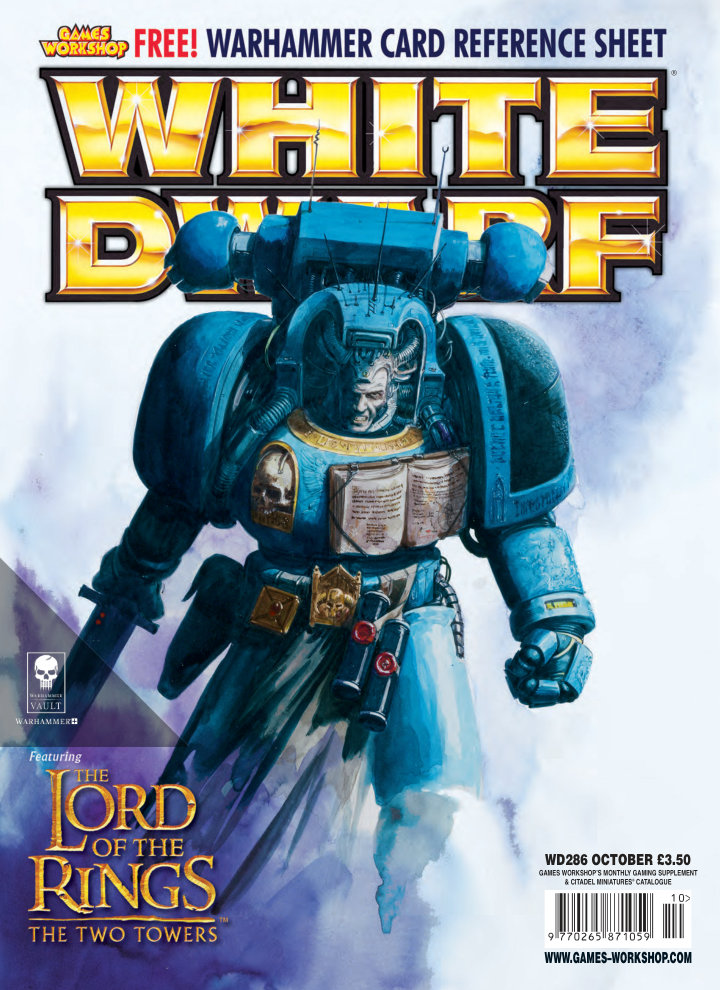
Cover and imprint confirm October 2003, issue 286. Scan locations are verified against the logical magazine sequence; the Malakhian showcase has misprinted footers, explained on its record. The Eye of Terror feature is the actual serial story, rather than the results promised by the contents. Main features, substantial rules and tutorials are indexed; catalogues, directories, advertisements and art-only spreads are excluded.