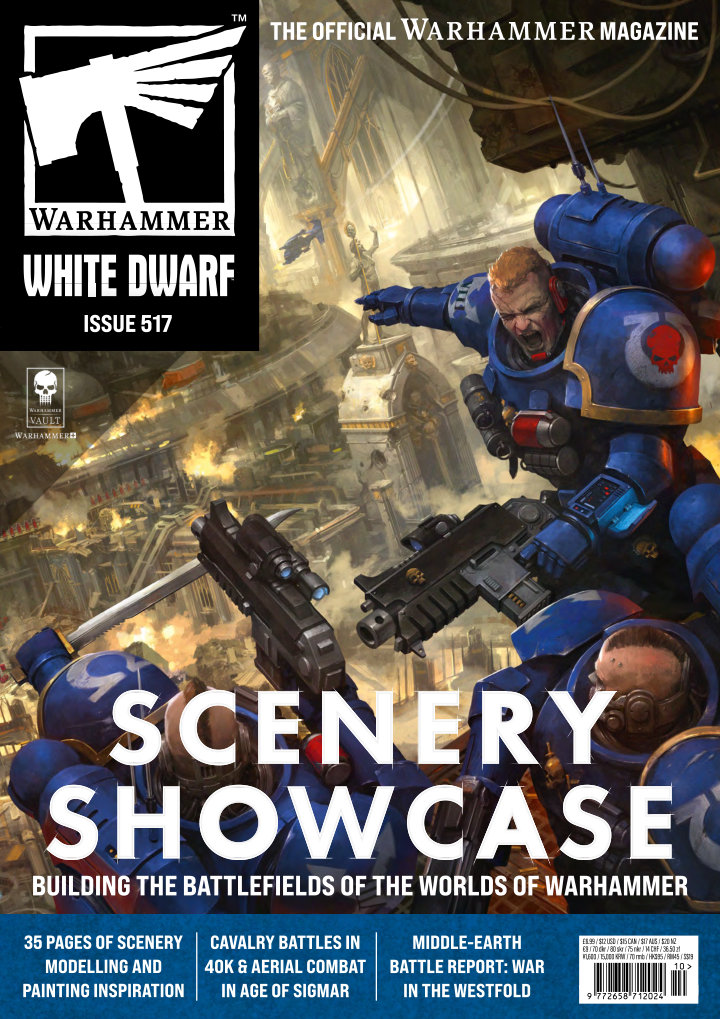
EditorialWD 517 · Inside cover
Lyle introduces the scenery issue by considering how terrain turns a game into an immersive battle. The selection combines elaborate display boards, practical scenery projects and a straightforward rock-building tutorial, with the aim of giving hobbyists evocative environments through which to imagine their armies fighting.
CommunityWD 517 · pp. 2–7
The readers’ pages foreground scenery with Christian Lemmen’s Necromunda board, Adrien Feroc’s industrial Kill Team battlefield and Elliot Prowse’s illuminated west gate of Moria. Elliot explains foam-and-bark rocks, wire trees, layered tinted resin and backlit Doors of Durin built to open into the mine interior.
NecromundaKill TeamTyranids8 paint colours
LoreWD 517 · pp. 8–11
Colin explores how familiar terrain kits can suggest the history and purpose of an Imperial battlefield. Fronteris bunkers, landing pads and auspex shrines imply isolated communities, fragile supply links and sometimes older secrets, while manufactorum buildings and cargo connect a small gaming table to a much larger industrial network.
Warhammer 40,000Adeptus Mechanicus
RulesWD 517 · pp. 12–16
A variant game mode pits 500-point armies composed of Mounted units against one another on a compact battlefield. It replaces normal Enhancements and Stratagems with a bespoke selection focused on mobile firepower, manoeuvre, reserve arrivals and replenishment, while allowing a force without a Character to select a Warlord.
Warhammer 40,000
RulesWD 517 · p. 17
Mounted forces race through a ruined transitway to recover functioning war machines and reopen supply routes. Advance re-rolls help them exploit gaps, while players can move an objective during their Command phase to change the next engagement. Scoring rewards control of several objectives, penetration into the enemy deployment zone and killing the opposing Warlord.
Warhammer 40,000
RulesWD 517 · p. 18
A cavalry assault must force its way through dangerous defensive positions and take a chain of objectives. Advancing or charging near an objective risks casualties from battlefield hazards, so reaching a position quickly can cost models needed to hold it. Progressive control scoring is combined with an end-game comparison of points lost, making both territorial pressure and economical fighting matter.
Warhammer 40,000
RulesWD 517 · p. 19
Riders compete to recover supplies on a storm-battered plain. Rain slows movement early in the game and changing crosswinds move the objectives each battle round, forcing both armies to adjust their plans. The opponent’s home objective is especially valuable, while a final reconnaissance sweep rewards retaining control of the mobile supplies.
Warhammer 40,000
LoreWD 517 · pp. 20–23
The Raven Guard’s new Chapter Master is introduced as a patient strategist who combines misdirection, sabotage and precise strikes. Aethon Shaan coordinates dispersed talons through hidden communications and intelligence networks, using his own jump-pack assault only when it will deliver the decisive blow. Servo-ravens are both practical information gatherers and powerful reminders of Corax.
Warhammer 40,000Space Marines
ShowcaseWD 517 · pp. 24–33
Gordon Miller presents a heavily weathered T’au collection inspired by the Farsight Enclaves’ aggressive style. Magnetised battlesuits, a converted Cadre Fireblade and human auxiliaries built from Palanite Enforcers give the force its own identity, while red sept markings connect it to Farsight’s Vior’la origins.
Warhammer 40,000T’au Empire13 paint colours
RulesWD 517 · pp. 34–35
Lethal difficulty raises the stakes of the cooperative mini-game by reducing revives, disabling special abilities while Marines are injured and repeatedly spawning Terminus enemies. New Neurothrope and Carnifex cards broaden the boss encounters, and players can also substitute these threats into the earlier Decapitation mission. Each arriving Terminus begins on its second-stage side, creating immediate pressure rather than a gradual build-up.
Warhammer 40,000Space Marines
InterviewWD 517 · pp. 36–37
Duncan and Sophie explain how alternating activations, defensive reactions, executions and changing enemy waves were used to capture the responsive feel of Space Marine 2 in a turn-based game. Their aim is a quick cooperative experience whose tactical problems vary with the mission, class combination and enemy activation order.
Warhammer 40,000Space Marines
ModellingWD 517 · pp. 38–43
Paul demonstrates how polystyrene can become durable, convincing battlefield rocks, explaining the different handling of packing foam and denser insulation board. Bases, filler, sand, slate and papier-mâché strengthen the structures and blend them into the table; examples range from natural strata to angular alien outcrops, ice shards and floating stones supported on pins.
21 paint colours
CampaignWD 517 · pp. 44–45
A new year of A Tale of Four Warlords sends Amber, Andrew, Dan and Matt into a shared Path to Glory campaign in Thyria, Ghyran. The familiar army-building challenges now develop alongside a narrative about purifying, befouling or otherwise disrupting the same region. The first challenge starts from a Spearhead, with progress tracked through painted units, games, victories and a completion bonus.
Age of SigmarSoulblight Gravelords
PaintingWD 517 · p. 46
Amber bases her undead army on people drowned or shipwrecked around the Naiad Archipelago, whose long-resting bodies rise after Nurgle’s invasions. This coastal origin gives her scope to explore weathered metal and cloth, and she imagines larger creatures erupting from the sand. Her test scheme keeps painting efficient with a pale undercoat, burnished armour, Contrast red cloth and sandy bases, while green staining links the models to their damp history.
Age of SigmarSoulblight Gravelords13 paint colours
PaintingWD 517 · p. 47
Andrew returns to army painting with Hallowed Knights inspired by their literary portrayal and the archetype of the heroic knight. He chooses a bright, clean finish that emphasises their valour while acknowledging the tragedy of their eroding souls. Recipes for polished steel, blue pauldrons and burnished gold keep the overall scheme cool, with warmer metal providing controlled contrast.
Age of SigmarStormcast Eternals13 paint colours
PaintingWD 517 · p. 48
Dan’s Dawnbringer Crusade returns from years of fighting to find its home town destroyed, then begins a new crusade that gathers other displaced peoples. Moving the project to Ghyran leads to green heraldry inspired partly by the Living City, while the retained brass armour provides continuity with his original test model. Separate recipes for brass, green cloth and blue cloth establish a core palette that can accommodate recruits from other cities.
Age of SigmarCities of Sigmar12 paint colours
PaintingWD 517 · p. 49
Matt chooses a Gitmob force after experimenting with Flesh-eater Courts, taking advantage of the new wolf-riding range and its matching Spearhead. Brillz’ followers come from the Yskian Veldt near Dan’s settlement, giving the two armies a ready narrative connection. Bright yellow cloth distinguishes this project from Matt’s earlier yellow armies, while Contrast shading and drybrushing keep the wolves practical to paint in numbers.
Age of SigmarGloomspite Gitz13 paint colours
LoreWD 517 · pp. 50–57
A Kharadron report evaluates Ayadah, a resource-rich continent in Chamon whose scrap fields, old technologies and realmstone draw several competing powers. The Looncurse has turned much of it into a dank fungal landscape, while the Vermindoom and the wreck of Barak-Urbaz make its existing conflicts more urgent and unpredictable.
Age of SigmarKharadron Overlords
RulesWD 517 · pp. 58–63
The Aerial Battles matched-play battlepack turns the space between isolated peaks into a battlefield for flying forces. At least half an army’s points must have Fly, while ground units occupy limited footholds and use dangerous leaps to reach other peaks. Control of those positions supplies victory points over six rounds.
Age of SigmarKharadron Overlords
ModellingWD 517 · pp. 64–69
Mark presents an underground research station on Inwit breached by Traitor attackers. Zone Mortalis and Ruined Underhive pieces form the core, while pipes, terminals, reactors, rubble and even snow entering through the breach turn the board into a believable slice of a much larger installation.
The Horus HeresyImperial Fists14 paint colours
ModellingWD 517 · pp. 70–73
Lewis builds a winter battlefield outside the Hornburg for the follow-up to issue 510’s War of the Rohirrim game. Four braced plywood sections receive loosely shaped foil rocks, PVA, grout and sand, then layered snow flock applied through repeated fine sprays of diluted glue.
Middle-earth Strategy Battle GameRohan7 paint colours
Battle reportWD 517 · pp. 74–89
Helm Hammerhand, Hera and a small Rohirrim force sally out from the Hornburg against Wulf’s besieging Hill Tribesmen in a 700-point winter battle. Lewis’s hero-heavy army must compensate for limited numbers, while Ash uses Crebain, burning-brand warriors and a Snow Troll to contest objectives and build Fortification Points.
Middle-earth Strategy Battle GameRohan
FictionWD 517 · pp. 90–97
Veteran artillerist Tomas waits on a remote Shyishan shore for what his regiment believes will be a pirate attack. Sickening wildlife, unexplained dreams and unease among the officers gradually undermine that expectation, until black-sailed plague ships emerge from the mist and the defenders’ preparations prove disastrously inadequate.
Age of SigmarCities of Sigmar
CommunityWD 517 · pp. 98–99
The Bunker introduces the studio’s Middle-earth slow-grow league, a new expansion for Tomb World cooperative and adversarial missions, and an eight-page Battlefield Biomes scenery challenge. Its supernatural painting challenge and achievement log invite readers to connect local hobby progress with the wider club, while Mr Pink’s Tyranid display continues the terrain theme in Satellite Uplink.
Middle-earth Strategy Battle GameKill Team
CommunityWD 517 · pp. 100–103
John organises a Middle-earth slow-grow league beginning with a 140-point hero and warband, increasing by 140 points at each gathering toward an approximately 600-point collection. The modest starting size makes the new edition approachable while shared evenings and a final tournament provide reasons to keep building.
Middle-earth Strategy Battle GameEnts35 paint colours
RulesWD 517 · pp. 104–109
Tomb World Joint Ops and Adversary Ops missions gain three themed tomb variants with new non-player operatives and event cards. A flayer-infected tomb replaces Warriors with flesh-hungry Flayed Ones; a Destroyer Cult tomb introduces Skorpekh and Hexmark Destroyers; a dynastic crownworld deploys a Royal Warden protected by Lychguard.
Kill TeamNecrons
ShowcaseWD 517 · pp. 110–117
The studio scenery challenge produces varied projects, from an ancient temple and mushroom-covered Wyldwood to Tyranid infestation, wintry ruined buildings and a suspended Necron monument. Contributors use kit combinations, sculpted additions, rubble, foliage and focused palettes to make each piece belong to a particular collection or environment. The gallery connects small objective markers and faction scenery with larger storytelling ambitions.
Warhammer 40,000Age of SigmarSeraphon
ModellingWD 517 · p. 110
John converts the Realmshaper Engine into an ancient temple, adding Arcane Ruins pillars and Krondspine statues. Successive neutral drybrushes establish the stone texture over a brown base, while paper-painted leaves tie the structure to a jungle environment. The resulting elevated platform provides a suitably monumental setting for his Lizardmen.
Warhammer: The Old WorldLizardmen6 paint colours
ModellingWD 517 · p. 111
Jonny extends the fungal theme of Flyn’s Sylvaneth into an Awakened Wyldwood. Modelling-putty discs become overlapping mushroom caps, replacing the usual woodland silhouette with a dense crop of red-and-white fungi. Grey undercoating and white preparation make the final red Contrast finish vivid enough to match the associated army.
Age of SigmarSylvaneth3 paint colours
ModellingWD 517 · pp. 112–113
Fynn’s Hive Fleet Karkinos expands into terrain with modular Tyranid pieces, converted Imperial buildings and organic objective markers. A bunker combined with Carnifex parts represents a structure being consumed, while an Ogor Mawpit becomes a pool of digested matter attended by Rippers. Matching organic colours and drained-looking grey ground make separate pieces read as stages of the same tyrannoforming process.
Warhammer 40,000Kill TeamTyranids1 paint colour
ModellingWD 517 · pp. 114–115
Timothée converts Sigmarite Chapels into a ruined Mordheim board, opening interiors and scratchbuilding floors, roofs and stairs with wood and cardboard. Covered roof openings help turn decorative buildings into useful gaming spaces. A bleak, desaturated palette and patches of snow tie the ruins to his Dwarf warband and make the abandonment visible.
1 paint colour
ModellingWD 517 · pp. 114–115
Dino aims for an overgrown, ancient environment touched by something unfamiliar. Zenithal preparation brings out sculpted texture before Contrast colours tint the bridges and platforms with mossy green. Dark trees and restrained drybrushing frame the raised walkways, creating a coherent forest battlefield rather than a set of isolated pieces.
Warcry6 paint colours
ModellingWD 517 · p. 116
James builds a diorama of a Starstele powering up, combining parts from all three Convergence of Dominion monuments. Jewellery wire holds fragments apart to create the illusion of an explosive suspended transformation. Purple-and-green mixtures establish the eerie atmosphere, with white blended into the flash crossing the monument.
Warhammer 40,000Necrons3 paint colours
ModellingWD 517 · p. 117
Jacque-Lucca gives Ogor faction scenery an earthy swamp palette suited to Ghur. The Mawpit’s pale teeth are painted through successive bone shades so they remain distinct from the surrounding ground. Concealed animal hides inside the pit suggest recent kills and make the battlefield scenery part of the army’s feeding habits.
Age of SigmarOgor Mawtribes3 paint colours
ShowcaseWD 517 · pp. 118–121
Mr Pink, also known as the Modern Synthesist, presents the Viridian Stalkers of Casavant Prime, a Tyranid kill team whose members are individually converted for specific biological roles. Miniature versions of larger Tyranid creatures, Genestealers reflecting several design generations and forms influenced by consumed alien species make the collection an exploration of sculpting as well as army identity.
Warhammer 40,000Kill TeamTyranids18 paint colours
CommunityWD 517 · pp. 122–123
The Rusty Nurgling returns with entries from the Dallas–Fort Worth Warhammer Store & Cafe. The gallery includes Derek Best’s Death Jester, Garret Admire’s Lion El’Jonson, Kevin Grubbs’s Ultramarines Command Squad and Corbin Govers’s Freeguild Command Corps. James describes the annual event and the workshops that help entrants refine techniques and prepare their models.
Warhammer 40,000Age of SigmarAeldari
CommunityWD 517 · pp. 124–125
Matt reveals the Flesh-eater Courts Spearhead he painted before choosing Gitmob for A Tale of Four Warlords, using pale highlights over blue-green skin to create a stretched, translucent effect. Dan reports a long gaming session in a Scout hut and a mixed record for his T’au, while other staff updates cover campaigns, large painting projects and new armies. The page also marks Lyle’s departure from the White Dwarf team.
Warhammer 40,000Age of SigmarFlesh-eater Courts5 paint colours
ModellingWD 517 · p. 126
Dan finishes a multi-level Goliath building for his Necromunda board, using easy washes and drybrushing to age the surfaces and small green details to connect it with the gang. The interior is fully painted and accessible through working doors, allowing fights to continue inside rather than treating the structure only as a platform for models.
NecromundaHouse Goliath