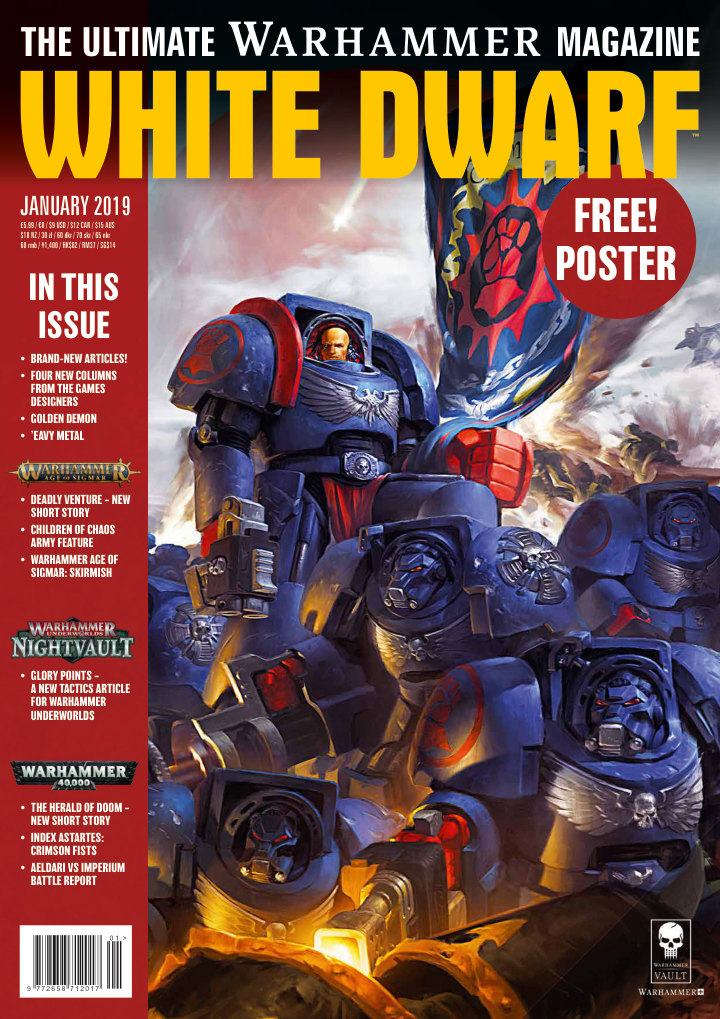
EditorialWD 438 · p. 1
Guest editor Pete Foley announces White Dwarf’s return to the Design Studio and a stronger emphasis on official game material. The restored Index Astartes is the first example, alongside new columns, fiction and painting features. He also asks readers to contribute their own armies, stories and gaming ideas.
CommunityWD 438 · pp. 6–7
Readers discuss accessibility aids, clear battle-report diagrams and a return to the hobby through recent boxed games. A disabled hobbyist explains how painting handles help him build and paint one-handed, while Grombrindal considers Drukhari Incubi confronting an Avatar. Other letters locate Cretacia and share Nighthaunt painting.
PaintingWD 438 · p. 6
Jay Goldfinch identifies the pictured Skitarii as Stygies VIII and recommends completing and washing the metals before blocking in the main colours. Separate small recipes cover black robes, a blue undersuit and red armour. The advice lets a reader reproduce a specific kill-team scheme without guessing its colours from the photograph.
Warhammer 40,000Adeptus Mechanicus10 paint colours
ShowcaseWD 438 · pp. 8–9
Painted Shadespire warbands from several readers range from skeletal Sepulchral Guard to Fyreslayers, Stormcast and Orruks. The model-of-the-month commentary praises a gritty, oily Ironskull’s Boyz scheme. A photography sidebar recommends a white background, good frontal light, a revealing camera angle and enough distance to keep the whole miniature sharp.
Warhammer UnderworldsSepulchral Guard
InterviewWD 438 · pp. 10–13
Phil Kelly explains the exchange between writers, sculptors, artists and rules designers that turns new miniatures into inhabitants of established settings. Short vignettes offer accessible glimpses of those worlds rather than a single exhaustive account. He uses the planned sequence of Malign Portents stories and the expanding Vigilus narrative to show how small perspectives build a larger history.
Age of SigmarWarhammer 40,000
FictionWD 438 · pp. 16–19
Admiral Hengtsson takes the Ironclad Dammerung beneath Hammerhal Ghyra in search of an extraordinary magical treasure. After blasting into a hidden temple, his crew disturbs a luminous seed whose guardian cannot be overcome by guns or aetheric skill. The expedition’s confidence turns to horror as flowers and grasping vines consume the intruders.
Age of SigmarKharadron Overlords
InterviewWD 438 · pp. 20–23
Jervis Johnson distinguishes clarification from changing a rule: designers’ commentaries explain existing text, while errata correct or rebalance it. Movement over terrain illustrates why spelling out every possible question would make concise rules unwieldy. He outlines a practical sequence of rereading the rule, checking related rules and official answers, then resolving any remaining uncertainty so play can continue.
Age of Sigmar
RulesWD 438 · pp. 24–27
John Bracken updates Age of Sigmar Skirmish for the second-edition core rules. Warriors act individually, renown derives from unit points, and champions or restricted equipment cost extra. Grand Alliance abilities, modified warband battleshock and a leader’s traits and artefacts keep the small force distinct, while restrictions on summoning and realm magic prevent ordinary army mechanisms overwhelming the game.
Age of Sigmar
RulesWD 438 · p. 28
The mission rewards a warband for defeating the opposing general, heroes and champions. If neither side removes that entire leadership group, slain enemies are compared by renown, with kills by the general or other champions worth more. It makes the choice between exposing a powerful leader and using ordinary fighters central to the battle.
Age of Sigmar
RulesWD 438 · p. 29
Both warbands try to control a roaming predatory endless spell by bringing more fighters near it. The spell cannot be dispelled and moves under the controlling player’s direction, changing the usual turn-order decision. Victory links retaining control with the harm the manifestation has inflicted, making proximity both valuable and dangerous.
Age of Sigmar
RulesWD 438 · p. 30
Five marked hoards may reveal artefacts when a player secures enough nearby fighters to search them. Once discovered, each relic becomes a contested objective, with heroes and champions adding weight to control. The victory conditions distinguish keeping the only recovered artefacts from simply holding more than an opponent.
Age of Sigmar
RulesWD 438 · p. 31
One warband protects a designated ritualist while the other tries to kill them or interfere through two loci of power. A successful ritual can end the game immediately, but enemy control of those loci reduces its chances. The asymmetry asks the attacker to balance direct assassination against disrupting the magic at a distance.
Age of Sigmar
RulesWD 438 · p. 32
Three central objectives draw both warbands into a concentrated fight. The middle marker yields more points than either flank, and control depends on nearby models rather than the standard army-scale rules. If the score remains tied, defeated enemies’ renown provides a second way to decide the encounter.
Age of Sigmar
RulesWD 438 · p. 33
Random table-quarter deployment scatters fighters into an unexpected encounter, with reinforcements used when a model cannot be placed. Darkness limits early ranged attacks and spells before lifting. Breaking the opposing warband and killing its general determines the result, rewarding recovery from disorder rather than a carefully prepared battle line.
Age of Sigmar
RulesWD 438 · p. 34
Four objectives force each player to defend their own territory while reaching into the enemy half. Opposing-side markers score more heavily, and heroes or champions add extra weight when contesting them. The battleplan therefore creates a choice between a safe foothold and committing valuable fighters to an offensive push.
Age of Sigmar
ModellingWD 438 · pp. 38–39
The opening Realm of Fire guide treats Aqshy as a source of character, colour and modelling ideas rather than a landscape uniformly covered in flames. Art, realm-specific relics and the distinction between calmer central lands and magical outer reaches provide starting points. Keys, braziers, altered weapons and basing can all express where an army lives or fights.
Age of Sigmar
PaintingWD 438 · pp. 40–41
A burnt Dryad, glowing Fyreslayers and Chris Peach’s mixed Freeguild collection demonstrate several ways to communicate Aqshy. The examples range from blackened feet and autumnal leaves to skin and weapons that appear permanently aflame. Shared warm accents can unite an army without requiring every model or base to be red and orange.
Age of SigmarSylvaneth4 paint colours
ModellingWD 438 · p. 42
A Flagellant’s burning brazier, Blood Warrior head and glaive, and a Corpse Cart fire basket turn a Slaughterpriest into a realm-themed champion. Dark red armour and flesh surround a nearly black Onyx Blade. The conversion demonstrates how an artefact or the realm’s background can supply a coherent theme for a hero.
Age of SigmarBlades of Khorne
ModellingWD 438 · p. 42
Anja adds sculpted flames to the Shaman’s robes and replaces the top of his staff with a burning stone crucible. The original skull moves to his head, while dirty cream cloth, scorch marks and an ash-white base frame the fire. The changed staff represents the characterful Exile Torch rather than a generic magical accessory.
Age of SigmarIronjawz
ModellingWD 438 · p. 43
Ben uses only parts from the Battlemages kit, arranging one hand to shield the wizard’s face from his own flames. A red wash over the base colours unites robes, hair and skin before ordinary highlighting resumes. It is a straightforward example of a strong pose and coordinated colour conveying magical power.
Age of SigmarCollegiate Arcane1 paint colour
ModellingWD 438 · p. 43
Akri Furnacehammer gains burning coals from a Hearthguard hammer and small Vulkite braziers on his equipment. James paints dark iron armour around glowing vents and power sources, suggesting barely contained heat. The changes adapt a recognisable Arkanaut Admiral to Aqshy without obscuring the machinery that defines the Kharadron.
Age of SigmarKharadron Overlords
ModellingWD 438 · p. 43
Corpse Cart braziers, burning skulls and two Zombie helpers transform a Necromancer, with a Battlemage collar completing the silhouette. Sergi keeps the master’s clothing sombre so flames dominate the scene. His assistants instead resemble cooling lava with glowing interiors, carrying the Realm of Fire theme through the accompanying figures.
Age of SigmarLegions of Nagash
PaintingWD 438 · p. 44
A black foundation and crackled Martian Ironearth establish the Phosphor Plains base. Progressively pale flesh-coloured drybrushing picks out the fractured ground, creating a warm, light surface without using the more obvious flowing-lava pattern shown elsewhere in the guide.
Age of Sigmar4 paint colours
PaintingWD 438 · p. 44
Grey ground receives a brown wash followed by pale stone and bone drybrushes. The Ash Wastes recipe creates desaturated, dusty terrain that can support brightly coloured miniatures while still connecting the force to Aqshy’s scorched landscapes.
Age of Sigmar4 paint colours
PaintingWD 438 · p. 44
The Lava Fields sequence moves from a red base through scarlet and orange to yellow. Its increasing brightness provides a direct molten-ground option among the article’s five bases, allowing figures from different factions to share a strong, recognisable Realm of Fire setting.
Age of Sigmar4 paint colours
PaintingWD 438 · p. 44
A muted grey-brown surface is shaded and drybrushed before receiving diluted orange in selected recesses. The Ember Tundras treatment combines cooled ground with hints of remaining heat, offering a more restrained fire-realm base than an entirely molten field.
Age of Sigmar5 paint colours
PaintingWD 438 · p. 44
Deep blue-green stone is shaded black and sharpened through brighter turquoise to a pale edge colour. The Onyx Halls scheme gives Aqshy a cool architectural surface, demonstrating the article’s broader point that a realm-themed army need not rely exclusively on warm colours.
Age of Sigmar4 paint colours
PaintingWD 438 · p. 45
Azyrite Ruins become a scorched building through increasingly pale grey drybrushing near the top and darker deposits around the base. Orange recesses suggest lava creeping up the walls, while a turquoise floor contrasts with the surrounding heat. The scheme is designed to sit convincingly on the article’s dark lava battlefield.
Age of Sigmar11 paint colours
ShowcaseWD 438 · pp. 48–56
Adam Elford discusses returning to Skaven after a Khorne project and then carrying his experiments with texture and skin tones into Nurgle. Converted monsters, mixed armour colours and carefully varied batches keep large units individual. His transformed Glottkin and Maggoth demonstrate how one kit’s leftovers can inspire several new characters, while tournaments provide the army’s continuing story.
Age of SigmarSkaven
PaintingWD 438 · p. 51
Adam’s revised scheme replaces an unsuccessful purple with lacquered red armour and contrasting blue cloth. Two undercoat colours and two skin recipes deliberately vary the Clanrats, while a common pale final highlight keeps them unified. The supplied recipes also distinguish drybrushed fur from cloth and carefully shaded reflective armour.
Age of SigmarSkaven20 paint colours
PaintingWD 438 · p. 53
Thin coloured glazes over white create three pale, unhealthy Plaguebearer skin tones. Before priming, Adam adds rough texture across shoulders and assembly joins; yellowed sores, layered green swords and progressively dark horns then provide contrasting finishes. The recipes preserve variety within the unit rather than giving every daemon one identical skin colour.
Age of SigmarMaggotkin of Nurgle18 paint colours
PaintingWD 438 · p. 55
The mortal followers of Nurgle receive a different skin treatment from Adam’s daemons: pale flesh is warmed with a flesh-coloured glaze and highlighted back towards a light finish. Swapped heads, improvised weapons and mixed armour colours support a ragged group of individuals. The recipe shows how changing the skin can distinguish mortals within a related collection.
Age of SigmarMaggotkin of Nurgle4 paint colours
PaintingWD 438 · p. 56
Adam builds bubbling tar from small Green Stuff spheres cut in half and fixed to the bases. A black basecoat and gloss finish turn them into wet, sticky pools. The small basing recipe gives his Nurgle army a shared environment without requiring complicated water effects or multiple blended colours.
Age of SigmarMaggotkin of Nurgle2 paint colours
TacticsWD 438 · pp. 58–61
Dave Sanders names the existing boards and explains how their starting spaces, blocked hexes and lethal hexes affect a plan before the first activation. Choosing first calls for flexibility because the opponent controls orientation; choosing second allows a more targeted arrangement. Worked layouts compare aggressive reach, defensive distance and the restrictions created by narrow or diagonal battlefields.
Warhammer Underworlds
RulesWD 438 · pp. 62–65
Official rules introduce pure Kroot teams with Carnivores, Hounds and a Krootox Rider. Faction tactics support aggression, movement, feeding-driven improvements and finishing wounded enemies, while profiles retain the creatures’ speed and vulnerability. Background tables and a name generator help define a mercenary group, and a Carnivore can instead join a T’au roster through Alien Auxiliaries.
Kill TeamKroot
InterviewWD 438 · pp. 66–71
Paul Dainton describes the fortress through unfamiliar architecture, withheld detail and quiet unease rather than a conventional battle cover. Precipice’s colourful frontier contrasts with cold triangular interiors; the absorbed cruiser Impaler conveys the structure’s scale. Changing rooms and apparently watchful drones leave questions open, while Obsidius Mallex’s court introduces the adventurers’ enemies.
Warhammer Quest: Blackstone FortressServants of the Abyss
InterviewWD 438 · pp. 72–75
Darren Latham reflects on returning from judging Golden Demon to entering it. He explains colour, texture and lighting decisions on an Ultramarine, a Blood Angels Captain, a Kharadron Endrinmaster and Elucia Vhane. Very thin layered blends, deliberately chosen contrasts and a new challenge for each piece make competition painting a way to develop rather than repeat established skills.
Warhammer 40,000Age of SigmarUltramarines1 paint colour
PaintingWD 438 · pp. 76–77
Andrew reposes a Leviathan to suggest turning into battle amid the Imperial Palace’s rubble. Airbrushed yellow, brown shading and pale edges keep the armour rich, while dust, sponged damage and hand-painted heraldry add history. The judges praise the smooth gradient and the restraint that prevents the yellow becoming pastel.
Warhammer 40,000Imperial Fists10 paint colours
PaintingWD 438 · p. 78
A subdued, rusty Grot Tank sets up an intentionally vivid crew and patches of looted armour. Stefan combines artists’ paints, pigments and unconventional weathering materials, then adds a tiny cigarette, smoke and an unfortunate crushed Grot. Judges identify the bright accents and blue oxidation as the means of unifying the chaotic machine.
Warhammer 40,000Orks
PaintingWD 438 · p. 79
John paints the Knight’s red armour brighter than the intended result so weathering and varnish can darken it without losing life. Oil washes weather the skeleton, sequential coloured airbrushing marks overheated barrels and transfers are sealed before scratches are added. The judges focus on maintaining consistent scale across such a large model.
Warhammer 40,000Imperial Knights5 paint colours
PaintingWD 438 · pp. 80–81
Alfrid’s broad, plain coat becomes a test of tiny freehand patterns and convincing luxurious cloth. A Lake-town pier is enclosed in layered clear resin with a suspended fish and metal-strip vegetation. The judges admire the miniature’s likeness, restrained textures and the contrast between purple clothing and greenish water.
Middle-earth Strategy Battle GameLake-town
PaintingWD 438 · p. 82
Martin gives Gandalf a quiet moment in the Shire, building a naturalistic pier base and varying the blues and browns within the grey clothing. The tiny face and overhanging hat demand careful access and scale. The judges credit the refined textures and colour variation that keep a predominantly grey subject from becoming flat.
Middle-earth Strategy Battle GameThe Fellowship
PaintingWD 438 · p. 83
A spare chariot captain becomes a shield-bearing single figure with a finely chequered cloak and shield. Blue gemstones, red patterning and blond hair create a balanced triad, while shaded and re-highlighted metals frame the detail. The judges appreciate a distinctive palette and a scenic base that supports rather than overwhelms the small Dwarf.
Middle-earth Strategy Battle GameIron Hills3 paint colours
ShowcaseWD 438 · pp. 84–89
Five ’Eavy Metal painters receive three months to build and paint a wizard or priest of their choosing. Darren Latham and Martin Footitt judge the results, comparing interpretation of the theme with colour, texture, conversion and basing. Their close critiques lead to Joe Tomaszewski’s Weirdnob Shaman winning over four other highly individual entries.
Age of Sigmar
PaintingWD 438 · p. 85
Max’s altered Plague Priest advances slowly among candle-bearing rats, with a wind-chime staff inspired by Lord Skrolk. Different green textures distinguish leather, coarse robes and hard warpstone against diseased flesh. The judges praise the realism and meticulous details while questioning whether the magical theme could be more explicit.
Age of SigmarSkaven
PaintingWD 438 · p. 86
A Lord-Relictor mask and modified staff make Martin’s Knight-Incantor a grim Anvil of the Heldenhammer. Polished black armour, controlled damage and purple Shyish accents contrast with a pale focal face. The judges admire its crisp finish and textiles, while suggesting the magically disturbed base could have been developed further.
Age of SigmarStormcast Eternals
PaintingWD 438 · p. 87
Tom replaces the Tidecaster’s setting with a partly buried boat, fine sand, fish and coral. Organic orange-pink armour takes the place of metallic surfaces and contrasts with varied turquoise fabrics and details. The judges value the sense of habitat and unusual palette, disagreeing over whether the metallic boat prow distracts from the character.
Age of SigmarIdoneth Deepkin
PaintingWD 438 · p. 88
Natalie converts a Nomad Prince with a Sisters of the Thorn staff top and paints its bird as a luminous magical spite. New growth on the base suggests Ghyran, while deep green and purple convey regal authority. Judges praise that reinterpretation but discuss how similar staff and hair tones compete when placed together.
Age of SigmarWanderers
PaintingWD 438 · p. 89
Joe places the Shaman among desert totems and contrasts waxy green skin with pink-purple magic. A blackened staff skull and carefully varied cloth, bone and energy direct attention to the face. The judges award it the challenge, singling out its clarity, refined textures and strong expression of the magic-and-ritual theme.
Age of SigmarIronjawz
FictionWD 438 · pp. 92–97
Ultramarine Reivers climb Galbraen Spire to root out the Pauper Princes, only to find the cultists fleeing another attacker. Breaking through the toxic cloud, Avarus sees a Chaos armada and Heldrakes that turn the exposed ascent into a desperate retreat. An amplified voice claims Vigilus for Abaddon as the squad attempts to carry the warning back.
Warhammer 40,000Ultramarines
InterviewWD 438 · pp. 98–101
Robin Cruddace recounts abandoning an early replacement game in favour of preserving Warhammer 40,000’s character while making it more accessible. Direct hit values, unit-specific datasheets and common profiles reduce rulebook lookups without removing layered choices. He also explains the scale of rewriting more than a thousand unit entries and the importance of external testing and player feedback.
Warhammer 40,000
LoreWD 438 · pp. 102–109
Andy Clark and Robin Cruddace follow the Crimson Fists from their founding under Alexis Polux to the Rynn’s World disaster and Pedro Kantor’s painstaking rebuilding. Historical battles, recruitment practices and the meaning of the crimson gauntlet establish a pragmatic Chapter accustomed to fighting outnumbered. Guilliman’s arrival brings Primaris reinforcements and a renewed duty to secure the surrounding sector.
Warhammer 40,000Crimson Fists
RulesWD 438 · pp. 110–111
A bespoke alternative to the Imperial Fists successor rules gives Crimson Fists a bonus when attacking much larger units. Three Warlord Traits, faction stratagems and two weapon relics reinforce stubborn defence, hunting enemy leaders and experience against Orks. The article requires a consistent choice across the army’s detachments and explicitly permits matched play.
Warhammer 40,000Crimson Fists
PaintingWD 438 · pp. 112–115
Dan Hyams expands the Primaris Crimson Fists he first painted for a thirtieth-anniversary battle report. Fewer, carefully placed armour highlights and unhighlighted hidden joints free time for faces, gauntlets and character details. He explains how this selective effort preserves an attractive army while making new squads and a Repulsor achievable.
Warhammer 40,000Crimson Fists4 paint colours
PaintingWD 438 · p. 114
Dan leaves the turret, guns, grav-plates and engine covers separate to paint metal and blue areas efficiently. Masked contact points preserve movement in the finished model. A restrained oil-like wash, fine blue edge highlights and brighter red transfer edges carry the infantry scheme onto the tank without losing its readable details.
Warhammer 40,000Crimson Fists6 paint colours
PaintingWD 438 · pp. 116–117
Jay Goldfinch finishes the dark blue armour first, then adds contrasting red fists, leather, gunmetal and character details. The guide offers clear stopping points so a force can be made ready for battle before further highlights are added. Recess washes retain strong colour, while extremely fine final red highlights prevent the gauntlets drifting towards orange.
Warhammer 40,000Crimson Fists29 paint colours
Battle reportWD 438 · pp. 120–141
Innes Wilson’s Imperial Knights, Blood Angels and Guardsmen face Liam O’Shea’s three-way Aeldari alliance in a Chapter Approved Maelstrom mission. The players tailor their objective decks and use deployment, movement and stratagem counters to disrupt one another. Liam destroys the Castellan early and uses numerous fast units to keep scoring despite losses.
Warhammer 40,000Astra Militarum
CommunityWD 438 · pp. 142–145
The studio’s personal projects include Goff Ork vehicles, Robin’s Hallowed Knights, Sam’s Aberrants and Leigh’s Darkoath royalty. A Kill Team game ends twelve–four to Nyle’s Death Guard over Erik’s Skitarii, with blight launchers stopping the fast attackers while Poxwalkers escape. Other snippets cover the web gun’s origins, Crimson Fists history and favourite features from the issue.
Warhammer 40,000Age of Sigmar4 paint colours
PaintingWD 438 · p. 145
Phil Kelly reimagines Nighthaunt as spirits called from bloody pools in a Shyishan underworld. Black undercoating and red spray from above establish the figures, with dark cloak tops and glossy blood-coloured lower portions finishing the effect. The short recipe shows how a simple process supports a distinct army background.
Age of SigmarNighthaunt4 paint colours
Contents-listed features, individual battleplans, named painting guides and substantive challenge entries are indexed. Short letters and studio snippets remain grouped. Covers, contents, advertising, section dividers and the next-issue preview are excluded. The advertised loose poster is not present in the supplied scan.