EditorialWD 422 · p. 3
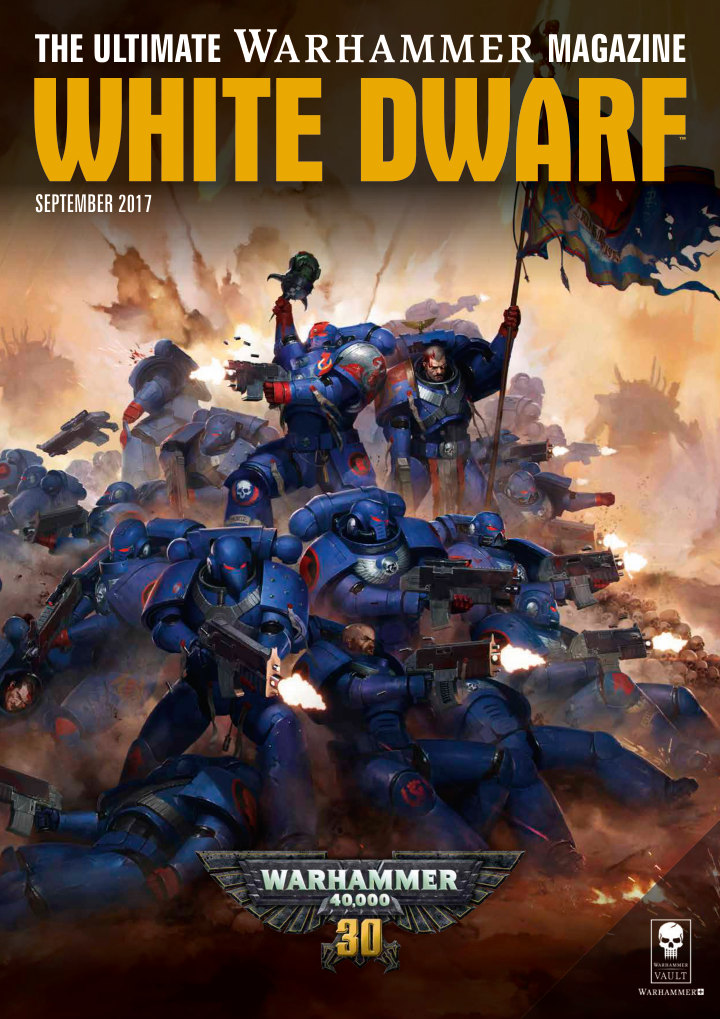
The editorial marks three decades of the game by considering its combination of miniatures, stories, art and play. Igor Sid’s anniversary cover recalls Rogue Trader’s Crimson Fists without simply repeating its scene, leading into the issue’s linked battles and retrospective.
Warhammer 40,000
ShowcaseWD 422 · pp. 6–7
A sequence of rulebook and starter covers traces the game from Rogue Trader to Dark Imperium. Space Marines remain the common thread while their opponents change, and the new Crimson Fists cover carries that recognisable imagery into the Primaris era.
Warhammer 40,000
ShowcaseWD 422 · p. 7
The anniversary model carries a sheathed gladius, veteran insignia, purity seals and marksmanship honours. Alternative heads and a separate shoulder pad let collectors adapt the commemorative warrior to their own Chapter, while the notice explains its limited period of availability.
Warhammer 40,000Space Marines
ShowcaseWD 422 · p. 8
Mortarion returns as an enormous winged plastic model carrying Silence and the Lantern. Interchangeable weapon hands change his pose, while corrupted Barbaran Plate, censers, phosphex bombs and miniature plague attendants connect his daemonic form to ten thousand years of bitter history.
Warhammer 40,000Death Guard
ShowcaseWD 422 · p. 9
The Death Guard receive an independent codex covering their history, Plague Planet, new characters and expanding miniature range. Datasheets, the Contagion discipline, Relics of Decay and faction stratagems accompany reference cards, with unusually soft-centred dice providing another expression of the Plague God’s aesthetic.
Warhammer 40,000Death Guard
ShowcaseWD 422 · pp. 10–11
Adeptus Mechanicus forces gain a unified codex for Skitarii, Cult units and Questoris Knights, with forge-world dogmas and new background supporting different collections. Cawl becomes available separately, and datacards organise the army’s objectives and extensive stratagem selection.
Warhammer 40,000Adeptus Mechanicus
ShowcaseWD 422 · p. 11
Five-model versions of the Intercessor, Hellblaster and Reiver sets retain the multipart kits’ equipment and construction options. The smaller packs offer a way to complete existing units or add a compact new squad without committing to a full ten-model box.
Warhammer 40,000Space Marines
ShowcaseWD 422 · pp. 12–13
Nurgle responds to defeat at the Genesis Gate by spreading new infections across the realms under Horticulous Slimux. Naeve Blacktalon and her Stormcast hunters pursue him, with the boxed set combining their forces, three battleplans and a Wheel of Corruption; sculpted details contrast the relentless warrior with the grotesque gardener and his mount Mulch.
Age of SigmarStormcast Eternals
ShowcaseWD 422 · pp. 14–15
The annual handbook expands multiplayer games, treacherous deals, sieges and realm-specific battle conditions alongside revised pitched-battle profiles. New faction allegiance abilities and warscroll-card releases give existing collections more distinct rules and make their effects easier to track during play.
Age of Sigmar
LoreWD 422 · p. 14
A short chronology recounts Nurgle’s strength during the Age of Chaos and his reverses against Sigmar and Alarielle. Torglug’s transformation into Tornus and the closing of the Genesis Gate precede the new Blightwar, presenting victory and failure as another cycle in the god’s campaigns.
Age of SigmarMaggotkin of Nurgle
ModellingWD 422 · p. 16
A component survey identifies human, alien and monstrous skulls in the new basing pack. Ten modelling suggestions range from trophies and reliquaries to skeleton heads, a skull throne and a container of harvested remains, demonstrating uses beyond simply decorating a base.
ModellingWD 422 · p. 17
Flexible plants add overgrowth to bases and ruined scenery, with heat used to retain more elaborate bends. The article stresses that this material requires superglue rather than ordinary plastic cement, and distinguishes the numerous small bracken plants from the longer climbing vines.
ShowcaseWD 422 · p. 18
The Thousand Sons’ ninth Fellowship captain appears with ornate armour, force halberd and forbidden books hidden under his robes. His removable scenic base depicts Tizcan ruins, connecting Magnus’s former mentor and equerry to the destruction of Prospero.
The Horus HeresyThousand Sons
ShowcaseWD 422 · p. 19
The rare Custodian war engine encloses a master warrior inside a massive suit related visually to the Contemptor. Its modular arms accept the caestus and Arachnus cannon on either side, while the latter’s different firing modes represent both anti-armour and rapid anti-infantry operation.
The Horus HeresyAdeptus Custodes
ShowcaseWD 422 · p. 20
Bard’s three children become a resin set for Middle-earth games. Bain’s determination to protect his sisters is placed within the family’s descent from Dale’s rulers and the fighting in Lake-town, rather than presenting the children as conventional experienced warriors.
Middle-earth Strategy Battle GameLake-town
ShowcaseWD 422 · p. 21
Three web-exclusive Plague Marines add distinct corrupted veterans to the Death Guard. Pitted ancient armour, replacement gun barrels and emerging tentacles illustrate how long warfare and infection merge their bodies and equipment, with postcards and a background booklet accompanying the models.
Warhammer 40,000Death Guard
ShowcaseWD 422 · p. 22
Josh Reynolds’s adventure gathers competing seekers around one of eight ancient weapons capable of threatening gods. Its large cast crosses the peoples of the Mortal Realms, giving smaller character stories room beside the central quest.
Age of Sigmar
ShowcaseWD 422 · p. 22
Chris Wraight explores Terra’s unstable society after the Noctis Aeterna through the Custodes and Sisters of Silence. Daemonic attack and a threat to the warp routes around the throneworld force the two secretive orders into unusually large deployments.
Warhammer 40,000Adeptus Custodes
ShowcaseWD 422 · p. 23
Justin D Hill recounts Cadia’s fall through Creed and other participants, including a Ratling caught in the fighting. Knowing the fortress world’s fate shifts the interest towards individual endurance, heroism and the experiences of those defending it.
Warhammer 40,000Astra Militarum
ShowcaseWD 422 · p. 23
Gav Thorpe sends Greyfax to recover an artefact that might weaken the Great Rift. The unexpectedly surviving Inquisitor Horst accompanies her, but their search depends on secrets held by Moriana, whose cooperation cannot be taken for granted.
Warhammer 40,000Inquisition
ShowcaseWD 422 · p. 23
Josh Reynolds’s audio story follows Endryd Haar and unaffiliated Legionaries trying to seize Dark Mechanicum Ordinatus technology. Their attempt to survive outside the loyalist and traitor divide becomes harder when they are trapped in another battle between the two sides.
The Horus HeresyBlackshields
InterviewWD 422 · p. 23
Reynolds traces the Eight Lamentations to a relic invented for Fury of Gork and discusses expanding that small idea into a novel. Grungni, Excelsis and the returning Crawling City illustrate the mixture of shared setting information, revisions and personal invention involved in the work.
Age of Sigmar
ShowcaseWD 422 · pp. 24–25
The sequel introduces a Great Vortex campaign and new races, while its associated Norse release brings War Mammoths, Skin Wolves and Fimir to the first game. A key to the supplied battle illustration follows Kroq-Gar’s quest and identifies spells, dragons, Skinks and the larger creatures shaping the battle.
Warhammer Fantasy BattlesLizardmen
ShowcaseWD 422 · p. 26
Four new heroes combine Imperial, elven and undead backgrounds in a mobile dungeon adventure. Distinct abilities confront Beastmen, Plaguebearers and other servants of Nurgle, with the environments themselves expressing the corruption of the End Times.
Warhammer Fantasy Battles
ShowcaseWD 422 · p. 26
Valgard Twice-Slain’s mobile adventures continue against Necrons in ten new missions. Freeblade’s PC release gives another platform access to its Imperial Knight battles, extending two existing games beyond their earlier campaigns and devices.
Warhammer 40,000Space Wolves
ShowcaseWD 422 · p. 27
The upcoming early-access action RPG casts players as an Inquisitorial Crusader or Assassin fighting corruption throughout the Imperium. Screenshots emphasise recognisable miniature details, while the preview describes early participation as a chance to help shape the finished game.
Warhammer 40,000Inquisition
ShowcaseWD 422 · p. 27
Doomwheel turns building and improving a Skaven machine into a fast mobile obstacle-and-destruction game. Aeronautica Squadrons instead previews turn-based aerial combat with campaigns, individual missions and multiplayer battles in the far future.
Warhammer Fantasy BattlesWarhammer 40,000Skaven
CommunityWD 422 · pp. 30–31
Letters discuss balancing open games, the Kharadron’s appeal, returning hobbyists and the need for more female miniatures. Replies explain sky-port migration and mysteries, the continuing narrative emphasis of battle reports, and readers’ enthusiasm for reviving Chainsaw Warrior.
LoreWD 422 · p. 31
Nine Liberator retinues can be distinguished through combinations of three tabard colours and three buckle metals. Grombrindal explains that the colours need not map one-to-one to units, giving collectors several legitimate ways to identify the four retinues in a Thunderhead Brotherhood.
Age of SigmarStormcast Eternals
InterviewWD 422 · pp. 32–55
The anniversary retrospective considers why Warhammer 40,000’s mixture of superstition, technology, miniatures and warfare has endured. Rather than presenting an optimistic future, it links an oppressive Imperium and threatening galaxy to the art, rules and personal collections that give the setting life.
Interviews, historical examples and irreverent top-five lists connect its expanding scale with its continuing invitation to invent armies and stories. The closing emphasis is on generations of painters, players and fan communities who make the imagined universe a shared hobby.
Warhammer 40,000
ShowcaseWD 422 · pp. 36–37
The rules grow from an intended mail-order giveaway into Rogue Trader and then towards the larger army battles players wanted. A milestone chronology recalls factions, boxed sets and expansions, explaining how vehicles and super-heavy machines eventually become ordinary parts of the game.
Warhammer 40,000
InterviewWD 422 · pp. 38–41
John Blanche describes medieval superstition, servitude and fear as essential to the imagery, with art providing worlds and context for the miniatures. Igor Sid discusses honouring the classic Crimson Fists composition, while small spot illustrations are recognised as crucial contributors to the setting’s oppressive character.
Warhammer 40,000
LoreWD 422 · pp. 42–43
The Eldar and Tyranids both appear in the earliest game but express different anxieties in the developed setting. Aeldari decline and lost innocence contrast with an unknowable, apparently limitless devouring enemy, while both remain active forces shaping humanity’s future.
Warhammer 40,000Aeldari
InterviewWD 422 · pp. 44–47
Steve Buddle and Aly Morrison explain how apparently futuristic soldiers become science-fantasy figures through relics, candles, swords and disturbing augmentation. Blanche’s brooding painting helped establish the endless-crusade appearance, and collaboration between artists and sculptors continues to develop the visual language. Jes Goodwin’s account of the long-delayed Mechanicus range shows how older imagery can become a new army decades later.
Warhammer 40,000
ShowcaseWD 422 · p. 45
The history of plastic vehicles runs from the early Rhino and Land Raider to larger tanks, flyers and towering walkers. Increasing size and lighter materials let players recreate more of the spectacular battles already depicted in the artwork, while vehicle design and game rules influence each other.
Warhammer 40,000
InterviewWD 422 · pp. 48–51
Jervis Johnson, Robin Cruddace and Phil Kelly connect rules to the setting’s characters, physical drama and deliberately archaic combat. Their account follows lessons passed between Games Workshop games and shows how codexes and supplements first explore ideas that later enter the core rules.
Warhammer 40,000
LoreWD 422 · pp. 52–53
Orks embody persistent and apparently senseless violence, present from the game’s beginnings and capable of threatening Terra itself. The younger T’au offer advanced technology and ideals of cooperation, but their reliance on artificial intelligence and limited experience introduce a different tragic vulnerability.
Warhammer 40,000Orks
ShowcaseWD 422 · pp. 54–55
A galaxy too large to describe completely leaves room for players to create Chapters, planets and campaigns of their own. The article considers lesser alien species, the changing galactic map and fiction beyond tabletop battles before celebrating the clubs, events and fan communities that keep the setting alive.
Warhammer 40,000
CampaignWD 422 · pp. 58–59
Two linked games connect Guilliman’s advance through a Chaos-held spaceport with the Crimson Fists’ last stand on Rynn’s World. The first battle’s result determines when Primaris relief arrives in the second, whose players are deliberately kept ignorant of that timing.
Warhammer 40,000Ultramarines
Battle reportWD 422 · pp. 60–71
Michael Wieske’s Indomitus force must clear Stuart Edney’s Crimson Slaughter quickly enough to send help to Rynn’s World. A destructive Repulsor explosion and a Lord of Skulls initially threaten the command group, but revived Guilliman and repeated reinforcements survive the crisis.
Raven Guard attacks open the flank and concentrated fire finally destroys the Daemon engine. The last defenders die in round five, giving the Imperium a major victory and improving the relief force’s arrival prospects in the linked game; the discussion highlights Hellblasters, Rubric Marines and the cost of plasma overheating.
Warhammer 40,000Ultramarines
Battle reportWD 422 · pp. 72–83
Matt’s depleted Crimson Fists defend hurried barricades against Dan Harden’s Orks, unsure when help will appear. Dreadnought counterattacks destroy major walkers, but transports, Nobz and dangerous Mek Gunz reduce the defenders to a handful of warriors and damaged machines.
Primaris reinforcements arrive in Matt’s third turn and reverse the battle. Kantor kills the Warboss, Aggressors crush Nobz and fresh firepower breaks the remaining assault, securing survival for the Chapter; both players reflect on force fields, command-point spending and the unexpectedly entertaining bubblechukka.
Warhammer 40,000Crimson Fists
LoreWD 422 · pp. 84–89
The Rhino’s origins as an STC exploration vehicle lead into military service, lost knowledge and the Great Crusade’s transport requirements. Annotated diagrams, technical details and Chapter markings show how one robust chassis supports a wide range of Imperial and corrupted vehicles.
The account follows its variants through the Heresy and explains the ritualised construction of modern examples. Machine spirits and venerable relics such as Nocturne’s Hammer turn a practical armoured carrier into an object of devotion as well as a battlefield tool.
Warhammer 40,000The Horus HeresySpace Marines
CommunityWD 422 · pp. 91–100
The six-month painting challenge concludes with four complete collections and substantial centrepieces. The collectors discuss deadlines, initial uncertainty, camaraderie and learning an edition while building an army, then prepare for a final game in the following issue.
Warhammer 40,000
ShowcaseWD 422 · pp. 92–93
Maxime reverses his crusade’s black-and-gold balance on Guilliman and accompanying Custodes, making gold the dominant colour. He reflects on the motivation supplied by fellow collectors and on returning to games after years away, while the mixed Imperial collection presents a choice between Chapter benefits and more command points.
Warhammer 40,000Black Templars
PaintingWD 422 · pp. 94–95
Chris adds all three Ynnari characters and recommends test models and choosing an army enjoyable to paint. Incubi Darkness links the Visarch to his collection, a spontaneously painted gyrinx accompanies Yvraine, and washes over white rapidly establish the Yncarne’s vortex before its purple armour is blended into the surrounding energy.
Warhammer 40,000Aeldari7 paint colours
PaintingWD 422 · pp. 96–97
James Ashbey finishes the Cadian 1260th with Celestine rather than another tank or an Imperial Knight. Bright gold distinguishes the saint from her white-armoured companions, while his reflections emphasise developing a scheme, applying it to unfamiliar models and discovering vehicle gaming during an edition change.
Warhammer 40,000Astra Militarum3 paint colours
ShowcaseWD 422 · pp. 98–99
Dan’s final centrepiece represents an ancient Knight recovered from a buried vault on Sebastus and repainted for the Iron Warriors. Its mysterious new pilot and recovery story connect the miniature to his force’s campaign, while broad hazard stripes and Blackshields transfers adapt the established army scheme to a much larger machine.
Warhammer 40,000Iron Warriors
PaintingWD 422 · p. 100
Dan completes a broad city-and-wasteland battlefield while Chris contributes Deathworld Forest scenery for the forthcoming finale. The painting notes describe pale ancient ruins, washed and drybrushed trees and bright yellow-orange flowers, matching the terrain to existing army details.
Warhammer 40,00012 paint colours
RulesWD 422 · pp. 102–105
The new handbook extends faction-specific abilities to older and smaller armies, separating battle traits, command traits and artefacts. Fyreslayers and Flesh-eater Courts illustrate how these rules express a force’s character, while new battalions provide further thematic structures.
Allies let matched-play armies fill tactical gaps without abandoning their main allegiance, but cannot supply mandatory units or use the host’s faction benefits. James Ashbey’s Ironjawz with Gitmob support demonstrates a combination that adds shooting, mobility and inexpensive magic while retaining a coherent story.
Age of SigmarFyreslayers
CampaignWD 422 · p. 107
Jay Clare revisits the chase near Rivendell after watching the films again, aiming to bring the tabletop action closer to the screen. Two linked scenarios replace and expand the early campaign sequence, first following Thorin’s escape and then reversing the pursuit against Yazneg.
Middle-earth Strategy Battle Game
RulesWD 422 · pp. 108–109
Radagast’s sleigh distracts the Hunter Orcs while Thorin’s company races across rocky ground to the Hidden Valley. The distraction ends if the company attacks or the wizard leaves, and returning Orc reinforcements stop only when the first Dwarf escapes; the Good side must save enough companions without sacrificing Radagast.
Middle-earth Strategy Battle GameThorin’s Company
RulesWD 422 · pp. 110–111
Elrond’s riders ambush Yazneg’s hunters outside Rivendell, with priority in the first two turns representing surprise. The Elves must kill half the enemy force while preventing Yazneg’s escape, making a mobile interception more important than merely winning a static fight; campaign results affect a later scenario’s priority.
Middle-earth Strategy Battle GameRivendell
PaintingWD 422 · pp. 112–113
Max Faleij explains how the Daemon Primarch’s armour appears infected rather than merely chipped, with sores and sickly tones spreading even onto the base. Pale decaying wings preserve the balance of the huge model, cloudy eyes suggest disease and purple robes frame the face while recalling older portrayals. Relatively restrained weapon weathering retains the distinction between flesh, ancient technology and daemonic smoke.
Warhammer 40,000Death Guard
CommunityWD 422 · pp. 114–117
Dan Harden describes using an army’s personality to guide decisions and create entertaining battlefield stories. Reckless Khorne followers, disciplined Stormcasts, self-preserving Skaven and an arrogant Nagash provide different models for behaviour, even when another choice might be tactically stronger.
The general becomes an avatar for the collection, with randomly generated traits suggesting unexpected character and selected artefacts supporting conversions. Dan’s developing Kharadron Admiral illustrates how a miniature’s equipment and an invented sky-port can become the starting point for future games.
Age of SigmarSkaven
ModellingWD 422 · pp. 118–119
The guide starts with a clear character idea and compatible components, recommending dry fitting before permanent assembly. A Slaanesh Lord demonstrates how a changed head, glaive and back banner can alter attitude without rebuilding the pose, while the original scenic base is transferred onto a round one.
Age of SigmarSlaves to Darkness
ModellingWD 422 · p. 120
Dan models a named Pestilens character using the Plague Furnace priest, a Plague Monk book and an additional scroll. Rats and the Liber Bubonicus establish his role as a plague enchanter through equipment and companions.
Age of SigmarSkaven
ModellingWD 422 · p. 120
Matt changes his Sylvaneth hero’s weapon with a Kurnoth scythe head and Tree-Revenant haft. Cutting the haft around the existing hand creates a subtle conversion that distinguishes a repeated character while retaining the original figure’s identity.
Age of SigmarSylvaneth
ModellingWD 422 · p. 120
Martyn removes the integral rock and repositions the hero on stairs, then adds a shield, a different hammer and a Vanguard head. Pinning strengthens the extended weapon, while removing the halo gives the new hair enough room.
Age of SigmarStormcast Eternals
ModellingWD 422 · p. 120
James Karch creates the Ironjawz character from Realmgate Wars by using Maw-krusha spare hands and head on a Megaboss. A Beastman shoulder skull and Stonehorn spinal trophy make a few straightforward swaps into a recognisable individual.
Age of SigmarIronjawz
ModellingWD 422 · p. 121
James Ashbey places a Grot Shaman on a Fenrisian Wolf and disguises the original foot rocks with putty. Removing the topknot and a held bone changes the silhouette and makes the small rider appear to grip the wolf’s fur.
Age of SigmarGitmob Grots
ModellingWD 422 · p. 121
James Gallagher mounts a Wight King torso on Black Knight legs and horse. The main challenge is trimming the cloak to sit convincingly over the mount, with small putty repairs completing the fit.
Age of SigmarDeathrattle
ModellingWD 422 · p. 121
Duncan builds a different commander from the Knight-Questor, combining Vandus’s head, an upgrade shield and a spare Liberator arm. Changing the sword hand gives the new figure its own pose while a replacement head keeps Vandus usable.
Age of SigmarStormcast Eternals
ModellingWD 422 · p. 121
A Spire of Dawn Warlord gains a Doomwheel head and a Kataphron arm to suggest unstable Skryre machinery. A borrowed lightning accumulator reinforces the role, while additional spare equipment also allows the donor Engineer to remain a distinct completed model.
Age of SigmarSkaven
ModellingWD 422 · p. 121
Two studio Nurgle heroes demonstrate the flexibility of the Lord of Plagues sculpt. Putrid Blightking heads, axe blades and an extra shoulder pad change their identities through a small number of compatible parts.
Age of SigmarMaggotkin of Nurgle
ShowcaseWD 422 · p. 122
Dom tackles his army five models at a time, using red spray, blocked-in metals and gloss washes as a foundation for later highlights. A sparse snowy board is planned to keep the red figures clearly visible rather than losing them against brown ground.
Age of SigmarBlades of Khorne5 paint colours
ShowcaseWD 422 · p. 123
James reconciles new industrial scenery with his Sons of Guilliman’s existing sand-and-grass bases by building an abandoned power plant on matching ground. Clipped building corners suggest damage and broken sheets of plaster provide convincing pale rubble.
Warhammer 40,000Sons of Guilliman
ShowcaseWD 422 · p. 123
Three rapidly completed Stormcast heroes illustrate James’s preference for efficient army painting. Basecoats, washes and drybrushing achieve a cohesive result in a few hours, preserving time for expanding the force and its display.
Age of SigmarHammers of Sigmar
ShowcaseWD 422 · p. 124
Andy’s new display trades last year’s crowded Skitarii for five immense Knights, beginning with High King Tybalt. Published heraldry and weapon configurations guide the four accompanying Barons, while minimal pipework and debris leave room for the machines.
Warhammer 40,000House Terryn
ShowcaseWD 422 · p. 125
Ant builds a mining complex where infected workers are excavating a buried Tyranid ahead of Hive Fleet Kraken’s arrival. Corrupted Guardsmen and a weathered Chimera extend the cult across society, red markings link them to Bladed Cog hybrids, and bark with filler creates the display’s underground rock face.
Warhammer 40,000Genestealer Cults2 paint colours
PaintingWD 422 · pp. 126–127
Jay Goldfinch paints the anniversary Primaris in deep blue with sharply controlled highlights and red veteran fists. Separate sequences cover leather, dark gunmetal, face, gold and cropped hair, while advice on thinned recess shades and narrow orange-red highlights prevents the armour’s main colours being overwhelmed. Fresh and older facial scars receive different treatments.
Warhammer 40,000Crimson Fists29 paint colours
PaintingWD 422 · p. 126
Aidan Daly explains the metallic blue-black mixture behind his competition Megaboss. A dark gloss-and-blue recess shade establishes depth before thin metallic glazing and carefully placed bright chips emphasise the most exposed armour edges.
Age of SigmarIronjawz8 paint colours
ModellingWD 422 · pp. 128–131
A basing challenge combines flexible plants, skulls, sculpted bases and spare components to create stronger settings for important models. Colour and composition should support the miniature, and elaborate bases are best painted separately; examples show both contrasting schemes and deliberate integration of figure and ground.
ModellingWD 422 · p. 128
John Manders adds skulls and climbing plants to an industrial Hero Base to suggest abandonment. Flexible prepainted vines can be pulled aside while fitting a miniature and then return to their intended position, making a complicated base easier to assemble.
Warhammer 40,000
ModellingWD 422 · p. 129
James Littler strips leaves from vines and shapes them around skulls and a half-buried Chaos star to build an unsettling shrine. Ash-grey ground, pale bone and fleshy creepers leave its nature ambiguous between vegetation and mutation, suitable for an objective or a character diorama.
Age of Sigmar1 paint colour
ModellingWD 422 · p. 129
John Manders refreshes an older scenic base with plants emerging naturally from cracks. Large skulls can enrich the open space without dominating a suitably imposing monster or cavalry figure, demonstrating why accessory scale matters as much as the choice of parts.
Age of Sigmar
PaintingWD 422 · pp. 130–131
Toby Hale’s Sentinel stands over a rusting turret amid poisonous vegetation, with green technical paint over texture suggesting swampy ground. Other examples frame a Sorceress with a pillar, blend a Tree-Revenant into its woodland and entangle an Ardboy in animated vines; James Littler’s final pale drybrush unifies a Lord-Castellant base.
Warhammer 40,000Age of Sigmar4 paint colours
PaintingWD 422 · p. 132
Jay Goldfinch balances high-quality highlights with a practical painting pace, leaving room for future red-armoured additions by keeping the riders’ flesh more neutral. Cool blue glows contrast with the warm figures, and separate riders and Juggernauts make awkward surfaces accessible before final assembly.
Age of SigmarDaemons of Khorne
PaintingWD 422 · p. 133
James Gallagher tests a quick pale-skin method using a white undercoat, a lightly shaded flesh base and one highlight. Blue, silver and dark hair distinguish the Order warriors from traditional Dark Elf schemes, while blood markings and skull-strewn bases preserve their violent religious identity.
Age of SigmarDaughters of Khaine5 paint colours
PaintingWD 422 · p. 134
Natalie matches an earlier Treelord by drybrushing bark and smoothing the transitions with glazes, reversing light and dark colours on a smaller archer unit. Recessed blue runes, white accents and glazed turquoise weapons give the woody figures a magical focus without repeating the original model’s lengthy painting process.
Age of SigmarSylvaneth3 paint colours
PaintingWD 422 · p. 135
Tom Moore gives a pirate-themed Destruction force varied skin tones and a common horned-skull identity. Ork transfers serve as both markings and tattoos, a Grot assistant gains a comic hat, and chipped black armour joins beach bases to imply a shipwrecked band.
Age of SigmarOgor Mawtribes2 paint colours
CommunityWD 422 · pp. 138–141
The gallery features reader-painted tanks, towering Knights, Imperial heroes, spectral undead and Nurgle followers. Its photography sidebar returns to plain backgrounds, even lighting and appropriate focus so small painted details remain readable in submitted images.
Warhammer 40,000Age of Sigmar
PaintingWD 422 · p. 141
Sarah Berens paints the airship in separate hull, endrin, support and crew assemblies, using an airbrush for the purple and grey. A lighter pinkish purple personalises the published scheme, bright layered gold supplies intensity and weathering powders add rust to the base.
Age of SigmarKharadron Overlords3 paint colours
PaintingWD 422 · pp. 142–143
Mark designs his Destruction army to read brightly from gaming distance, linking Ironjawz and ogors through yellow and turquoise. A scratch-built Grot howdah animates the Rogue Idol, and a straightforward basecoat-and-wash method, pale highlights and metallic scuffing make the infantry coherent. Returning to a favourite Brian Nelson Shaman connects the new collection to an older model he still enjoys.
Age of SigmarIronjawz9 paint colours
CommunityWD 422 · p. 144
The staff continue display boards and army projects while a five-player league tests the new rules. Mel marks where finished scenery belongs before spreading ground texture so the pieces will sit level, and Matt adds a Barak-Mhornar Gunhauler to his growing Shadowlands collection.
Warhammer 40,000Age of Sigmar
CommunityWD 422 · p. 145
The Rhino opening the Ultimate Guide is revealed as Warhammer World’s full-sized vehicle composited into a miniature battle. The explanation shows how scale and viewpoint can create a convincing image from subjects that were never photographed together.
Warhammer 40,000
InterviewWD 422 · p. 145
Martyn and Dan discuss how fieldable Magnus and Mortarion make Chaos’s threat tangible, while Guilliman’s return changes the story’s possibilities. They imagine battles large enough for these characters and question how much hope one returning loyalist can provide amid a collapsing Imperium.
Warhammer 40,000
CommunityWD 422 · p. 145
The anniversary artwork prompts Duncan to paint a Crimson Fist after a visit to the office. Ben completes Commissar Harrius Scheider with an orange plasma-pistol accent, enjoying the model despite reservations about its habit of executing its own soldiers.
Warhammer 40,000Crimson Fists1 paint colour
Battle reportWD 422 · pp. 146–147
Five players choose roughly fifty-power Patrol forces and play a round robin of Eternal War missions on small boards during lunch breaks. Early games leave Matt and Martyn leading, Jonathan undefeated with a draw, and Dan and Ben still seeking a win. The compact reports show how aircraft, arriving Terminators, Aggressors and battlesuits influence these rapid games.
Warhammer 40,000Dark Angels
PaintingWD 422 · p. 148
Matt chooses Magnus’s single-eyed head and leaves the fully sculpted torso exposed in homage to the old Epic miniature. Separate components make the wings and body easier to reach, with pink flesh glazed red and familiar turquoise details connecting the Primarch to the rest of the Thousand Sons.
Warhammer 40,000Thousand Sons6 paint colours