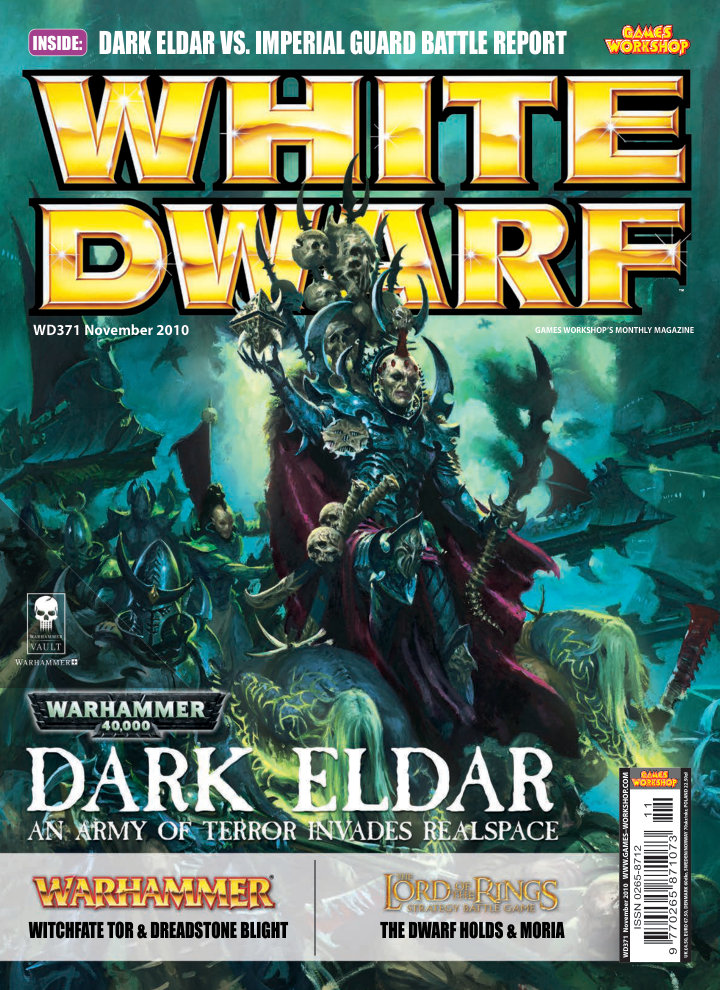
EditorialWD 371 · Inside cover
Andrew Kenrick welcomes the Dark Eldar’s comprehensive relaunch and the answers it brings to questions left open by their original sparse Codex. He connects the pleasure of discovering their role in the Fall to reading new revelations in the Horus Heresy novels, arguing that carefully developed answers can be as exciting as the setting’s enduring mysteries.
Warhammer 40,000The Horus HeresyDark Eldar
CommunityWD 371 · pp. 18–21
The news pages introduce Mike Anderson’s fighter-pilot Grombrindal and examine the whimsical runes and aviation details of the annual White Dwarf miniature. Graham McNeill reflects on winning the David Gemmell Legend Award for Empire and on Gemmell’s influence on his writing. The online preview points readers toward the Dark Eldar designers’ commentary, pain-token modelling and additional assembly guidance.
Warhammer Fantasy BattlesWarhammer 40,000Dwarfs
InterviewWD 371 · pp. 22–29
Jes Goodwin tells Andy Hall how a long redevelopment gave the Dark Eldar room to become a distinct culture and miniature range. Their survival through stolen vitality, loss of psychic gifts and physically manufactured equipment distinguish them from their Craftworld cousins. The interview follows that thinking into serrated Kabalite armour, interchangeable kits, airborne transports and running Wyches, then explains the specialised silhouettes of Reavers, Hellions, Incubi and monstrous Mandrakes. Removable Raider passengers and shared components make the visual ideas useful to collectors as well as evocative.
Warhammer 40,000Dark Eldar
InterviewWD 371 · pp. 30–37
Phil Kelly explains how the new background connects the Dark Eldar’s deliberate excess to the Fall, their refuge in Commorragh and the continuing hunger that drives realspace raids. Captives and suffering sustain both individual immortality and political power, while Kabals, Wych Cults and Haemonculi support a precarious social order under Vect. Their speed and increasing power after slaughter translate those motives into battlefield character. The article also explores the Dark City’s scale, its technological wonders and the horrific regenerative bargains that allow its strongest inhabitants to cheat death.
Warhammer 40,000Dark Eldar
InterviewWD 371 · pp. 36–37
Kevin Chin explains how artwork fills the space between miniatures and written background by showing the Dark Eldar’s different ways of fighting. Sweeping Wych poses express speed, flesh constructs advance with oppressive brutality, and an Incubus’s proud stillness conveys effortless confidence. John Blanche’s densely packed Commorragh image gives the city its own character, while collaborative discussions with Jes Goodwin and Phil Kelly keep the illustrations connected to the wider project.
Warhammer 40,000Dark Eldar
RulesWD 371 · pp. 40–43
New Strategy Battle Game profiles extend the struggle between Dwarves and Goblins with elite Blackshields, their captain, shaman and mobile drum team, alongside the Cave Drake, Flói Stonehand and the King’s Champion. Each includes points, characteristics, equipment and army-list compatibility. Their special rules emphasise ancient enmity, disruptive magic, underground mobility, accumulated lore and close cooperation between the Champion and his protective heralds.
Middle-earth Strategy Battle GameMoria
RulesWD 371 · p. 40
The Blackshield Captain provides a hardened leader for Moria or Dwellers Below forces, with heavy armour and a two-handed weapon. Ancient Enemies grants improved reliability when wounding Dwarves and Elves, while Cave Dwellers situates him within the subterranean fighting style of his followers. The profile gives the elite Blackshield contingent a leader whose battlefield role mirrors its veteran, heavily armed identity.
Middle-earth Strategy Battle GameMoria
RulesWD 371 · p. 40
The Blackshield Shaman uses destructive and disruptive powers rather than the conventional Goblin shaman’s support role. Tremor knocks down and strikes models along a randomly extended line, while Shatter destroys an enemy’s weapons for the rest of the battle. The complete profile places this specialist caster in Moria and Dwellers Below armies, offering a way to weaken powerful opponents before the Blackshields engage them.
Middle-earth Strategy Battle GameMoria
RulesWD 371 · p. 41
Gundabad’s elite Goblins trade the usual rabble’s light equipment for heavy armour and large shields, with optional spears extending their supporting role. Their stronger profile and Ancient Enemies wound re-rolls are specifically suited to the long wars against Dwarves and Elves. The rules retain Cave Dwellers and compatibility with both Moria and Dwellers Below lists.
Middle-earth Strategy Battle GameMoria
RulesWD 371 · p. 41
A bearer and drummer form a mobile team whose drum grants nearby Goblins a banner-like combat re-roll and changes Courage across the battlefield. The instrument plays while its two operators remain in contact, and nearby unengaged Blackshields can take over the equipment if one falls. This lets an advancing Goblin force retain important morale and combat support without relying on a stationary drum.
Middle-earth Strategy Battle GameMoria
RulesWD 371 · p. 42
The Cave Drake combines a powerful, resilient profile with unimpeded movement through difficult terrain and a charge that knocks opponents down. If trapped after losing a fight it lashes out against nearby friends and enemies alike. Its Gaping Maw can replace ordinary strikes with an attempt to swallow a man-sized victim outright, with Fate providing the last chance of escape.
Middle-earth Strategy Battle GameMonsters of Middle-earth
RulesWD 371 · p. 43
Flói spends Will to suppress a visible enemy’s special rule for the turn, with no distance limit beyond his line of sight. His reserve of knowledge grows whenever the Dwarves kill an enemy hero or a multi-Wound creature, replenishing the resource needed for further interference. The designer’s note frames unexpected interactions as the advantage of centuries of accumulated experience.
Middle-earth Strategy Battle GameKhazad-dûm
RulesWD 371 · p. 43
The King’s Champion is purchased together with two banner-bearing heralds, creating a coordinated three-model group. Their mutual protection increases Defence when they remain in base contact, and the heralds can spend their own Fate to protect the Champion. The profile supports a force’s central combatant with defensive cooperation and banners, while its background presents him as the king’s instrument of vengeance.
Middle-earth Strategy Battle GameKhazad-dûm
TacticsWD 371 · pp. 44–49
Adam Troke argues that High Elf success depends on controlled movement, choosing where to receive charges and preparing a decisive counterattack. He surveys the units’ strengths while repeatedly returning to their combination of lethal skill and physical fragility. Support from chariots, cavalry, Eagles, missile troops and magic helps the infantry deliver its attacks without being overwhelmed. A 2,498-point example assigns explicit jobs to sweepers, a firebase and complementary elite blocks, illustrating a plan to concentrate the army against selected portions of a larger enemy force.
Warhammer Fantasy BattlesHigh Elves
EditorialWD 371 · pp. 52–57
Jeremy Vetock describes how completing the new Warhammer rulebook inspired further armies, unit vignettes, unusual terrain and linked scenarios. Large formations invite scenic multi-basing, battle standards help hold a coherent line, and interactive woods make the landscape part of the story. His examples progress from carnivorous hills to a two-game struggle for the Forest of Shadows, showing how the book’s existing ideas can become personal modelling and gaming projects.
Warhammer Fantasy Battles
RulesWD 371 · p. 55
Vetock’s Gnasher Hills turn ordinary ground into a threat that may awaken beneath a battle. At the start of a turn, an occupied hill can grow ravenous mouths and inflict hits on every unit touching it, giving both sides a reason to weigh the advantage of its position against the danger. The simple rule illustrates how a vivid piece of invented background can be represented without an elaborate subsystem.
Warhammer Fantasy Battles
CampaignWD 371 · p. 56
A linked pair of battles begins with the rulebook’s Watchtower mission and then expands the armies for Battle Beneath the Eaves. The first winner receives a small points advantage and the second battle’s Woodcraft Advantage, making the tower’s control matter to the later struggle for the forest. Vetock also suggests connecting River of Death and Raze and Ruin so an invasion’s success or failure determines which side attacks the next settlement.
Warhammer Fantasy Battles
RulesWD 371 · p. 57
Every terrain feature is a Mysterious Forest in this six-turn scenario, and controlling individual woods adds victory points to the normal battle result. The player with Woodcraft Advantage chooses deployment and secretly fixes each forest’s identity after setup, allowing careful use of dangerous or beneficial terrain. The article explains how that knowledge can protect flanks, aid skirmishers or place poisoned attacks where they will matter, making reconnaissance a meaningful reward in the linked campaign.
Warhammer Fantasy Battles
Battle reportWD 371 · pp. 58–77
Phil Kelly’s Dark Eldar raid Andrew Kenrick’s Catachans in a 2,000-point Annihilation battle on Kato III using Dawn of War deployment. Early assaults give Kabalite Warriors pain tokens and surprising durability, while the webway portal, fast Reavers and Incubi keep the scattered Guard under pressure and kill Straken. Imperial fire eventually destroys many raiders, including Lelith, but repeated vehicle suppression and small exposed squads let Phil build a decisive 15–4 kill-point victory. The discussion highlights how deployment, target choice and escalating Power from Pain shaped a result very different from the practice game.
Warhammer 40,000Dark Eldar
EditorialWD 371 · pp. 78–79
Jervis Johnson recommends beginning with miniatures that appeal to you, then considering background, illustrations, preferred tactics and painting opportunities. He expands the decision to the kinds of models you enjoy, your appetite for challenge, friends’ armies and how a new collection complements existing ones. Competitive effectiveness can matter, but should not displace the personal appeal that makes collecting and painting worthwhile over time.
ModellingWD 371 · pp. 80–87
Adam Troke explores Witchfate Tor and Dreadstone Blight as magical centres that can give a battle its character. Suggested terrain rules range from ordinary buildings to spell-filled towers, haunted ruins and protective magic circles. Dave Andrews explains the architectural references and deliberately reused, mismatched details behind the kits, while a narrative Empire battle demonstrates how their powers and positions can support a larger story.
Warhammer Fantasy Battles
RulesWD 371 · p. 82
The article offers two approaches to Witchfate Tor: a garrisonable building governed by the standard shooting and assault restrictions, or a Wizard’s Tower whose library temporarily grants a nearby caster every spell in the chosen lore. It explains the tactical and narrative consequences of each, from denying cavalry its usual assault advantages to making control of the tower a contest between competing wizards.
Warhammer Fantasy Battles
RulesWD 371 · p. 83
Dreadstone Blight can retain a sinister influence despite being ruined. Treating it as a Haunted Mansion produces spectral attacks nearby and makes its garrison fearsome; using its inscribed floor as a Magic Circle instead grants protection from spells without forcing the battle to revolve around occupying a building. The examples show how a single terrain model can support different tactical stories.
Warhammer Fantasy Battles
LoreWD 371 · pp. 86–87
Chaos warlord Harrax Soultrader seizes the eccentric Gold Wizard Leopold Groeth’s remote tower, drawing an Ostland relief army under Groeth and Warrior Priest Toben Bell. Artillery kills the Chaos Giant and a catastrophic magical overreach helps Groeth recover his library. The final duel turns upon the haunted ruins themselves, whose spectres claim Soultrader as he prepares to strike the priest, giving the battlefield’s magical scenery a decisive narrative role.
Warhammer Fantasy BattlesThe Empire
PaintingWD 371 · pp. 88–95
Anja Wettergren and Joe Tomaszewski establish the relaunched Dark Eldar’s clean, sinister appearance through deep colours interrupted by bright, neon-like highlights. The collection-wide tutorial covers glowing eyes, sharply edged armour, brass, pallid Wych flesh, vivid hair, tattoos, Mandrake runes and grisly skin garments. Vehicle markings extend the same visual identity to larger surfaces through controlled freehand designs rather than weathering away the Dark Eldar’s cultivated elegance.
Warhammer 40,000Dark Eldar
PaintingWD 371 · p. 88
Anja Wettergren builds green eye lenses toward a white focal highlight and applies increasingly pale, thinned versions of the same colours around the sockets. Keeping the eyes brighter than the surrounding reflection makes the source of the glow convincing. The concise sequence introduces the neon object-source-lighting effect used to contrast with the army’s dark armour.
Warhammer 40,000Dark Eldar4 paint colours
PaintingWD 371 · p. 89
The Kabal of the Black Heart’s armour starts with a near-black green-blue mixture and gains definition from successively sharper, paler edge highlights. Black recess shading keeps the individual plates distinct and supports the contrast. A companion brass sequence mixes dark metallics with brown before black-brown shading and bright silver-tipped highlights, providing a restrained ornamental counterpoint to the armour.
Warhammer 40,000Dark Eldar10 paint colours
PaintingWD 371 · p. 90
Joe Tomaszewski gives the Wyches an almost alabaster complexion with a flesh-and-blue-grey foundation, warm recess shade and increasingly white highlights. Purple around the eyes and nose supplies depth without losing pallor. A separate dark-red-to-orange hair sequence adds a strong primary colour against the otherwise neutral skin and leather, reinforcing the models’ sharp contrasts.
Warhammer 40,000Dark Eldar12 paint colours
PaintingWD 371 · p. 91
A prepared reference is first traced with dilute red paint so mistakes can be removed, then blocked in once the shape is settled. Reapplying the original flesh shadows and highlights with some red mixed in makes the tattoo sit within the skin rather than on top of it. Finished examples show how cult markings and personal patterns can distinguish Wyches, Reavers and Lelith.
Warhammer 40,000Dark Eldar2 paint colours
PaintingWD 371 · p. 92
Anja Wettergren paints the Mandrake as an inverse Eldar, contrasting blue-black skin and white hair with intensely bright green runes. The skin receives cool grey highlights while the runes move through green, yellow and white to imply supernatural light. Selective highlights on individual hair strands prevent the pale mass from becoming artificially uniform.
Warhammer 40,000Dark Eldar10 paint colours
PaintingWD 371 · p. 93
Several related flesh-and-brown foundations make a Mandrake’s stolen skin garments appear assembled from different victims. Shared purple-brown shading and progressively paler Rotting Flesh highlights unify the patches while preserving their variation. A companion note transfers the glowing-rune palette to balefire, reversing the highlight direction so the flame is brightest around the creature’s hand.
Warhammer 40,000Dark Eldar10 paint colours
PaintingWD 371 · p. 94
Anja sketches a red pattern onto a Reaver canopy with thin paint, strengthens the accepted lines and tidies their edges with the underlying canopy colour. Bright red and orange borders make the graphic design stand out crisply. The method allows individual riders’ markings to follow a vehicle’s shape or form a separate personal icon.
Warhammer 40,000Dark Eldar4 paint colours
PaintingWD 371 · pp. 94–95
Joe prepares a white Raider sail with carefully thinned blue-grey shading to emphasise its curve, then blocks in a black circular field. Plotting the red icon as points before joining them helps establish its proportions, after which orange and pale highlights add depth. The article also explains that hulls and canopies use the Kabalite armour method on a larger scale.
Warhammer 40,000Dark Eldar11 paint colours
ModellingWD 371 · pp. 96–103
Jes Goodwin and Juan Diaz demonstrate how the new plastic kits can convey purposeful movement without extensive conversion. Preparing legs, armed torsos and heads separately lets a whole squad be posed provisionally before glue fixes the final relationships. Annotated Warriors, Wyches and Hellions show how small changes in head direction, waist angle, weapon placement and flying-stand tilt can create individual actions while keeping the squad visually coherent.
Warhammer 40,000Dark Eldar
ModellingWD 371 · pp. 97–99
The step-by-step assembly builds a stable foundation from the feet upward, adding arms before joining torso and legs so weapons clear the backpack. Heads are fitted last to establish a convincing direction of attention. Jes recommends experimenting with all ten models at once using adhesive putty, allowing individuality and a shared squad dynamic; illustrated frame guides identify the extensive parts and the interchangeability of Warrior and Wych kits.
Warhammer 40,000Dark Eldar
ModellingWD 371 · pp. 102–103
Jes uses opposing arm and knee positions, twisting torsos and angled heads to make the Wyches’ running and fighting poses natural. The examples range from a directing Hekatrix to a crouching knife-fighter, showing why every figure need not simply charge straight ahead. Flowing hair, flails and agonisers extend the motion established by the body and give each silhouette a readable action.
Warhammer 40,000Dark Eldar
ModellingWD 371 · p. 103
Juan Diaz uses the ball joint between skyboard and flying stand to change the pitch and roll of each Hellion. He settles the rider and weapon with the board before attaching the head, creating climbing, swooping and attacking poses whose attention matches their movement. The annotated examples show how a small number of adjustable connections can make an airborne gang look actively engaged.
Warhammer 40,000Dark Eldar