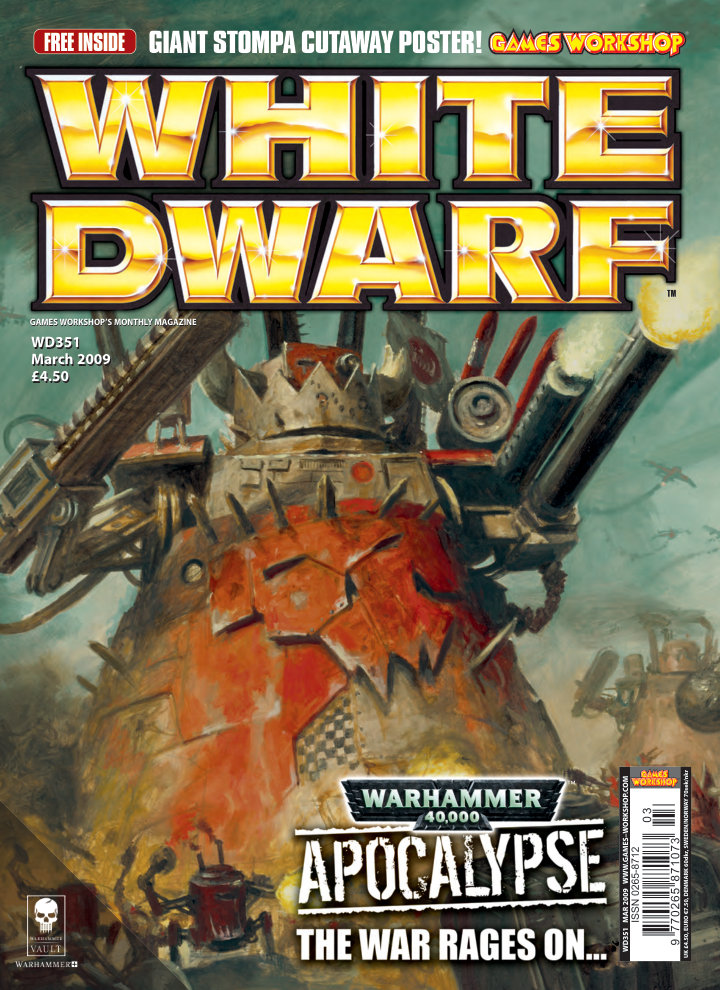
EditorialWD 351 · p. 1
Mark treats Apocalypse as a way to field the models he enjoys rather than build towards a restrictive list. He reminds readers that three thousand points is only a starting scale for the expansion. Large games can also use ordinary rules when that better suits the group. The same collecting freedom extends to Legendary Battles and the forthcoming War of the Ring.
Warhammer 40,000
ReviewWD 351 · pp. 2–3
A huge plastic idol combines a chainfist, heavy guns and a ramshackle armoured body. Alternative faceplates, a removable boss plate and freely positioned riggers allow considerable variation. One illustrated version leaves room for a painted clan symbol. The release notice emphasises both the machine’s destructive role and the kit’s wealth of small Ork details.
Warhammer 40,000Orks
ReviewWD 351 · pp. 4–5
One plastic chassis supports six different super-heavy tank builds. The Shadowsword hunts Titans with its volcano cannon, while the Stormlord transports troops beneath heavy anti-infantry fire. Other barrels create specialist siege and support vehicles. The notice introduces the modelling choices before later pages provide the two principal datasheets.
Warhammer 40,000Astra Militarum
ReviewWD 351 · p. 6
Seb Perbet’s looting Orcs carry a torch or stolen pig alongside their plunder. Juan Diaz’s Wolf Guard instead charges forwards with paired lightning claws. The figures illustrate the range’s combination of comic subjects and alternative army characters. The page identifies their sculptors and distinctive equipment.
Warhammer Fantasy BattlesWarhammer 40,000Orcs & Goblins
ReviewWD 351 · p. 7
Blood Ravens arrive on a desert world looking for recruits. An Ork invasion forces them into a series of counterattacks. Those strikes reveal a Tyranid presence behind the immediate danger. The short notice establishes the novel’s campaign premise and its changing enemy.
Warhammer 40,000Blood Ravens
ReviewWD 351 · p. 7
Tchar’zanek’s advance spreads mutation and plague across the Empire. High Elf intervention offers relief but faces interference from the Dark Elves. Four heroes must cooperate against a threatened daemon summoning. The notice presents the stakes of the developing war rather than a detailed plot account.
Warhammer Fantasy BattlesThe Empire
ReviewWD 351 · p. 7
Sergeant Wulfe’s tank company joins a mission to Golgotha. Their objective is to recover Yarrick’s Fortress of Arrogance from the alien world. Retrieving the famous vehicle is only part of the problem, since the battlegroup must also escape. The notice introduces an armoured adventure with a specific historical prize.
Warhammer 40,000Astra Militarum
ReviewWD 351 · p. 7
Gotrek and Felix find a golden bracelet in Marienburg. Its connection to Stromfels brings the pair into conflict with the ancient storm god. The adventure is released as audio fiction rather than a printed novel. Danny Webb reads the new story of the familiar companions.
Warhammer Fantasy BattlesDwarves
NewsWD 351 · p. 8
Robin Cruddace’s forthcoming Guard codex aims to accommodate the army’s many vehicles even in smaller forces. An orders system promises new opportunities for ordinary infantry. Ratlings and the plastic Valkyrie add fresh models alongside that rules work. The preview reveals the direction of the release without printing its complete army list.
Warhammer 40,000Astra Militarum
NewsWD 351 · p. 9
The Blood Ravens return in Relic’s strategy sequel. Tyranids appear beside Orks and Eldar as opponents for the new campaign. Cooperative and multiplayer modes broaden the ways to play. The preview also introduces the updated engine and Windows Live service as features of the contemporary release.
Warhammer 40,000: Dawn of War IIBlood Ravens
FeatureWD 351 · pp. 14–16
Andy presents Apocalypse as a toolbox for themed games and unrestricted collections. Stompas and the new tank kit create opportunities for bespoke forces and scenarios. Drop Pod assaults and massed armour suggest focused games rather than simply larger versions of familiar missions. He encourages groups to adapt the material around their own collections.
Warhammer 40,000
CommunityWD 351 · p. 16
Tom Meer explains how his gaming group prepares for enormous battles. A suitable venue, reliable transport and agreed packing responsibilities matter as much as the rules. Written reminders prevent players leaving essential equipment behind. His experience makes the practical planning part of the enjoyment rather than an obstacle to it.
Warhammer 40,000
ShowcaseWD 351 · p. 17
Jeremy builds his Orks around models and units he enjoys rather than a fixed points target. A powerful Dredd Mob becomes a particularly effective centrepiece. New transports and Deffkoptas give further reasons to expand. Apocalypse lets those individually appealing projects become one large force.
Warhammer 40,000Orks
ShowcaseWD 351 · p. 18
Rik’s collection grows from Dawn of War and the Medusa V campaign into a large Marine force. Completing a battle company becomes a stepping stone to more ambitious projects. Legendary formations support the enlarged collection. The showcase describes the changing goals that keep a long-running army active.
Warhammer 40,000Blood Ravens
ShowcaseWD 351 · p. 19
Fil expands the force familiar from A Tale of Four Gamers into Apocalypse. A larger Dredd Mob, Gargantuan Squiggoth and custom rolling Stompa provide the new heavy elements. Numerous characters can now fight together instead of competing for limited selections. Transport capacity also helps protect the infantry from large blast templates.
Warhammer 40,000Orks
ShowcaseWD 351 · p. 20
Nick chooses an army that can be painted efficiently at a large scale. Rusted Ogre weapons inspire the weathered robotic finish. Monoliths and massed Warriors create the visual and gaming identity. Apocalypse supplies the cinematic moments he enjoys from putting the full collection on the table.
Warhammer 40,000Necrons
ShowcaseWD 351 · p. 21
Matt brings several Marine projects together as a larger combined force. His Armageddon interests connect Imperial Fists and Steel Legion collections. Existing datasheets make whole companies practical in Apocalypse. The showcase illustrates how several separate armies can keep growing without losing their individual identities.
Warhammer 40,000Imperial Fists
InterviewWD 351 · pp. 22–25
Aly Morrison credits a long collaboration with the tool room for the Stompa’s final design. Small details such as shell damage and weld thickness establish its scale. The project keeps evolving between other assignments over more than two years. A numbered component inventory then shows the head, hull, crew, weapons and optional equipment available in the kit.
Warhammer 40,000Orks
TacticsWD 351 · pp. 26–27
Four alternative builds offer different support roles. The Doomhammer combines a magma cannon with limited transport, while the Banehammer disrupts enemy movement. Long-range siege fire distinguishes the Banesword. The Stormsword instead uses a short-ranged but devastating shell, with complete external datasheets referenced rather than reproduced.
Warhammer 40,000Astra Militarum
RulesWD 351 · p. 28
The datasheet makes the Shadowsword a dedicated Titan hunter with a destroyer-class volcano cannon. Sponson changes trade extra weapons for heavier side armour. Targeters can improve accuracy at the expense of lascannons. A command-tank upgrade also supports nearby Guard morale, adding a secondary role to the long-range engine.
Warhammer 40,000Astra Militarum
RulesWD 351 · p. 29
A forty-model troop capacity gives the Stormlord a substantial assault-support role. Up to twenty passengers can fire from its platform. Its Vulcan mega-bolter can shoot twice when the vehicle remains stationary. Alternative sponsons and armour options allow the datasheet’s firepower and protection to be adjusted.
Warhammer 40,000Astra Militarum
ScenarioWD 351 · p. 30
Abandoned super-heavy vehicles stand near the centre of the battlefield. The first infantry model to reach one claims it permanently for its side. Teams compete to control the greatest number when time runs out. Deployment bids and extra assets for the weaker force retain the Apocalypse framework around that unusual objective.
Warhammer 40,000Orks
ScenarioWD 351 · p. 31
A lone Stompa attempts to escape through a thousand-point defending army. Half the defenders begin on the table while the remainder arrive from reserve. Gogard must destroy enough opposition before leaving, or wipe out the enemy completely. Night fighting covers the opening turn, with optional scaling for several Stompas.
Warhammer 40,000Orks
RulesWD 351 · pp. 34–38
Kevin’s campaign house rules keep named characters and their equipment consistent across battles. Achievements earn points for advances, while defeat can bring lasting injury or death. Legendary abilities, healing and nemesis relationships make leaders increasingly individual. Suggestions for chronicles and conversions help those developing rules become visible stories on the tabletop.
Warhammer Fantasy Battles
ShowcaseWD 351 · p. 39
Studio collectors show how battle history changes their personal characters. Chris Peach represents Christian Leitdorf at several stages of a campaign. Pete Foley adds a defeated rival’s head to his Skaven, while Nurgle and Orc leaders gain their own trophies and reputations. The gallery connects remembered exploits with small but distinctive conversions.
Warhammer Fantasy BattlesThe Empire
RulesWD 351 · pp. 40–42
Mat previews command companies, banners and musicians as the framework of formations. Heroes add Might, special actions and distinctive abilities that can alter the sequence of play. Magic ranges from familiar powers to combinations that weaken morale or damage troops. Legendary formations and mobile Epic Heroes provide further ways to recreate the setting’s famous participants.
War of the RingFree Peoples
BackgroundWD 351 · pp. 44–45
Jervis places the Stompa at the religious and mechanical heart of a Waaagh. Meks build individual idols of Gork or Mork from scavenged armour and improbable machinery. The captain, specialist bosses and Grot riggers make its vast crew function. Several engines gather under a Boss Stompa, leading into the accompanying new datasheets.
Warhammer 40,000Orks
RulesWD 351 · pp. 46–47
A custom engine begins with familiar heavy weapons and transport space. Optional belly guns, repair teams and extra arsenals radically change its role. A wrecking ball can devastate an area but also endanger its own machine. The datasheet embraces varied conversions, with some upgrade rules explicitly referring back to Apocalypse.
Warhammer 40,000Orks
RulesWD 351 · p. 48
Three or more engines form a mob around a designated boss. Their coordinated stampede crushes ordinary troops and terrain in the path. Momentum improves an impact against larger opponents. Overenthusiastic crews may be forced to keep charging straight ahead, even carrying their machines off the battlefield.
Warhammer 40,000Orks
RulesWD 351 · p. 49
A gigantic roller replaces the custom Stompa’s normal assault armament. Its special advance can crush models and scenery before engaging larger foes. The datasheet includes transport space, rockets and burnas beside the main weapon. An account of flattening a path through an Iron City introduces the conversion’s deliberately excessive character.
Warhammer 40,000Orks
FeatureWD 351 · pp. 50–55
Andy asks several collectors what draws them to Lizardmen. Dinosaurs, a lost civilisation and participation in every phase offer different motivations. Small first games help players learn their new units, while matching bases unite varied creatures. Jungle ruins and portable themed terrain then extend the collection into its environment.
Warhammer Fantasy BattlesLizardmen
PaintingWD 351 · p. 52
Ian combines a blue wash with drybrushed scales and smoother layered skin. Pale blue brings out the final highlights without flattening the darker recesses. Purple shading enriches the gold while grey spear points contrast with bone claws. A warm red-and-brown shield balances the otherwise cool miniature.
Warhammer Fantasy BattlesLizardmen15 paint colours
PaintingWD 351 · p. 53
Andy begins his Kroxigor with a pale grey foundation under a blue wash. Mixing the same grey into more wash creates translucent highlights without extra water. That method is intended to vary across the army while preserving a related palette. Added glyphs give the bases a more specifically Lustrian identity.
Warhammer Fantasy BattlesLizardmen2 paint colours
Battle reportWD 351 · pp. 58–83
Twelve players fight a planetary invasion across a fortress, desert, lava city and orbital weapon. Remote commanders issue orders from reconnaissance photographs while secret personal goals complicate cooperation. Imperial reserves secure the fortress battlefield, but Orks win the campaign through better execution of orders and successes elsewhere. The final sixteen-to-thirteen score reflects that wider story rather than only casualties or the central objective.
Warhammer 40,000Orks
ScenarioWD 351 · pp. 60–65
A gamesmaster links four simultaneous tables through orders, reserves and an orbital laser. The main armies race towards opposing fortified objectives. Remote commanders see only photographs and recorded messages from their subordinates. Individual order cards add rivalries and contradictory goals, allowing narrative behaviour to contribute to the overall score.
Warhammer 40,000Orks
EditorialWD 351 · pp. 84–86
Rick Priestley looks forward rather than revisiting the old days. Expanding plastic ranges promise more affordable cavalry armies, larger monsters and easier conversions. Alternative builds can also introduce new units within familiar vehicle or creature concepts. He still sees a place for metal figures where production methods suit individual designs.
Warhammer Fantasy Battles
ModellingWD 351 · p. 87
The new series begins with one of the simplest ways to personalise a figure. Compatible plastic components often need only a changed head, while metal models can require careful cutting. Examples turn a Man-at-Arms into a knightly hero and personalise a Marine captain. Nick Bayton combines chosen heads, a halberd and shield to distinguish a Chaos leader.
Warhammer Fantasy BattlesWarhammer 40,000Bretonnia
PaintingWD 351 · pp. 88–94
Darren converts the Black Reach Warboss into an imposing Bad Moon before painting. Yellow-enriched skin makes the leader stand out, while cool cloth contrasts with warm armour. Rusty steel and verdigris brass provide different kinds of ageing. Layered chips, freehand motifs and a brightly coloured Squig turn the simple plastic character into a detailed display subject.
Warhammer 40,000Orks33 paint colours
PaintingWD 351 · p. 90
Yellow and bone mixed into green make the Warboss’s skin brighter than his followers. Successive thin layers preserve smooth muscular transitions. Blue veins, tinted eyelids and muted lips add variety without losing the shared pale highlight. Dark talons provide a cooler contrast to the surrounding flesh.
Warhammer 40,000Orks11 paint colours
PaintingWD 351 · p. 91
Darren uses the same khaki highlight across black and brown cloth. That choice keeps the surfaces softer than a conventional grey leather highlight. Dark washes define stitching and folds. Cool clothing then balances the warm yellow armour elsewhere on the figure.
Warhammer 40,000Orks5 paint colours
PaintingWD 351 · p. 92
The guide distinguishes warm rusted steel from cooler verdigris brass. Brown washes and stippling age the silver weapons. Green-blue stains gather around rivets and recesses of the brass. Small bright highlights keep sharp blades and exposed edges readable despite the weathering.
Warhammer 40,000Orks13 paint colours
PaintingWD 351 · p. 93
Foundation yellow supports stronger layers over the armour. Dark flesh shades the recesses before progressively paler highlights establish the edges. Chips are built from their outside outlines towards dark and metallic centres. Leaving different stages visible suggests damage of different ages rather than identical fresh scratches.
Warhammer 40,000Orks9 paint colours
PaintingWD 351 · p. 94
Red hair repeats as a spot colour across the model. The Squig contrasts purple flesh with blue-green hair. Freehand flames reuse the armour palette to hold the composition together. Tiny lengths of rod become spent shell cases on the base.
Warhammer 40,000Orks12 paint colours
PaintingWD 351 · p. 94
Joe answers a reader’s question about Sigvald’s reflective armour. He stresses studying how light actually behaves on shiny surfaces before attempting non-metallic metal. Black and white shading anchors the technique regardless of the chosen hue. The brief response points to a longer external painting focus without reproducing that guide.
Warhammer Fantasy BattlesWarriors of Chaos
InterviewWD 351 · p. 96
Dave Andrews nominates Michael Perry’s mysterious mounted knight. The rearing horse and weighted cloth give it both drama and believable movement. Tree-spirit imagery links the sculpt to older legends of the Green Man. The original Mike McVey paintwork illustrates a miniature Dave regards as an enduring design standard.
Warhammer Fantasy BattlesBretonnia
ShowcaseWD 351 · p. 97
A small gallery surveys Michael’s varied miniature work. Middle-earth characters and warriors sit beside a large Catachan display figure. The latter remains a personal favourite above his desk. Its one-off status is made explicit rather than suggesting it is a normally available army model.
Middle-earth Strategy Battle GameWarhammer 40,000Lamedon
ModellingWD 351 · pp. 98–107
Mark Jones develops a methodical set of sub-assemblies before joining the enormous model. Spare guns, wooden beads, plasticard and wire create additional weapons and convincing repairs. Chains support the exhausts while sharpened armour and razor wire emphasise its ramshackle menace. Crew placement tells small stories, with parts kept removable so painting remains possible.
Warhammer 40,000Orks1 paint colour
CommunityWD 351 · p. 109
Warhammer World explains Battlefields as a social event format alongside tournaments and doubles. Scenario achievements reward unusual outcomes rather than only overall victories. Larger master armies provide smaller forces for different games. Flexible use of compatible older supplements broadens what participants can bring from their collections.
Warhammer 40,000
All substantive features, new-release notices, printed datasheets and scenarios, campaign house rules, galleries, painting sections, modelling workshop and the image-only Battlefields explanation are indexed. Uniform +2 body pagination is verified. The separate Stompa cutaway poster advertised on the cover is absent from this scan and is not invented. Routine product tables, store and club directories, calendars, advertising and externally referenced articles are excluded.