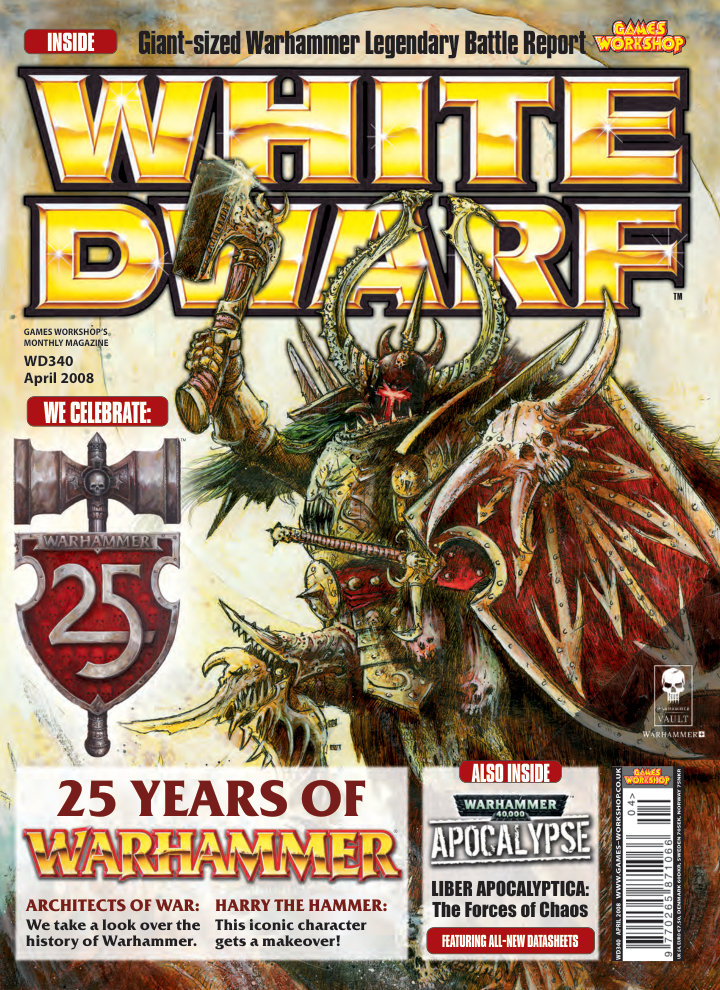
EditorialWD 340 · Inside cover
Grombrindal welcomes Warhammer’s twenty-fifth anniversary with a programme of design interviews, new scenarios and a large-battle expansion. The celebration culminates in a siege report using a vast collection of troops. He also introduces Jervis’s Chaos Apocalypse formations and the first instalment of a Middle-earth allies tactica, framing the issue as both a look back at the game’s origins and an invitation to try different ways of playing.
Warhammer Fantasy BattlesWarhammer 40,000
CommunityWD 340 · pp. 8–9
The Mordor preview promises forces from Barad-dûr, Minas Morgul and Cirith Ungol, expanding Sauron’s armies beyond ordinary Orcs and Trolls. Black Númenóreans, Morgul Knights and new Nazgûl models accompany a sourcebook that explores the Ringwraiths’ history and gives them a collective army list. A plastic Troll can represent either Mordor or Isengard. The article positions the June release as a broad increase in the options available to Evil collectors.
Middle-earth Strategy Battle GameMordor
CommunityWD 340 · p. 10
The news page announces a June wash range designed to shade existing white, metallic and coloured coats with little preparation. A new edition of How to Paint Citadel Miniatures will explain the paint range through practical guides and expert examples. A separate notice introduces the National Painting Competition, with stores taking registrations and running activities before selecting local champions. Together the items link new painting materials with opportunities to develop and display skills.
CommunityWD 340 · p. 11
Warhammer Historical plans to demonstrate its forthcoming First World War game at Military History LIVE, supported by designers and historical gaming displays. The same news page announces the first nationwide Black Library Day in Games Workshop stores. Games based on novel scenes, character conversions and painting activities will celebrate fiction’s contribution to the settings. Both notices describe planned events, giving readers different ways to connect miniatures with historical or imagined stories.
Warhammer Fantasy BattlesWarhammer 40,000
RulesWD 340 · pp. 12–19
Jervis Johnson adapts Warhammer for teams commanding at least five thousand points per side. Alliance relationships control which armies and units can cooperate, while special formations permit massed artillery and monsters. Alternative deployment methods, shared-phase conventions and divided magic pools keep the enlarged game manageable. Reserves and desperation tokens accommodate crowded tables and unequal collections, and a turn-weighted objective system rewards sustained control while making the closing stages especially decisive.
Warhammer Fantasy Battles
Battle reportWD 340 · pp. 20–45
A huge greenskin force advances on Wolfenburg behind Big Gork, an enormous siege engine, while Empire and Dwarf commanders try to delay it and recapture surrounding objectives. The Emperor falls, reinforcements turn several fights and unreliable tower magic finally burns through the attackers. Objective scores remain almost equal when the machine reaches the walls. Its final successful breach gives the Orcs victory, making the battle’s narrative climax matter as much as its impressive twenty-five-thousand-point scale.
Warhammer Fantasy BattlesOrcs & Goblins
RulesWD 340 · pp. 22–23
The siege scenario adds three contested objectives, a powerful but dangerous Bright Wizard tower and a relentless Orc siege engine. Big Gork can be damaged only through limited attacks and determines the battle’s ending when it reaches the wall. A special Shaman ritual unleashes destructive magic at personal risk, while scheduled reinforcements and randomly assigned Giants complicate the struggle. These dramatic additions show how a few thematic rules can give a massive battle a clear central story.
Warhammer Fantasy BattlesOrcs & Goblins
InterviewWD 340 · pp. 48–55
Andy Hall brings Rick Priestley, Jervis Johnson, Gav Thorpe and Alessio Cavatore together to trace Warhammer from rules for existing miniature collections to a widely accessible army-book game. They discuss changes to movement, characteristics, magic and army selection, identifying major generational shifts rather than seven wholly separate inventions. Alan Merrett and John Blanche add the setting’s thematic and visual history. The conversation repeatedly returns to miniatures as the reason the game began and continues to develop.
Warhammer Fantasy Battles
InterviewWD 340 · p. 53
Alan Merrett defines Warhammer through its armies, powerful commanders and competing racial identities. Its darkness coexists with rebellious humour, and each people’s character supplies reasons for new conflicts. History, folklore, popular culture and the work of artists and designers combine into a setting that can support many different battles. Early miniatures from his collection illustrate the long development behind that familiar world.
Warhammer Fantasy BattlesDwarfs
InterviewWD 340 · pp. 54–55
John Blanche recalls freelance work, joining Citadel and illustrating early Warhammer alongside Tony Ackland while Rick Priestley assembled the rules by hand. He explains the Northern European influences that helped the game develop a dark identity distinct from more conventional high fantasy. Renaissance art, particularly Altdorfer’s Battle of Issus, remains an inspiration. The original and renewed Harry the Hammer images show that continuity, though Blanche reserves his greatest enthusiasm for the next project.
Warhammer Fantasy Battles
RulesWD 340 · pp. 56–57
Gav Thorpe updates the first published Warhammer scenario as six Dwarfs make a last stand on an ancient stepped temple. Goblin forces arrive through a random reinforcement table, while ramps, high ground, cover and throwable rocks shape the defence. The Dwarfs cannot break, so the number of turns they survive determines the result. Alternative characters and enemy units let collectors adapt the encounter without losing its compact, desperate siege.
Warhammer Fantasy BattlesDwarfs
RulesWD 340 · pp. 60–67
Jervis launches a recurring Apocalypse series with four Chaos datasheets and a survey of the armies that might surround them. Sorcerers, daemon engines, corrupted Titans and competing champions supply distinct ways to express Chaos at enormous scale. The article encourages collectors to use the printed formations alongside online and Forge World material, or invent additions themselves. Its background treats mortal followers, Traitor Marines and daemonic machines as parts of the same destructive host.
Warhammer 40,000Chaos Space Marines
RulesWD 340 · p. 64
A Sorcerer or Ahriman leads a specially upgraded Chosen coven, optionally protected by Thousand Sons Terminators. The formation grants Tzeentch’s mark and altered squad abilities, then channels the coven’s strength into Storm of Change. Draining more Aspiring Sorcerers increases the psychic barrage, but removes those models from the battle and requires the ritualists to remain still. The datasheet turns an expensive concentration of sorcerers into a powerful, vulnerable magical weapon.
Warhammer 40,000Thousand Sons
RulesWD 340 · p. 65
The Banelord is a corrupted Titan with heavy artillery, a monstrous battlehead, a destructive tail and formidable close-combat machinery. Possession protects its operation, but a frenzy table can force reckless advances or attacks partly controlled by another player. Size restricts its ability to engage nearby small targets, while psychic assaults provoke dangerous retaliation. A catastrophic reactor failure is especially destructive, making the machine’s eventual loss a threat to surrounding armies.
Warhammer 40,000Khorne
RulesWD 340 · p. 66
Three to six Defilers operate around an appointed commander whose presence improves their accuracy and fighting skill. They deploy together, preserving the formation’s concentrated assault. Multiple engines can abandon attacks on troops to dismantle a terrain feature, with additional Defilers improving the chance of success. Occupants suffer wounds and disruption when their cover collapses, reflecting the background account of Defilers reducing Bladen Keep’s supposedly secure fortifications.
Warhammer 40,000Chaos Space Marines
RulesWD 340 · p. 67
A named Chaos leader gathers four to eight additional champions, each accompanied by Chosen or Terminators. Their combined presence disrupts enemy coordination, with every character acting as a moving Disruptor Beacon. The force also receives a pinning orbital barrage whose size depends on the number of surviving champions. The formation gives a large collection of exceptional Chaos personalities a shared battlefield role while making their survival important to its continuing firepower.
Warhammer 40,000Chaos Space Marines
LoreWD 340 · pp. 68–73
A secret Studio ballot ranks Warhammer’s great personalities, combining short histories, defining deeds and deliberately partisan commentary. Founders, villains, inventors and legendary warriors compete for places, with Sigmar near the top and Grombrindal claiming first position in his own magazine. Designers dispute omissions and rankings, while Thanquol’s suspiciously repetitive votes lead to disqualification. The feature celebrates how individual characters have shaped the setting without pretending its humorous poll is an objective verdict.
Warhammer Fantasy BattlesDwarfs
EditorialWD 340 · pp. 74–76
Jervis explains why the Daemons receive coordinated army books for both major settings. Limited space in the Chaos Space Marines codex opens an opportunity to revisit the deeper material of Realm of Chaos and develop named daemonic characters. He compares Chaos to a single mythological pantheon whose members can ally or quarrel. Shared background, new models and flexible army choices are intended to broaden its possibilities rather than divide followers into four isolated collections.
Warhammer Fantasy BattlesWarhammer 40,000Chaos Daemons
ModellingWD 340 · p. 77
The guide uses a hobby knife to trim frame attachments and scrape away mould lines without cutting into nearby detail. It explains why repeated light scraping is preferable to forcing the blade through the surface, then demonstrates replacing a worn blade. Practical reminders cover storing the knife with its sheath, using a cutting mat and avoiding excess pressure on the tip. Accurate preparation matters both for the finished miniature and for controlled tool handling.
TacticsWD 340 · pp. 78–83
Mat Ward examines how Good armies can use allies to compensate for missing troop roles. Tough Bulwarks occupy ground, powerful Brawlers break enemy formations and concealed Sneaks divert attention from the main battle. He compares suitable units, explains the counters each role must fear and combines them in a Rohan-led sample force. The approach treats alliance selection as a practical tactical tool while still offering a plausible story for the finished army.
Middle-earth Strategy Battle GameRohan
TacticsWD 340 · p. 79
High Defence and Fight values let a small Bulwark hold a key gap while the rest of the army deals with weaker enemy elements. Fountain Court Guard, Dwarf elites and the pikes of Dol Amroth offer different combinations of resilience and offence. Terrain makes these formations more difficult to overwhelm, but exposed flanks and disruptive spells remain dangerous. Choosing allies for this role can give an otherwise fragile army a dependable place around which to manoeuvre.
Middle-earth Strategy Battle GameGondor
TacticsWD 340 · pp. 80–81
Mat identifies fighters with high Fight values, several attacks and strong wounding abilities as the army’s Brawlers. Good relies heavily on heroes for this work, from Aragorn and Gil-galad to the Elven twins and Treebeard. Their efficiency against ordinary troops or enemy leaders does not remove the risk of a poor combat roll. Supporting warriors and sensible target choices prevent a powerful hero from becoming trapped and overwhelmed by cheaper opponents.
Middle-earth Strategy Battle GameThe Fellowship
TacticsWD 340 · p. 82
Sneaks use cover, terrain movement and missile weapons to harass an enemy without presenting an easy return target. Woses combine concealment with low cost, Legolas concentrates substantial shooting in one hero and Dwarf Rangers trade stealth for toughness. Their threat works best alongside a credible main force, forcing the opponent to divide attention. Fast pursuit units can counter them, so the article cautions against spending so heavily on specialists that the army loses its centre.
Middle-earth Strategy Battle GameDrúadan Forest
TacticsWD 340 · p. 83
A Rohan core under Erkenbrand provides numbers and cavalry, supported by Woses, Fountain Court Guard with Beregond and Boromir from the Fellowship. The allies supply the three specialist roles without sacrificing a substantial main force. At just under seven hundred points the army offers considerable Might and fifty-two models. Mat gives it an alternative-history premise in which Boromir survives Amon Hen and unites the peoples around the White Mountains.
Middle-earth Strategy Battle GameRohan
PaintingWD 340 · pp. 84–91
Fil Dunn, Neil Green and Chad Mierzwa demonstrate organised batch assembly and painting across Skeletons, Space Marines and Corsairs. Neat base colours, simple shading and selected highlights make complete units attainable without treating every trooper as a display piece. The guide covers fitting ranked models, leaving awkward parts separate, basing and adding identifying details. A finished Vampire Counts battalion shows how manageable blocks of work and a final character reward can sustain a larger project.
Warhammer Fantasy BattlesWarhammer 40,000Vampire Counts30 paint colours
PaintingWD 340 · pp. 85–90
Fil builds the regiment from the ground up on a mixture of multiple and individual bases, adjusting torsos and arms so the models fit together. Foundation colours establish bone, red shields and brown equipment before an all-over dark wash. Strong pale and metallic highlights restore definition, with warm weathering on the metal and green shading on the horn. Sand, ink and sparse grass finish the bases consistently across the unit.
Warhammer Fantasy BattlesVampire Counts17 paint colours
PaintingWD 340 · pp. 85–90
Neil aligns the Marine’s arms while their glue is still workable and uses the loose bolter to check the pose before finishing assembly. Dark blue armour and muted metallic bases gain a controlled shade and progressively finer edges. Red lenses and wax provide small points of contrast, while gold trim distinguishes the armour. Sand bases, transfers and optional freehand squad markings turn the repeated method into a cohesive identifiable unit.
Warhammer 40,000Ultramarines16 paint colours
PaintingWD 340 · pp. 85–90
Chad uses brown skin, deep blue shirts and purple trousers to produce colourful Corsairs from a straightforward layered sequence. The base colours remain visible in recesses as lighter skin, cloth and leather highlights define the details. Warm bronze and cooler steel distinguish the buckler from the sword. Grass-covered sand bases and individual tattoos complete a group that retains the irregular appearance of pirates despite being painted together.
Middle-earth Strategy Battle GameCorsairs of Umbar17 paint colours
PaintingWD 340 · p. 89
PVA-fixed sand provides a common starting texture for all three example units. Space Marines and Corsairs use a painted brown base with pale drybrushing and earth-coloured rims, while Skeletons use an ink-covered surface before the same highlight. Different amounts of grass change the setting suggested by each base. Applying sand before undercoating is offered as an alternative, sealing it under primer but requiring a painted rather than ink-coloured foundation.
Warhammer Fantasy BattlesWarhammer 40,0004 paint colours
RulesWD 340 · pp. 92–93
Harald Hammerstorm’s legend begins with victories over a Daemon and the skeletal inhabitants of a buried city. Gav Thorpe turns that reputation into a narrative character who is especially terrifying to undead foes, passing resilience and hatred to his followers. His enchanted hammer destroys more than ordinary flesh, while his presence can make normally fearless undead flee. The suggested points value is expressly approximate because his effectiveness changes so sharply with the opponent.
Warhammer Fantasy BattlesWarriors of Chaos
RulesWD 340 · p. 94
Harry and a thousand points of Chaos infantry must escape an ancient city defended by a larger undead force. The defenders include at least two Skeleton units but no characters, while the Chaos list relaxes ordinary unit-category restrictions. Harry’s warband takes the first turn and wins only by getting him off the far edge; his death gives victory to the undead. The small scenario provides an immediate setting for his unusually focused abilities.
Warhammer Fantasy BattlesWarriors of Chaos
ShowcaseWD 340 · pp. 95–99
Seven ’Eavy Metal painters interpret the same anniversary miniature in a contest judged by Aly Morrison and Alan Merrett. Their approaches range from dark freehand faces to rich glazed red, bone marbling, corroded green and blood-caked metal. Darren Latham wins narrowly with art-inspired stippled red armour, non-metallic gold and carefully observed leopard fur. The comparison shows how colour, texture and detail can transform one sculpt without offering complete step-by-step recipes.
Warhammer Fantasy BattlesWarriors of Chaos9 paint colours
CommunityWD 340 · p. 100
Warhammer World’s anniversary programme combines special games, designers and a public replay of the Wolfenburg battle. A Hobby Bar lets visitors assemble infantry from different armies, taking the models away after trying unfamiliar kits. A touring exhibition draws early artwork and miniatures from Studio archives and private collections, with parallel displays for Europe and North America. Its local showing connects the birthday weekend with a longer look at the game’s visual history.
Warhammer Fantasy Battles
CommunityWD 340 · p. 103
Phil Kelly reports from Warsaw’s POLCON, where fantasy and science-fiction events share a busy convention with tournaments and display games. Artur Szydler’s large Blood Angels collection demonstrates Apocalypse against Tyranids, but judging the first Polish Golden Demon gives Phil his strongest impression. Comparing outstanding entries makes him newly appreciative of the judges’ task and determined to paint more. The report presents a flourishing international community around both gaming and display painting.
Warhammer 40,000Warhammer Fantasy BattlesBlood Angels