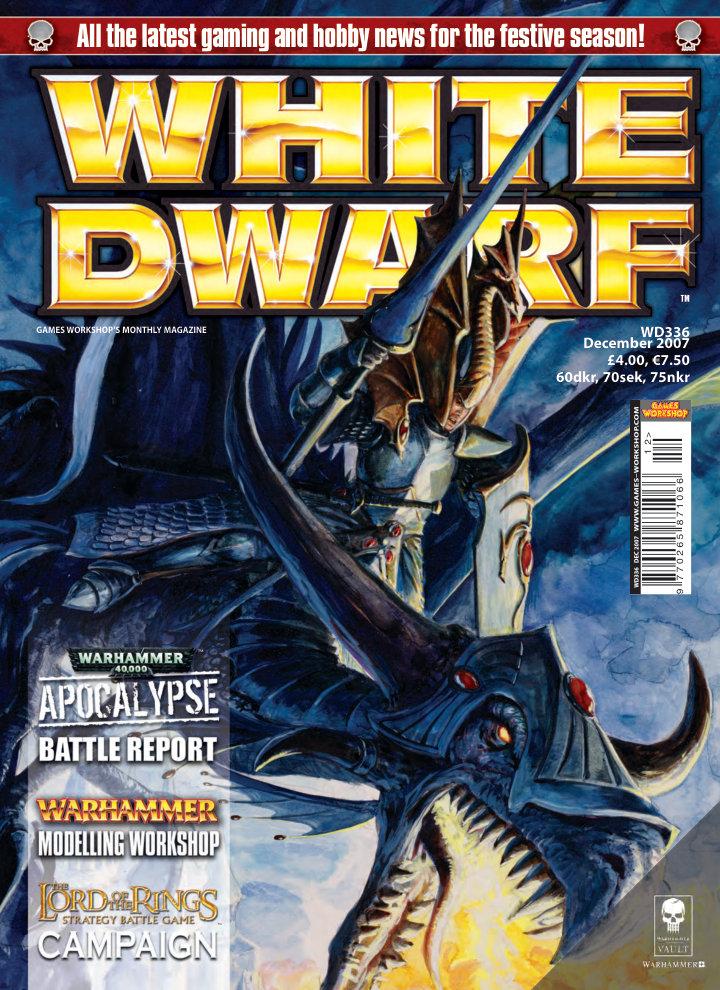
EditorialWD 336 · Inside cover
Grombrindal recommends using the festive season’s new miniatures and free time for shared battles and ambitious hobby work. The issue supplies a complete Middle-earth campaign, concludes Cities Shall Fall and follows the assembled Baneblade into painting. Buildings, a Dragon masterclass and Golden Demon inspiration broaden the choices, while the large Tau battle report demonstrates how several friends’ collections can become one memorable event.
Warhammer 40,000Warhammer Fantasy Battles
LoreWD 336 · pp. 12–13
The forthcoming Serpent Kingdoms sourcebook expands the armies of Harad beyond their famous Mûmakil. Corsairs, assassins, Half-Trolls and Mahûd troops give the southern realms different ways to threaten their enemies, with new characters joining Suladân. The preview connects those models to the south’s history and its role in Sauron’s wars, announcing three army lists and additional scenarios for the planned February release.
Middle-earth Strategy Battle GameHarad
CommunityWD 336 · p. 14
Warhammer Historical announces a new maritime game following Legends of the Old West. Its full-colour rulebook promises background and scenarios for naval clashes, with players commanding either legendary pirates or Royal Navy captains. The brief preview frames those opposing roles through the choice between imposing order and spreading plunder, introducing another historical setting to readers of the fantasy and science-fiction magazine.
Legends of the High Seas
CommunityWD 336 · p. 14
The announcement describes a proposed digital adaptation by Capcom and Big Rooster for Windows, Xbox 360 and PlayStation 3. It promises three-dimensional adventures based on the recently released fourth-edition board game, with solo play and groups of up to four online or offline. Different play modes are intended to suit short or extended sessions while preserving the race for the Crown of Command.
Talisman
Battle reportWD 336 · pp. 17–37
Matt Hutson’s Blood Angels company and Ian Strickland’s tanks attempt to recover a Tau colony held by two allied commanders. Jammers disrupt Tau deployment, while railgun nodes, aircraft and a reserve battlesuit force punish the Imperial advance. Once Mephiston and the Marines breach the compound, however, its defenders struggle to dislodge them. A Marauder devastates the counterattack and Imperial armour clears key positions, producing a four-objective-to-two victory despite a lost Baneblade and a disastrous wandering Vortex grenade.
Warhammer 40,000Blood Angels
ShowcaseWD 336 · p. 24
Richard assembles and prepares an entire Tau force before beginning its paintwork, then finishes one squad or tank at a time. His historical modelling experience influences an army deliberately marked by mud and chipped equipment rather than pristine armour. Airbrushed vehicles and extremely dilute finishing layers create a smooth desert scheme, although he stresses the care needed to avoid a lumpy deposit. The collection supplies much of the Tau strength in the accompanying battle.
Warhammer 40,000Tau Empire1 paint colour
RulesWD 336 · p. 25
The exclusive datasheet introduces an immobile drone-controlled railgun emplacement with two structure points. It can fire a long-ranged solid shot or a blast submunition whose failed wound rolls are repeated. Several networked nodes can combine solid shots into a Point Attack, gaining Destroyer effects when enough hits connect. Background explains their defensive role as expendable machines that allow valuable Fire Warriors to withdraw without surrendering a position unopposed.
Warhammer 40,000Tau Empire
CampaignWD 336 · pp. 40–49
Mark Latham presents a complete map campaign for Gondor, Rohan, Isengard and Mordor, turning the wars of the final films into a strategic contest. Players raise and reinforce armies from resources generated by important locations, then use scouting and forced marches to manoeuvre between them. Tabletop battles decide possession and remove defeated armies. A fifteen-turn limit, four-faction map and optional refinements make the framework usable immediately while leaving room for other realms and more detailed local stories.
Middle-earth Strategy Battle GameGondor
RulesWD 336 · pp. 41–46
Each faction begins with two small armies and can eventually maintain up to five. Capitals and Strategic Points generate the resources used to create or strengthen forces, while terrain checks and increasingly difficult marches limit movement. When opposing armies meet they remain locked until a tabletop battle supplies a clear winner; the defeated marker is removed. Initiative determines the order of actions, and the final objective is control of the greatest number of Strategic Points.
Middle-earth Strategy Battle GameGondor
RulesWD 336 · pp. 42–43
Four example forces demonstrate the available faction identities. Gondor combines Faramir’s knights with a substantial infantry body and Citadel Guard, while Théoden’s host emphasises mounted Rohirrim with foot support. Saruman and Gríma direct a compact Uruk-hai force carrying several weapon types, and Mordor blends ordinary Orcs, Warg Riders and Morannon troops under a Ringwraith. The lists provide contrasting starting collections without imposing one fixed roster on the whole campaign.
Middle-earth Strategy Battle GameGondor
RulesWD 336 · p. 47
Optional faction bonuses make Isengard better at scouting, Rohan faster on the march, Mordor richer and Gondor more likely to act first. Further suggestions expand the map and participants, vary resources between prosperous and desolate regions, or select scenarios appropriate to a stronghold. A less final defeat system replaces immediate annihilation with lost points and a dangerous retreat, allowing longer-lived armies and a more detailed campaign narrative.
Middle-earth Strategy Battle GameGondor
EditorialWD 336 · pp. 51–53
Jervis traces the Orks from Rogue Trader and the Battle at the Farm through their influential background books, boxed armies and Armageddon campaigns. Their forthcoming return matters because they provide a different emotional register within the dark setting: exuberant characters, improbable inventions and uninhibited modelling. A looted Carnifex illustrates the possibilities. The column argues that restoring their prominence adds breadth to the hobby as well as supporting a long-established army.
Warhammer 40,000Orks
CampaignWD 336 · pp. 54–59
Inquisitor Ilthaman draws Ptar’s Chaos horde deeper into Cor Hydrae through an artillery-supported stand at Martyr’s Square. The final engagement then concentrates around the Chapel of the Pious Heart, where Ptar intends to complete a pact and become a Daemon Prince. Character notes and narrative passages establish the commanders’ obsession and the defenders’ terrible cost, while two complete scenarios let players decide whether the Inquisitor’s sacrificial strategy saves or condemns Malin’s Reach.
Warhammer 40,000Imperial Guard
RulesWD 336 · pp. 56–57
The Imperial defenders hold six objectives across an open square while a separate table represents the artillery positions on Saint Jerron’s Hill. Supporting guns can fire into the principal battle, with visible targets relayed by command vox equipment improving accuracy. Chaos enjoys additional reserves but must use deep-striking troops to threaten the distant battery. The result carries forward to the finale, granting Stubborn defenders or an Ambush asset to the attackers.
Warhammer 40,000Imperial Guard
RulesWD 336 · pp. 58–59
Both sides gather their remaining strength around the chapel for a final struggle determined by Ptar’s ritual. Reaching the altar transforms him into a Daemon Prince at the next turn’s start; his survival after that transformation wins the campaign for Chaos. Grey Knight Terminators then arrive nearby without scatter to intervene. Fixed deployments, urban stratagems and a concentrated central objective bring the commanders’ personal rivalry to the front of an otherwise enormous battle.
Warhammer 40,000Imperial Guard
InterviewWD 336 · pp. 60–64
Mark recalls moving from childhood military kits and painting with a metal pin to teaching himself miniature techniques from White Dwarf. Competition setbacks encouraged him to improve rather than stop, eventually producing award-winning duels and narrative conversions. Detailed examples show how altered posture, carefully positioned limbs and tiny base elements make scenes convincing. His discussion of changing colour fashions also reflects the move from bright earlier schemes towards more natural, earthy finishes.
Warhammer Fantasy BattlesWarhammer 40,000Orks
ModellingWD 336 · p. 65
The guide sizes a tray from the sheet’s twenty- or twenty-five-millimetre grid, then scores and snaps the plastic to suit the unit. Corner pieces establish the frame before straight edges are cut to fit the remaining gaps. Sand and static grass can match the army’s bases, while an open rear conserves components. Careful marking and measuring keep a simple project from being spoiled by an incorrectly sized cut.
Warhammer Fantasy Battles
ShowcaseWD 336 · pp. 66–75
Alan Merrett explains the competition’s emphasis on exceptional painting, seamless modelling and a convincing expression of the established settings. The international Slayer Sword gallery then illustrates different routes to that standard: contrasting surface finishes, ambitious sculpting, subtle transitions, restrained palettes and intricate freehand detail. Winners discuss challenging themselves, seeking advice and developing subjects they care about, presenting sustained effort and thoughtful choices as important as technical virtuosity.
Warhammer 40,000Warhammer Fantasy BattlesTyranids
PaintingWD 336 · pp. 76–83
Mark Jones finishes the assembled super-heavy in Cadian green and khaki camouflage, keeping the pattern continuous across the hull and turret. Recess washes define panels and rivets before restrained drybrushing and edge highlights reveal the tank’s mass. Crew, lenses, tracks and rust receive separate treatments, followed by chips, dirt and transfers. Detachable subassemblies preserve access throughout the process, while the final varnish protects the finished model for play.
Warhammer 40,000Imperial Guard31 paint colours
PaintingWD 336 · pp. 82–83
Small irregular grey chips represent damaged primer, with metallic marks reserved for exposed extremities where wear reaches the bare surface. Thin dusty drybrushing accumulates towards the lower hull, and black residue darkens the exhausts and muzzle. Mark recommends reference photographs and restraint, because excessive dirt is hard to undo. Glossy preparation beneath transfers and a matt finish afterwards integrate the markings with the carefully worn camouflage.
Warhammer 40,000Imperial Guard7 paint colours
ModellingWD 336 · pp. 84–89
Chad Mierzwa combines the plastic building, ruin and fortress kits into three distinctive pieces of scenery. An occupied Orc tower tells the story of its capture, an off-centre Empire gatehouse blends two major structures and a wizard’s tower pushes the components into irregular stacked levels. Careful cutting, gap filling and small narrative details make the conversions coherent. Painting notes and suggested Special Features connect those showpieces with the wider appearance and stories of a battlefield.
Warhammer Fantasy BattlesThe Empire15 paint colours
ModellingWD 336 · p. 85
The captured watchtower gains an unstable higher platform, crude stakes and an Orc scarecrow. Damage around the windows and a discarded door record the original assault, while an unfortunate Goblin caught on the structure supplies a darkly comic trace of its attackers. Reused sprue becomes sharpened timber, showing how inexpensive leftover material and carefully placed details can make an ordinary kit tell a specific occupation story.
Warhammer Fantasy BattlesOrcs & Goblins
ModellingWD 336 · pp. 86–87
A fortress gatehouse and watchtower join at several different levels, requiring accurate cutting, plasticard patches and putty to hide the transitions. The asymmetrical tower and precarious upper outbuilding reinforce the Empire’s characteristic architecture. Talabheim colours establish its allegiance, while dusty stone and rusty chains age the finished structure. Added fortress sections can turn the piece into a siege setting and a deliberately contested landmark.
Warhammer Fantasy BattlesThe Empire5 paint colours
ModellingWD 336 · pp. 88–89
A cut-down hill supports a tower assembled from watchtower walls, ruin pillars and two converted chapel roofs. An octagonal middle storey and irregular battlements make the silhouette deliberately eccentric, while timber details hide difficult roof joins. A damaged tree, candles and braziers suggest a Bright Wizard’s experiments. Matching textures on plasticard and original stone components help the elaborate mixture read as one improbable building.
Warhammer Fantasy BattlesThe Empire11 paint colours
PaintingWD 336 · p. 89
Dark roof tiles receive a pale grey drybrush, while layered earthy tones bring out the carved pillars. Flames progress through red, orange and yellow to white, with black tips distinguishing the large braziers from simpler candle flames. The compact recipes cover the tower’s strongest visual accents, letting the sculpted stone and roof texture do much of the work.
Warhammer Fantasy BattlesThe Empire11 paint colours
ModellingWD 336 · pp. 90–99
The feature explores how plastic engineering gives a Dragon more dynamic posing and a wide selection of riders, armour and anatomical details. Martin Footitt describes adapting Trish Morrison’s creature through physical sculpting, digital scans and enlarged prototypes. Neil Green then builds a fiery red-and-gold finish, with a separately painted Prince and elaborate shield. The combined design and painting coverage shows how the kit can become a personal centrepiece rather than one fixed monster.
Warhammer Fantasy BattlesHigh Elves
InterviewWD 336 · p. 91
Martin Footitt explains how Trish Morrison’s original creature was scanned, enlarged into a resin prototype and combined with new High Elf riders and equipment. The process repeatedly moves between physical and digital models to resolve fit, pose and plastic production. Optional heads, spines, armour and reins broaden the result, while the varied technical stages keep a long development project engaging for its sculptor.
Warhammer Fantasy BattlesHigh Elves
PaintingWD 336 · pp. 92–98
Neil Green works from the rocky base outwards, using separate Dragon and rider subassemblies to preserve access. Red flesh and scales are differentiated through orange highlights and ink shading, while darker purple-red wings, pale reins and polished metallic armour provide contrasting materials. Thin blended layers gradually reduce the highlighted area. The Prince, decorated shield, saddle and final fittings receive their own sequences before the finished centrepiece is assembled.
Warhammer Fantasy BattlesHigh Elves34 paint colours
PaintingWD 336 · p. 97
The rider is treated as a separate painting project, with four material stages supporting a carefully highlighted face. Blue cloth and a topknot brighten towards ice blue, cream areas move through bone to white and gold gains progressively sharper silver-modified highlights. Several dilute white layers keep the flowing robes smooth. A small face sequence starts from warm brown and finishes with pale flesh mixtures, making the tiny head readable above the Dragon.
Warhammer Fantasy BattlesHigh Elves17 paint colours
PaintingWD 336 · p. 98
A deep blue field fades towards black behind the sculpted phoenix. Separate red wings, pale plumage and warm flames develop through washes and fine highlights, while small blue-white stars enliven the background. The sequence gives the conspicuous shield attention comparable to the Dragon itself, turning a small heraldic element into another focal point in the finished composition.
Warhammer Fantasy BattlesHigh Elves12 paint colours
FictionWD 336 · p. 99
A Chaos fleet forces its way onto the coast of Yvresse, where the Elven spear line begins to buckle under successive assaults. The arrival of a Dragon rider reverses the struggle: the beast burns the kingship, the rider kills the northern warlord and the remaining invaders flee towards ships already catching fire. The receding tide removes the final traces of the expedition, making the Dragon’s intervention both a military rescue and an image of overwhelming vengeance.
Warhammer Fantasy BattlesHigh Elves
CommunityWD 336 · pp. 102–103
Brian Aderson reviews a record attendance of more than eight thousand hobbyists at the NEC. Apocalypse demonstrations, enormous templates, author meetings and the new High Elves share the day with hobby competitions and Golden Demon. Photographs highlight the Conversion Clinic and Adam Troke’s army-book discussion, while David Rodriguez’s winning Carnifex represents the painting competition. The account presents the show as a gathering of enthusiastic participants as much as a release showcase.
Warhammer 40,000Warhammer Fantasy Battles