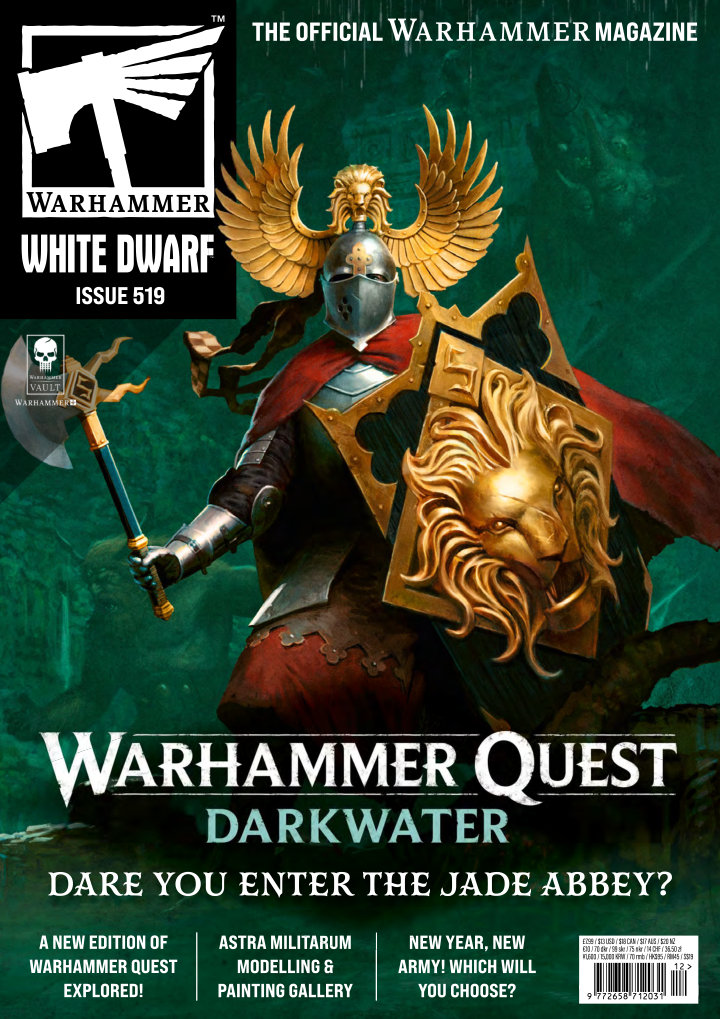
EditorialWD 519 · Inside cover
The editor frames Warhammer Quest as a chance to become an adventurer for an evening, even when everyday life leaves little room for real exploration. Darkwater’s release and the dungeon game’s thirtieth anniversary anchor the issue, with its new heroes, Nurgle adversaries and threatened sacred site in Ghyran supplying the month’s central adventure.
Warhammer Quest
CommunityWD 519 · pp. 2–7
The reader gallery combines large display pieces with personal hobby memories, from a Reaver Titan and an imposing dragon to Howling Banshees, Cyreni’s Razors and a Lamenters Dreadnought. Letters describe returning to the hobby through a late parent’s miniatures and rediscovering Gotrek and Felix through books and classic sculpts, showing how collections can connect different generations of hobbyists.
Warhammer 40,000Age of SigmarAeldari
RulesWD 519 · pp. 10–19
Games developer John introduces Darkwater’s cooperative adventure through the corrupted Jade Abbey. Its core action system makes each turn a small puzzle: heroes choose Move, Attack or Aid, but must expend another available ability card to power the choice. New players begin with a modest set of options, then gradually acquire the tools needed for harder encounters.
Warhammer QuestMaggotkin of Nurgle
InterviewWD 519 · pp. 20–31
The designers explain the cast and visual direction of Darkwater, a grounded adventure whose Nurgle horror grew from rediscovered Liber Chaotica imagery. The seven heroes reinterpret familiar quest archetypes through the Mortal Realms: Edmark’s polished knight contrasts with Bren’s scavenged equipment, Inara and Jacobus embody different relationships with Ghyran, and Drolf, Kelthannor and Drasher Vorn broaden the party’s cultures and silhouettes.
Warhammer QuestAge of SigmarMaggotkin of Nurgle
PaintingWD 519 · pp. 32–33
Emily’s Edmark guide balances sharp metallic highlights with smoother cloth transitions, giving the knight a bright, heroic appearance over a black undercoat. Illustrated recipes cover the visible skin, pale ribbons, steel, black cloth, leather, red robes and gold ornament. Extra advice explains how thin black glazing deepens the cape’s folds, a tiny eye can still be painted inside the helmet, and controlled shading and highlights can suggest reflected light on the axe.
Warhammer Quest20 paint colours
PaintingWD 519 · pp. 34–35
Inara’s lighter scheme begins with Wraithbone, using thin shade and highlight glazes to preserve the softness of her pale robes. Emily explains how repeated Screaming Skull glazes build the transition gradually and how increasingly selective hair highlights create reflected light. The recipes cover skin, cloth, pouches, hair, tabard, metal and water magic, with a separate effect showing the conjured water passing along the blade.
Warhammer Quest22 paint colours
Battle reportWD 519 · pp. 36–55
Leigh, Jae, Nick and Kelly guide Edmark, Bren, Drolf and Inara through Darkwater’s first act, combining a narrated adventure with photographs of the actual turns. The party cleanses Mire Kelpie nests, struggles to breach the abbey, searches for a key and crosses the hedge-moat before confronting Shaman Foulhoof. Time pressure and accumulated wounds make cooperation and character activation order more important than simply killing every enemy.
Warhammer QuestMaggotkin of Nurgle
PaintingWD 519 · pp. 56–58
Max and Connor explain how tyranny, vanity, industry and perfectionism shaped the Helsmiths’ official colour scheme. Purple cloth and warm metallic trim communicate status, but the armour remains dark and industrial, its purple tint suggesting extraordinary metalworking rather than ordinary enamel. Sinister green daemonfire and cool, unnatural skin distinguish the army from other duardin and the major Chaos Gods.
Age of SigmarHelsmiths of Hashut51 paint colours
PaintingWD 519 · p. 59
Three alternative Helsmith schemes connect colour choices to the roles of their ziggurats. Ur-Zorn uses teal to evoke restrained daemon energy; Zharr Vyxa’s angry reds and golds refer to martial strength and sacrificial forging; Muspelzharr pairs black armour with pale gold and yellow cloth for an uncompromising light–dark contrast. The article supplies separate recipes for each scheme’s armour, mail, cloth and decorative elements.
Age of SigmarHelsmiths of Hashut33 paint colours
PaintingWD 519 · p. 60
Connor compares two ways to paint the Infernal Taurus as a crafted material animated by forbidden power. One model resembles polished brass with molten-looking channels; the other is hard-edged green jade, deliberately close in hue to the army’s daemonfire. Recipes for the jade body, wing edges and brass body show how controlled recess glazing and bright highlights can preserve the impression of a smooth statue rather than living skin.
Age of SigmarHelsmiths of Hashut15 paint colours
PaintingWD 519 · p. 61
The Hobgrot recipes deliberately depart from the clean, opulent Helsmiths. Dirty rags, sackcloth and muted skin mark out an exploited workforce, with burgundy collars supplying the only real link to their masters’ purple. Two skin recipes and guides for leather, orange and brown cloth, and worn armour give painters a varied but coherent set of colours for the mob.
Age of SigmarHelsmiths of Hashut26 paint colours
PaintingWD 519 · p. 61
Max treats the bases as evidence of the Helsmiths’ bombardment rather than neutral scenery. Texture paint, patches of sand and angled slate produce a blasted surface, then grey-brown tones, pale drybrushing and green shading make it resemble an unnatural industrial wasteland. The brief heraldry note beside the recipe also relates the army’s archaic runes, horns and ziggurat motifs to its carefully ordered visual identity.
Age of SigmarHelsmiths of Hashut7 paint colours
CommunityWD 519 · pp. 62–63
The four collectors have reached their first Spearhead milestone in a shared Ghyran setting. Amber’s undead, Andrew’s Hallowed Knights, Dan’s Cities of Sigmar and Matt’s grot chariots are now ready to fight, with painting, played games, victories and the completed box challenge all contributing to their scores. The feature sets out the ongoing challenge structure and introduces the more personal army diaries that follow.
Age of SigmarSoulblight Gravelords
ShowcaseWD 519 · pp. 64–65
Amber finishes her Soulblight Spearhead as an army emerging from sandy coastal ground in Ghyran. A rough undercoat caused by hot weather becomes part of that story, while washes, weathering and oasis-like basing bring a repetitive batch of basecoats together. She substitutes King Velmorn for the usual Wight King and leaves the banners without heraldry until future vampire additions establish the force’s dynasty.
Age of SigmarSoulblight Gravelords2 paint colours
ShowcaseWD 519 · pp. 66–67
Andrew completes the Vigilant Brotherhood, applying his established silver-and-blue scheme and using natural animal references to keep the Lord-Vigilant’s mount from overwhelming its rider. Conversions establish individual characters: Taranis gains a new head, sword and shield, a Saviours of Cinderfall model becomes the Lord-Veritant, and paired Liberator hammers recall the original Prosecutors. Their first games go poorly, but the army’s narrative and visual identity are taking shape.
Age of SigmarStormcast Eternals
ShowcaseWD 519 · pp. 68–69
Dan adapts an older Cities of Sigmar scheme to a force from Ghyran, using brass armour, green rook heraldry and moss-covered shields to establish its home. A step-by-step freehand exercise breaks the rook into rectangles and squares before adding highlights and a door. A converted Thyrian priest and the customised Cavalier-Marshal Kai Jeffison add further details to the newly completed Survivors of Hardship Spearhead.
Age of SigmarCities of Sigmar4 paint colours
ShowcaseWD 519 · pp. 70–71
Matt establishes a repeatable yellow scheme for his mounted Gloomspite Gitz, using quick grey wolves to reserve painting time for their riders. The Sunsteala Wheelas require planning around sub-assemblies and the new challenge of woven wicker. He describes a yellow-brown wicker recipe and verdant bases whose yellow flowers even supply an in-world explanation for the grots’ favourite colour, then looks ahead to expanding the force and its Doom Diver.
Age of SigmarGloomspite Gitz6 paint colours
CommunityWD 519 · pp. 72–81
A branching questionnaire turns broad preferences about an army into a suggested Warhammer 40,000 faction. Decisions about hordes versus elites, cunning versus aggression, unusual technology, mobility and religious or martial outlook lead through illustrated faction descriptions. The final note encourages readers to treat loyalist Chapters and Traitor Legions as starting points, replacing the result with a successor, renegade warband or invented force when that better matches the story they want to tell.
Warhammer 40,000Space Marines
LoreWD 519 · pp. 82–85
These faction-specific random tables provide an origin, mission and defining quirk for a new army. Rather than stopping at a colour scheme, readers can give their force a home, a reason to fight and an unusual trait that suggests conversions, thematic missions or a longer campaign. The prompts range from Imperial crusaders and secretive Inquisitorial forces to Necron dynasties, Ork freebooters, remote Kin outposts and T’au exploratory cadres.
Warhammer 40,000Space Marines
TacticsWD 519 · p. 86
The guide explains how moving from Combat Patrol to a roughly 1,000-point Incursion army changes list building. Every unit needs a purpose, and an army must balance objective taking, holding ground, movement, Actions and answers to large targets. It highlights the new importance of choosing a Detachment, the value of mobility and deployment abilities, and the need to check current points before copying the five example expansions on the following pages.
Warhammer 40,000
TacticsWD 519 · p. 87
The Gladius Task Force expansion gives both Terminator characters an accompanying unit and lets those armoured squads supply the army’s main punch. A Ballistus Dreadnought helps against hard targets, while Intercessors, Scouts and Outriders address objective security, early positioning and mobile Actions. The commentary explains why these supporting roles matter instead of merely adding more elite damage dealers to the starter force.
Warhammer 40,000Space Marines
TacticsWD 519 · p. 88
A Combined Arms example builds resilience around the Astra Militarum Combat Patrol with a Leman Russ, supporting Basilisk and transports for vulnerable infantry. Cadian Shock Troops secure objectives, a Scout Sentinel improves the wider force’s efficiency, Ratlings supply forward deployment and a Castellan brings more Orders. The guide also points out that delivered transports can become blockers or perform Actions rather than retiring from the battle.
Warhammer 40,000Astra Militarum
TacticsWD 519 · p. 89
The Deceptors expansion uses infiltrating Legionaries and Cultists, reinforced by scouting Accursed Cultists, to put pressure on the opponent from the opening turns. A Chaos Lord and Chosen in a Rhino add a durable assault element, while Obliterators provide an additional threat that can arrive from reserve. The list keeps the starter force’s Master of Possession and Possessed as another source of heavy melee damage.
Warhammer 40,000Chaos Space Marines
TacticsWD 519 · p. 90
The Aspect Host example expands an Aspect-heavy Combat Patrol with specialists for armoured targets, forward deployment and mobile reserve attacks. A Wave Serpent helps fragile infantry reach useful positions, Wraithblades supply a tougher and more forgiving combat unit, and Storm Guardians maintain objective control while the specialists move elsewhere. The emphasis is on balancing the army’s precision tools with protection and enough bodies to retain the battlefield.
Warhammer 40,000Aeldari
TacticsWD 519 · p. 91
Da Big Hunt builds on the Combat Patrol’s Beast Snagga focus, using the Detachment’s help against monsters and vehicles to free space for utility units. A Kill Rig and Trukk carry Boyz, Gretchin provide cheap objective holders and Command Point support, and Kommandos add forward pressure. Another Squighog unit supplies the combination of speed, toughness and impact that the article sees as particularly useful in a compact Incursion army.
Warhammer 40,000Orks
ModellingWD 519 · pp. 92–93
The introduction to this regimental gallery explains how to give an Astra Militarum collection its own identity. Choosing a home planet, battlefield speciality, designation, history and colour scheme can connect modelling decisions to the fiction, whether the result is a stealth regiment, armoured formation or force from a hazardous world. A sample profile for the Krieg 101st Trench Rats demonstrates how those decisions can form a coherent starting point before the individual collections and recipes that follow.
Warhammer 40,000Astra Militarum
ShowcaseWD 519 · pp. 94–95
Shane’s Scythes of the Emperor combine a substantial armoured column with purple-equipped infantry and tank crews converted from Escher components. Cutting the crew below the knees lets those parts fit Imperial vehicle hatches. Washes and drybrushing keep the larger collection manageable, leaving more time for commanders, hand-painted tank names and squadron markings; the accompanying recipes cover weathered grey vehicles and lilac armour.
Warhammer 40,000Astra Militarum9 paint colours
ShowcaseWD 519 · pp. 94–95
Matt gives Captain Vesker’s Cadian 8th a desert-war identity while retaining recognisable Cadian greens. His heavily rebuilt Leman Russ borrows Baneblade wheels, Land Raider tracks and a narrowed Rogal Dorn turret to change the vehicle’s silhouette. Recipes for fatigues, armour, straps, gloves and desert bases show how the infantry and their converted armour remain part of the same collection.
Warhammer 40,000Astra Militarum11 paint colours
ShowcaseWD 519 · pp. 96–97
Euan recreates Praetorian pith helmets by combining Cadian bodies with Empire Outrider and Pistolier heads. The regiment’s new narrative places it under Inquisitor Kyria Draxus against the Necrons in the Pariah Nexus, while stippled rather than edge-highlighted vehicles add the impression of campaign wear. The palette is documented through separate cream armour, red fatigues and warm vehicle-armour recipes.
Warhammer 40,000Astra Militarum8 paint colours
ShowcaseWD 519 · pp. 96–97
David’s winter specialists are stranded on an ice world, explaining the worn vehicles and cold palette of the Cadian 31st. A hidden Genestealer Cultist adds a quiet narrative threat within the infantry ranks. The basing method begins with sanded-flat bases and coloured layers, then uses UV resin, scuffing, snow texture and tufts to suggest ice; tables list the armour, fatigues and underlying ice colours.
Warhammer 40,000Astra Militarum10 paint colours
ShowcaseWD 519 · pp. 98–99
Luke Dunford’s Lambdan Lions emphasise bright red armour, fast transports and Valkyries, with cold blue cracked-ice bases setting off the warm figures. The regiment’s links to the Adeptus Mechanicus justify its equipment, while white vehicle markings tie the airborne and ground elements to their snowy setting. Recipes explain the vivid red, gold trim, steel, leather and black weapon casings.
Warhammer 40,000Astra Militarum13 paint colours
ShowcaseWD 519 · pp. 100–101
Damien’s armoured collection began as defenders of Helsreach before expanding to the wider war for Armageddon. Khaki-and-grey camouflage unifies the tanks, while oils and weathering powders add soot, rust and grime suited to a prolonged mechanised conflict. The article supplies modern paint equivalents for his older palette and explains masking the grey areas before airbrushing khaki, alongside recipes for metal, plasma glow and squadron markings.
Warhammer 40,000Astra Militarum17 paint colours
PaintingWD 519 · p. 102
James gives a pale Rogal Dorn the appearance of a well-used fighting vehicle. Sponge-applied dark chips interrupt its light armour, with thinned Shade and Contrast colours producing oil and rust streaks. Short recipes document the white armour, blue squadron marks and layered, dirty tracks, showing how weathering can provide the principal detail on an otherwise restrained tank scheme.
Warhammer 40,000Astra Militarum10 paint colours
PaintingWD 519 · p. 102
Rich limits his Cadian infantry to a near-monochrome palette to practise differentiating surfaces through texture and highlighting. Grey armour and fatigues use related colours with separate tonal ranges, while inked eyes and a heretical sign turn the small group into an unsettling narrative scene. The two accompanying recipes make the restricted palette reproducible without supplying extra colours for the unexplained horror details.
Warhammer 40,000Astra Militarum4 paint colours
ModellingWD 519 · p. 103
Andy builds Tanith reinforcements from Cadian Shock Troopers, assorted bare heads and sculpted camouflage cloaks. The combination of Hive Scum and Wildwood Ranger components gives the squad individual faces while retaining a uniform military foundation. Recipes distinguish dark fatigues, armour and leather, then build a stippled woodland pattern on the cloaks to connect the conversions to the regiment’s scouting identity.
Warhammer 40,000Astra Militarum10 paint colours
ModellingWD 519 · p. 103
Neil revisits the House Greim Krieg Mester as a Praetorian officer, sculpting a replacement head with a pith helmet and extravagant cavalry whiskers. The finish draws on the classic Massacre at Big Toof River display. A compact crimson-jacket recipe moves from a darkened red glaze to progressively brighter highlights, preserving the traditional uniform as the conversion’s main visual cue.
Warhammer 40,000Astra Militarum4 paint colours
ModellingWD 519 · p. 103
Tom transforms Lord Solar Leontus and Konstantin into a Steel Legion commander on a biomechanical mount. Serberys Raider parts replace the steed’s head, legs and tail, while removed barding, filled gaps and simplified armour change the model’s profile. A Krieg head completes the rider, and the accompanying steel-and-gold recipe explains the subdued metallic finish.
Warhammer 40,000Astra Militarum5 paint colours
ModellingWD 519 · p. 104
Will turns the Blooded kill team into Imperial penal troopers by removing Chaos insignia and spikes while retaining damaged clothing and mismatched equipment. The result suggests soldiers being given a final chance to serve rather than an immaculate regiment. An orange-fatigue recipe supports that prison-uniform identity, using red shading, bright orange highlights and a darker recess mix.
Warhammer 40,000Astra Militarum5 paint colours
ModellingWD 519 · p. 104
Mark assembles a defensive diorama around a Field Ordnance Battery, an Aegis Defence Line and extra Cadians. Painting the models and walls separately allows the foam display base to develop alongside them. Burnt trees and returning vegetation imply an emplacement occupied for some time, while compact recipes tie the Cadian uniforms and weathered fortifications into the scene.
Warhammer 40,000Astra Militarum6 paint colours
PaintingWD 519 · p. 105
Milo uses Death Korps models as Armageddon Steel Legion veterans, relying on the paint scheme and setting to establish their identity. Coats are painted first so their textured drybrushing does not interfere with later trousers and armour. The yellow-brown fabric and grey trousers receive separate recipes, and two cracked-earth texture products make the bases read as Armageddon’s ash wastes.
Warhammer 40,000Astra Militarum8 paint colours
ModellingWD 519 · p. 105
Inspired by the Royal Volpone in Necropolis, James combines Kasrkin with Exaction Squad helmets and shoulder guards to create heavily equipped soldiers with a distinct regimental appearance. A cyber-mastiff becomes an appropriately forceful mascot. Recipes for blue armour and gold detail establish the unit’s disciplined, richly coloured finish without changing its recognisable Imperial equipment.
Warhammer 40,000Astra Militarum6 paint colours
ModellingWD 519 · pp. 106–107
Ken extensively rebuilds a Shadowsword with a rotating turret, plastic-card structure and metal gun barrels, then adds working lights with the electrics concealed in the hull. Digital camouflage is created by repeated spraying and tiny T-shaped masking-tape pieces, followed by a lengthy unmasking session. The recipe lists the successive armour colours and recess washes, with additional weathering powders completing the enormous model’s finish.
Warhammer 40,000Astra Militarum6 paint colours
LoreWD 519 · pp. 108–113
This lore feature examines the Golden Throne through the limited and conflicting knowledge available inside the Imperium. Its origins and original function remain secret, but its present importance is unquestioned: the Emperor’s existence, psychic protection and the demands associated with the Astronomican bind it to humanity’s survival. The account also describes the Black Ships’ supply of psykers and the competing religious interpretations of their sacrifice.
Warhammer 40,000Adeptus Custodes
CommunityWD 519 · pp. 114–115
The December Bunker introduction connects winter hobby time to two studio activities: the search for the missing Emberwing and a new festive modelling challenge. Gingerbread buildings, a present-delivery Drop Pod and a surprisingly cheerful Ushoran illustrate how widely staff interpreted the brief. The regular challenge calendar and rank tracker give readers a way to log their own games, painted units and club participation.
ShowcaseWD 519 · pp. 116–121
The studio’s festive challenge produces a deliberately eccentric winter village and cast of characters. A Great Unclean One becomes a pudding, a manufactorum and crypt become gingerbread buildings, Nurgle creatures form a carol choir, and Ushoran receives a tree, socks, candy canes and an unnervingly happy expression. Contributors explain how ordinary kit parts, modelling putty, wood offcuts and even a piping bag support the transformations.
Age of SigmarWarhammer 40,000Maggotkin of Nurgle15 paint colours
CampaignWD 519 · pp. 122–123
Matt introduces a studio Path to Glory campaign using Ravaged Coast rules, with two teams trying to locate a missing Kharadron vessel and its emberstone cargo in Chamon. Players select coordinates on a coloured spreadsheet map, fight the closest opposing explorer and earn clues through their team’s victories. The first player diary describes Kelly’s Tzeentch army losing a battle to mobile Sylvaneth, while the map explanation shows how each region selects a different battleplan.
Age of SigmarKharadron Overlords
ShowcaseWD 519 · p. 123
Elliot’s Khorne Daemons use bright lava-orange skin and cracked molten bases to establish a distinctive force within the Emberwing campaign. Its general is a converted hot rod originally built for the White Dwarf Car Show, now used as a Herald on Blood Throne. A growing skull tally determines when the army receives reinforcements, while separate skin and base recipes reproduce the heat-themed scheme.
Age of SigmarBlades of Khorne9 paint colours
CommunityWD 519 · pp. 124–126
The team reviews its favourite projects and games from 2025, then lays out plans for the next hobby year. Adam enjoyed inventing and painting a Space Marine Chapter, Ben expanded a playable Genestealer Cult, Dan combined Adeptus Mechanicus preparations with narrative gaming, and Matt built a large airborne Legions Imperialis collection.
Warhammer 40,000Age of SigmarGenestealer Cults