EditorialWD 516 · Inside cover
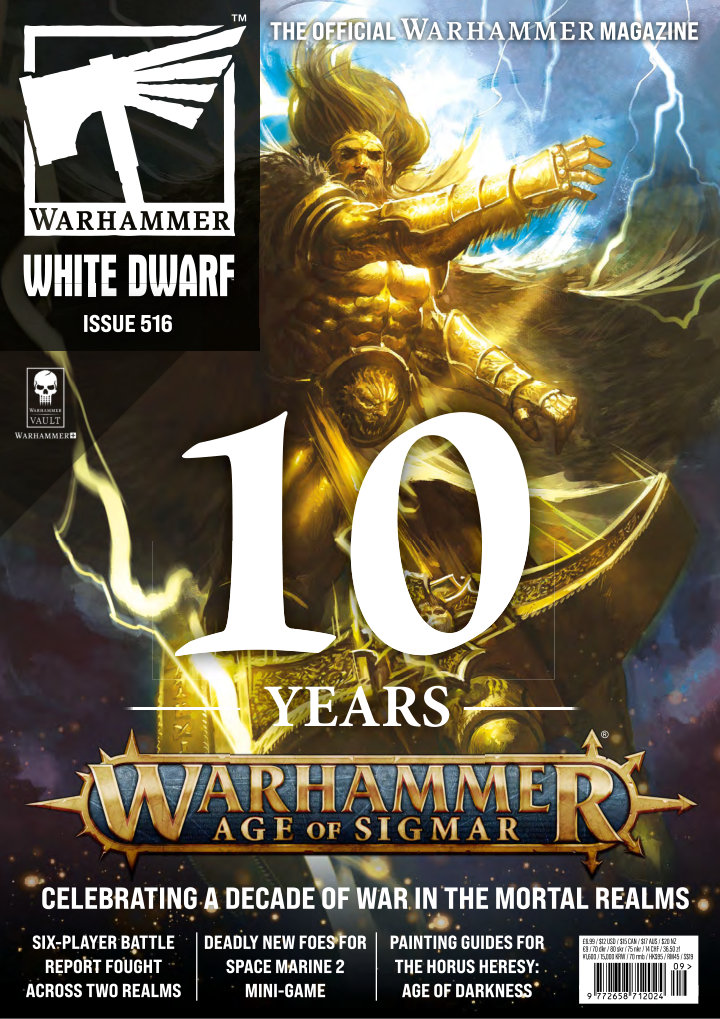
Lyle Lowery reflects on watching Age of Sigmar grow from its first boxed set into a richly developed setting and game. The issue marks that tenth anniversary through a historical retrospective, the changing identity of the Stormcast Eternals, Grombrindal’s memories of the gods and a six-player battle fought across two realms.
Age of Sigmar
CommunityWD 516 · pp. 2–7
Helen Hickman’s birch- and cherry-blossom-inspired Kurnoth Hunters lead a reader gallery that also includes a knitted Warhammer jumper, a Blood Bowl team and a Carcharodons Predator. Letters celebrate a return to the hobby, children’s first painted models and a remarkably ambitious Angron base containing 2,740 skulls.
Age of SigmarWarhammer 40,000Sylvaneth7 paint colours
LoreWD 516 · pp. 8–19
Jordan condenses ten years of Mortal Realms history into a connected narrative, beginning with the formation of the realms, Sigmar’s discovery by Dracothion and the flawed alliance of the Age of Myth. The collapse into the Age of Chaos leads to Azyr’s isolation and the creation of the Stormcast Eternals, whose return begins the Realmgate Wars and the founding of new cities.
Age of SigmarStormcast Eternals
RulesWD 516 · pp. 20–23
Three sets of realm rules recreate distinctive periods and locations from Age of Sigmar’s history. The Brimstone Peninsula rewards furious attacks amid dangerous volcanic terrain; Glymmsforge adds deathly resilience, easier manifestation summoning and returning casualties; Thondia encourages aggressive movement and charges in a landscape that can injure nearby troops.
Age of Sigmar
Battle reportWD 516 · pp. 24–49
Six players fight an anniversary battle across linked Aqshian and Ghyranite battlefields. Two 2,000-point Stormcast armies defend opposite ends of a realmgate against four 1,500-point forces drawn from the game’s successive starter sets. Places of power confer protective wards, while portals and Skaven Gnawholes let events on one table influence the other.
Age of SigmarStormcast Eternals
LoreWD 516 · pp. 50–56
Ionus Cryptborn looks back on the Stormcast Eternals’ changing wars and weapons, from their thunderous first deployment to the Hour of Ruin. Early tactical limitations gave way to Vanguard reconnaissance, Sacrosanct magic, Draconith alliances and Thunderstrike armour, but repeated Reforging gradually exposed a deeper crisis of identity.
Age of SigmarStormcast Eternals
FictionWD 516 · p. 57
Astreia confronts Ionus over the treatment of Stormcasts whose repeated Reforgings have damaged their souls. He defends containment as the only available protection, while she insists that continuing to seek a cure is an act of faith rather than denial. Their exchange leaves Ionus uncertain whether his practical acceptance has also become a surrender of hope.
Age of SigmarStormcast Eternals
TacticsWD 516 · pp. 58–61
John explains the jobs performed by each universal manifestation lore, from the Krondspine’s staying power to Forbidden Power’s movement tools and Morbid Conjuration’s ability to obstruct advances. Rather than judge spells only by damage, the guide considers healing, charge reliability, shooting protection, command denial and control of the places an opponent can safely occupy.
Age of SigmarOssiarch Bonereapers
LoreWD 516 · pp. 62–69
Grombrindal recounts personal encounters with the Mortal Realms’ ascended gods, offering a traveller’s judgment of personalities rather than a detached pantheon catalogue. Alarielle’s changing moods, Teclis’s wisdom and pride, Malerion’s possible change of heart and Morathi’s relentless ambition reveal why divine cooperation is so difficult to sustain.
Age of SigmarSylvaneth
LoreWD 516 · pp. 70–73
A concise intelligence briefing outlines the Kin’s origins, their kindred communities and the institutions that sustain life in the dangerous galactic core. Cloneskeins, crucibles, hearths, forges and fanes connect physical survival to the Ancestor Cores, whose immense accumulated memories guide society but increasingly produce slow and erratic answers.
Warhammer 40,000Leagues of Votann
LoreWD 516 · pp. 74–79
Buri Aegnirssen’s history begins with the fall of the Emberg-Aegnir Bloc to the Tyranids. His league’s Votann had apparently prepared an unusual suit of armour long before the invasion; when the hold’s defenders were destroyed, Buri escaped from inside a bio-titan and took up that armour and his fallen Kâhl’s weapon.
Warhammer 40,000Leagues of Votann
TacticsWD 516 · pp. 80–83
The new Leagues of Votann codex is explored through three contrasting Detachments and example army cores. Persecution Prospect uses Hernkyn mobility and concentrated targeting to disrupt and pin enemies; Delve Assault Shift turns Cthonian Beserks into a deep-striking assault threat; the Ironkin-focused option relies on durable Steeljacks, Brôkhyr support and reliable firepower.
Warhammer 40,000Leagues of Votann
RulesWD 516 · pp. 84–85
Optional Strategic Gambits let opposing commanders negotiate immediate advantages during a battle. A player can request improved movement, a charge boost or better combat dice, but the opponent can demand victory points, command points, a repositioning move or temporary protection in exchange. Both must agree before the bargain takes effect, making tactical judgment and negotiation part of the risk.
Warhammer 40,000
RulesWD 516 · pp. 86–87
The cooperative mini-game expands with Extremis enemies and a new Terminus threat category. Zoanthropes, Raveners and Lictors enter the spawning tables, while a Hive Tyrant uses a two-stage card: defeating its first stage leaves it on the board, then it returns with a refreshed wound total and altered abilities. The guidance encourages careful class selection and experience with Inferno before attempting the harder missions.
Warhammer 40,000Space Marines
RulesWD 516 · pp. 88–89
The squad faces a Hive Tyrant while trying to protect Avarax’s astropathic relay. Separate starting zones and constant incoming waves complicate the fight, and a changing priority threat rewards eliminating the right enemy groups by removing injuries. Victory requires destroying the two-stage Tyrant before the eighth turn ends, with a healthier surviving squad earning the better result.
Warhammer 40,000Space Marines
RulesWD 516 · pp. 90–91
An Astra Militarum depot and maglev line provide the means to strike Tyranids infesting an Avarax hive. The Marines must work through randomly selected active terminals while successive waves increase the pressure on the squad. Its changing objective sequence makes movement and teamwork central to completing the operation, rather than letting players settle into a single defensive position.
Warhammer 40,000Space Marines
TacticsWD 516 · pp. 92–97
Ben helps Les convert his existing Sons of Horus collection into a 3,000-point army using the new force organisation system. Tactical Squads supply the objective-taking core, a Praetor opens an Apex Detachment for Justaerin, and Command choices unlock supporting formations for tanks, heavy weapons and Terminators.
The Horus HeresySons of Horus
PaintingWD 516 · pp. 98–99
Amber paints a weathered Salamanders Saturnine Terminator, recommending separate shoulder and collar assemblies to make the recessed areas accessible. Muted green armour receives warm brown shading and successive highlights, while black panels, gold trim and functional metal create clearly different surfaces. Additional stages cover red lenses, purple-toned dark brass and a glowing lava effect worked into the armour decoration.
The Horus HeresySalamanders24 paint colours
PaintingWD 516 · pp. 100–101
Amber’s Iron Warriors guide separates silver armour, darker working metal, black panels and two bronze finishes so the suit’s mechanical structure remains legible. Controlled grey glazing accumulates toward the bottoms of panels to suggest battlefield grime. Hazard stripes begin with thin yellow guidelines, then receive chips and warm shading, while blue plasma and copper details add distinct points of colour.
The Horus HeresyIron Warriors24 paint colours
ShowcaseWD 516 · pp. 102–107
The ’Eavy Metal and Army Painting teams present Saturnine Terminators in eleven Legion schemes. Their commentary focuses on visual decisions: keeping silver distinct from yellow, warming cold metal with dirt, using secondary Legion colours to break up broad armour panels and differentiating black-armoured Loyalists through texture or subtle hue.
The Horus HeresyImperial Fists
PaintingWD 516 · p. 102
Paul builds a warm yellow suit over Zandri Dust, establishing other base colours before committing to the final highlights. Silver trim avoids losing gold against the armour, and a red helmet provides the focal point. The recipe shades with brown before returning through progressively brighter yellows to a white pin highlight.
The Horus HeresyImperial Fists8 paint colours
PaintingWD 516 · p. 103
Les gives the silver armour warmth with successive brown glazes concentrated toward the lower panels. Restrained chevrons guide the eye toward the head instead of overwhelming the model, while red lenses and gems punctuate the metallic palette. The recipe preserves crisp silver edges above the accumulated grime.
The Horus HeresyIron Warriors7 paint colours
PaintingWD 516 · p. 103
Rowan uses a muted, weathered green suited to the Legion in the Horus Heresy. Green, yellow and gold form an analogous palette, with blue weapon details as a deliberate contrast. Green-tinted cloth and painted golden embroidery distinguish the cape from the solid armour, whose recipe rises from Waaagh! Flesh to Krieg Khaki highlights.
The Horus HeresySalamanders6 paint colours
PaintingWD 516 · p. 104
James places the Word Bearer after the Legion’s adoption of crimson before Calth. Dark green shading gives the red recesses depth, while black shoulders and helmet identify a veteran and frame the iconography. Matching powders on the base and lower legs suggest the ash of Calth.
The Horus HeresyWord Bearers6 paint colours
PaintingWD 516 · p. 104
Les adapts White Scars heraldry to the broad Saturnine shoulders, extending transfers with a freehand red line around each pad. Red markings and a faceplate direct attention toward the head, while warm gold offsets cool white armour. Reapplying bottled Corax White over the sprayed coat ensures later corrections have a matching finish.
The Horus HeresyWhite Scars5 paint colours
PaintingWD 516 · p. 105
James paints the Ultramarine as a battlefield counterpart to his Word Bearer, matching their bases and weathering. Warm recess shading keeps the blue used-looking without excessive damage, white shoulders break up the large armour surfaces and bright gold reinforces the Legion identity. The recipe progresses through Calgar Blue and Fenrisian Grey to Blue Horror.
The Horus HeresyUltramarines7 paint colours
PaintingWD 516 · p. 105
Graham makes the Iron Hands’ black visibly metallic by glazing Black Templar over Ironbreaker. Lighter metal trim separates the surfaces, then brown glazes suggest oil and dust without obscuring the sheen. White iconography supplies the strong light-dark contrast needed to read the Legion at a glance.
The Horus HeresyIron Hands8 paint colours
PaintingWD 516 · p. 106
Jason contrasts the World Eaters’ heavily weathered white with saturated blue armour panels. Brown glazes, dark chips and rust streaks make the suit more neglected than a White Scar’s, while red-toned gold hints at the Legion’s future palette. The white recipe uses cool grey shading and progressively cleaner highlights.
The Horus HeresyWorld Eaters12 paint colours
PaintingWD 516 · p. 106
Ben differentiates Dark Angels black with a subtle green tint applied by airbrush over zenithal highlighting. Red checks, weapons and warm base colours reinforce the First Legion’s identity. Green-grey edge highlights retain that hue while keeping the armour recognisably black.
The Horus HeresyDark Angels7 paint colours
PaintingWD 516 · p. 107
Aidan layers translucent turquoise over a shaded metallic foundation to produce the Alpha Legion’s shimmering blue-green armour. Contrast Medium preserves the sheen while an airbrush keeps the coloured glaze even. Darker turquoise recess shading and clean silver edges restore definition after the overall colour is established.
The Horus HeresyAlpha Legion9 paint colours
PaintingWD 516 · p. 107
Aidan adapts Les’s Thousand Sons scheme from issue 514, glazing clear crimson over metallic armour. Warm gold and matt white shoulders and weapon casings create several simultaneous contrasts, while blue-grey shading makes the white resemble marble. Black markings and faceplate complete an opulent appearance suited to the Legion’s mystical character.
The Horus HeresyThousand Sons7 paint colours
FictionWD 516 · pp. 108–115
Newly acclaimed king Albarak learns that his son Andazar has died, and persuades Grombrindal to lead him into Shyish to recover the boy. The expected ancestral refuge has become a ruined fortress serving Nagash, where fallen kin and Mazur’s revenant oppose them and Andazar himself voices the god of death’s claim.
Age of SigmarDispossessed
CommunityWD 516 · pp. 116–117
The studio’s scenery challenge is under way, with the new constructions promised for a future issue. This month’s Bunker also introduces the returning Rusty Nurgling painting event and explains how competitions of any size can bring a community together, whether organised around broad categories, a specific game or a single miniature. The regular elite-unit painting challenge and achievement log accompany the update.
ShowcaseWD 516 · pp. 118–121
Readers’ elite units include Putrid Blightkings, Prosecutors and Deathwing Terminators. The studio contributes stippled grey Sternguard with orange accents, luminous green Wraithguard and black-armoured Ruination chamber warriors from the Marble Guard Stormhost. Their concise painting notes explain the colour choices and show how an elite unit can echo an army’s palette or deliberately depart from it.
Warhammer 40,000Age of SigmarSpace Marines14 paint colours
CommunityWD 516 · pp. 122–123
Organiser James describes the 2024 Rusty Nurgling, which brought together more than 600 entrants across the Tokyo, Los Angeles and Dallas–Fort Worth Warhammer Store & Cafe locations. He stresses the shared enthusiasm and support available to painters at every level, with preparatory sessions planned for the next event. This instalment presents Tokyo winners including a Crusader, a Freeguild Cavalier-Marshal and a Warbringer Nemesis Titan.
CommunityWD 516 · pp. 124–125
Ben adds a second Neophyte squad made from mixed gang parts to give his cult a more varied, improvised appearance. Dan finishes a long-delayed Plagueburst Crawler with grey armour, a heavy brown wash and weathered brass; their accompanying game ends in a 50–20 victory for Dan after Ben’s risky plasma roll goes wrong. Staff updates also track Iron Warriors, Sons of Horus and completed bingo cards.
Warhammer 40,000The Horus HeresyGenestealer Cults6 paint colours
TacticsWD 516 · p. 126
The solution to the earlier manifestation puzzle compares bridge and boat approaches, noting the deployment and movement restrictions that make tempting shortcuts unreliable. It recommends using Shards of Valagharr to screen the home objective, moving the Soulmason with Lauchon and charging the Kavalos Deathriders into the Cavaliers to take the opposing objective. The explanation shows how control, positioning and damage must work together.
Age of SigmarOssiarch Bonereapers