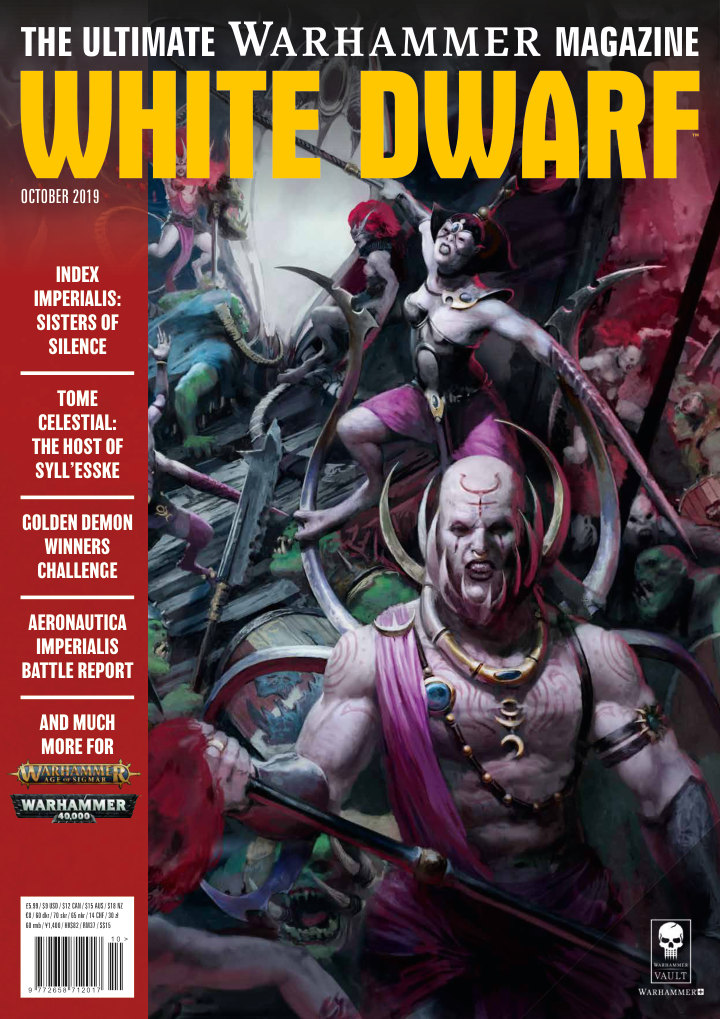
EditorialWD 447 · p. 1
The editor proposes practical ways to keep several hobby projects moving: achievable deadlines, a game or reward at the end, a visible countdown and a simple progress board. The advice treats project management as a way to protect painting time and reduce distraction while leaving room for unexpected new interests.
CommunityWD 447 · pp. 4–7
Readers discuss adapting the hobby after a serious injury, the engineering behind plastic miniatures and the pleasure of sharing drawings and finished models. A friend-painted Knight army illustrates how a collection can change to suit a player’s circumstances, while the gallery celebrates a broad selection of individual painting projects.
PaintingWD 447 · p. 4
Dan Harden answers a reader’s question about his dark Kharadron scheme by separating brasswork, cloth and armour into distinct recipes. Drybrushed metal is completed before the dark areas are restored, while pale blue aether globes and a glossy finish provide small luminous accents against the subdued body colours.
Age of SigmarKharadron Overlords14 paint colours
LoreWD 447 · p. 6
Grombrindal explains that the Imperium uses many currencies rather than one reliably interchangeable system. Thrones, crowns, credits and local scripts coexist with trade in supplies, resources and people, reflecting the distances and inconsistencies that make a single everyday monetary standard impractical across so many worlds.
Warhammer 40,000Imperium
PaintingWD 447 · p. 7
Sam Davies describes a warm bone-coloured skin recipe built from shading, overbrushing and drybrushing, then deepens selected facial and stomach details with a fine brush. Brown fur receives progressively brighter warm drybrushes, giving the enormous daemon-rat contrasting surfaces through straightforward repeatable methods.
Age of SigmarSkaven9 paint colours
LoreWD 447 · pp. 8–11
Phil Kelly tours the Mortal Realms through strange details that range from domestic trade and seasonal calendars to divine schemes and unsettling transformations. Stormcast memory loss, magical geography, wandering monsters and hidden agents demonstrate how everyday life and spectacular fantasy can coexist, offering starting points for armies and stories beyond the main wars.
Age of Sigmar
TacticsWD 447 · pp. 14–17
Jervis Johnson argues that reliable play requires planning for failed rolls rather than assuming an important attack or charge will succeed. Backup units, conserved resources and preparation for the double turn reduce exposure to bad luck, while recognising frustration and keeping the opponent’s enjoyment in mind make unavoidable defeats more instructive and less unpleasant.
Age of Sigmar
LoreWD 447 · pp. 18–27
Phil Kelly traces the partnership between the mortal gladiator Esske and the daemon muse Syll from their separate ambitions through betrayal, enforced servitude and a desperate reunion. Their eventual reward creates the Vengeful Allegiance, whose mixed mortal and daemonic following imitates a union that remains exceptional within Slaanesh’s treacherous courts.
Age of SigmarHedonites of Slaanesh
LoreWD 447 · pp. 26–27
A chronology places the partnership’s origins and revenge beside later campaigns in the Mortal Realms. Battles against Khornate daemons, an Idoneth soul-haul, an emptied festival city and a punitive Stormcast chamber show the growing host’s attraction to both personal vengeance and the destruction of perceived rivals.
Age of SigmarHedonites of Slaanesh
RulesWD 447 · p. 28
A Syll’Esskan Host rewards a carefully balanced mortal and daemon army with extra command resources and enhances nearby heroes’ depravity generation. The rules define the allowed battalions and the special counting role of Syll’Esske, translating the background’s shared purpose into both list construction and battlefield support.
Age of SigmarHedonites of Slaanesh
RulesWD 447 · p. 28
This large formation gathers Syll’Esske with several smaller mortal, mounted and daemon battalions. Its benefits rely on the dual entity remaining on the battlefield, using enhanced mortal bravery and a continuing command resource to represent the authority that holds an otherwise unlikely coalition together.
Age of SigmarHedonites of Slaanesh
RulesWD 447 · p. 29
A mortal Slaaneshi hero leads infantry, optional Spawn and supporting Warshrines in a formation centred on answered prayers. The battalion improves the shrine’s reliability rather than simply adding more attacks, encouraging players to combine ordinary warriors with the religious support that sustains their devotion.
Age of SigmarHedonites of Slaanesh
RulesWD 447 · p. 29
Mounted warriors and chariots gather around a suitably mobile mortal hero for a single explosive headlong charge. The formation can threaten enemies from farther away and add impact damage, turning the story’s pursuit of revenge into a carefully timed cavalry commitment.
Age of SigmarHedonites of Slaanesh
RulesWD 447 · p. 29
Soul Grinders represent the permanent payment Syll’Esske owes the Forge of Souls after the earlier bargain. The formation makes its machines more accurate and harder to damage, connecting a compact battlefield bonus with the continuing cost of the pair’s apparent escape from servitude.
Age of SigmarHedonites of Slaanesh
PaintingWD 447 · pp. 30–31
Andrew Palies divides the model into three assemblies before working from large areas toward details. The full guide contrasts pale flesh, several kinds of purple, hard black leather and reflective metals; differences between full layers and edge highlights let repeated colours produce distinct textures, with blue gemstones supplying focused light effects.
Age of SigmarHedonites of Slaanesh32 paint colours
FictionWD 447 · pp. 32–35
Jordan Green follows Yarkasai, a disappointed tribal heir whose daemon muse promises the union and power he believes he deserves. His flight after murdering his brother leads to Syll’Esske’s caravan, where the apparent patronage proves to serve another grievance entirely and his coveted transformation becomes a punishment.
Age of SigmarHedonites of Slaanesh
ModellingWD 447 · pp. 36–43
Azyr’s stars, celestial instruments and varied landscapes provide a vocabulary for painting and converting armies. The article develops regal palettes, unusual basing and individual heroes before presenting a heavily converted Seraphon host, encouraging collectors to suggest a shared realm through symbols and materials rather than one compulsory uniform.
Age of Sigmar
PaintingWD 447 · pp. 38–39
Thin blue and purple glazes over a black foundation give the endless spell a sense of magical depth. The commentary links the purple sequence to the adjacent Star Temple guide, showing how a basing palette can also connect an army’s magical effects with the wider celestial theme.
Age of Sigmar9 paint colours
PaintingWD 447 · p. 39
The Azyrite Hall base builds pale stone through increasingly light drybrushes, then picks out its recessed celestial detail in a contrasting pink. The warm foundation keeps the stone from looking flat white, while the final coloured recess creates a focal motif without requiring freehand decoration.
Age of Sigmar6 paint colours
PaintingWD 447 · p. 39
A succession of purple drybrushes brings out the carved surface of a Shattered Dominion base. A white foundation in the recessed design supports a translucent pale blue, separating the glowing celestial pattern from the surrounding stone while keeping the whole piece within a cool Azyrite palette.
Age of Sigmar6 paint colours
PaintingWD 447 · p. 39
Blue-grey masonry receives a brown wash and a cool drybrush, while exposed soil uses a separate warm sequence. The simple division distinguishes ruined architectural remnants from the ground around them, offering a practical base treatment that can frame a model without competing with its main colours.
Age of Sigmar6 paint colours
PaintingWD 447 · p. 39
The Sigmarite Ruin guide treats the carved portion as an aged golden relic using a shaded metallic foundation and two bright drybrushes. Brown earth around the object is highlighted separately, creating a strong material contrast between the broken ornament and the landscape reclaiming it.
Age of Sigmar6 paint colours
PaintingWD 447 · p. 39
Fine blue lines are laid over a pale foundation and softened with a diluted glaze to suggest marble veins. The later pale layers refine and sharpen the stone effect, producing a luminous celestial surface whose irregular pattern comes from controlled brushwork rather than a moulded texture alone.
Age of Sigmar5 paint colours
ModellingWD 447 · p. 40
Anthony Saliba raises a mounted Lord-Arcanum onto a piece of ruined masonry to give the centrepiece extra presence. A shouting replacement head echoes the Dracoline’s roar, while a noble pale-and-purple scheme contrasts with the mount’s earthy colours to separate rider, beast and scenic base.
Age of Sigmar
ModellingWD 447 · p. 40
Dan Harden combines a Hurricanum wizard and equipment with a different Collegiate Arcane head, mounting the result on a cut-down objective piece. Telescopes, candles and a miniature griffon create a coherent celestial scholar, with the familiar’s raised claw mirroring the wizard’s casting hand.
Age of Sigmar
ModellingWD 447 · p. 41
Ashley Lowe uses an Evocator’s head and stormstave to alter a Knight-Azyros without losing the character’s role as a celestial beacon. The blue-and-white Knights Excelsior colours reinforce the pure, noble appearance, showing how a modest component change can produce a recognisable but individual hero.
Age of Sigmar
ModellingWD 447 · p. 41
Richard Garton places an Order of Azyr hunter on Astreia Solbright’s Dracoline, using the mounted Freeguild General as the human basis. The creature’s dark body and star-like scales make the fantastic mount part of the celestial theme, extending an idea inspired by the Callis and Toll fiction.
Age of Sigmar
ModellingWD 447 · p. 41
Sam Wilson gives an Astral Templars leader a scarred head and an urban flagstone base to suggest an experienced monster hunter stationed in Azyr. Airbrushed pale greys followed by blue washes make the Gryph-charger appear mystical, while purple armour and neutral paving keep rider and setting distinct.
Age of Sigmar6 paint colours
ModellingWD 447 · pp. 42–43
Steve Party pushes the Seraphon’s mystical technology further by incorporating Necron weapons, armour panels and vehicle components. A converted mounted Scar-Veteran, extensively remodelled Slann and ghost-cloaked Chameleon Skinks become part of a unified blue-and-pink host, with translucent shading and shared celestial forms binding the many conversions together.
Age of SigmarSeraphon5 paint colours
InterviewWD 447 · pp. 46–49
Robin Cruddace explains four goals behind the standalone mass-battle game: familiarity, shorter play, reduced downtime and an opportunity to use every unit before it is removed. Unit-level resolution, detachment activations, orders and delayed damage all serve those aims, with playtesting adjusting blast markers to prevent armies disappearing too quickly.
Warhammer 40,000
FictionWD 447 · pp. 50–53
Andy Clark follows Sister Superior Jessavyn Pheng’s cadre through a seemingly empty hauler in pursuit of the blood-witch Mother Cerynt. Methodical searching, silent communication and psychic immunity support the assault, but darkness and enthralled followers make reaching the quarry costly even after the Sisters have located her sanctum.
Warhammer 40,000Sisters of Silence
LoreWD 447 · pp. 54–59
Colin Cubbon traces the Silent Sisterhood’s duties, organisation and uneasy relationship with the psykers on whom the Imperium depends. Their null presence, vows and specialised cadres underpin both the Great Tithe and battlefield witch-hunting, while Guilliman’s return allows scattered groups to rebuild into a wider network of autonomous Vigils.
Warhammer 40,000Sisters of Silence
LoreWD 447 · p. 59
Three short actions illustrate the Sisterhood’s different methods: hunting a smuggler-witch, holding a psychic installation against daemons and assassinating an Ork Warphead. The final account makes their ruthless priorities explicit when an Imperial unit is exposed to draw guards away from the real target.
Warhammer 40,000Sisters of Silence
RulesWD 447 · pp. 60–61
Updated datasheets cover bolter-armed Prosecutors, sword-bearing Vigilators, flamer-equipped Witchseekers and their Rhino transport. Shared abilities suppress enemy psychic tests and improve witch-hunting, while a special Vanguard arrangement allows the infantry to form a legal support detachment without an ordinary commander.
Warhammer 40,000Sisters of Silence
PaintingWD 447 · pp. 62–63
The complete guide begins with warm burnished armour before adding a cool purple tabard, black equipment and pale details. Blue gems and hair highlights connect the accents, while white fur links the model to its cadre name; the advice leaves the topknot until late to avoid rubbing away finished paint during handling.
Warhammer 40,000Sisters of Silence23 paint colours
PaintingWD 447 · p. 64
The Auric Eagle scheme matches the Studio Custodes through gold armour and red cloth. Layered warm metallics receive a darker wash and a bright final highlight, while the cape’s increasingly light red-orange sequence establishes a strong heraldic counterpart to the blue gemstones shown on the finished model.
Warhammer 40,000Sisters of Silence8 paint colours
PaintingWD 447 · p. 64
Dark red armour and black clothing define the Crimson Lion example, with warm highlights on the plates and cooler ones on the cloth. The contrast separates two dark surfaces, while the surrounding commentary notes the green accents and ancient cross-shaped marking that add further character to the miniature.
Warhammer 40,000Sisters of Silence8 paint colours
PaintingWD 447 · p. 64
The Bone Tiger’s pale armour is shaded warm and rebuilt with light layers over a white foundation. A red cape supplies the main contrast, with the finished example keeping the other details darker so that the armour’s shape remains clear rather than merging into an entirely pale figure.
Warhammer 40,000Sisters of Silence9 paint colours
PaintingWD 447 · p. 64
The Steel Drake recipe uses bright brass armour and pale clothing, with metallic highlights concentrated toward the upper part of each panel. That selective placement suggests light from above, allowing a relatively short sequence to give the metal a more reflective appearance than a uniform edge highlight would provide.
Warhammer 40,000Sisters of Silence8 paint colours
PaintingWD 447 · p. 65
Jason Lee draws on an older image of dark-armoured Sisters for a mostly monochrome collection punctuated by rich magenta cloth. A long progression of cool armour highlights distinguishes reflective plates from the shorter, warmer fabric sequence, giving an Imperial Agents contingent its own coherent character.
Warhammer 40,000Sisters of Silence10 paint colours
CommunityWD 447 · pp. 66–75
The four collections expand through new units, experiments and a pair of Golden Demon entries. Genestealer Cult reinforcements begin to include actual Tyranids, Chaos allies diversify and Death Guard benefit from fast Contrast painting, while the Raven Guard finally face a full battle and add heavier Vanguard support.
Warhammer 40,000
ShowcaseWD 447 · pp. 67–75
James Karch wins a close first game against Genestealer Cults and earns a competition finalist pin with a scenic group of heroes. He also adds Eliminators and an Invictor, using separate assemblies for access and a distinct gun-metal paint to break up the otherwise black-and-silver machine.
Warhammer 40,000Raven Guard2 paint colours
ShowcaseWD 447 · pp. 68–69
Sam Pearson links the cult’s successful uprising to its intended Tyranid conclusion by adding a red-and-bone psychic vanguard. Sentinels and more Genestealers reinforce the cult itself, while a narrative game ends with the enemy ritual stopped at the cost of his entire force.
Warhammer 40,000Genestealer Cults8 paint colours
ShowcaseWD 447 · pp. 70–71
James Gallagher paints Abaddon for a competition but deliberately keeps him consistent with the army he will later lead. Extra highlights improve the centrepiece without separating it completely from the troops, and small trophy and hair choices tie the miniature to both his own force and his rivalry with the Raven Guard collector.
Warhammer 40,000Black Legion
ShowcaseWD 447 · pp. 72–73
Mark Bedford catches up after changing armies by adding daemons, Terminators and plague engines. Randomly mingled Contrast colours make Plaguebearers look sickly very quickly, while texture paint applied before undercoating gives the Crawlers cracked surfaces that can later be drybrushed and weathered.
Warhammer 40,000Death Guard8 paint colours
RulesWD 447 · pp. 76–81
New and replacement datasheets bring the expanding Vanguard range into the first Kill Team system. Incursors, Eliminators, Infiltrators, Reivers, Intercessors and a Phobos Lieutenant gain their available equipment and specialisms, accompanied by reserve rules and an Outflank tactic that broaden deployment options outside ultra-close confines.
Kill TeamSpace Marines
ModellingWD 447 · pp. 82–83
The conversion guide combines Reiver, Infiltrator and other Primaris components into specialist operatives. It emphasises coherent posture and expression, tests parts with adhesive putty and replaces an overlong mine-carrying arm with a bent one, showing how a small change can make an otherwise compatible combination look more convincing.
Kill TeamWarhammer 40,000Space Marines
ModellingWD 447 · p. 84
John Bracken gathers warriors from especially ruthless Chapters into a team suited to dangerous assignments. Shared skull masks create a sinister identity across different roles, while a pointing hand becomes a silent signal and individual Chapter pads retain each operative’s origin beneath the common black armour.
Kill TeamWarhammer 40,000Deathwatch
ModellingWD 447 · p. 85
Jason Lee uses the Chapter’s blue body and pale arms as a foundation for several personalised specialists. Weapon swaps, reposed hands and kneeling Eliminator legs make their jobs visible, while the explicit armour recipes ensure the different component combinations still read as one force.
Kill TeamWarhammer 40,000Necropolis Hawks7 paint colours
ModellingWD 447 · p. 86
Mark Bedford imagines recently inducted Greyshields sent to prove themselves before receiving company markings. Bare heads, shields and Fenrisian upgrade pieces give the otherwise modern armour its Chapter identity, while plain shoulder pads preserve the narrative of a group not yet fully accepted by its new brothers.
Kill TeamWarhammer 40,000Space Wolves
ModellingWD 447 · p. 87
Elliot Hamer combines close-range Reivers and relatively unaltered Eliminators to suit different missions. A metallic foundation tinted with a green airbrush colour produces the armour, while carefully chosen bare heads communicate individual personalities rather than relying on extensive structural conversions.
Kill TeamWarhammer 40,000Dark Angels4 paint colours
InterviewWD 447 · pp. 88–91
Dave Sanders explains the move from Shadespire to a living mountain in Ghur and the mechanical changes accompanying it. Larger faction-specific card sets, lethal feature tokens, revised Guard and new objective categories support the setting, while competitive card cycling aims to keep the pool manageable without retiring old warbands and their own cards.
Warhammer Underworlds
RulesWD 447 · pp. 92–97
A loot-obsessed Flash Git becomes another possible retinue companion, but first the explorers must interrupt his destructive search through the fortress. The feature supplies his background, character card and recruiting expedition, turning the same indiscriminate firepower from a battlefield hazard into an unpredictable resource for future parties.
Warhammer Quest: Blackstone FortressOrks
RulesWD 447 · p. 93
The retinue rules explain how an extra companion acts after the current leader without using normal activation or destiny dice. Sidequests temporarily pause the main expedition’s progression and remove ordinary discovery income, keeping recruitment distinct while preserving existing dangers and equipment effects.
Warhammer Quest: Blackstone Fortress
RulesWD 447 · pp. 94–97
The recruitment stronghold places Zapdakka among several hostile groups and scattered loot, with his actions prioritising treasure and then nearby targets. Explorers must remain alive and prevent him collecting too much before the combat ends, so success requires more than simply clearing enemies from the map.
Warhammer Quest: Blackstone FortressOrks
ShowcaseWD 447 · pp. 98–107
The final part of the invitation challenge presents eight more interpretations of the witch and announces the overall winner. Artists explain levitation, possession, faith, Imperial hypocrisy and tragic foresight through conversions and staged scenes, while the judges assess storytelling, colour and composition alongside technical paint quality.
Warhammer 40,000
ShowcaseWD 447 · p. 98
Yohan Leduc turns Eldrad’s base scenery into a vertical support and adjusts his feet so the Farseer appears to levitate. Pointillist cloth, non-metallic armour and carefully repeated accent colours distinguish materials while directing attention toward the face, hands and psychic display.
Warhammer 40,000
ShowcaseWD 447 · p. 99
Andrew Palies places Celestine above an armed religious procession to question an Imperium that venerates miracles while condemning witches. John Blanche’s art informs the scene and palette, with exposed faces, small freehand patterns and a consistent imagined light source sustaining the crowded diorama.
Warhammer 40,000
ShowcaseWD 447 · p. 100
Peter Bell splits a shipboard scene so the observer must turn it to discover the source of a psyker’s distress. Grand naval architecture above contrasts with a daemonic breach below, where differently painted Nurglings and a Plaguebearer express both the comic and visceral aspects of the intrusion.
Warhammer 40,000
ShowcaseWD 447 · p. 101
Jonathan De Vos stages an ambush around bounty hunters and their captured Medusae, using contrasting poses to establish who is advancing and who must hold ground. Straight structural beams guide the viewer around a compact base, while a muted abandoned-city setting lets the combatants’ brighter colours carry the story.
Warhammer 40,000
ShowcaseWD 447 · pp. 102–103
Christoffer Jonsson makes an Exalted Sorcerer’s psychic dominance visible through a kneeling Crimson Fist. Similar colours connect the opponents, but smooth brighter painting on the sorcerer and stippled textures on his victim create a selective-focus effect that pushes attention toward the witch.
Warhammer 40,000
ShowcaseWD 447 · p. 103
Matt Wingrove paints daemon Mortarion in brass and pale armour recalling the Legion’s earlier heraldry, then adds weathering and a warm red cowl. A borrowed scenic base supports his first green-marble attempt, built through sponged dark colour, pale veining and a unifying wash.
Warhammer 40,00010 paint colours
ShowcaseWD 447 · p. 104
Ryan Allen builds the Emperor from an emaciated Nagash body, a spare daemon head and sculpted robes amid industrial throne machinery. A restricted pool of colour and light surrounds the central figure while the rest recedes into darkness, favouring an atmospheric vision of barely understood life-support technology.
Warhammer 40,000
InterviewWD 447 · pp. 105–107
Darren Latham, Joe Tomaszewski and Max Faleij discuss selected entries before choosing Angelo Di Chello’s scene. Their comments value a readable narrative, deliberate colour placement and presentation that supports the central figures, showing how an ambitious diorama must succeed as a coherent whole as well as a collection of finely painted miniatures.
Warhammer 40,000
ShowcaseWD 447 · pp. 106–107
The winning diorama places a loyal Librarian above a hidden summoning ritual that his own violence unwittingly completes. Angelo Di Chello connects the two levels with falling blood and repeated psychic effects, using grime, contrasting protagonists and triangular figure placement to make the tragic relationship readable.
Warhammer 40,0001 paint colour
FictionWD 447 · pp. 108–111
David Annandale places the reader inside Malveil, a house whose six doors offer different forms of entrapment and ruin. A die selects the path through the short horror, with repeated images and an apparently circular ending making the promise of free choice feel increasingly illusory.
Battle reportWD 447 · pp. 112–123
Jay Clare’s Orks attack missile silos defended by Michael Bax’s Imperial aircraft and flak batteries. Early losses put the Navy behind, but a surviving Thunderbolt fights back through a succession of close manoeuvres; the Orks’ bombing damage proves just enough for a narrow 168–164 victory despite losing most of their aircraft.
Aeronautica ImperialisOrk Air Waaagh!
CampaignWD 447 · pp. 124–129
A historical campaign recreates the improvised squadron defending Hive Volcanus during the Third War for Armageddon. Five linked actions move from raids and supply missions to a desperate attack on Gargants, with named aces and an optional fixed roster reinforcing a story in which Imperial aircraft cannot simply be replaced after every battle.
Aeronautica ImperialisImperial Navy
RulesWD 447 · pp. 126–127
Four familiar Rynn’s World scenarios gain rules for moving gunboats, concealing smog, an Ork high-altitude ambush and the defence of a damaged commander. The sequence steadily changes the squadron’s circumstances, using a common roster and restricted replacement to make later missions depend on earlier survival.
Aeronautica ImperialisImperial Navy
RulesWD 447 · p. 128
The final mission attacks three tall ground targets whose defences become progressively active as the game continues. An Armageddon variant allows a desperate collision to damage a Gargant and requires every target’s destruction for a true Imperial victory, turning dwindling aircraft into a finite resource for the final assault.
Aeronautica ImperialisImperial Navy
RulesWD 447 · p. 129
Two named aircraft profiles embody the rivals behind the campaign. Answith’s Thunderbolt Fury can seize initiative once, while the Ork Dakkajet gains a burst of extra throttle; their fixed pairings and restricted upgrades preserve the identity of the pilots and machines rather than treating the abilities as generic purchases.
Aeronautica ImperialisImperial Navy
CampaignWD 447 · pp. 130–139
An isolated Enforcer post faces an alliance seeking revenge, with a mini-campaign tracking the siege through an opening attack, optional intermediate actions and a final stand. Persistent damage, ammunition, injuries and captured rooms make each short battle affect the next, while replenishing attackers and limited defensive support create deliberately unequal pressures.
NecromundaPalanite Enforcers
RulesWD 447 · pp. 131–134
The framework builds a central precinct with doors, prisoners and support staff, then gives attackers assault waves and defenders useful but destructible rally points. Short respite actions force choices between repairs, recovery and rearming, and the overall result ultimately depends on whether any effective defender survives the last scenario.
NecromundaPalanite Enforcers
RulesWD 447 · p. 135
The opening attack catches part of the defending force concentrated at the centre of the precinct while a second enemy group can arrive later from a flank. The balance of effective fighters inside at the end determines whether the attackers overrun rooms or the defenders gain additional respite capacity.
NecromundaPalanite Enforcers
RulesWD 447 · p. 136
A smaller attacking force tries to set rooms ablaze, with accumulating fire worsening visibility, injuring occupants and eventually forcing evacuation. Defenders can spend actions extinguishing the flames, making the number of burning tiles a separate objective from merely shooting the enemy.
NecromundaPalanite Enforcers
RulesWD 447 · p. 137
A blackout allows six attackers to enter the precinct and target the commander and essential support staff. Sentries, limited light and concealed movement govern the opening, while the eventual loss or survival of the named roles determines how much ground changes hands.
NecromundaPalanite Enforcers
RulesWD 447 · p. 138
The rival leaders begin a restricted confrontation with their followers initially watching rather than acting. More fighters become ready as the rounds pass and a serious injury or retreat can unleash a broader fight, letting the results of an apparent duel change the campaign’s territorial balance.
NecromundaPalanite Enforcers
RulesWD 447 · p. 139
The final assault comes through all four approaches as the defenders retreat toward the centre. Rooms can fall permanently during the battle and rally points be destroyed, while the renewed need to test morale makes survival through the last six rounds the decisive campaign goal.
NecromundaPalanite Enforcers
CommunityWD 447 · pp. 140–144
The closing pages mix painting progress, converted characters, small games and the magazine’s publishing award. Titans and Guardsmen advance alongside Blood Angels and Sylvaneth projects, while brief battle accounts give those collections an immediate purpose beyond display.
PaintingWD 447 · p. 140
Lyle adds two Warhounds to his Legio Astorum collection and begins a new Guard army. A pale blue Contrast paint provides the plasma glow on the Titans, while following an established app palette helps him bring the first infantry to a useful consistent standard quickly.
Adeptus TitanicusWarhammer 40,000Legio Astorum1 paint colour
ModellingWD 447 · p. 141
Dan Harden turns a Phobos Lieutenant into a Blood Angels character with a Death Company chainsword and a Baal Predator head. Reattaching the occulus sensor keeps the equipment recognisable, while a halo, blood drop and small belt detail carry the Chapter identity through the relatively restrained conversion.
Warhammer 40,000Blood Angels
Battle reportWD 447 · p. 142
Jonathan tests his T’au in small games against Dan’s Orks and then Adeptus Mechanicus. The second contest becomes a fierce exchange of fire followed by unexpected close combat, but the T’au again finish ahead, illustrating how practice with a collection can reveal threats beyond its obvious shooting role.
Warhammer 40,000T’au Empire
Battle reportWD 447 · p. 143
Matt and Lyle use matching forces of a Warlord and two Warhounds for an introductory clash. Aggressive scouting exposes Lyle’s smaller engines to the opposing Warlord, after which Matt’s surviving Warhounds encircle the last target, making the game a practical lesson in positioning around a much heavier opponent.
Adeptus TitanicusLegio Ignatum
ModellingWD 447 · p. 144
Mark Bedford combines a Treelord with the new Wyldwood to create a cape of branches and leaves. Replacing the staff’s top with a large sword produces a spear-like weapon, while ruins beneath the figure give the finished woodland character a substantial scenic setting.
Age of SigmarSylvaneth
All substantive body features read, including complete rules tables, both short stories, all eight new Winners Challenge entries, campaign scenarios and named painting guides. Recipe pages30–31,39 and62–65 rendered for visual verification. Magus Purple in the extracted Plaguebearer prose is indexed as the established Magos Purple paint; no extra recipe colours inferred from photographs.