EditorialWD 416 · p. 1
The editorial introduces the return of Roboute Guilliman and the questions it raises for the Imperium. It also previews the ordinary lives and adventures explored in Shadows Over Hammerhal and invites readers to join the new Warhammer 40,000 Tale of Four Warlords.
ShowcaseWD 416 · pp. 4–5
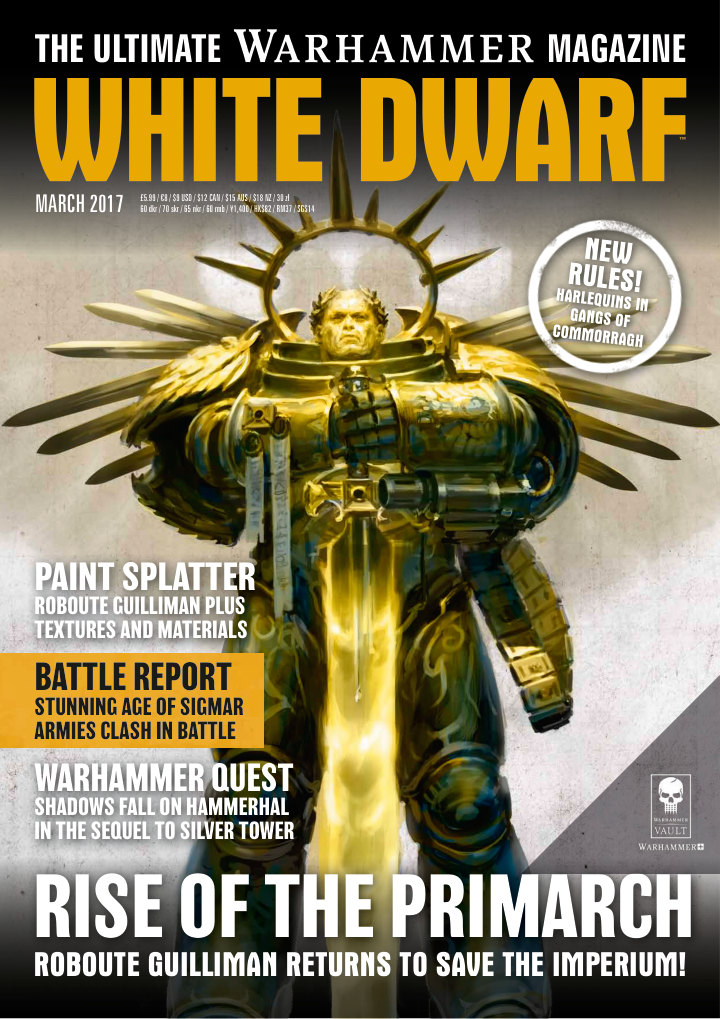
Rise of the Primarch brings the Gathering Storm’s pilgrims to Macragge and restores Guilliman to a galaxy he scarcely recognises. The preview outlines the concluding supplement’s story, army options and missions, and places the resurrection within the devastation following the fall of Cadia.
Warhammer 40,000Ultramarines
ShowcaseWD 416 · pp. 6–7
Guilliman, Grand Master Voldus and Cypher form an unlikely trio of new plastic characters. Close-ups explain the Primarch’s life-support armour and interchangeable heads, Voldus’s hammer and tomes, and Cypher’s ancient equipment; a route map follows the Terran Crusade through Ultramar, the Maelstrom and Luna.
Warhammer 40,000Ultramarines
ShowcaseWD 416 · pp. 8–9
The new Warhammer Quest box sends four adventurers into the catacombs of the Twin-tailed City under the direction of a gamemaster. A component tour explains destiny dice, treasure, skills, renown and dungeon exploration, including the opportunities to spend gold above ground in Cinderfall.
Warhammer Quest
ShowcaseWD 416 · p. 10
The Vanguard’s mounted hunters ride Gryph-chargers with which they share an earned bond of trust. The preview examines the three-model kit’s javelins, handaxes, pistols and leader options, alongside the practical equipment needed for long patrols beyond civilisation.
Age of SigmarStormcast Eternals
ShowcaseWD 416 · p. 11
Lord-Aquilors are independent commanders and expert trackers chosen to lead Vanguard Auxiliary Chambers. The model’s astral compass, heavy pistol and starbound blade express that role, while alternative heads allow a bare-faced or masked leader atop the Gryph-charger.
Age of SigmarStormcast Eternals
ShowcaseWD 416 · p. 12
These marksmen use either rapid-firing hurricane crossbows or longstrike weapons intended for precise kills. Their Aetherwing companions serve as scouts and spotters, and the preview explains how both the birds and three crossbowmen are represented in the boxed set.
Age of SigmarStormcast Eternals
ShowcaseWD 416 · p. 13
Two conversion frames provide the insignia and heads needed to recruit existing miniatures into different forces. Deathwatch shoulder pads and weapons personalise Space Marines, while hybrid heads, cult icons and equipment turn Astra Militarum kits into Genestealer Cult followers and their commandeered vehicles.
Warhammer 40,000Deathwatch
LoreWD 416 · p. 13
A compressed high-and-low history recalls the Primarchs’ creation, disappearance and rediscovery during the Great Crusade. The missing two and the catastrophic rebellion of Horus provide the dark counterpart to their conquests for the Emperor.
The Horus HeresySpace Marines
ShowcaseWD 416 · pp. 14–15
The separate release of Tartaros Terminators and Mark III Space Marines makes two ancient armour designs available outside their original boxed game. The preview distinguishes the Terminators’ mobility and rare weapons from Mark III’s suitability for boarding actions, and lists the plastic kits’ equipment and command options.
Warhammer 40,000The Horus HeresySpace Marines
ShowcaseWD 416 · p. 16
An Ogre provides the Reikland Reavers with the strength ordinary Human players often lack against tougher teams. The news also introduces the separately boxed Human roster and a flexible neoprene recreation of the Reavers’ home stadium, the Oldbowl.
Blood BowlHuman teams
RulesWD 416 · p. 17
Teams may sneak an unusual ball into one drive per match, risking the referee sending off the kicker. Rules distinguish a dangerous extra-spiky ball, an escaping Orc squig, a mutating Skaven warpstone brazier and a heavy Dwarf ball that changes passing, scattering and impact injuries.
Blood BowlOrc teams
ShowcaseWD 416 · p. 18
The resin Slambo revisits a two-axe Chaos Warrior first seen in White Dwarf 81. The release notice emphasises the connection to the 1986 model and introduces his return as an Exalted Hero for Age of Sigmar, with an accompanying Warhammer Quest character card.
Age of SigmarSlaves to Darkness
RulesWD 416 · p. 18
Slambo’s hero card translates his pair of axes into close combat, thrown attacks and a powerful decapitation strike. Killing an adversary improves his later attacks that turn, while his high-dice legendary action lets him move and strike every adjacent opponent; decapitations can also earn extra renown.
Warhammer QuestSlaves to Darkness
ShowcaseWD 416 · p. 20
Guy Haley’s novel explores the history of the ancient Blood Angels Chapter Master, whose thousand years of command have encompassed victory and defeat. The preview presents both the regular hardback and a signed limited version with an additional story and author introduction.
Warhammer 40,000Blood Angels
ShowcaseWD 416 · p. 20
Dan Abnett’s returning novel brings the exhausted Legio Invicta to Orestes, where a Chaos Titan invasion threatens an already divided forge world. The preview highlights the mixture of god-engine warfare, ordinary lives and a conspiracy that could split Mars from Terra.
Warhammer 40,000Adeptus Titanicus
ShowcaseWD 416 · p. 21
The graphic novel follows the war engine Imperius Dictatio and Princeps Hekate against Orks, Tyranids and Chaos. This collected edition pairs Dan Abnett’s story with Anthony Williams’s black-and-white artwork, presenting the long-running account of life and combat within a Titan.
Warhammer 40,000Adeptus Titanicus
ShowcaseWD 416 · p. 21
Before becoming the Dark Angels’ Master of Librarians, Ezekiel leads Fifth Company warriors in defence of Honoria. The preview places his developing legend within a desperate campaign against Waaagh! Groblonik, fought alongside the armies of the Astra Militarum.
Warhammer 40,000Dark Angels
ShowcaseWD 416 · p. 21
David Annandale’s audio drama explores the political formation of the Adeptus Mechanicus during the Horus Heresy. The Fabricator General in exile must find agreement with the divided Council of Terra, making bureaucracy and factional rivalry as dangerous as the civil war beyond it.
The Horus HeresyAdeptus Mechanicus
InterviewWD 416 · p. 21
The narrator discusses learning the Warhammer vocabulary and making unfamiliar names and weapons sound convincing. He describes the pace and theatricality of the Garro dramas, decisions about narrating Eisenhorn in the first person, and the intimate, unsettling voice he gives Cherubael.
Warhammer 40,000
ShowcaseWD 416 · pp. 22–23
Inferno expands the histories of the Thousand Sons, Space Wolves, Talons of the Emperor and Ordo Sinister during the Burning of Prospero. Alongside the book, the feature examines the huge Acastus Knight Porphyrion and three Custodes grav-vehicles, stressing the rare technologies the Emperor reserved for his personal warriors.
The Horus HeresyThousand Sons
ShowcaseWD 416 · pp. 24–25
The modular Lake-town house combines reversible walls, walkways and small waterside accessories into varied buildings. Gundabad Berserkers and Ogres reinforce Azog’s forces, while Goat Riders, dismounted spearmen and command models broaden the Iron Hills range; an event-exclusive Alfrid conceals stolen gold beneath his disguise.
Middle-earth Strategy Battle GameLake-town
ShowcaseWD 416 · pp. 26–27
The expanded computer game bundles previously added content with Bretonnia as a playable faction and Andy Hall’s Prince of Altdorf novella. The preview explains Bretonnia’s feudal campaign themes, the Peasant Economy and Vows, and its knights, Damsels and Legendary Lords.
Warhammer Fantasy BattlesBretonnia
ShowcaseWD 416 · p. 27
The first collected arc brings together the comic’s opening four issues and its introductory issue zero. The story preview describes the newly accessible Calaphrax Cluster, whose ancient secrets attract numerous forces while the Dark Angels pursue a purpose of their own.
Warhammer 40,000Dark Angels
CommunityWD 416 · pp. 30–31
Readers describe discovering painting through Silver Tower, returning to the hobby through boxed games and seeking more scenery and beginner advice. The replies discuss the place of points-free battle reports and promise continued technique coverage, while requests range from scorched armour to fighting vertically inside an Imperator Titan.
PaintingWD 416 · p. 31
Responding to a reader’s question, Aidan Daly recalls the dark red recipe for Smaug’s back and wing scales. A red-and-black foundation develops through red edge highlights into a pale final mixture, with the caveat that his recollection may need a little experimentation.
Middle-earth Strategy Battle GameSmaug4 paint colours
LoreWD 416 · p. 31
Grombrindal explains that Nurgle’s mortal champions began as humans, though mutations and divine gifts can obscure their origins. He distinguishes these corrupted mortals from Plaguebearers, some of whom crossed into daemonhood after succumbing to Nurgle’s Rot.
Age of SigmarMaggotkin of Nurgle
InterviewWD 416 · pp. 32–35
Developers and Games Workshop’s licensing team trace Dawn of War from its territory-based resources to the smaller, customised squads of the sequel. The discussion turns to the third game’s larger armies, believable battlefield structures, Imperial Knights and returning characters, explaining how animation and design choices translate the setting into a real-time strategy game.
Warhammer 40,000Blood Ravens
LoreWD 416 · p. 36
An in-world stadium tour explains why so few teams still own their grounds after the NAF’s collapse. The Old Bowl, Doom Dome and undersized Halfling Green Acres illustrate contrasting venues, while a play diagram celebrates a Gutter Runner’s series of dodges that turns a Human fumble into a Skaven touchdown.
Blood BowlHuman teams
InterviewWD 416 · pp. 38–43
Jervis Johnson, Nicholas Horth and Nuala Kinrade explain how a permanent city and dungeon layout prompted the addition of a gamemaster to Warhammer Quest. Hammerhal’s linked settlements in Fire and Life support a detailed exploration of Cinderfall, where trade, crime, taverns and strange inhabitants give the heroes reasons to care about their home.
Warhammer Quest
LoreWD 416 · p. 43
Between dungeon expeditions, adventurers can shop in the Riftmarket, bid at the House of Venargo, visit a chapel or earn money in the fighting pits. Gambling, drinking and Red Yugol’s fortune-telling offer renown and treasure but also risks, making the surrounding city an active part of the adventure.
Warhammer Quest
ShowcaseWD 416 · p. 46
Four hobbyists begin a six-month Warhammer 40,000 collecting challenge with a Start Collecting! box and a commitment to paint at least one unit each month. This introductory instalment presents their test models and motivations, leaving readers time to build their own starting forces before the first full progress report.
Warhammer 40,000Space Marines
ShowcaseWD 416 · p. 47
Maxime Corbeil returns to the article series that originally inspired his collecting, using John Blanche’s third-edition cover as the basis for Black Templars. Cold blue-black armour, creamy shoulder pads and warm dusty bases establish contrasting textures, with scripture and battle damage to develop as the army grows.
Warhammer 40,000Black Templars
ShowcaseWD 416 · p. 47
James Ashbey chooses the Astra Militarum army he has long wanted to collect despite the recent destruction of Cadia. Red armour, grey fatigues and green weapons give his survivors a distinctive scheme, while the regiment’s story will follow its continuing struggle and search for a future.
Warhammer 40,000Astra Militarum
ShowcaseWD 416 · p. 48
Dan Harden is drawn to the Iron Warriors’ bitterness and their opportunity to strike at the beleaguered Imperium. The project will challenge him to paint a largely metallic army, with tarnished gold and grimy hazard stripes suggesting industrial equipment that has endured millennia of warfare.
Warhammer 40,000Iron Warriors
ShowcaseWD 416 · p. 49
Chris Bilewicz chooses the less commonly painted matriarchal craftworld Iybraesil, planning female commanders and Howling Banshees around its background. His jetbike test model uses separately painted components and drybrushed highlights to demonstrate an efficient approach to a large collection.
Warhammer 40,000Aeldari
InterviewWD 416 · pp. 50–55
Andy Clark and the model makers explain why the empire-building Guilliman was chosen to return, and how his battlefield resurrection gives way to despair at the Imperium’s condition. Seb Perbet and Steve Buddle discuss the visual language of Guilliman, Voldus and Cypher, while the painters describe consistent spot colours and character-specific weathering across the group.
Warhammer 40,000Ultramarines
FictionWD 416 · pp. 50–51
At Guilliman’s awakening, Celestine interprets the battle’s fallen as martyrs whose sacrifice has delivered a miracle. The short fiction contrasts her grateful reverence with the Primarch’s immediate fury as he tears through the Black Legionnaires still fighting inside the shrine.
Warhammer 40,000Ultramarines
InterviewWD 416 · pp. 56–59
Simon Adams reposes Guilliman into a commanding figure addressing the people of Terra rather than fighting. Custodian attendants establish scale and connect the scene to classic Imperial artwork, while an onyx aquila and restrained gold framing direct attention to the Primarch’s face and burning sword; Adams explains how story, composition and colour make a diorama work.
Warhammer 40,000Ultramarines
LoreWD 416 · pp. 62–69
This introduction follows Sigmar’s chosen heroes from their mortal last stands through the trials of reforging and service within the Stormhosts. It explains chambers, conclaves, heraldry and weapons, but also the loss of identity that accompanies repeated rebirth and the new duty of protecting cities from corruption as well as armies.
Age of SigmarStormcast Eternals
ShowcaseWD 416 · pp. 70–71
Angelo Di Chello explains the blue-purple mood of his Slayer Sword-winning Gaunt Summoner and the many thin, filtering layers that make its colours shimmer. The judges emphasise the contrast between dark atmosphere and intense colour, particularly the unsettling eyes reading the book while the others look outward.
Age of SigmarDisciples of Tzeentch
ShowcaseWD 416 · p. 72
Jaroslaw Drabek carries a cracked, ruined landscape from the base onto the Slaughterpriest’s armour, evoking Khorne’s domain. The judges praise his distinct material textures, smoothly blended non-metallic weapons and the individually highlighted cracks that support the figure’s dark majesty.
Age of SigmarBlades of Khorne
ShowcaseWD 416 · p. 73
Michał Pisarski converts a Varanguard warrior into a broad, open-posed Lord of Khorne whose glowing chest rune echoes lava below. Metallic-looking red armour stays rich through deep shading and fine highlights, while scars and skulls reinforce the furious veteran’s identity.
Age of SigmarBlades of Khorne
ShowcaseWD 416 · pp. 74–75
Damien Tomasina airbrushes a huge Phantom Titan in his Sons of Asurmen army’s blue and yellow, treating its panels as reflective surfaces. Freehand icons, glowing cockpit details and splattered weathering complement a narrative base where the ancient war engine crushes an Emperor’s Children Land Raider beneath a temple-like stride.
Warhammer 40,000Aeldari2 paint colours
ShowcaseWD 416 · p. 76
Pawel Makuch presents Putrid Blightkings as an oddly cheerful procession with the mood of a Zdzisław Beksinski oil painting. The judges single out the variety of sore skin, rust, blood and verdigris, whose unsettling rawness gives the diorama its emotional impact.
Age of SigmarMaggotkin of Nurgle
ShowcaseWD 416 · p. 77
Andy Wardle focuses on richly reflective armour, stippled texture and carefully balanced turquoise and crimson. Judges praise the restraint of his blue glazes and the ornate freehand, especially a skull-and-wreath motif on the cloak that completes the Primarch’s elaborate appearance.
The Horus HeresyUltramarines
InterviewWD 416 · pp. 78–85
Artists describe the scale, character and contradictions of Imperial armies, from individual Space Marine heroes to massed mortal regiments and inhuman machines. Discussions of the Iron Cage-inspired battle, Cadian troop landers, Chapter assemblies and mechanical processions show how lighting, viewpoint and layered detail turn miniatures into convincing imagined warfare.
Warhammer 40,000Space Marines
TacticsWD 416 · pp. 86–87
Guy Haley argues that Age of Sigmar’s short core rules allow complexity to grow from warscrolls and scenarios rather than dense general exceptions. Drawing on decades of gaming and his themed open games, he celebrates its scalability, permission to invent rules and acceptance of different approaches to collecting and competition.
Age of Sigmar
ShowcaseWD 416 · pp. 88–89
Dan Hyams uses an event deadline to turn an Errant-Questor test model into a complete Stormcast army. He describes efficient painting priorities, an airbrushed turquoise armour recipe and subtle head swaps, with a contrasting mortal Warrior-Priest adding variety to the otherwise immortal force.
Age of SigmarStormcast Eternals4 paint colours
ShowcaseWD 416 · pp. 90–91
Jes Bickham builds an industrial-looking cult to accompany his established Tyranids, finishing more models than his doubles-event list required. Yellow work suits, unhealthy flesh and green alien carapaces connect the army’s human and monstrous extremes; he also reflects on the patience required to exploit its ambushes.
Warhammer 40,000Genestealer Cults11 paint colours
ShowcaseWD 416 · pp. 92–93
Duncan Rhodes and Martyn Lyon combine Men of Dale with the Dwarves of Thror’s prosperous kingdom, creating a force inspired by the films’ historical flashback. Bright cloaks, clean armour and a converted bow-armed Girion win Best Army at a doubles weekend even though their battlefield results leave them last.
Middle-earth Strategy Battle GameArmy of Thror1 paint colour
ShowcaseWD 416 · pp. 94–95
Pete Foley’s red Ironjawz borrow Flash Gitz parts for a pirate identity, with individual bosses and a converted Weirdnob supporting their search for great fights. He explains the layered red painting method, homemade hero-phase reminder counters and the importance of writing an event list before discovering a last-minute points shortage.
Age of SigmarIronjawz1 paint colour
Battle reportWD 416 · pp. 96–110
Chris Peach defends his multi-racial city against Steve Bowerman’s Nurgle army in a jointly designed six-round battle. Two 2,280-point forces contest the city gates and a pair of Realmgates, combining narrative armies with objectives adapted from the General’s Handbook. Failed early charges expose the defenders, but militia, heroes and determined duardin make the game unexpectedly close.
Age of SigmarFreeguild
ShowcaseWD 416 · pp. 112–113
The August 2004 retrospective revisits Storm of Chaos, the arrival of the plastic Mûmak and the Haradrim’s battlefield coverage. It also recalls the Armoured Company list, eccentric Imperial engineering and Paul Sawyer’s staged Chaos Warrior painting guide, placing the issue just before another edition of Warhammer 40,000.
Warhammer Fantasy BattlesWarhammer 40,000
RulesWD 416 · pp. 114–115
This expansion adds Skyweavers and Voidweavers to Gangs of Commorragh in one-off games and campaigns. Two-member crews can use more weapons, holo-fields improve defence and new manoeuvres model mirage cover, fly-by strikes and rear fire; masque organisation and a possible blessing from Cegorach replace ordinary gang assumptions.
Gangs of CommorraghHarlequins
ModellingWD 416 · pp. 118–119
The Studio Army Painters combine Mark IV Marines, robed Dark Angels Veterans and an upgrade frame into fifteen Fallen. Four annotated character builds demonstrate how armour marks, heads, weapon poses and shoulder pads can suggest ancient warriors while providing exact component references for reproducing the conversions.
Warhammer 40,000Fallen
ModellingWD 416 · p. 120
A practical drill guide begins with a centred pilot hole and explains choosing the chuck and limiting exposed drill-bit length. It then follows the muzzle and side vents of a bolter, emphasising alignment, gentle pressure and careful removal of plastic debris for a clean result.
ModellingWD 416 · p. 121
Dan Harden builds another Fallen squad from robed veterans, Mark III armour and spare heavy-weapon parts. A drilled missile launcher accepts a trimmed firing missile, while shallow drilled holes opened with a knife produce convincing battle damage on an armoured greave.
Warhammer 40,000Fallen
PaintingWD 416 · pp. 122–125
Paul Norton simplifies the ornate Primarch into familiar Space Marine painting stages, drybrushing gold before tidying the surrounding blue. Separate recipes cover armour, metal, scrolls, seals, face, eyes, hair and laurels, then the ruined base, Black Legion corpse and flames; thin washes and reversed light-to-dark fire highlights keep the head and sword as the focal points.
Warhammer 40,000Ultramarines51 paint colours
PaintingWD 416 · p. 126
Layered orange hair on a Wulfen demonstrates how successive highlights can describe individual strands. Orange and brown washes deepen the colour before bright orange and pale final highlights sharpen the texture.
Warhammer 40,000Space Wolves5 paint colours
PaintingWD 416 · p. 126
A Wulfen’s fur hide is painted with a brown foundation and two warm shades before a pale drybrush catches the sculpted texture. The guide contrasts this coarse finish with the adjacent layered hair example.
Warhammer 40,000Space Wolves4 paint colours
PaintingWD 416 · p. 126
Ulrik’s wolf tails use layered bone-coloured highlights and carefully placed washes to create bands in the fur. This gives a different finish from drybrushing even though both examples represent similar animal material.
Warhammer 40,000Space Wolves5 paint colours
PaintingWD 416 · p. 126
Ulrik’s skull helm develops from a warm bone foundation through a sepia wash into pale, precise highlights. The restricted shading and sharp finish distinguish its hard surface from the nearby wolf pelts.
Warhammer 40,000Space Wolves5 paint colours
PaintingWD 416 · p. 127
A Kastelan Robot’s exposed metal is shaded dark and progressively relayered with brighter metallic paints. Fine final lines imitate scratches while preserving the surrounding worn surface.
Warhammer 40,000Adeptus Mechanicus4 paint colours
PaintingWD 416 · p. 127
Irregular blue and dark-brown marks define damaged paint on a robot’s armour, with tiny metallic accents implying the layer exposed underneath. Pale edge marks complete an effect that can be placed selectively rather than covering every panel.
Warhammer 40,000Adeptus Mechanicus4 paint colours
PaintingWD 416 · p. 127
The Magmadroth’s craggy scales receive a red spray foundation and crimson shade before broad drybrushed highlights. A final yellow glaze warms and unifies the surface without losing the deep recesses.
Age of SigmarFyreslayers5 paint colours
PaintingWD 416 · p. 127
The Magmadroth’s crest uses a yellow foundation and pale drybrush to pick up its form. Orange shading followed by a yellow glaze produces a leathery warmth distinct from the red rocky scales.
Age of SigmarFyreslayers5 paint colours
PaintingWD 416 · pp. 128–133
Max Faleij, Aidan Daly and the Army Painters explain how paint can make the same plastic suggest cloth, bone, leather, polished armour or fur. Sculpted and painted textures are distinguished, with advice on matching technique to surface, separating similar colours and using weathering to support a model’s story rather than obscure its shape.
23 paint colours
ShowcaseWD 416 · p. 134
Stu Black replaces the Bloodsecrator’s elaborate axe with a simpler sacrificial weapon from the Chaos Warshrine. The contrast lets the brutal blade balance the ornate Portal of Skulls while beginning his eight-character Gorechosen project.
Age of SigmarBlades of Khorne
ShowcaseWD 416 · p. 134
A bare head lets Stu concentrate on the Deathbringer’s expression and flowing hair. Pale aged skulls separate trophies from the armour, while thinned purple and crimson washes emphasise mutations and ritual marks.
Age of SigmarBlades of Khorne2 paint colours
ShowcaseWD 416 · p. 135
Practice on sixty Bloodreavers helps Stu establish the flesh and armour techniques for his Bloodstoker. Washes emphasise folds and weight, a missing tooth adds character and darkened pink hair stands apart from red armour and skin.
Age of SigmarBlades of Khorne2 paint colours
ShowcaseWD 416 · p. 135
Stu paints beaten iron rather than red armour to reflect the Skullgrinder’s smithing role. Turquoise on the plume contrasts with the fiery anvil, and glowing eyes hint at something inhuman behind the helmet.
Age of SigmarBlades of Khorne4 paint colours
ShowcaseWD 416 · p. 135
A Flesh Hound painting guide provides the unexpected basis for the Exalted Deathbringer’s ruddy skin. Dark horns and limited red cloth keep this near-daemonic champion distinct from the cleaner bone and bright armour of his companions.
Age of SigmarBlades of Khorne
ShowcaseWD 416 · p. 136
The mutated spine and trophies receive layered bone colours, with darker washes at the tips suggesting horn. Nuln Oil around the eyes makes the priest seem exhausted by an endless life of fighting and bloody devotion.
Age of SigmarBlades of Khorne5 paint colours
ShowcaseWD 416 · p. 136
Stu explains the flesh method shared by most of his champions: warm layered skin, a thinned darker colour in the recesses and a pale finishing highlight. Rusty-looking washes, a bright edge and blood splashes make the hackblade a rough, unpleasant counterpart to the carefully finished flesh.
Age of SigmarBlades of Khorne8 paint colours
ShowcaseWD 416 · p. 136
The most heavily armoured champion demonstrates Stu’s quick red scheme. A dark recess wash defines the plates before two increasingly bright edge highlights restore their shape, with neighbouring bone and metal worked together to streamline the process.
Age of SigmarBlades of Khorne4 paint colours
ShowcaseWD 416 · p. 137
Michael Wieske connects his Skullgrinder to the Axes of Skarbrand with red plates and black banding. Forge-like glows animate the eyes and chest vents, orange-white flames omit the usual yellow layering, and teal patina cools the otherwise warm scheme.
Age of SigmarBlades of Khorne1 paint colour
ShowcaseWD 416 · p. 137
Chris Peach gives the Iron Horde priest bright, blood-smeared metal armour with warmer banding. The contrasting hackblade is painted as volcanic rock or daemonic crystal using black, red and orange, linking the weapon to the model’s supernatural violence.
Age of SigmarBlades of Khorne8 paint colours
ShowcaseWD 416 · p. 137
Tom Moore concentrates on smoothly defined muscles and a meticulously detailed face, drawing the eye to teeth, tongue and cheekbones. Metal chips highlight black armour while fine striations distinguish brown horn from the larger bone growth on the back.
Age of SigmarBlades of Khorne2 paint colours
CommunityWD 416 · pp. 138–142
Reader submissions range from colourful Ironjawz and Blood Angels to Sons of Horus war machines and large Stormcast creatures. The gallery pairs each photographed miniature with its painter, including a Deathwing Contemptor, Corvus Corax and an Iron Circle automaton.
PaintingWD 416 · p. 143
Jez Andrews paints Alarielle’s pale clothing to suggest translucent gossamer, relating the cloth highlights to the skin beneath. A green pool provides reflected light on the Wardroth’s legs and underside, with progressively paler mixtures defining the glow.
Age of SigmarSylvaneth7 paint colours
CommunityWD 416 · p. 146
The staff’s Blood Bowl league has become costly in injuries, leaving several teams with depleted line-ups. The column also follows Martyn’s borrowed Stormcasts and the team’s painting deadlines; Dan’s tackle-zone note clarifies how opposing players can assist blocks.
Blood Bowl
InterviewWD 416 · p. 146
Adam Troke discusses the enthusiastic response to renewed Middle-earth releases and the There and Back Again book. The interview describes plans to keep following The Hobbit’s characters and units while returning to events from The Lord of the Rings, with the sculpting work necessarily taking time.
Middle-earth Strategy Battle Game
CommunityWD 416 · p. 147
Martyn Lyon starts Celestial Vindicators after reading Bladestorm and other Stormcast fiction. The short hobby update points readers towards novels and audio dramas covering different Stormhosts and explains how their background informed his collecting choice.
Age of SigmarStormcast Eternals
CommunityWD 416 · p. 147
Michael Wieske adds five Bloodreavers to accompany his previously painted Skullgrinder. They share the same colour scheme, but he plans to add blood effects to their weapons only after they have earned their first kills in a game.
Age of SigmarBlades of Khorne1 paint colour
CommunityWD 416 · p. 147
Stu and Ben compare the appeal of Guilliman and Cypher and consider how the Fallen could fit into an existing collection. Their conversation turns to Hammerhal, whose ordinary inhabitants and functioning city give the battles of the Mortal Realms more tangible stakes.
Warhammer 40,000Warhammer Quest
PaintingWD 416 · p. 148
Matt Hutson expands an allied Shadowlands army with Fyreslayers whose soot-striped hair and ash bases place them in Ulgu. Painting the Magmadroth and rider separately simplifies their different foundations, though individually highlighting every black scale proves a substantial task.
Age of SigmarFyreslayers3 paint colours