EditorialWD 391 · p. 2
Andrew Kenrick looks back at the Salamanders army he began with fifth edition, the allied collections it has gained and the campaigns and rivals encountered since. The new rulebook makes him anticipate further armies, battles and projects, especially adding a Stormtalon to his Marines. He presents the edition change as a renewal of a continuing hobby story rather than simply a replacement set of mechanics.
Warhammer 40,000
CommunityWD 391 · p. 17
The news roundup connects the sixth-edition launch to summer gaming and painting activity, then introduces developments beyond the tabletop. Tome of Fate expands Black Crusade’s treatment of Tzeentch, while Space Marine gains multiplayer Dreadnought combat and Dawn of War II: Retribution adds the Tau Commander to Last Stand. These releases give several different ways to revisit the setting during the new edition’s arrival.
Warhammer 40,000Black Crusade
InterviewWD 391 · p. 19
Bill King introduces Angel of Fire and the Guardsmen whose changing relationship with Macharius will carry the trilogy. He models the general’s early brilliance and personal courage on Alexander, then plans to show a darker and more ruthless figure as the crusade progresses. Rather than attempt every campaign, the three books select its beginning, height and bitter collapse, combining ordinary soldiers’ viewpoints with a leader who reshapes Imperial history.
Warhammer 40,000Imperial Guard
RulesWD 391 · pp. 20–27
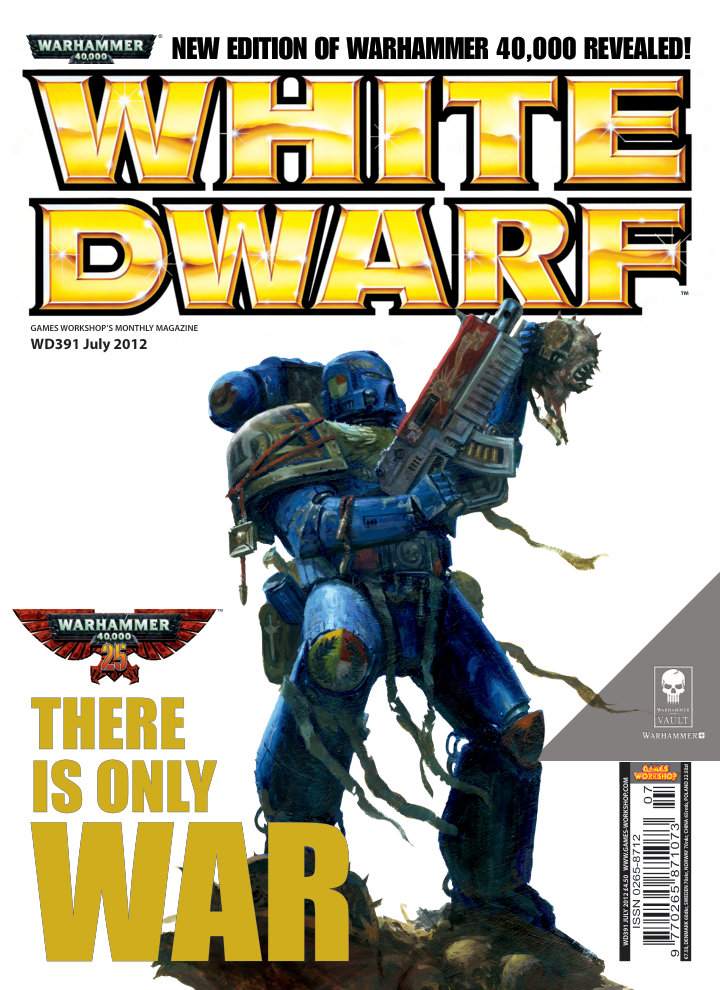
Simon Grant introduces sixth edition through its attempt to make the setting’s dramatic stories happen on the tabletop. Characters issue challenges, jump troops and monsters strike as they charge or fly past, and defenders fire desperate Overwatch as aircraft fight above fortifications and allied forces. Warlord Traits, varied objectives and optional battlefield conditions give battles more individual character. Contributions from the design, scenery and photography teams explain how the book’s imagery and practical components support the same atmosphere.
Warhammer 40,000
ShowcaseWD 391 · pp. 30–55
Studio hobbyists prepare collections for the new game through lunch-break painting, friendly deadlines, conversions and additions to older armies. Their interviews reveal motives ranging from novels and nostalgic first forces to a love of particular models or a desire to try new battlefield options. The survey demonstrates the variety possible within familiar factions, with visual themes and personal characters mattering alongside enthusiasm for the new rules.
Warhammer 40,000
TacticsWD 391 · p. 32
Christian Byrne returns to the first army he ever painted after a defeat against Matt Hutson’s Blood Angels renews his determination. Kit-bashing and correct Chapter iconography, including yellow Assault Marine helmets, give the new force its character. He particularly values jump packs’ charge flexibility and the Death Company’s increased attacks under Rage, planning more of the latter as the collection grows.
Warhammer 40,000Blood Angels
ShowcaseWD 391 · pp. 32–33
A committed Warhammer player, Carl Dafforn chooses Black Templars as his first 40K force because tabards, heraldry and martial bearing make them feel like knights in space. Shields and hammers reinforce that theme, including a Dreadnought weapon borrowed from a Nemesis Dreadknight. The walkers’ imposing silhouettes are as important to the appeal as their ability to advance while firing heavy weapons.
Warhammer 40,000Black Templars
ShowcaseWD 391 · p. 34
Glenn More changes direction from Eldar and Grey Knights to Word Bearers after reading The First Heretic and Know No Fear. The Chaos range’s conversion opportunities drive the project, combining Possessed, Spawn and Dark Angels parts from several bit collections. He intends the resulting assault army to retain plenty of Troops for objectives, connecting its battlefield plan to the large, personalised collection he wants to build.
Warhammer 40,000Chaos Space Marines
TacticsWD 391 · p. 35
Wade Pryce sees Fear and Flying Monstrous Creatures as particularly fitting expressions of his Daemons’ background. Bloodthirsters and Princes can cross the table rapidly, while a Soul Grinder promises heavy support for a force otherwise often outgunned. He also plans to combine the Daemons with World Eaters as allies, turning an existing devotion to Khorne into a practical combined army.
Warhammer 40,000Chaos Daemons
ShowcaseWD 391 · p. 36
Aaron Dembski-Bowden’s Night Lords novels inspire Bowerman’s renegade force, especially their scavenged armour and uneasy relationship with other Chaos Legions. Mixing ordinary Space Marine parts into the Battleforce gives the models that piecemeal appearance. He intends to add renegade Guard to represent the human followers described in the books, making the collection’s future growth follow its fictional source.
Warhammer 40,000Chaos Space Marines
ShowcaseWD 391 · pp. 36–37
Ben Jefferson starts with a Ravenwing Battleforce, combining nostalgia for his first 40K army with the attraction of fast bikes and Land Speeders. Their Jink protection is an immediate benefit in the new game, but he also values the Chapter’s monastic imagery. A stone slab on the Land Speeder deliberately prioritises Gothic symbolism over practicality, expressing how ritual shapes the collection’s appearance.
Warhammer 40,000Dark Angels
ShowcaseWD 391 · p. 38
Stu Black uses the rulebook launch as an excuse to paint a range whose models already appealed to him. A simple scheme keeps the sculpted detail clear, with an Archon’s Court and Scourges extending the initial Battleforce. The Razorwing Jetfighter is the model that first drew him to the army, and remains his most anticipated addition to its sleek, fast identity.
Warhammer 40,000Dark Eldar
TacticsWD 391 · p. 39
Hutson builds around the Eldar’s volume of fire and considers larger Guardian units as durable objective holders through Overwatch. His Farseer can strengthen that role with Divination, especially Foreboding allowing normal accuracy against a charging enemy. The discussion shows a psychic power being chosen to reinforce an army’s existing strength rather than treated as a separate offensive tool.
Warhammer 40,000Eldar
TacticsWD 391 · p. 40
Grey Knights combine Glenn More’s interest in large walkers with his enjoyment of psychic armies. He highlights the Mastery Level 3 Librarian as a flexible resource whose powers, hood and Warlord Trait can provide several different forms of support. Nemesis Dreadknights and Dreadnoughts give the collection its mechanical focus while the psykers provide the battlefield versatility he values.
Warhammer 40,000Grey Knights
TacticsWD 391 · p. 41
The pair’s doubles-tournament project centres on Terminators whose heavy armour now resists most ordinary combat weapons. Their grenades add a further ranged option, while the Stormraven offers a formidable aircraft capable of fighting enemy Flyers. The commentary identifies small rule changes that strengthen models already chosen for the shared collection rather than requiring a new army from scratch.
Warhammer 40,000Grey Knights
ShowcaseWD 391 · p. 42
Chris Peach imagines the Imperium as flamboyantly baroque, so his Guardsmen wear hats and plumed helmets borrowed from Empire Pistoliers. Plume colours and increasing hat size provide his own system of rank and role. He collects units as inspiration strikes and enjoys heroic last stands, making the force’s identity a mixture of personal ornamentation and enthusiasm for ordinary soldiers facing overwhelming danger.
Warhammer 40,000Imperial Guard
ShowcaseWD 391 · p. 43
Mike Anderson returns to army painting after years concentrating on competition models, choosing the diversity of Imperial Guard regiments as his starting point. The new background’s abhuman material inspires a converted Beastman in the Command Squad, with a full unit planned later. He finds the detailed infantry a satisfying compromise between interesting individual models and a collection that can be painted at a practical speed.
Warhammer 40,000Imperial Guard
ShowcaseWD 391 · p. 44
Joe Tomaszewski paints his first army since joining ’Eavy Metal, using one test Necron to establish a simple scheme before repeating it across the collection. Shared colours make that approach efficient, while new models provide the initial motivation. He chooses wargear mainly for its appearance rather than gaming optimisation, treating the finished host as a painting project first.
Warhammer 40,000Necrons
TacticsWD 391 · pp. 44–45
Cruddace identifies mobile rapid fire, Overwatch and Hull Points as particularly favourable developments for Necrons. Tesla becomes dangerous to charge because a successful six adds further hits, while gauss fire strips enemy vehicle durability. Ghost Arks’ own resilience complements those offensive benefits, giving the army more options to advance and hold ground despite its usual vulnerability in combat.
Warhammer 40,000Necrons
ShowcaseWD 391 · pp. 46–47
Fil Dunn’s quick painting method helped Stu Black overcome the daunting size of an Ork army and grow it beyond five thousand points. He aims to paint every entry, with his named Warboss remaining the force’s centre and aircraft beginning a new expansion. Black-sprayed vehicles are defined through chips and weathering, providing a fast method that suits a large collection.
Warhammer 40,000Orks1 paint colour
ShowcaseWD 391 · p. 48
Two ’Eavy Metal painters collaborate on an army that can still excite them outside their professional painting work. The Orks’ savage models and conversion possibilities make that possible, starting with a Battleforce before aircraft prompt a Burna-bommer addition. Deffkoptas, Grots and a converted Warboss are the next steps, giving the shared project a clear path beyond its initial core.
Warhammer 40,000Orks
ShowcaseWD 391 · p. 49
Dave Andrews uses Ultramarines to demonstrate that even a Chapter with rigid traditions can support an individual modeller’s interpretation. Converted Scouts and a leaping Assault Marine distinguish the force without abandoning its classic imagery. A new Captain is planned as its Warlord, with a future game against Jeremy Vetock providing the practical incentive to finish him.
Warhammer 40,000Ultramarines
TacticsWD 391 · pp. 50–51
Hutson’s Imperial Fists concentrate on mobile bolter fire, with Sternguard ammunition giving that foundation extra flexibility. He values the Land Raider’s combination of armour, Hull Points and several ways to fire while moving. A newly painted Stormtalon extends the army into interception, then can switch to ground attack after enemy aircraft are dealt with.
Warhammer 40,000Imperial Fists
TacticsWD 391 · p. 52
Simon Grant wants his Space Wolves to fight as Heroes with oaths and reputations, especially his Warlord Sigvald Deathgranter. The ability to issue challenges now allows him to enact that idea directly by calling out enemy champions. His commentary treats the new combat rule as a way to pursue a personal saga rather than merely a tool for efficient damage.
Warhammer 40,000Space Wolves
ShowcaseWD 391 · p. 53
Emma Parrington’s enthusiasm for wolves leads to a first army from Harald Deathwolf’s Great Company. A converted Lone Wolf and two Fenrisian companions become the survivors of a lost pack, with concealed markings expressing their shame. She builds personalities around the models as she paints them, using their background to make future battlefield deeds more meaningful.
Warhammer 40,000Space Wolves
TacticsWD 391 · p. 54
Dinwiddy combines military green blocks with bright white and orange to emphasise the Tau’s clean futuristic design without turning it into camouflage. On the table, long-ranged mobile pulse fire and Overwatch make basic infantry effective, while a battlesuit’s jetpack movement makes it difficult to catch. The profile connects the collection’s visual clarity with the manoeuvrability he enjoys in the new rules.
Warhammer 40,000Tau Empire
TacticsWD 391 · pp. 54–55
Peach’s painting-book army gains a Swarmlord and now fields two powerful Monstrous Creatures. Their armour-ignoring attacks and Smash ability threaten even Terminators or heavy vehicles, while the Swarmlord’s psychic choices offer further specialisation. He contrasts Biomancy and Telepathy support with a more directly destructive Telekinesis approach, showing several directions for the same painted host.
Warhammer 40,000Tyranids
Battle reportWD 391 · pp. 58–69
Simon Grant’s Chaos Marines and Daemon allies attack Andrew Kenrick’s Cadians and Grey Knights in a 2,500-point demonstration of sixth edition. Guard fortifications and promising objective positions are undermined by poor shooting and enemy cover saves, while Chaos monsters, the Lord and effective anti-aircraft weapons steadily break the defence. The Grey Knights kill the Great Unclean One but cannot rescue the battle after both Imperial aircraft fall. Chaos wins nine victory points to none, with the commentary illustrating allies, Warlord Traits, mysterious terrain, Overwatch and aircraft modes through actual decisions.
Warhammer 40,000Chaos Space Marines
RulesWD 391 · pp. 70–75
Three illustrated battlefields connect historical engagements to the new terrain rules. Bastions, Aegis lines and tank traps demonstrate defensive positions, while ruins, mysterious forests, undergrowth and Imperial statuary create less predictable ground. The Piscina IV layout adds fuel reserves, impact craters and a Fortress of Redemption, showing how scenery can be both an atmospheric setting and a source of concrete protection, hazards or morale effects.
Warhammer 40,000
Battle reportWD 391 · pp. 78–83
Steve Bowerman’s White Scars fight Duncan Rhodes’s Evil Sunz over the Relic using the armies painted in the previous issue. Skullkrumpa kills Joghaten Khan and ravages the Marines, while the returning Dakkajet brings down their Stormtalon. The remaining Dreadnought eventually drives the relic carriers away, but cannot claim it because it is not a scoring unit. Duncan wins two secondary-objective points to one, so the report’s outcome differs sharply from the heroic Cardrim narrative it recreates.
Warhammer 40,000White Scars
PaintingWD 391 · pp. 84–92
Steve Bowerman and Duncan Rhodes paint a Tau Battleforce with an Ethereal and Vespid to explore the army’s deliberately varied subjects. Uniform ochre Fire Warriors, vehicles and battlesuits contrast with red Stealthsuits, blue Vespid and green Kroot, while shared bases keep them together. Spray-gun foundations speed the large surfaces, and restrained weathering, fine script and glossy lenses preserve the clean technological appearance they want for the army.
Warhammer 40,000Tau Empire3 paint colours
PaintingWD 391 · p. 85
XV-88 and Tau Light Ochre are sprayed in succession to establish the armour quickly and evenly. Agrax Earthshade defines the joints before the ochre is restored and Ungor Flesh adds crisp final highlights. The same sequence can transfer to battlesuits and the Devilfish, ensuring the army’s different sizes of machine share a consistent main colour.
Warhammer 40,000Tau Empire4 paint colours
PaintingWD 391 · p. 85
Celestra Grey provides an opaque base for the circular sept badge, and White Scar brightens its exposed edge. Abaddon Black then defines the central symbol sharply against that pale field. The small isolated sequence gives the ochre armour a clean identifying mark rather than relying on another broad colour panel.
Warhammer 40,000Tau Empire3 paint colours
PaintingWD 391 · p. 85
Rhinox Hide and Nuln Oil make the fatigues much darker than the ochre armour. Gorthor Brown picks out the raised cloth while leaving the folds deep, separating soft uniform from hard plates. The restrained three-stage treatment keeps attention on the armour and weapons without leaving the underlying clothing unmodelled.
Warhammer 40,000Tau Empire3 paint colours
PaintingWD 391 · p. 86
Abaddon Black establishes dark weapon and equipment surfaces before Eshin Grey traces their raised edges. Most of the area remains black, so the highlight describes shape without competing with the army’s ochre panels. This simple treatment is repeated on several technological details to make the collection look orderly and clean.
Warhammer 40,000Tau Empire2 paint colours
PaintingWD 391 · p. 86
Khorne Red provides the dark lens base, followed by Fire Dragon Bright and Yriel Yellow towards the lightest area. A small White Scar mark suggests reflected light rather than a flat coloured eye. The progression gives tiny sensors a strong warm focal point, with the article’s later gloss finishing reinforcing their glassy appearance.
Warhammer 40,000Tau Empire4 paint colours
PaintingWD 391 · p. 86
Armageddon Dust supplies the ground texture and initial colour before Agrax Earthshade settles into its grit. Terminatus Stone drybrushing catches the raised surface, Steel Legion Drab tidies the rim and Middenland Tufts finish the setting. Shared basing links the very differently coloured allied species without forcing their bodies into the Tau’s uniform palette.
Warhammer 40,000Tau Empire4 paint colours
PaintingWD 391 · p. 87
The Stealthsuit’s red armour begins with Khorne Red and Nuln Oil, then Wazdakka Red restores its plates. Bloodletter glazes the colour together before Squig Orange marks the final edges. The result is a darker, more covert-looking red distinct from the ochre of ordinary Fire Warriors, while using the same disciplined panel definition.
Warhammer 40,000Tau Empire5 paint colours
PaintingWD 391 · p. 87
The blue skin uses sprayed The Fang and Russ Grey for broad coverage before Drakenhof Nightshade restores shadow. Fenrisian Grey and fine White Scar highlights pick out the exposed forms, demonstrated on a Vespid. The Ethereal uses the same opening colours with a brush because only small areas of his face and hands are visible.
Warhammer 40,000Tau Empire5 paint colours
PaintingWD 391 · p. 88
Deathworld Forest is shaded with Athonian Camoshade and raised through Straken Green to Ogryn Camo. The earthy green progression makes the Kroot clearly alien to the blue-skinned Tau while keeping them compatible with the army’s natural bases. The final pale accents define the lean face and limbs without making them as uniform as manufactured armour.
Warhammer 40,000Tau Empire4 paint colours
PaintingWD 391 · p. 88
Rhinox Hide gives the quills a dark root colour before Gorthor Brown and Kislev Flesh catch the projecting lengths. The sequence distinguishes the stiff hair from the green skin and uses narrow highlights to preserve its texture. The lightest flesh-toned accent is confined to the exposed tips rather than turning the whole crest pale.
Warhammer 40,000Tau Empire3 paint colours
PaintingWD 391 · p. 88
Mournfang Brown and Seraphim Sepia create warm leather wrapped around the rifle. Skrag Brown restores its raised strips and Deathclaw Brown sharpens their edges. The small material recipe supplies a natural contrast with both the green hands and the weapon’s separate metal fittings.
Warhammer 40,000Tau Empire4 paint colours
PaintingWD 391 · p. 89
The bindings begin with Zandri Dust and an Agrax Earthshade wash, then Ushabti Bone and Pallid Wych Flesh brighten the raised cords. The pale finish makes the wrapped sections legible against dark wood and metal. Leaving the wash between adjacent strands preserves the impression of separate laces rather than one solid band.
Warhammer 40,000Tau Empire4 paint colours
PaintingWD 391 · p. 89
Balthasar Gold and Gehenna’s Gold establish warm metallic details before Agrax Earthshade adds depth. Runefang Steel marks their exposed edges, separating them from the darker organic materials around the rifle. The recipe brings a small controlled sheen to a figure whose main identity remains natural skin, quills and leather.
Warhammer 40,000Tau Empire4 paint colours
PaintingWD 391 · p. 89
Leadbelcher is shaded with Nuln Oil and finished with Runefang Steel on the weapon’s raised metal. The short sequence keeps dark joints visible while giving the working edges a hard reflection. It contrasts with the warmer gold and leather treatments on the same rifle without requiring an elaborate separate metallic palette.
Warhammer 40,000Tau Empire3 paint colours
RulesWD 391 · pp. 98–101
Mat Ward explains which existing codex psykers may exchange their powers for the new rulebook disciplines and how many powers each generates. Access is deliberately selective: Orks and Daemons retain their unusual systems, while armies without psykers gain none. His faction advice distinguishes damage, support and disruption, encouraging players to choose disciplines that help the units and roles they actually field rather than assume every psyker should seek direct attacks.
Warhammer 40,000
RulesWD 391 · p. 99
Blood Angels Librarians may exchange their codex powers for two generated powers from the listed disciplines, including Mephiston. Ward particularly recommends Biomancy for a Librarian fighting close to the enemy, where enhanced physical ability and short-ranged witchfire complement the army’s aggressive role. The entry makes clear that the exchange replaces the existing power selection rather than simply adding more options.
Warhammer 40,000Blood Angels
RulesWD 391 · pp. 99–100
Chaos psykers generate a replacement for each purchased codex power, with specific totals for Typhus and Ahriman. Pyromancy and Telekinesis support direct firepower, while Telepathy gives a disruptive alternative that avoids relying on several witchfire attacks in one turn. Ward suggests choosing a mixture with the limitations of the caster’s actual turn in mind.
Warhammer 40,000Chaos Space Marines
RulesWD 391 · p. 100
Dark Angels Librarians, including Ezekiel, can replace their powers with two generated choices from the permitted disciplines. Ward favours Telepathy’s denial tools for small Ravenwing and Deathwing forces that cannot afford straightforward exchanges. Against another elite army, Divination rerolls offer a way to make fewer shots more decisive.
Warhammer 40,000Dark Angels
RulesWD 391 · p. 100
Farseers replace each purchased power with Divination or Telepathy, while Eldrad generates four new powers. Ward values Divination’s reliability but prefers Telepathy’s mix of benefits and penalties for rescuing specialised Eldar units caught in unsuitable fights. The advice connects discipline choice to the army’s dependence on placing the right specialist in the right situation.
Warhammer 40,000Eldar
RulesWD 391 · p. 100
A Grey Knights Librarian generates powers according to Mastery Level while retaining Hammerhand, and eligible Inquisitors or Coteaz receive their own exchange arrangements. Ward highlights close-ranged Pyromancy for a powerful Librarian who can reach the right place to use it. The distinctions prevent treating every psyker in the codex as though it had the same selection allowance.
Warhammer 40,000Grey Knights
RulesWD 391 · p. 101
The Primaris Psyker can exchange his codex selection for two powers from four disciplines. Ward encourages considering Telepathy and Biomancy alongside obvious ranged Pyromancy, since a well-timed physical enhancement can make even this modest commander unexpectedly dangerous. The entry frames psychic choice as a source of surprises within an otherwise conventional Guard force.
Warhammer 40,000Imperial Guard
RulesWD 391 · p. 101
Space Marine Librarians normally generate two replacement powers, with Tigurius receiving three. Ward recommends Telekinesis as a versatile starting point, then Biomancy for an assault force or Pyromancy for a shooting army. He also notes that an unsuitable generated power can be exchanged for its discipline’s Primaris option, especially when a machine-focused effect faces Tyranids.
Warhammer 40,000Space Marines
RulesWD 391 · p. 101
Rune Priests, including Njal, may generate two powers from Biomancy, Divination or Telekinesis. Divination helps a small force make its attacks count, while Biomancy suits a priest who intends to fight personally and earn a saga. The recommendation keeps the choice tied to the character’s intended role rather than assuming every Space Wolf psyker behaves alike.
Warhammer 40,000Space Wolves
RulesWD 391 · p. 101
Eligible Tyranid organisms generate a new power for each existing or purchased one from their allowed disciplines. With many psykers available, Ward recommends variety: support can make even Termagants troublesome, while movement and combat enhancements transform an already dangerous Hive Tyrant. The entry encourages distributing complementary powers across the swarm rather than repeating one narrow attack plan.
Warhammer 40,000Tyranids
EditorialWD 391 · pp. 102–103
Jeremy Vetock takes over the column to describe teaching the new rules to competitive old friends. He argues for two-versus-two games, where a partner shares plans and helps remember unfamiliar details, and for friendly reminders while players learn casualty allocation and other changes. Banter, sportsmanship and a close loss can all provide motivation, with the edition launch offering a useful burst of momentum for unfinished hobby projects.
ShowcaseWD 391 · pp. 104–105
Dave Taylor’s Nuln army begins as Gründel’s Defenders, inspired by an illustration in Uniforms & Heraldry of the Empire and successful as a Golden Demon diorama. Expanding that unit becomes a complete parade collection that wins its local vote and reaches the Chicago final. Scenic artillery, a converted Engineer and Marius Leitdorf used as the General extend the city-state theme beyond the original spearmen.
Warhammer Fantasy BattlesThe Empire
CommunityWD 391 · pp. 106–107
Ead Brown previews Forge World’s planned displays of book production, new models and work in progress. Authors, artists and sculptors are presented as people visitors can question directly, from the forthcoming Black Fire Pass and Imperial Armour books to Necron concepts, monsters and Zone Mortalis scenery. The feature combines those creative processes with demonstrations and advance releases, promising a view of how future projects are being made.
Warhammer 40,000Warhammer Fantasy Battles
CommunityWD 391 · p. 115
The new Chiswick Hobby Centre opens near the site of Games Workshop’s first store, linking a fresh local community to the company’s early history. Visitors try the new paints, examine the Empire army book and join the opening celebrations, with tables and painting areas supporting continuing activity. The profile returns a few months later to find an established group and another opening party planned.
CommunityWD 391 · p. 117
Liverpool’s long-established store combines battlefields and painting space with regulars who enter Golden Demon and share their experience. The profile emphasises advice that serves beginners and painters seeking a particular advanced technique equally. Competitions and gaming events provide recurring reasons for that mixed community to meet and work on new projects.