EditorialWD 379 · Inside cover
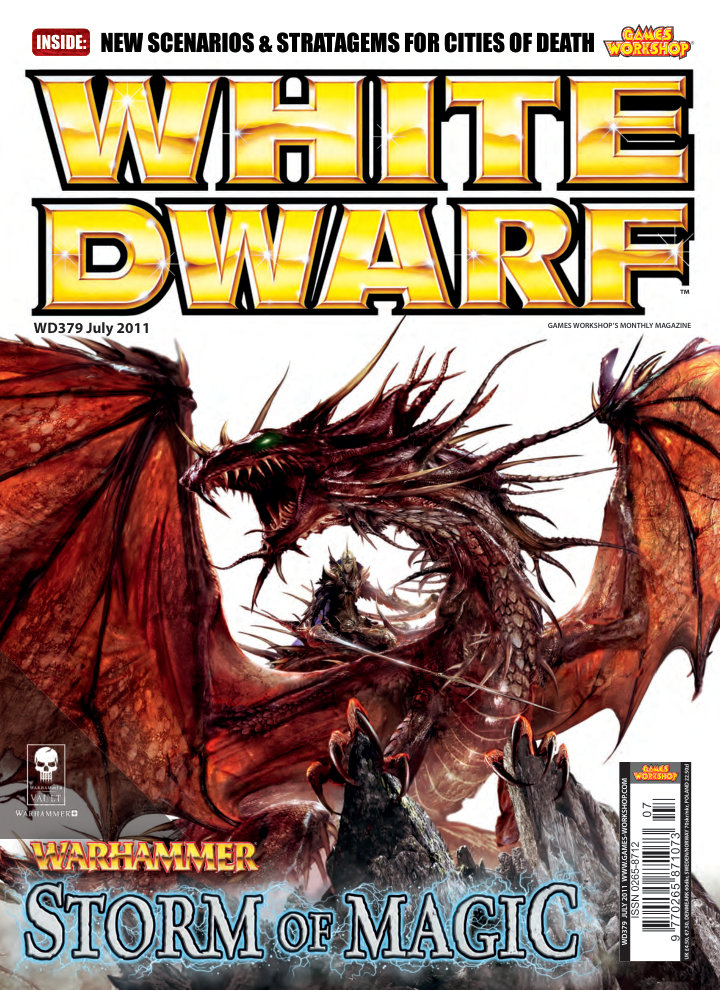
Andrew Kenrick welcomes an expansion built around the monsters and magic he regards as central to Warhammer’s appeal. Scrolls of Binding allow every army to acquire new creatures, while the issue explores the book, designers and studio players’ preparations before staging a large demonstration battle. A Cities of Death update and a second report extend the theme of dramatic, unusual engagements into Warhammer 40,000.
Warhammer Fantasy BattlesWarhammer 40,000
CommunityWD 379 · pp. 16–17
The video-game previews follow Captain Titus in Space Marine and a smaller squad boarding an Ork vessel in the downloadable Kill Team arcade game. Black Crusade offers roleplayers the opportunity to become Chaos Space Marines or human servants of the Dark Gods. Black Library begins a Storm of Magic fiction series with Razumov’s Tomb, tying the new tabletop expansion to stories of extraordinary magical conflict.
Warhammer 40,000Warhammer Fantasy Battles
InterviewWD 379 · pp. 18–27
Simon Grant explores Storm of Magic with Mat Ward, who explains the narrative opportunity of fighting during a world-altering magical tempest. Arcane Fulcrums connect battlefield control to escalating spell power, while an extra Monsters and Magic allowance adds creatures, pacts and legendary artefacts to an existing army. The design deliberately brings back extravagant spells and old models within a setting that can contain their power, balanced by dangerous miscasts and the need to protect vulnerable objectives.
Warhammer Fantasy Battles
RulesWD 379 · pp. 21–25
A Wizard occupying an Arcane Fulcrum receives powerful protection but risks both ordinary and additional miscast results. Presence, Equilibrium and Dominance determine which Cataclysm spells become available, while a rotating ascendant lore encourages opportunistic casting. The overview also explains cantrips, summoning, Dwarf Ancestor Runes, sorcerous pacts and the additional quarter-points allowance, showing how control, mobility and magical risk shape the expansion.
Warhammer Fantasy Battles
LoreWD 379 · pp. 26–27
Grey Seer Scyletooth follows a magical storm into sacred Lizardman territory, binding fiery monsters to protect his trespassing army. A Slann counters with its own Chimera while Saurus strike the Skaven flanks. The Mage-Priest prepares the Great Leveller at the cost of its life, and the illustrated encounters show the storm transforming both the available creatures and the significance of the surrounding ruins.
Warhammer Fantasy BattlesSkaven
InterviewWD 379 · pp. 28–37
Andy Hall asks Trish Carden how she develops the new Chimera, Manticore, Black Dragon and Cockatrice. Mythology supplies starting points, but Warhammer identity and a threatening silhouette matter more than literal fidelity. Sketches, mock-ups, carefully worked manes and distinct wings turn the concepts into dynamic kits, while plastics and light resin free the poses from older constraints; the rider designers add alternatives without preventing the monsters from serving any army.
Warhammer Fantasy Battles
RulesWD 379 · pp. 30–31
The Chimera’s full binding entry makes a flying, terrifying six-attack monster available from the expansion’s additional allowance. Optional venom, protective hide, flaming breath, tails and specialised bites let players tailor its role and expense. The background leaves its origin uncertain, describing a creature rarely seen at low magical ebb but drawn inexorably to the storms that empower its presence.
Warhammer Fantasy Battles
LoreWD 379 · p. 36
Dragon colour reflects temperament and supernatural ability rather than simple inheritance from Kalgalanos the Black. The cruel Black Dragons were feared even before Malekith’s sorcery bound them to the Dark Elves, and they regard Caledor’s dragons as humiliated servants. Size increases with age, while Scrolls of Binding make such normally rare creatures available beyond their usual armies during a storm.
Warhammer Fantasy BattlesDark Elves
TacticsWD 379 · pp. 38–43
Simon Grant examines how studio players reshape familiar armies for Storm of Magic. Successful forces need attackers able to dislodge a protected Wizard, reliable defenders to block enemy monsters and enough spellcasters to occupy newly won fulcrums. Five sample armies show different solutions, using the extra allowance for mobility, magical flexibility or overwhelming creatures while retaining a purposeful core from the original army book.
Warhammer Fantasy Battles
TacticsWD 379 · p. 39
Robin Cruddace’s 3,000-point Tomb Kings army and 745-point extras divide cleanly between immense skeleton hordes that screen the home fulcrums and fast or entombed attackers. Multiple Priests restore the defenders while monsters, Stalkers and Necropolis Knights threaten enemy Wizards. A heavily armed King with the Windcatcher Prism can lead his Tomb Guard into a defended objective and force the occupying mage to re-roll successful ward saves.
Warhammer Fantasy BattlesTomb Kings
TacticsWD 379 · p. 40
Matt Hutson’s 2,000-point Dwarfs defend their Runesmiths through sturdy regiments, stacked dispelling bonuses and specialised firepower. Lord Durak’s runic axe hunts monsters, while Organ Guns threaten fulcrum Wizards and a flaming, flyer-targeting bolt thrower exploits large creatures’ weaknesses. The 500-point allowance adds a Truthsayer, Chimera and Eagles to supply magic and mobility that the Dwarf list otherwise lacks.
Warhammer Fantasy BattlesDwarfs
TacticsWD 379 · p. 41
Matthew Hobday retains a sprawling 3,000-point greenskin army but supports it with a Lammasu, Dark Emissary, Chimera and the Black Book of Ibn Naggazar. A huge Night Goblin unit supplies sacrificial fuel for the book’s magic, while the Lammasu can kill a fulcrum’s occupant and then claim it as a Wizard. Wizzbang’s Skull Wand offers a particularly nasty defence against the lone monster permitted to attack his perch.
Warhammer Fantasy BattlesOrcs & Goblins
TacticsWD 379 · p. 42
Mat Ward’s 2,999-point Wood Elf army exploits spellcasting, shooting and control of woodland to disrupt enemy plans. A Chimera and Cockatrice hunt Wizards, while River Trolls block access to a home fulcrum. The extra Truthsayer adds a flexible trick: become a dragon, remove an enemy Wizard, then end the transformation and occupy the captured fulcrum himself.
Warhammer Fantasy BattlesWood Elves
TacticsWD 379 · p. 43
Jeremy Vetock’s 2,000-point Skaven force keeps its Grey Seer free from a Screaming Bell so he can move between fulcrums, while lesser Engineers add further claiming options. A Hell Pit Abomination and bound Hydra provide a difficult regenerating partnership, with a Chimera supplying flight and a Nurgle Spawn acting as a small independent nuisance. Vetock also pursues Verminous Ruin’s chance to summon a Vermin Lord, valuing its theatrical surprise as much as its strength.
Warhammer Fantasy BattlesSkaven
Battle reportWD 379 · pp. 46–69
Andrew Kenrick’s Warriors of Chaos face Matt Hutson’s Dark Elves with roughly 3,000 points each and a further 750-point monsters-and-magic allowance. Matt’s opening assaults kill all three Chaos Giants, but the decisive contest becomes one of teleportation, magical duels and moving the fulcrums themselves. After explosions kill Wizards and remove an objective, Matt copies Andrew’s summoning idea from a better position and claims a second fulcrum, winning 2–1 despite the Chaos sorcerers’ destructive achievements.
Warhammer Fantasy BattlesWarriors of Chaos
EditorialWD 379 · pp. 70–71
Jervis Johnson revisits the old argument over metal and plastic by tracing how multipart kits overcame the restrictions of rigid steel moulds. He credits interchangeable components with creating a thriving conversion hobby, then considers the renewed role of bespoke snap-fit figures and single-frame plastic heroes. His conclusion presents Finecast resin as the next complement to plastic kits, preserving the sculptor’s individual vision while promising different practical advantages.
PaintingWD 379 · pp. 74–81
Duncan Rhodes builds a coven around Urien Rakarth and the Prophets of Flesh, taking inspiration from their disturbing artwork and six-digit seal. A pale, bruised skin recipe establishes the Wracks before extending to larger creations and leaders with suitable changes. Masked vehicle crews, skin-like sails, shared toxin vials and a connected Wych cult keep the force visually coherent across resin infantry and plastic transports and engines.
Warhammer 40,000Dark Eldar16 paint colours
ModellingWD 379 · p. 75
The Wrack demonstration separates resin components from their frame, removes large and then small areas of flash, and gently scrapes remaining mould lines. A dry fit checks each joint before a small amount of super glue bonds the pieces. Once mounted on its base, the assembled figure is ready for a black undercoat; the process is presented as applicable across the Finecast range.
1 paint colour
PaintingWD 379 · p. 76
Duncan carries the Wrack method onto the coven leaders with more careful highlights but omits the bruises, reasoning that the masters inflict pain rather than receive it. Urien’s black cloak contrasts with his colleague’s stitched skin coat. Grotesques receive extra attention across their larger areas of flesh, while Urien’s background and battlefield benefits explain their role as the force’s heavy bodyguards.
Warhammer 40,000Dark Eldar10 paint colours
PaintingWD 379 · p. 77
Dheneb Stone flesh, bright metal and dark leather establish the base palette before separate washes define each material. Bone-white skin highlights make the models sickly, with purple patches followed by thin green staining creating the bruised effect. The six illustrated stages form the army’s reusable painting template, and a sidebar advises removing any overlooked resin flash as it becomes visible during painting.
Warhammer 40,000Dark Eldar12 paint colours
ModellingWD 379 · p. 78
Duncan modifies spare Wych masks for the Raider crew, smoothing them with putty and drilling openings that echo the coven’s impassive faces. The Prophets of Flesh transfer marks the sail, whose skin-like finish links it to the passengers’ aprons. Numerous chains and hooks reinforce the transport’s slave-taking purpose and extend the infantry’s visual theme onto a very different model.
Warhammer 40,000Dark Eldar
ModellingWD 379 · p. 79
The Venom carries a small Wych squad intended for rapid attacks and capturing objectives. Duncan chooses slave-catching equipment and abundant chain-snares to express the Dying Breath’s obligations to its Haemonculus patrons. He paints crew and passengers together for consistency and uses visible chemical vials to suggest the cult’s biological modifications without adding limbs that might spoil the models’ dynamic poses.
Warhammer 40,000Dark Eldar
LoreWD 379 · p. 79
The cult’s unusually close relationship with the Haemonculi turns its Wyches into heavily altered living weapons. Extra limbs, internal stabilisers, hidden blades and reinforced tendons supplement their natural prowess, while specialised glands replace external drug injectors. Even death becomes a weapon as those glands can produce a final cloud of hypertoxins to poison the victorious enemy.
Warhammer 40,000Dark Eldar
ModellingWD 379 · p. 80
The Talos supplies both a heavy battlefield presence and a rich supply of spare components for the surrounding coven. Duncan suggests spreading its weapon parts onto Grotesques and other models to increase variety. He positions the tail behind the body so it resembles an extended spine, then uses bone and black carapace colours to connect the monster to the Haemonculi and vehicles.
Warhammer 40,000Dark Eldar
PaintingWD 379 · p. 80
The shared vial recipe moves from a black block-in through dark green, brighter green and pale reflective highlights. A final Thraka Green wash integrates the tones into a glowing toxic liquid effect. Applying this same treatment to chemicals, toxins and glassware across the army provides a small but repeated visual connection between its otherwise varied units.
Warhammer 40,000Dark Eldar6 paint colours
ModellingWD 379 · p. 81
The Cronos expands an army already rich in pain tokens by converting victims’ life essence into further resilience and ferocity. Duncan equips it with the spirit probe to maximise that function and strengthen its insect-like appearance, intending the Talos to receive the earliest benefit. Flesh-like tendrils and a Prophets of Flesh transfer connect the new engine to its companion and the broader coven.
Warhammer 40,000Dark Eldar
RulesWD 379 · pp. 82–89
Adam Troke revisits urban warfare for the current rulebook, explaining which older Cities of Death principles are now covered by fifth edition and where its own scoring rules still apply. True line of sight, movement through ruined walls and fighting across floors are illustrated with examples. The article directs readers to the separate online FAQ, then supplies new faction stratagems and four missions to renew the tactical and narrative possibilities of densely built battlefields.
Warhammer 40,000
RulesWD 379 · pp. 86–87
The twelve faction stratagems make particular ruins or deployment tricks reflect an army’s character. They include Eldar redeployment, Tau navigation, a Gargoyle eyrie, a hidden Dark Eldar portal and tainted Chaos ground, alongside buildings that attract Flayed Ones, inspire Marines, strengthen faith or relay Guard orders. Warp rifts can erase a building, Orks learn cover movement and Grey Knights create dangerous warded sanctuaries, giving each force a specific way to exploit the city.
Warhammer 40,000Eldar
RulesWD 379 · p. 88
Alternating deployment strips split both armies into separated groups, representing a city battle whose lines have dissolved. Four turns of kill-point fighting force rapid decisions about isolated units, with the Omega level allowing extra time. Reserves may enter where the opponent chooses, making reinforcements another uncertain element rather than a dependable solution to fragmentation.
Warhammer 40,000
RulesWD 379 · p. 88
Command demands a swift end to the battle while incendiary bombardment progressively consumes the city. Each Shooting phase adds another scattering inferno marker whose damage persists, and a marker striking a ruin sets the entire building ablaze. Kill points decide the result with penalties for units that flee or remain broken, leaving the combatants little incentive to wait in cover.
Warhammer 40,000
RulesWD 379 · p. 89
Each army carries a device toward the opponent’s designated command centre and tries to detonate it there. Nearby friendly infantry can recover a fallen carrier’s weapon, but an abandoned device remains where it drops until reclaimed. A successful detonation immediately wins; if neither side manages one, both lose, creating a symmetrical race between attack, recovery and defence.
Warhammer 40,000
RulesWD 379 · p. 89
The mission adds a named battle leader to each army and awards bonus kill points for assassinating that commander. The reward rises as the attack becomes more personal, from a distant shot to close combat and a kill by the opposing leader. Quarter deployment and a short game encourage aggressive pursuit while forcing players to consider how much risk their own commander should take.
Warhammer 40,000
ModellingWD 379 · pp. 90–95
The workshop builds urban battlefields from compatible Imperial Sector ruins and a growing collection of street scenery. It recommends denser cover than the original supplement suggested, balancing vertical firing positions, narrow streets and open vehicle routes. Examples progress from a compact Alpha board to Chad Mierzwa’s vast modular Omega city, showing how kitbashing and repeated materials create both practical play space and a convincing ruined metropolis.
Warhammer 40,0005 paint colours
PaintingWD 379 · p. 91
A sprayed brown-grey mix establishes the ruin before increasingly pale green-grey drybrushes pick out its texture. Circular brush motion helps avoid visible streaks across the architectural detail. The final white-and-Rotting-Flesh pass sharpens the raised surfaces, while black stippling marks bullet holes and broken edges with concentrated battle damage.
Warhammer 40,0005 paint colours
ModellingWD 379 · p. 92
The basic city board adds a fourth ruin and craters to the original small-game recommendation, creating more cover for fifth-edition play. Buildings cluster into recognisable streets while open areas remain useful for manoeuvre. The advice emphasises enough upper-floor space for models and the tactical exchange between elevated firing positions and opponents sheltering at the foot of walls.
Warhammer 40,000
ModellingWD 379 · p. 93
A denser four-foot-square layout reuses the earlier ruins but adds a Shrine of the Aquila as a multilevel centrepiece. Barricades, walls, statues and accessories break up the streets without filling every vehicle route. The result demonstrates how smaller cover and gothic street dressing make the city richer and tactically less uniform than a collection of isolated buildings.
Warhammer 40,000
ModellingWD 379 · pp. 94–95
Chad Mierzwa’s large cityscape fixes ruins to modular Realm of Battle sections to control bottlenecks, plazas and focal points. Movement-tray sheets become paving and concrete, while landing-pad pylons support aerial gantries between towering buildings. Dense rubble and fallen statues fill even the open areas, producing the multilayered battlefield used in the issue’s urban report.
Warhammer 40,000
Battle reportWD 379 · pp. 96–103
Phil Kelly’s Space Wolves challenge Adam Troke’s Red Corsair-led Chaos force in the new Decapitation mission amid Chad’s dense city terrain. Early vehicle kills and infantry victories give the Wolves momentum, though a Daemon Prince and later Greater Daemon inflict serious losses and Ragnar dies in combat. A Dreadnought finds a line of sight through the ruined battlements to kill the wounded Huron, helping the Wolves finish with twelve kill points to Chaos’s seven.
Warhammer 40,000Space Wolves
RulesWD 379 · p. 101
The players add a simple agreed rule for jumping between the city board’s elevated walkways. A difficult-terrain roll must exceed the gap in inches; otherwise the model falls to the ground and takes a Strength 4 hit. The example demonstrates how a small local rule can make distinctive terrain interactive without a complicated new subsystem.
Warhammer 40,000
CommunityWD 379 · pp. 106–107
Rik Turner visits Forge World and Black Library to preview the teams and projects appearing at Games Day. Sculptors promise discussions of monsters, Titans, Eldar and power armour, while book designers explain profiles, maps and page production. Authors including James Swallow, Sarah Cawkwell, Chris Wraight and Nick Kyme describe the pleasure or nerves of meeting readers, with early books and a special anthology adding to the event.
CommunityWD 379 · p. 110
Bek Hawkby reports a season involving 88 schools, 488 players and more than 1,500 games, culminating in a final for the top 36 teams. Keeping the rules stable for the following season allows clubs to practise through the summer. A new support forum gives teachers and librarians scenarios, army lists and a place to exchange practical club-running experience.