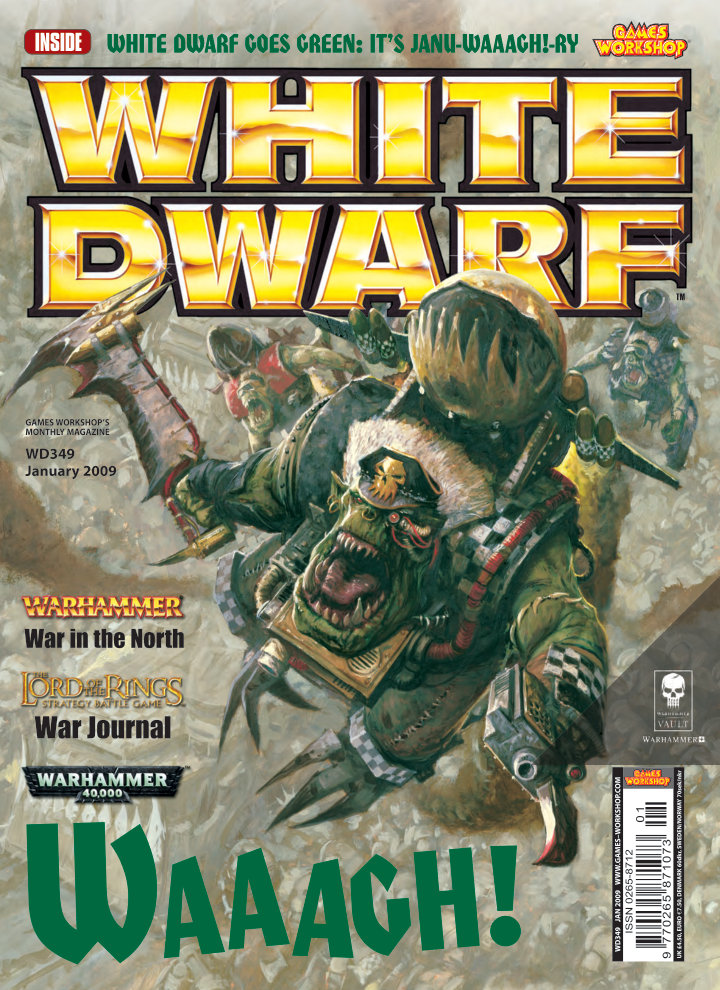
EditorialWD 349 · p. 1
Mark Latham sets out the Studio’s hobby resolutions for the new year, from finishing existing Space Marine and Empire collections to preparing tournament armies and attempting an army every month. Andrew Kenrick and Andy Hall plan to keep each other painting through regular games and reminders, while the new Ork releases offer a reason to return to older armies rather than abandon them.
CommunityWD 349 · p. 10
A first look at the forthcoming plastic Shadowsword explains that the kit will build six super-heavy variants rather than a single vehicle. The page also follows Fantasy Flight Games’ support for licensed games: Dark Heresy receives reprinted core material and Disciples of the Dark Gods, while the revised fourth-edition Talisman gains plastic playing pieces and an upgrade route for owners of the earlier printing.
Warhammer 40,000Dark HeresyImperial Guard
ShowcaseWD 349 · p. 11
Studio staff report on their entries in the 2008 Golden Demon Open competition, including Joe Tomaszewski’s gold-winning Marneus Calgar and Mike Anderson’s bronze-winning pirate diorama. Fil Dunn’s Tau Broadside and Keith Robertson’s Lizardman character illustrate the other personal projects reaching the judging tables. The surrounding notes also offer a glimpse of Matt Hutson’s Armageddon campaign map and work in the art department.
Warhammer 40,000Warhammer Fantasy BattlesUltramarines
CommunityWD 349 · p. 13
The Iron Halo programme presents a structured run of free in-store workshops intended to improve painting and modelling skills during January and February. Participants work through practical lessons with staff rather than simply watch demonstrations, and completing the programme earns a certificate and pin badge. The announcement treats a regular hobby commitment as a manageable New Year resolution.
LoreWD 349 · pp. 14–23
Phil Kelly follows the growth of a Waaagh! from local brawling into a planetary and then interstellar invasion. Meks’ construction projects and towering Gargants act as religious rallying points, drawing warbands into an increasingly violent hierarchy before the fleet launches into the uncertain currents of space. The accompanying battlefield discussions connect this background to mobs, Stormboyz, Kommandos, specialist shooters, Oddboyz and the conspicuous status of Nobz.
Warhammer 40,000Orks
TacticsWD 349 · p. 17
Large Boyz mobs combine numbers, a formidable charge and a power-klaw Nob who can threaten opponents ordinary choppas struggle to wound. The discussion stresses the intimidating volume of attacks from a full mob and the way that cheap Gretchin free the better fighters for offensive work. Objective holding therefore belongs in the plan alongside the straightforward attraction of overwhelming an enemy in combat.
Warhammer 40,000Orks
TacticsWD 349 · p. 18
Stormboyz are presented as a way to deliver an assault much faster than footslogging Boyz, using their unusually long movement to cross the battlefield and exploit openings. Boss Zagstruk changes their role further by allowing a spectacular arrival from reserve and an immediate attack, with his bionik talons supplying the hitting power. Speed is the appeal, but the article keeps the unit’s risky, unpredictable Ork character in view.
Warhammer 40,000Orks
TacticsWD 349 · p. 19
Kommandos can begin close to vulnerable targets and move through difficult ground more reliably than ordinary Boyz, making them useful for attacking supporting weapons and exposed infantry. Burnas give the mob both short-ranged fire and close-combat options. Snikrot’s ability to bring his unit on from an unexpected table edge turns that harassment into a threat that can alter an opponent’s deployment before the ambush even arrives.
Warhammer 40,000Orks
TacticsWD 349 · p. 20
A mechanised Ork force uses Trukks to get its mobs into combat before enemy fire can whittle them away, with the Waaagh! providing a final burst of reach when the timing is right. Warbikes and buggies contribute mobile fire and pressure on objectives rather than merely following the transports. A Warboss accompanied by Nob Bikers provides a particularly hard assault element for this fast-moving approach.
Warhammer 40,000Orks
TacticsWD 349 · p. 21
Lootas make up for Ork accuracy through the potential weight of their high-strength fire, while Burna Boyz can switch from massed flame attacks to dangerous close combat. Tankbustas instead specialise in getting anti-armour weapons close enough to matter, combining rokkits, tankhammers and explosive squigs. These contrasting roles show why an Ork army benefits from specialists chosen for a task rather than simply adding more undifferentiated bodies.
Warhammer 40,000Orks
InterviewWD 349 · pp. 24–27
Andy Hall talks to Dale Stringer about turning the Battlewagon concept into a versatile plastic kit. Tim Adcock’s mock-up and Seb Perbet’s crew sculpts had to be translated into carefully measured digital components, with the apparent disorder of Ork engineering hiding very precise joins. Interchangeable hatches, weapons and fittings allow both gun-heavy and transport configurations, while compatibility with the Trukk encourages conversions beyond the standard instructions.
Warhammer 40,000Orks
LoreWD 349 · pp. 28–33
Phil Kelly distinguishes a warband’s immediate loyalty to its boss from the older cultural identity supplied by an Ork clan. Clans recur across the galaxy and shape dress, tactics, wealth and attitudes even when their members fight together in the same Waaagh! Six illustrated profiles explain the Snakebites, Goffs, Death Skulls, Evil Sunz, Bad Moons and Blood Axes as recognisable traditions within the apparently chaotic greenskin horde.
Warhammer 40,000Orks
LoreWD 349 · p. 28
Snakebites define themselves through old ways, endurance and distrust of overcomplicated machinery. Their initiation involves surviving a venomous bite, and their appearance favours hides, trophies and earthy colours rather than polished technological display. Even their vehicles tend to acquire animal associations and primitive-looking embellishments, making the clan’s traditionalism visible without requiring every Snakebite army to abandon modern Ork weapons.
Warhammer 40,000Orks
LoreWD 349 · p. 29
Goffs prize physical strength and the direct application of violence, regarding elaborate schemes and extravagant decoration with suspicion. Their black equipment, checks and restrained red details reinforce this severe identity, while the bull symbol advertises aggression. Ghazghkull’s enormous following embodies their preference for powerful mobs, and the clan’s walkers also give otherwise downtrodden Gretchin a chance to wield terrifying force.
Warhammer 40,000Orks
LoreWD 349 · p. 30
Death Skulls acquire weapons, vehicles and useful scraps wherever they can, with ownership elsewhere offering little protection against their appetite for salvage. Blue is considered lucky and appears prominently on their otherwise mismatched equipment. The clan profile connects this scavenging reputation to its symbols and stories, including the Boneheadz, showing how an army’s varied stolen machinery can still have a coherent cultural identity.
Warhammer 40,000Orks
LoreWD 349 · p. 31
Evil Sunz pursue speed with a devotion other clans reserve for wealth or brute strength. Fast vehicles, roaring engines and a desire to reach the fighting first dominate their warbands, while red paint gives physical expression to the conviction that red vehicles go faster. Their sun glyph and preference for mechanised warfare provide a strong visual theme for collections built around bikes, Trukks and Battlewagons.
Warhammer 40,000Orks
LoreWD 349 · p. 32
Bad Moons owe their unusual wealth to teeth that grow faster than those of other Orks, continually replenishing the currency they can spend on guns and armour. Their ostentatious yellow-and-black appearance advertises this prosperity, as do expensive weapons and heavily equipped Nobz. The profile explains that being the richest clan does not make them safer from their neighbours: conspicuous teeth also invite a profitable beating.
Warhammer 40,000Orks
LoreWD 349 · p. 33
Blood Axes borrow practices from humans, including camouflage, military decorations, organised manoeuvres and trade, provoking suspicion from more straightforward Orks. Their willingness to bargain for tanks or advice goes alongside a fondness for ambushes and withdrawals when these improve the odds of winning later. Human-looking equipment therefore marks a distinct Ork interpretation of warfare rather than discipline in the Imperial sense.
Warhammer 40,000Orks
CampaignWD 349 · pp. 36–43
The four-player northern campaign reaches its conclusion as Phil Kelly, Nick Bayton, Wade Pryce and Pete Foley compete for territory, divine favour and the title of Emperor of Chaos. Early land grabs and uneven rewards give way to decisive clashes involving Chosen, cavalry and Daemons. Wade’s final recovery and alliance victory secure the imperial title, while Pete holds the largest realm; the accompanying player reflections explain why campaign success need not match simple battlefield aggression.
Warhammer Fantasy BattlesWarriors of Chaos
Battle reportWD 349 · p. 38
Wade and Phil’s clash ends in a draw despite several dangerous character and magic combinations. Charnal Gorehand’s Bloodskull Pendant threatens models in contact without relying on a conventional challenge, while Proteus Klaw adds potent Tzeentchian sorcery to Phil’s army. Chosen flee and recover, and Nurgle’s Grumbleguts repeatedly disappoints, making the report a useful example of how impressive gifts can still produce an indecisive campaign result.
Warhammer Fantasy BattlesWarriors of Chaos
ShowcaseWD 349 · p. 39
Phil explains the imposing appearance and battlefield role of his large Chosen regiment, combining lavish armour, halberds and components taken from the Knights kit. Wade takes a different lesson from his games, questioning how many champions his force needs when opponents can avoid feeding them challenges and rewards. Together their accounts connect army construction, conversions and the campaign’s incentive to develop memorable individual warriors.
Warhammer Fantasy BattlesWarriors of Chaos
Battle reportWD 349 · p. 40
Nick’s mounted army initially appears to have the advantage, with Knights, Dragon Ogres and Warhounds putting pressure on Phil’s slower force. Phil reverses the situation by using Unseen Lurker to launch his Chosen into a charge before the cavalry can dictate the fight. By the fifth turn Nick has little left beyond fleeing Dragon Ogres, illustrating how an unexpected magical movement can overturn a sound-looking approach to an infantry army.
Warhammer Fantasy BattlesWarriors of Chaos
TacticsWD 349 · p. 41
Nick assesses an all-mounted Chaos force whose speed delivers early pressure but does not always provide the staying power needed to finish a battle. He discusses the character of his mounted heroes, including Vashnaar the Tormentor and a Sorcerer on a Daemonic Steed, while considering Warriors as a future addition. The campaign encourages him to refine a developing collection in response to actual defeats rather than simply reinforce its original theme.
Warhammer Fantasy BattlesWarriors of Chaos
TacticsWD 349 · p. 42
Pete describes the charge threat provided by Bloodletters with the Icon of Endless War and the deliberately characterful treatment of his humbled Skarbrand model as a Herald. Campaign gifts make that leader distinctive without turning him back into his full published incarnation. Pete also explains his emphasis on close combat over magical dominance, giving his opponents room to engage with the narrative while his Daemonic army remains dangerous.
Warhammer Fantasy BattlesDaemons of Chaos
Battle reportWD 349 · p. 43
The concluding multiplayer battle puts Pete and Nick against Wade and Phil, concentrating the campaign’s rivalries into a succession of character duels. Sigvald kills Nick’s hero before falling to Pete’s Skarbrand, who is then slain by Wade’s own Lord. Victory for Wade and Phil supplies the decisive result that makes Wade Emperor of Chaos, closing the campaign with a memorable chain of personal triumphs and reversals.
Warhammer Fantasy BattlesWarriors of Chaos
TacticsWD 349 · pp. 44–49
Simon Grant examines how Gondor’s broad roster can be assembled into a dependable combined force. Expensive named heroes must justify the troops forgone to include them, while disciplined infantry, specialist guards, Rangers and cavalry each solve different problems. Supporting heroes and war machines round out the discussion, with particular attention to courage, Terror, armour and keeping mounted units in a position to charge.
Middle-earth Strategy Battle GameGondor
TacticsWD 349 · pp. 45–46
Aragorn, Boromir, Faramir and Imrahil offer different ways to concentrate power in a Gondor army. Aragorn’s free Might and Andúril support prolonged heroic action, while Boromir combines a large Might reserve with the influence of his banner. Faramir offers a more economical option, particularly as a Ranger, and Imrahil’s wide banner effect strengthens the Dol Amroth troops built around him.
Middle-earth Strategy Battle GameGondor
TacticsWD 349 · pp. 46–47
Lower-cost heroes provide useful abilities without consuming the points required for Gondor’s most famous leaders. Madril helps manage reserves, Beregond’s Bodyguard rule makes him dependable around a broken force, and Forlong contributes unusual strength. Angbor and Cirion address courage and Terror in different ways, encouraging players to choose a support character for a specific weakness rather than regard all minor heroes as interchangeable captains.
Middle-earth Strategy Battle GameGondor
TacticsWD 349 · pp. 47–48
The infantry survey contrasts armoured Warriors of Minas Tirith with higher-Fight Citadel Guard and heavily protected Guard of the Fountain Court. Rangers exchange armour for reliable shooting, while Clansmen of Lamedon and Axemen of Lossarnach bring regional close-combat options. Shielding, supporting ranks and courage against Terror determine where each troop type belongs, rather than a simple ranking by cost or defence.
Middle-earth Strategy Battle GameGondor
TacticsWD 349 · pp. 48–49
Knights of Minas Tirith offer a comparatively affordable mounted contingent, whereas the Knights of Dol Amroth become a much greater investment when accompanied by Imrahil. Both rely on securing charges rather than being trapped in an exchange that wastes their cavalry advantages. The article emphasises nearby heroic support and Might as ways to keep the initiative, making a smaller well-led mounted force more useful than an unsupported collection of expensive riders.
Middle-earth Strategy Battle GameGondor
TacticsWD 349 · p. 49
Gondor’s trebuchet belongs behind the battle line, where its minimum range can be managed and its heavy shot can threaten major targets such as Trolls. The Avenger Bolt Thrower supplies a different form of close support, using high-strength fire and a limited scatter to engage dangerous enemies, including those near a combat. Both machines require thoughtful positioning and suitable targets to repay the warriors sacrificed to buy them.
Middle-earth Strategy Battle GameGondor
InterviewWD 349 · pp. 50–51
Mat Ward introduces War of the Ring as a separate mass-battle game designed to coexist with the Strategy Battle Game. He explains why moving individual warriors becomes cumbersome as collections grow, and how companies of eight infantry or two cavalry on movement trays allow much larger armies to play quickly. The preview gives tray dimensions and stresses that existing miniatures remain usable, making the new system an additional way to field a collection.
War of the Ring
CampaignWD 349 · pp. 54–81
The conquest of Bhorc Prime is played as four connected battles, following Klawjaw’s Orks through a dockyard, an airstrip and a scrapyard to an enormous gun’s attack on Furnacehive. Earlier games alter the final confrontation, most visibly through aircraft allowed to take off from the airstrip. The campaign ends with the Krater Maker firing successfully and collapsing the hive, demonstrating how bespoke scenery and linked objectives can turn a release-month battle report into a shared Studio story.
Warhammer 40,000Orks
RulesWD 349 · p. 56
Four scenario outlines define the campaign’s varied objectives: submarines become active hazards at the dockyard, pilots launch aircraft from the airstrip, the highest model wins the scrapyard, and a moving super-gun threatens Furnacehive in the Apocalypse finale. The games use different points limits and deployment styles, with some force-organisation restrictions relaxed. These summaries explain the special premises and links; the introductory feature directs readers online for the fuller scenario material.
Warhammer 40,000Orks
Battle reportWD 349 · pp. 57–62
Fil Dunn’s 1,750-point Orks meet Alessio Cavatore’s Dark Angels in a Seize Ground battle among submarines and precarious dockside routes. Sammael dies early, and Ghazghkull kills Belial before a surviving Deathwing Terminator brings him down. The last Ork Battlewagon attempts a desperate drive into objective range but sinks on a failed terrain roll, leaving the Dark Angels a 1–0 victory and cutting the greenskins’ supply route.
Warhammer 40,000Orks
Battle reportWD 349 · pp. 63–68
Jeremy Vetock’s 2,500-point Orks drive six Battlewagons into Andy Hoare’s Imperial Guard gun line while disguised pilots race for their aircraft. Zagstruk destroys a Basilisk but his squad is immediately cut down, and a captured flakka tower even damages the Orks’ own vehicles. The durable armoured advance still delivers a 16–7 kill-point win, with two Fighta-Bommerz and a Pulsa Rokkit taking off to influence the campaign’s final battle.
Warhammer 40,000Orks
Battle reportWD 349 · pp. 69–74
Phil Kelly and Robin Cruddace fight a 1,500-point contest for the highest position in a towering scrapyard, with Robin’s Howling Griffons initially occupying the crane. Lootas destroy a Dreadnought immediately, but the Shokk Attack Gun then catastrophically destroys its own Mek. Snikrot’s ambush briefly gives the Orks the crucial height, until a costly Assault Marine attack dislodges him and leaves the Space Marines victorious despite losing their Captain to the Warboss.
Warhammer 40,000Orks
Battle reportWD 349 · pp. 75–81
Phil Kelly and Matt Holland escort the Krater Maker against Adam Troke and Matt Hutson’s combined Ultramarines and Blood Angels in a 5,000-point Apocalypse finale. Earlier airstrip successes supply Ork air support, while a vortex grenade kills Cassius and his own escort after helping destroy the Squiggoth. Imperial tanks damage the gun but cannot stop it reaching Furnacehive; the final roll brings down the spire and completes the Ork conquest.
Warhammer 40,000Orks
EditorialWD 349 · pp. 82–84
Jervis Johnson explains the Studio’s decision to release new miniatures between army-book launches. He traces how the sensible earlier rule against unsupported army-list entries eventually restricted sculptors, then describes a coordinated approach that plans future units and permits a Collectors Range. The new Orks illustrate the result: more models, accompanied by fresh background and gaming material, without making players wait for another complete codex cycle.
Warhammer 40,000Warhammer Fantasy Battles
ModellingWD 349 · p. 85
Nick Bayton demonstrates how a wire or brass-rod pin strengthens a heavy joint or a small contact point. A dry fit establishes the angle, paint on the protruding pin marks the second drilling position, and another test fit prevents excess wire from obstructing assembly. The guide also covers removable joins, double pins, deeper holes and Green Stuff reinforcement, using Treebeard’s removable Hobbits as an example of practical transport-friendly construction.
ModellingWD 349 · pp. 86–91
Ork vehicles provide a conversion playground because no two Meks need build the same machine. Chad Mierzwa demonstrates interchangeable Battlewagon, Trukk, Warbike and buggy components, from a gun-laden Goff wagon to an Evil Sunz trike and altered Skorcha. A Studio gallery extends the idea to lowered suspensions, looted tanks, boarding ramps and a Formula Waaagh! buggy, while strategic pinning lets a single Battlewagon serve several configurations.
Warhammer 40,000Orks
ModellingWD 349 · pp. 87–89
Chad Mierzwa explains four conversions assembled from readily compatible Ork vehicle frames. A Goff buggy receives a Warbike weapon mount and crew, an Evil Sunz trike joins an old bike front to a buggy rear, and a Bad Moon Skorcha replaces its barrels and front assembly. The Death Skull Wartrakk mixes newer vehicle parts with Boyz and Warhammer Orc components, showing how selective changes can refresh older kits without rebuilding every surface.
Warhammer 40,000Orks
ShowcaseWD 349 · pp. 90–91
Glenn More gathers the Studio’s personal Ork vehicles, highlighting the individual choices that turn shared plastic kits into distinctive machines. Alex Boyd incorporates Terminator armour, Dave Cross reuses conversion leftovers, Gabrio Tolentino builds a racing-car-inspired buggy and Matt Holland changes axles and suspension. Andy Hoare’s looted tank, John Blanche’s altered bike and Chad Mierzwa’s removable Battlewagon roof broaden the gallery beyond any single modelling style.
Warhammer 40,000Orks
InterviewWD 349 · pp. 92–93
Jes Goodwin nominates Brian Nelson’s Cadian Colonel, praising its severe expression, narrow silhouette and unusually delicate grip on the sword. He contrasts those vertical lines with Ursarkar Creed’s stockier, more horizontal authority, showing how pose and proportions communicate personality before a model is painted. A gallery of Nelson’s Ghazghkull, Archaon and Ludwig Schwarzhelm places the understated Colonel alongside his more spectacular sculpts.
Warhammer 40,000Warhammer Fantasy BattlesImperial Guard
PaintingWD 349 · pp. 94–99
Seven Studio painters spend several days apiece converting and painting the new Collectors Range Dreadlords. Their approaches range from Joe Tomaszewski’s draconic freehand and Keith Robertson’s golden Corsair to Neil Green’s cold palette, Nick Bayton’s nautical base, Christian Byrne’s weathered metals, Chris Peach’s battlefield composition and Anja Wettergren’s lacquered armour. The feature explains the modelling and colour decisions behind the finished figures rather than supplying complete paint recipes.
Warhammer Fantasy BattlesDark Elves1 paint colour
ModellingWD 349 · pp. 95–98
The close-up profiles show how small weapon and hand swaps can change a Dreadlord’s role, while more extensive work reshapes cloaks, dragon tails and scenic bases. Corsair and Cold One Knight parts recur across the entries, but the painters use different warm–cool contrasts, lacquer effects and freehand motifs to avoid repeating the Studio army. Neil Green explicitly softens armour highlights with Bleached Bone; other colours remain descriptive rather than named recipes.
Warhammer Fantasy BattlesDark Elves1 paint colour
ShowcaseWD 349 · p. 99
A final gallery collects additional Dreadlords painted for White Dwarf and the Dark Elves army book, including Joe Tomaszewski’s Battle Standard conversion. Contributions from Kirsten Williams, Neil Green, Anja Wettergren, Darren Latham and Keith Robertson demonstrate how varied the available character models can look within the same faction. The page provides named painter credits and finished examples, without extending the previous profiles into new step-by-step recipes.
Warhammer Fantasy BattlesDark Elves
CommunityWD 349 · p. 101
The report follows Warhammer World’s week-long hobby camps, where participants begin with a chosen Battalion or Battleforce and build, paint and play with it under staff guidance. Visits from Studio painters add specialist advice, while regular afternoon games provide a reason to finish the collection. Demand after the summer programme leads to camps throughout the school holidays, with the announcement explaining the inclusive materials, coaching and practical format.
Warhammer 40,000Warhammer Fantasy Battles