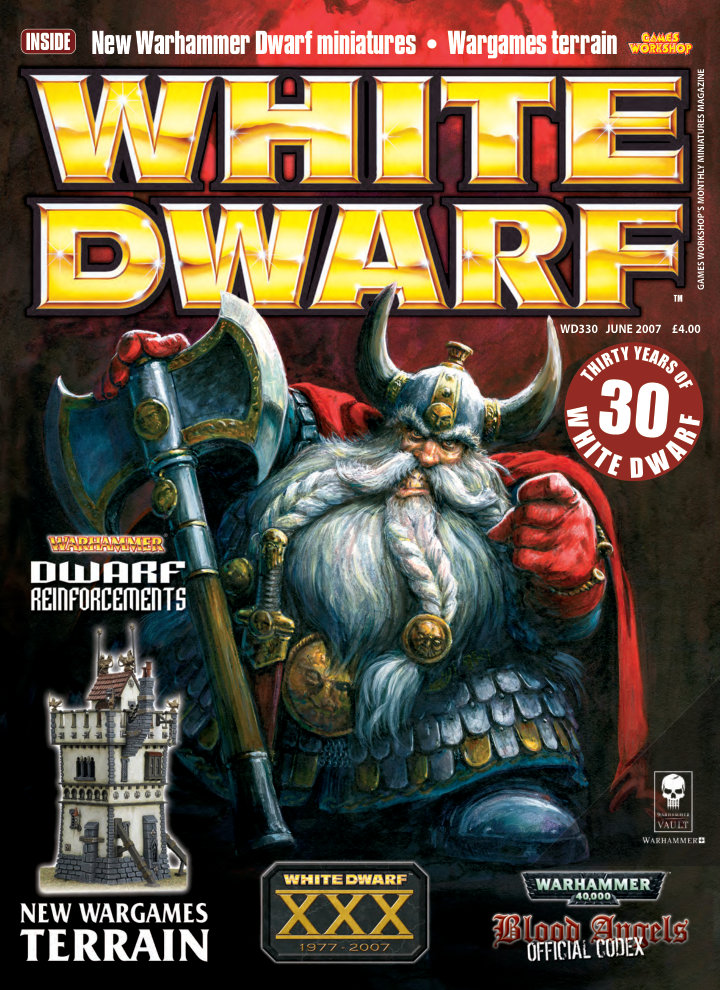
EditorialWD 330 · Inside cover
Grombrindal welcomes a complete range of plastic scenery that can furnish a battlefield without requiring every feature to be built from scratch. Although the buildings chiefly express the Empire, hills and woods can serve all three principal games. The editorial also celebrates the character of the new Dwarf Miners and heroes, connecting a better-looking table with equally distinctive armies to fight across it.
Warhammer Fantasy BattlesDwarfs
LoreWD 330 · pp. 18–19
Two forthcoming supplements approach Gondor from different directions: The Return of the King follows the novel’s journey, while Gondor in Flames surveys the realm’s armies and history. New figures broaden the Fiefdoms, Minas Tirith, the Dead and their Haradrim enemies. The preview places the coming releases within the wider struggle for the Pelennor Fields rather than reproducing their future scenarios or profiles.
Middle-earth Strategy Battle GameGondor
TacticsWD 330 · pp. 24–33
The feature treats scenery as both a believable landscape and a powerful influence on play. Hills, woods, obstacles and buildings should be arranged with enough open ground for manoeuvre, avoiding implausible clusters or rigid symmetry. New kits illustrate those principles, while Gav Thorpe’s advice explains occupation, march blocking and countermeasures. The chapter on building design and painting shows how a convincing physical setting can strengthen a game’s story and tactical decisions together.
Warhammer Fantasy Battles
InterviewWD 330 · p. 26
Colin Grayson explains how digital geometric modelling and organic sculpting combine to make an unmistakably Warhammer building. Bricks, timber and metal begin as simple shapes before texture, wear and warped surfaces give them character. Religious symbols and improbable structural details tie the manor to the Empire, turning what might have been generic scenery into a specific part of the setting.
Warhammer Fantasy BattlesThe Empire
PaintingWD 330 · p. 27
The tree recipes begin with muted grey-brown bark rather than the brighter brown painters may instinctively choose. Selected leaves receive varied colours before a final drybrush brings each canopy together, producing distinct summer and autumn effects. Bare winter trees rely on the trunk treatment alone, with optional moss, while textured bases can be completed through layered drybrushing and small patches of flock.
14 paint colours
PaintingWD 330 · pp. 28–29
Unattached pillars, plinths and the obelisk let one kit serve as a complete temple or scattered remnants. Three finishes suggest different stone: grey granite, pale sandstone and black obsidian with red marbling. Most texture is brought out through drybrushing, but the obsidian uses a sponge to build irregular translucent colour, making the same sculpted surfaces evoke quite different materials.
Warhammer Fantasy Battles9 paint colours
TacticsWD 330 · pp. 30–33
The rules overview explains how difficult ground, defended obstacles, hills and buildings change movement, shooting and combat. Gav Thorpe then develops those effects into practical plans: conceal march blockers, use elite infantry to hold buildings, exploit units that ignore terrain and threaten occupants with flying Terror-causers. The examples also warn that scouts cannot simply begin inside a visible building and that terrain advantages always have potential counters.
Warhammer Fantasy BattlesThe Empire
LoreWD 330 · pp. 36–41
The new plastic Miners combine the Dwarfs’ working lives with their battlefield identity, supplying drills, carts, a pony and blasting equipment as well as warriors. New heroes and an Oath stone reinforce the idea of an army defined by honour and endurance. A starter force and the Miners’ tunnelling rules show how these practical craftsmen can add surprise and mobility to an otherwise deliberate Dwarf battle line.
Warhammer Fantasy BattlesDwarfs
TacticsWD 330 · pp. 38–39
The thousand-point example resists the temptation to fill a Dwarf army with expensive machines and runic characters. Warriors, Thunderers and Miners each cover a different battlefield task, supported by a Thane, Runesmith and cannon. Deployment diagrams protect the guns without obstructing them, while the Miners can threaten a distant firing line or reinforce a vulnerable flank depending on the opposing army.
Warhammer Fantasy BattlesDwarfs
RulesWD 330 · pp. 40–41
Miners may arrive from any table edge after the battle begins, giving Dwarfs a way to threaten the enemy rear or an exposed flank. A steam drill improves the arrival chance and provides a powerful melee weapon, while one-use blasting charges punish a charging unit. The Rune of Brotherhood allows a hero to accompany the advance, and the component guide identifies the equipment that makes these functions visible in the regiment.
Warhammer Fantasy BattlesDwarfs
PaintingWD 330 · pp. 42–45
Mark Jones makes the detailed Miners manageable by establishing neat flat colours and leaving narrow black separations between them. Layered skin, washed and drybrushed beards, edged steel and shaded gold then develop each material without obscuring the sculpt. Leather takes a simple two-stage treatment, while candle wicks, pale wax and highlighted bases supply the final details needed to make the regiment coherent on the tabletop.
Warhammer Fantasy BattlesDwarfs21 paint colours
Battle reportWD 330 · pp. 46–57
Gav Thorpe’s Dwarfs occupy the manor and meet Phil Kelly’s greenskins with a stubborn centre and tunnelling reserves. Early success collapses when the main Miners arrive late and an ignored chariot breaks through the flank. Black Orcs and Boar Boyz overwhelm the exposed Dwarf units despite losing their Warboss, earning a solid victory. Tactical annotations and the players’ reflections explain building immunity, coordinated support and the cost of overlooking a developing threat.
Warhammer Fantasy BattlesDwarfs
ModellingWD 330 · p. 59
Small, irregular patches of static grass make a miniature’s base more convincing than a uniform blanket. The guide shows a quick adhesive method for individual models and a broader flocking process for hills, applying contrasting patches before the dominant colour. Recovering excess material and allowing each stage to dry produces a durable landscape whose varied surface resembles natural ground rather than artificial turf.
1 paint colour
EditorialWD 330 · pp. 60–65
Guy Haley follows White Dwarf from a small role-playing magazine into an international publication centred on Citadel miniatures. A timeline uses landmark issues to trace new games, plastic kits, army books, battle reports and changes in editors and production. The feature also explains the period of differing national editions and the recent return to shared Studio content, making the magazine’s changing format part of the wider history of Games Workshop.
Warhammer Fantasy BattlesWarhammer 40,000
LoreWD 330 · p. 66
Adam Troke recounts the legendary meeting of Josef Bugman, Gotrek and Grombrindal when an outnumbered Dwarf force faced greenskins and Beastmen. Their arrival transforms an expected last stand into an impossible victory, followed by an oath to defend Dwarfkind together whenever needed. The account acknowledges the extravagant numbers of the saga, presenting the anniversary miniature as the physical expression of that shared legend.
Warhammer Fantasy BattlesDwarfs
RulesWD 330 · pp. 66–67
The anniversary model combines Grombrindal’s magic with attacks from his two legendary bearers, making a deliberately extravagant thousand-point character. Drinking can restore wounds at the cost of movement, while Gotrek may propel the trio towards the most valuable enemy. Powerful armour, rallying effects and protection from ranged attacks reinforce the joke’s scale; the introduction expressly reserves these rules for agreed, light-hearted games rather than ordinary tournament use.
Warhammer Fantasy BattlesDwarfs
RulesWD 330 · pp. 68–79
Jervis Johnson’s official update begins a two-part replacement for the existing Blood Angels codex. The Chapter’s tragedy leads into self-contained equipment and special rules, named leaders, Death Company, veterans and distinctive armoured support. Combat Squads add deployment flexibility, over-charged engines create a risky burst of speed and the specialist units translate the Black Rage into battlefield behaviour. Army selection and the remaining common units are deferred to the next issue.
Warhammer 40,000Blood Angels
LoreWD 330 · pp. 68–70
Sanguinius’s death leaves a psychic inheritance that can overwhelm his descendants with memories of the Primarch’s final battle. The account distinguishes this Black Rage from the blood craving of the Red Thirst, and explains the Sanguinary Priests’ role in preserving the blood used to create new Marines. Their long lives and pursuit of perfection make the Blood Angels accomplished artists and warriors, even as awareness of their curse darkens that idealism.
Warhammer 40,000Blood Angels
RulesWD 330 · pp. 71–72
The shared rules define regrouping, five-man Combat Squads and the risk-and-reward movement of over-charged engines. A consolidated equipment reference then covers armour, medical support, psychic defence, Techmarine repairs, standards and transport functions. Keeping these definitions together makes the Chapter playable from the magazine update and the core rulebook, rather than requiring readers to infer missing details from another codex.
Warhammer 40,000Blood Angels
RulesWD 330 · pp. 73–75
Dante inspires surrounding warriors and weakens nearby enemies, while Tycho brings his longstanding hatred of the Orks. Mephiston’s exceptional psychic mastery contrasts with Corbulo’s restorative and assault support, and Lemartes focuses a squad’s fearlessness and charging fury. The complete character entries tie distinctive relics and abilities to their narrative positions, alongside three Chapter psychic powers that increase attacks, immobilise opponents or grant flight.
Warhammer 40,000Blood Angels
RulesWD 330 · p. 76
Warriors overcome by the Black Rage are organised into a fearless formation that seeks death in the Emperor’s service. Their resilience, charging strength and Rending attacks make them dangerous once they reach combat. Without a nearby Chaplain or Corbulo, however, their compulsory advance towards the closest enemy limits tactical control, turning the Chapter’s curse into a concrete command problem.
Warhammer 40,000Blood Angels
RulesWD 330 · pp. 78–79
The Baal Predator supports the Chapter’s advance with rapid-firing weapons and potentially faster movement from modified engines. The Furioso trades ranged versatility for two close-combat weapons, and a Death Company variant gains extra attacks while risking uncontrolled movement towards the enemy. Background on Moriar illustrates how even interment in a Dreadnought does not free a Blood Angel from the curse carried in his inherited memories.
Warhammer 40,000Blood Angels
EditorialWD 330 · pp. 81–83
Jervis explains how revisiting Angels of Death led to a complete Blood Angels update in White Dwarf. A growing FAQ had made the old book awkward to use, while the newly completed Dark Angels structure supplied much of the common Marine groundwork. Magazine publication offered a faster route to a clear, self-contained army and let the team concentrate on the Blood Angels’ distinctive units, but affection for the Chapter was ultimately the decisive reason.
Warhammer 40,000Blood Angels
TacticsWD 330 · pp. 84–89
Adam Troke groups Good heroes by the jobs they can perform: adaptable leaders, morale anchors, resilient defenders, prolific fighters and subtle specialists. Practical examples combine heroic actions, mounting choices and healing with the ordinary warriors a hero supports. Magical partnerships can protect an advance or repeatedly knock enemies down, while even famous fighters are warned against becoming trapped in combats that prevent them influencing the wider mission.
Middle-earth Strategy Battle GameGondor
ModellingWD 330 · pp. 90–95
Detailed component keys explain how the Fortified Manor combines its chapel, watchtower and courtyard. Optional fittings can turn the same structures into an inn, monastery, merchant’s house or wizard’s residence, while leaving major sections unglued preserves flexibility between games. Suggestions for roads, hills and larger settlements encourage a coherent landscape around the buildings instead of an isolated decorative centrepiece.
Warhammer Fantasy BattlesThe Empire
PaintingWD 330 · p. 94
Grey walls are progressively drybrushed towards white, while blue-grey roof tiles receive occasional lighter pieces to avoid a perfectly uniform surface. Earthy timber and brickwork are unified with a dark wash that includes matt varnish. The compact recipe uses broad texture treatments appropriate to a large building, leaving its sculpted architectural details to carry much of the visual interest.
Warhammer Fantasy BattlesThe Empire7 paint colours
ShowcaseWD 330 · pp. 98–101
The painted collection ranges from Gondor’s famous leaders to the garrisons and regional forces defending its broad realm. Dol Amroth’s Swan Knights, Ithilien’s Rangers and Minas Tirith’s professional soldiers express distinct identities within one kingdom. Elendil and Isildur connect the display to the Second Age, while the Army of the Dead recalls the oaths that Aragorn calls upon during the final struggle with Sauron.
Middle-earth Strategy Battle GameGondor
CommunityWD 330 · pp. 102–106
The category guide clarifies how to place individual figures, squads, vehicles, monsters and scenic entries in the 2007 competition. Base size, unit legality and display dimensions distinguish several categories that could otherwise overlap, while large-scale models, licensed Middle-earth figures, Young Bloods and Open entries have their own requirements. Previous winning miniatures illustrate the range of work those categories can recognise, from restrained single figures to complex narrative scenes.
Warhammer 40,000Warhammer Fantasy BattlesImperial Guard
CommunityWD 330 · pp. 114–115
The exhibition programme brings original art, miniature displays and themed installations into Warhammer World, following the success of the previous Nottingham Castle show. Visions of War explores the imagined battlefields of Warhammer and the visual traditions behind Games Workshop’s Gothic style, from medieval imagery to dramatic heroic painting. Plans for a John Blanche exhibition and changing displays present the venue as a place to examine the artwork and creative history behind the games, as well as to play them.
Warhammer Fantasy Battles
CommunityWD 330 · pp. 116–119
One hundred and thirty finalists gather after the autumn heats, with Dimitrios Kasdovasilis taking the title through six victories. Ben Johnson’s Tribe of the Severed Hand wins Best Army, while the accompanying interviews follow players whose paths to the final were very different. Photographs and individual accounts show the event combining demanding games, army presentation and the pleasure of meeting opponents from across the tournament community.
Warhammer Fantasy BattlesLizardmen
TacticsWD 330 · pp. 117–119
Phil Manwaring builds his Ogre army around a hard-hitting Tyrant, three Butchers and small Irongut units, accepting fewer bodies in exchange for dependable threats and magical protection. He avoids Gnoblars and their Bickering, using a long deployment line so units can flee charges without passing through friends before nearby Ogres counterattack. His heat and final results illustrate the risks of the approach, including memorable encounters with another Ogre army and a Lizardmen force, while keeping the army’s character central to further refinements.
Warhammer Fantasy BattlesOgre Kingdoms
InterviewWD 330 · p. 118
Dimitrios Kasdovasilis describes winning the final after only two and a half years of playing Warhammer. Qualification in thirtieth place with his Lizardmen gave him room to refine the force before the six victories that secured the title. His answers place that result within an active Greek gaming scene and look ahead to a team event in Poland and a possible defence of his championship, showing how preparation and experience developed between the heats and final.
Warhammer Fantasy BattlesLizardmen