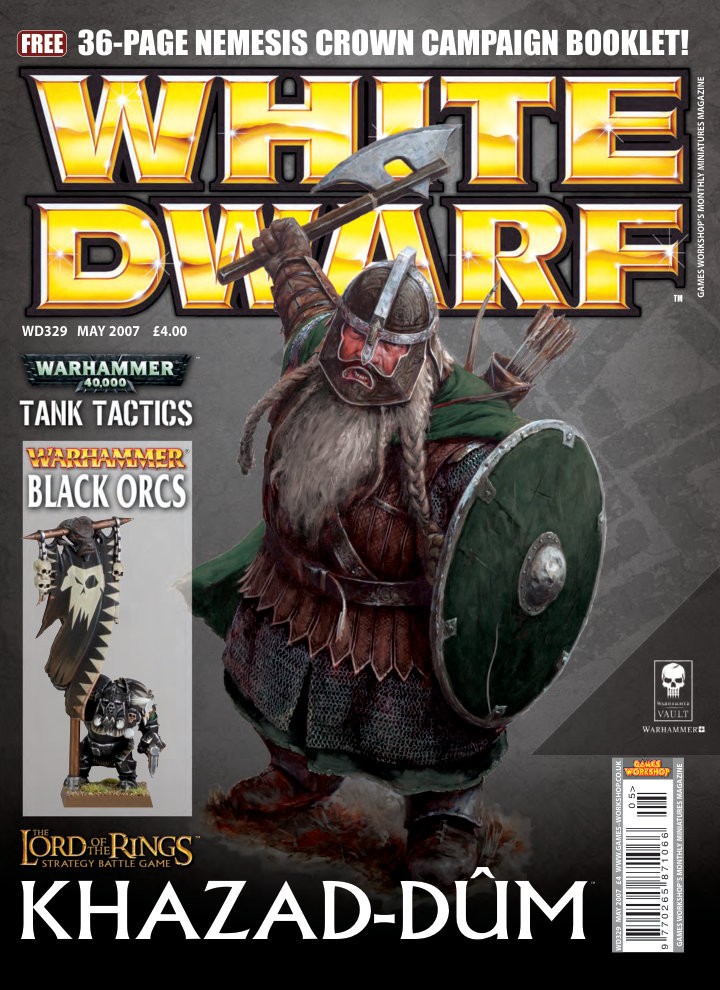
EditorialWD 329 · Inside cover
Grombrindal recalls Khazad-dûm’s transformation from a magnificent Dwarf kingdom into the lair of the Balrog. The new sourcebook and miniatures offer ways to recreate both the realm’s strength and its destruction, with Dwarves, goblins and a dragon joining the range. New Warhammer greenskins and the magazine’s approaching thirtieth anniversary complete an editorial concerned with returning to old stories through new collections.
Middle-earth Strategy Battle GameWarhammer Fantasy BattlesKhazad-dûm
CampaignWD 329 · p. 16
The forthcoming Mighty Empires supplement gives individual battles a strategic context through a configurable hex-tile map. Mountains, plains and rivers can represent existing regions or an invented territory, while the accompanying booklet links battles through recruitment and other campaign actions. The preview’s emphasis is on making victories contribute to a continuing struggle rather than supplying the complete campaign rules in the magazine.
Warhammer Fantasy Battles
CommunityWD 329 · p. 18
A revised Battlefleet Gothic rulebook is announced with updated Nova Cannon and ordnance rules. It retains the landscape format while adopting a more rigid cover, and the notice describes both printed and downloadable availability. This brief historical update records the changing support for the space-combat game without reproducing the amended mechanics themselves.
Battlefleet Gothic
InterviewWD 329 · pp. 24–31
Andy Hall interviews Adam Troke about a sourcebook spanning Khazad-dûm’s prosperity, downfall and attempted recovery. Three Dwarf lists distinguish different eras and alliances, while plastic Warriors and Rangers make full armies more accessible. Vault Wardens, Iron Guard and ballistas add specialised roles; the forces below answer with Prowlers and a customisable dragon whose design draws on real reptiles rather than the conventions of other Citadel dragons.
Middle-earth Strategy Battle GameKhazad-dûm
RulesWD 329 · pp. 30–31
The basic dragon can be strengthened with two selected abilities, each representing a different kind of surviving wyrm. Fire spends Will to attack an area, wings permit flight, Wyrmtongue supplies disruptive spells and Tough Hide increases physical resilience. These choices let a collector tailor the creature’s story and battlefield role while keeping the most devastating abilities optional rather than combining every legendary dragon trait in one profile.
Middle-earth Strategy Battle GameMonsters of Middle-earth
TacticsWD 329 · pp. 32–33
Adam Troke expands the Dwarf battlehost into a near-thousand-point force led by Durin and Mardin. A compact armoured centre advances under banner support, Rangers secure the flanks and a ballista group attacks suitable targets from range. The guide discusses alternative expansions and the value of protecting the artillery with a captain, while Mat Ward advises opponents to isolate and surround Dwarves instead of relying on ineffective long-range fire.
Middle-earth Strategy Battle GameKhazad-dûm
Battle reportWD 329 · pp. 34–47
Adam Troke’s Dwarves attempt to stop Alessio Cavatore’s Balrog and goblin horde in the mines beneath Khazad-dûm. A divided deployment and awkward reinforcement choice prevent the Dwarves concentrating their strength, while goblins protect the monster from being surrounded. Durin kills trolls and many lesser foes, but the drum and shamans sustain the attackers until the Balrog slays him. Both players’ conclusions connect the historical result to concrete decisions about terrain, support and target choice.
Middle-earth Strategy Battle GameKhazad-dûm
RulesWD 329 · p. 35
The Dwarves defend the mine workings while the Balrog initially advances alone, followed by goblins pursuing delayed Dwarf reserves. Mirrors reduce enemy courage, occupied grates seal infiltration routes and chasms make forced movement deadly. The monster ignores the goblins’ breaking point and cannot benefit from their heroic actions, creating a battle in which terrain control and the timing of reinforcements matter as much as the opposing armies’ raw strength.
Middle-earth Strategy Battle GameKhazad-dûm
TacticsWD 329 · pp. 46–47
Alessio’s six-hundred-point Moria force distributes Might among several heroes and relies on shamans, trolls and bats to keep the goblin horde effective. Adam’s revised Dwarf force reduces artillery and adds Rangers and Iron Guard so more of its strength can reach the fighting. Together the rosters translate the battle report’s lessons into alternatives for ordinary matched games, especially the need to support powerful models and select artillery targets realistically.
Middle-earth Strategy Battle GameMoria
LoreWD 329 · pp. 50–61
The returning greenskins range centres on plastic Black Orcs, the first regiment designed entirely with the Studio’s digital sculpting technology. New bosses, trolls and Goblin characters expand the surrounding horde, while Gorbad embodies the historical scale of a great Waaagh! Background, kit diagrams, a starter army and a complete Black Orc painting project explain how the releases can become a characterful collection rather than just isolated display models.
Warhammer Fantasy BattlesOrcs & Goblins
RulesWD 329 · p. 53
Gorbad combines the duties of army general and battle standard bearer, extending his influence over nearby units until a wound undermines their confidence. His presence permits numerous Big ’Un upgrades, reflecting the elite warriors drawn to his banner. Gnarla strengthens his mounted defence and charge, while Morglor gives him an exceptionally dangerous first strike, making his leadership and combat role inseparable.
Warhammer Fantasy BattlesOrcs & Goblins
TacticsWD 329 · pp. 54–55
The sample force uses an Orc general and battle standard to steady a central line of Black Orcs and Boyz. Fanatic-carrying Night Goblins screen the advance, Spider Riders exploit difficult ground and a chariot supports selective attacks. The guide highlights the army’s lack of wizards and explains how a protective banner helps compensate, while leaving room to expand the boxed collection into a larger horde.
Warhammer Fantasy BattlesOrcs & Goblins
RulesWD 329 · pp. 56–57
Black Orcs are portrayed as disciplined, heavily armed greenskins whose disputed origins may lie with the Chaos Dwarfs. Their leaders restore order through violence, inflicting casualties on squabbling troops to keep the formation moving. Armed to Da Teef lets the warriors select a suitable weapon arrangement at the start of combat, and the component guide encourages mixed equipment that makes this arsenal visible on the models.
Warhammer Fantasy BattlesOrcs & Goblins
PaintingWD 329 · pp. 58–61
Chad Mierzwa begins with Foundation basecoats that already make the regiment usable on the table, then adds detail in manageable later stages. Chipped red armour and brighter metal create a campaigning appearance, while dark green flesh receives carefully limited highlights. Bone, cloth, drum skin and the standard supply lighter accents, and fine brown ink around armour joins gives definition without repainting the entire unit.
Warhammer Fantasy BattlesOrcs & Goblins22 paint colours
ShowcaseWD 329 · pp. 62–67
Guy Haley and Mark Latham explore how an army’s preferred models, historical references or chosen character can establish a theme. Neil Hodgson’s armoured followers of Grimgor and Chad Mierzwa’s woodland greenskins demonstrate two different approaches using coherent colour, selected troop types and restrained conversion work. The feature treats army history as a way to enrich campaigns and collecting, while acknowledging that themed forces still need practical battlefield support.
Warhammer Fantasy BattlesOrcs & Goblins1 paint colour
ShowcaseWD 329 · pp. 64–65
Neil Hodgson excludes Goblins from Grimgor’s retinue and uses additional armour, jaw plates and matching red paint to connect every unit visually. Even the Giants wear salvaged Black Orc shields and improvised straps. The resulting force is unusually compact and hard-hitting, with less trouble from Animosity than a mixed horde, but its small size makes further ordinary Boyz a useful next expansion.
Warhammer Fantasy BattlesOrcs & Goblins1 paint colour
ShowcaseWD 329 · pp. 66–67
Chad Mierzwa builds a forest-themed horde around numerous Spider Riders, unifying older and newer models through skull symbols and consistent skin and stone colours. Chariots and trolls vary the painting work, while Savage Orc Big ’Uns add the muscle the smaller greenskins lack. Speed threatens enemy flanks and artillery discourages an easy advance, showing how a strong collecting theme can still support a varied battle plan.
Warhammer Fantasy BattlesOrcs & Goblins
EditorialWD 329 · pp. 70–72
Jervis explains why the Nemesis Crown campaign centres on a dangerous artefact rather than another world-threatening invasion. The Empire, Dwarfs and greenskins have the strongest direct reasons to fight in the Great Forest, while other factions can pursue smaller missions that suit their histories. The approach encourages players to invent plausible expeditions and linked stories without forcing every army into one artificial worldwide confrontation.
Warhammer Fantasy BattlesThe Empire
TacticsWD 329 · pp. 74–79
Andy Hoare sorts tanks by the battlefield job their armour, mobility and weapons let them perform. Stationary gun platforms need carefully chosen sightlines, assault tanks require infantry protection and support tanks preserve advancing squads by drawing fire and removing threats. Weapon fits and upgrades can shift the same chassis between roles, while examples show why merely owning a powerful vehicle is less useful than integrating it into the mission plan.
Warhammer 40,000Imperial Guard
PaintingWD 329 · pp. 82–85
The workshop distinguishes true drybrushing from overbrushing and shows how very little paint should remain before the brush touches the model. Successive passes reveal textured fur, cloth and armour, with washes restoring depth or reducing a chalky appearance. Selective work is completed before surrounding details so stray paint causes less damage; feathers and flat tank panels require particular attention to stroke direction and subtlety.
Warhammer Fantasy BattlesWarhammer 40,00013 paint colours
PaintingWD 329 · p. 83
A brown-furred creature receives progressively paler drybrushing followed by a darker wash around the creases. A black-robed figure instead starts directly from its undercoat, building grey texture before an ink wash reduces the chalky effect. The paired examples show how the same technique changes with the intended material and how final shading can preserve depth after broad highlights.
Warhammer Fantasy Battles7 paint colours
PaintingWD 329 · p. 84
The Ranger’s cloak is finished before the surrounding details, allowing broad brushwork without damaging completed areas. A dark grey base receives two progressively lighter passes, followed by an earthy edge to suggest dirt and travel wear. The sequence demonstrates how controlled drybrushing can describe both the material’s folds and the character’s experience on the road.
Middle-earth Strategy Battle GameDwarves4 paint colours
PaintingWD 329 · p. 85
The Marine is drybrushed in metal before black shading and selected dark details restore separation between the plates. A brighter metallic pass defines the armour while red lenses and seals add small focal points. Bone-coloured parchment and a simple highlighted base complete a repeatable method that suits an entire metallic-armoured unit rather than a single elaborate display figure.
Warhammer 40,000Space Marines6 paint colours
InterviewWD 329 · pp. 86–90
Seb describes discovering old Hobgoblins, learning through practice and progressing from ’Eavy Metal painter to sculptor. His award-winning models use contrast to lead the eye towards the head, with subassemblies protecting long painting projects from handling damage. Ghazghkull, a converted Nurgle prince, a knight and a scratch-built mounted Chaos Lord illustrate how painted texture, careful basing and increasing sculpting ambition developed together.
Warhammer Fantasy BattlesWarhammer 40,000Orks1 paint colour
ShowcaseWD 329 · pp. 92–96
The gallery compares the colour identities and invasion histories of Behemoth, Leviathan and Kraken. Painted Hive Tyrants, Warriors, Carnifexes and lesser organisms illustrate the swarm’s range of battlefield forms, while different heads and symbiotic weapons communicate its adaptability. Background links these models to Macragge, the Eastern Fringe and Leviathan’s unexpected approach from below the galactic plane, without providing named painting recipes.
Warhammer 40,000Tyranids
ModellingWD 329 · p. 97
The tutorial shows how controlled back scraping removes mould lines without cutting into the miniature. A knife also tidies small sprue remnants where cutters would risk damaging fine detail, while larger obstructions are better handled with another tool. Checking the intended cut, supporting the work and using a suitable blade make preparation more precise and reduce the repair work needed before painting.
CommunityWD 329 · pp. 98–99
The feature invites local groups to recreate the Barazinbar Deeps struggle with their own Middle-earth collections. Dwarves and goblins form its historical centre, but other armies and the new dragon can contribute to the store’s version of the event. It places the magazine’s battle report within a wider programme of shared games, painting competitions and modelling activities rather than adding a new scenario ruleset.
Middle-earth Strategy Battle GameKhazad-dûm
CommunityWD 329 · pp. 102–105
Phil Walter and Rob Taylor take a monster-heavy Tyranid army through seven games under a revised doubles format. A larger points allowance and new scoring encourage varied lists and reward preserving one’s own force as well as destroying enemies. Their five wins, draw and loss produce sixth place, while the account’s unusual alliances and relaxed competitive atmosphere show why paired events appeal to both experienced players and tournament newcomers.
Warhammer 40,000Tyranids
CommunityWD 329 · pp. 106–107
The competition guide explains which models, conversions and bases qualify for the 2007 Golden Demon categories. It distinguishes removable display plinths from integral dioramas and sets out the requirement that each entry be the work of one hobbyist. Separate restrictions apply to licensed Middle-earth models, while Open and Young Bloods categories provide different routes into the competition; presentation and fidelity to the settings remain central judging considerations.
Warhammer 40,000Warhammer Fantasy Battles
CommunityWD 329 · pp. 108–111
James Milne reports on an expanded tournament where Legions of Middle-earth and a seven-hundred-point limit permit anything from Hobbit hordes to tiny forces of monsters. Players bring both Good and Evil armies, creating contrasting tactical experiences across the weekend. Vesa Nenye’s victory and sportsmanship, Nick Bayton’s painted collection and first-time entrants’ accounts give equal attention to competition, generous play and the event’s welcoming atmosphere.
Middle-earth Strategy Battle GameThe Shire
CommunityWD 329 · pp. 112–113
Brian Aderson explains how two years of event development produced a weekend built around varied battles rather than an overall player ranking. Each participant brings up to three thousand points but must divide that collection into smaller, independently legal forces for six games across three scenarios. Appendix and Storm of Chaos lists widen the choices, while a whole-army painting competition rewards theme, modelling and presentation. The format asks players to adapt a collection to different battlefield problems instead of designing one list for every encounter.
Warhammer Fantasy Battles