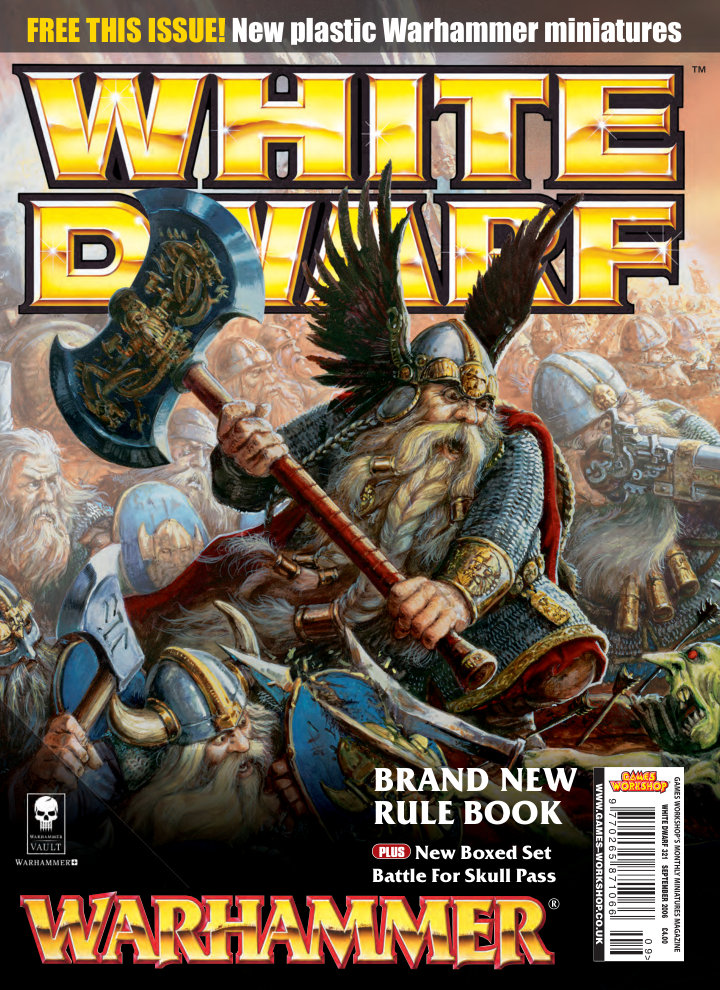
EditorialWD 321 · Inside cover
Grombrindal welcomes the new Warhammer edition as a refinement that preserves existing armies while making battles smoother and more tactically satisfying. His excitement includes the spectacle of painted armies as much as the rules, with Battle for Skull Pass offering both a beginning for newcomers and a substantial addition to a veteran’s collection. The first new army book is already on the horizon.
Warhammer Fantasy Battles
CommunityWD 321 · pp. 20–21
The Eldar preview introduces a broad reinforcement of the miniature range alongside the revised codex. New War Walkers, Dire Avengers and Aspect Warriors join Farseers and the more aggressive Autarch leader, while Yriel returns as a special character associated with Iyanden. The article presents the design work under Jes Goodwin and hints at a large configurable kit without yet revealing all of the forthcoming rules.
Warhammer 40,000Aeldari
RulesWD 321 · pp. 25–29
Alessio Cavatore explains the deliberately limited changes behind the new edition, preserving compatibility with existing army books while correcting unclear interactions. Five-wide ranks encourage more models to fight, fleeing becomes a straight and more decisive movement, and small support units gain a clearer role without causing widespread panic. Wizard-specific power dice reduce the use of lesser casters as batteries, while Insane Courage retains a chance of survival even when a combat looks certain. Pitched Battle becomes the core setup, with alternative encounters retained in the hobby material.
Warhammer Fantasy Battles
InterviewWD 321 · p. 30
Guy Haley asks Rick Priestley how a game made to give roleplaying miniatures another use grew into the foundation of an international company. Rick credits timing, accessible rules and a setting shaped collaboratively by the models people wanted to make. Historical interests, unexpected sculpts and a willingness to mix solemn fantasy with humour explain why the world developed its distinctive variety rather than following one author’s fixed plan.
Warhammer Fantasy Battles
InterviewWD 321 · p. 31
The developers outline how the new rulebook joins a more practical learning sequence to a broad account of the setting and the hobby. Setup and deployment appear early, the rules are clarified without invalidating army books, and the background supplies a shared reference for the world. Jeremy Vetock’s hobby section then connects assembly, painting and army collecting with additional scenarios and ways of finding games.
Warhammer Fantasy Battles
ShowcaseWD 321 · pp. 32–33
The artwork feature treats Warhammer as a world built through exchange between drawings, miniatures, rules and stories. A panoramic battle and smaller scenes supply the cities, machinery and ordinary inhabitants that a tabletop army cannot show by itself. Examples from John Blanche, Paul Dainton, Karl Kopinski and Alex Boyd demonstrate the mixture of historical and fantastic influences behind a recognisable dark visual language.
Warhammer Fantasy Battles
Battle reportWD 321 · pp. 34–47
Alessio Cavatore’s expanded Dwarf force defends the pass against Jervis Johnson’s all-Goblin army in the inaugural battle under the new rules. Accurate artillery and a Gyrocopter initially devastate the greenskins, but attacks on the Dwarfs’ weaker units and an unusually destructive Squig rampage free the fast troops to deliver multiple flank charges. The Goblins take Skull Pass despite their Warboss dying in a final challenge. The post-game analysis connects that reversal to combined attacks, failed Dwarf break tests and the danger of treating earlier easy victories as a guarantee.
Warhammer Fantasy BattlesDwarfs
EditorialWD 321 · pp. 50–53
Jervis Johnson explains his affection for Warhammer through the interaction of miniatures, stories, art and rules. A painted collection becomes a personal creation, the background gives its battles meaning and understandable game mechanics turn imagined actions into decisions. The accompanying introduction to the boxed forces contrasts the Dwarfs’ dependable warriors and engineering with the Goblins’ numbers, sneaky weapons, spiders and unreliable monsters.
Warhammer Fantasy BattlesDwarfs
PaintingWD 321 · pp. 54–55
The beginner’s guide paints a complete Night Goblin regiment in clear stages, using the black undercoat as the robes before adding green skin, red spear shafts, brown details, yellow moon emblems and metal. The Dwarf example adds blue cloth and shield, gold ornament and flesh to the same straightforward method. Neat placement and correcting mistakes take priority over elaborate shading, making the free figures a manageable starting project.
Warhammer Fantasy BattlesDwarfs9 paint colours
RulesWD 321 · pp. 56–57
The history of Clan Brynik and its refuge near Karak Eight Peaks establishes the stakes for Dagskar Earscrapper’s attack on the Dwarf mines. Using the boxed armies on a small battlefield, players contest three differently valued objectives: the mine, brewery and forge. Only sufficiently strong units can claim them, and the Idol of Mork grants the Goblin Shaman extra magical power, so preserving the right units and directing them to the richest targets matters more than indiscriminate fighting.
Warhammer Fantasy BattlesDwarfs
RulesWD 321 · pp. 58–59
The large siege scenario recreates an assault whose tempo changes when Gandalf and the Rohirrim arrive. Evil can replenish many slain warriors until that relief force reaches the field, while the defenders must protect a braced gate and the vulnerable culvert. From a specified stage of the battle Théoden can lead his men to the stables and ride out, providing a dramatic choice between holding the walls and taking the fight beyond them.
Middle-earth Strategy Battle GameRohan
Battle reportWD 321 · pp. 58–70
Graham McNeill defends Helm’s Deep against Gav Thorpe’s Uruk-hai, Dunlendings and armoured Troll in a battle lasting the better part of two days. The culvert explodes despite Legolas killing the torchbearers, but the defenders contain the breach while Aragorn repeatedly rescues the walls from attackers. Gimli dies holding the gateway, then Gandalf and Erkenbrand arrive in time for Théoden’s mounted sortie to turn the battle. Good wins, with Gav identifying scattered ladders and too few heroes as weaknesses in an assault that had achieved its initial breaches.
Middle-earth Strategy Battle GameRohan
PaintingWD 321 · p. 71
Large flat brushes speed up several repetitive stages of painting an army. The examples cover restoring missed areas of black undercoat, overbrushing a brown base while leaving darker shading, applying an all-over ink wash and drybrushing raised detail. The guide connects speed with brush care: keeping paint out of the ferrule and cleaning thoroughly prevents the wide bristles from losing the shape that makes these methods effective.
3 paint colours
EditorialWD 321 · pp. 72–73
Jervis Johnson proposes a practical sequence for resolving uncertainties without letting them consume a game. Start with the written rule, use a temporary dice roll if it remains ambiguous and investigate the official errata afterwards. His account of the unintended consequences of a Space Wolves FAQ explains why corrections should repair actual errors rather than redesign a rule informally; house rules remain useful when the players agree on them and remember their local scope.
LoreWD 321 · pp. 76–79
During the withdrawal from the Damocles Gulf Crusade, an Inquisitorial shuttle carrying captured Tau technology crashes on the abandoned world of Kappa Mortis. Captain Agemman diverts a small Ultramarine force to retrieve the cargo, while Commander Nightwind’s nearby detachment attempts to recover its own secrets. Force plans contrast a disciplined Marine search with the Tau’s rapid reaction, and the historical account links the salvage of an XV15 helmet to the accelerated development of the simpler XV25 Stealthsuit.
Warhammer 40,000Ultramarines
RulesWD 321 · pp. 80–81
The Kappa Mortis scenario turns a crashed shuttle’s cargo into four hidden salvage counters, only one of which contains the useful prize. The Ultramarines begin a limited search while Tau Stealthsuits infiltrate and the remaining forces enter from reserve. Optional asymmetrical stratagems give Nightwind a scanner and the Marines a damaged reactor hazard; suggestions for alternative factions keep the core recovery mission usable beyond its original historical setting.
Warhammer 40,000Ultramarines
ModellingWD 321 · pp. 82–84
The metal and new plastic Balrogs demonstrate two presentations of the same immense creature of shadow and flame. The assembly guide stresses fitting the plastic wings before the arms and shows how modelling putty can continue the flame texture across the joins. Painting begins with the bright internal fire before returning to the dark outer scales, reversing the usual tendency to reserve highlights for the most exposed surfaces.
Middle-earth Strategy Battle GameMoria8 paint colours
RulesWD 321 · p. 82
The contemporary Balrog profile combines exceptional combat characteristics and ten Wounds with a high points cost suited to large games or prepared scenarios. Its fiery lash operates as a powerful short-ranged throwing attack, resistance to magic makes direct spells less dependable and its ancient presence reduces nearby Good models’ Courage. The entry therefore presents the creature as a psychological and physical centrepiece rather than an economical routine addition.
Middle-earth Strategy Battle GameMoria
PaintingWD 321 · p. 84
The tutorial establishes a solid black undercoat, paints the exposed fiery cracks white and yellow, then enriches the heat with coloured inks before carefully restoring the dark scales. A final grey drybrush defines the black body without concealing the luminous gaps. The alternative colour diagrams explain the progression from darker red edges to pale yellow heat and a restrained sequence of grey highlights over the skin.
Middle-earth Strategy Battle GameMoria8 paint colours
ModellingWD 321 · pp. 86–89
Jeremy Vetock’s Ork settlement shows how Cities of Death can move beyond Imperial ruins. Simple card shapes become dwellings, workshops and rocket structures through layers of plates, girders and scavenged detail, while spare kit parts supply ammunition dumps and scrap heaps. Different building heights and platforms keep the industrial town useful for play, with a wellhead and a large fuel store giving its apparently chaotic construction a convincing purpose.
Warhammer 40,000Orks
PaintingWD 321 · pp. 92–97
The Inquisition showcase uses individual colour schemes to distinguish ornate Daemonhunters, restrained Witch Hunters and their unusual followers. Metal finishes, skin glazes, parchment and glossy details receive particular attention because each figure can serve as an army’s focal point. Grey Knights and Sisters of Battle broaden the collection into militant forces, with heraldry and limited common palettes connecting diverse characters to their organisations.
Warhammer 40,000Inquisition28 paint colours
PaintingWD 321 · pp. 92–93
Torquemada Coteaz and the Ordo Malleus Inquisitors demonstrate richly decorated armour and strong cloth contrasts, while their followers demand more unusual finishes. Pale Daemonhost skin gains an otherworldly cast, bronze shackles and glossy assassin details add variation, and a purple glaze gives a Sage’s pallid face depth. Fine simulated writing on parchment reinforces the retinue’s character without requiring elaborate scenic additions.
Warhammer 40,000Inquisition7 paint colours
PaintingWD 321 · pp. 94–95
The Witch Hunters use dark reds, subdued cloth and worn metal to keep their finery less conspicuous than the Daemonhunters’. Heat-discoloured plasma equipment, pale parchment and carefully defined armour provide local interest. The acolytes and Penitent Engine introduce brighter flames and whites, with printed recipes covering dark red, fire, blue-tinted silver, bronze and pallid flesh so the retinue can remain varied within a coherent palette.
Warhammer 40,000Inquisition23 paint colours
PaintingWD 321 · p. 96
Captain Stern and Grey Knights in power and Terminator armour show how small red, gold and parchment details can enliven a largely silver force. Brown Ink shades gold recesses, fine grey edges define black weapons and pale highlights keep purity seals readable. The heraldry examples also suggest combining transfers with painting, or using a technical pen for tiny lettering, to achieve consistent detail across an army.
Warhammer 40,000Grey Knights6 paint colours
PaintingWD 321 · p. 97
A Canoness, a Sacred Rose Battle Sister and a Hospitaller demonstrate the variety inside the Adepta Sororitas. Warm skin and gold ornament offset the martial armour, while bright red cloth and white undercoats produce the cleaner contrast needed for pale schemes. The accompanying Order badges connect those colour choices to heraldry and remind the painter that non-militant Sisters can also appear in an Inquisitorial force.
Warhammer 40,000Adepta Sororitas4 paint colours
CommunityWD 321 · pp. 98–101
The guide organises the forthcoming event around its three halls, helping visitors locate sales, participation games, design displays and Golden Demon entries. It highlights the larger Studio presence and the opportunity to see forthcoming models and work in progress, alongside publishing and computer-game stands. Maps and the entry form support planning a day whose attractions extend well beyond a single competition or purchase.
TacticsWD 321 · pp. 102–107
Joe Sturge follows the Army of the Midwinter Glade through six Grand Tournament games, including four quite different Skaven opponents. The force relies on carefully timed cooperation between archers, mobile Elves and resilient tree spirits; a premature Treeman commitment shows how one positional error can unravel that balance. Wins against Bretonnians and Tomb Kings and painful lessons against rat armies lead into his assessment of the forthcoming season, where revised magic offers new opportunities without requiring him to abandon the collection he knows well.
Warhammer Fantasy BattlesWood Elves