EditorialWD 296 · p. 2
Paul Sawyer looks forward to a campaign about the destruction of Bugman’s Brewery as an excuse to return to his first army, Goblins. A river raid offers the conversion opportunities he wants. He also revises an unfinished Tyranid scheme after deciding its pale base colour would take too many coats. Red bodies and striped black carapaces provide a quicker, stronger alternative for the swarm.
Warhammer Fantasy BattlesWarhammer 40,000Orcs & Goblins3 paint colours
CommunityWD 296 · pp. 4–7
Storm of Chaos reporting is under way, with online maps, forums and newsletters extending the campaign beyond the tabletop. Dawn of War reveals Eldar as its fourth faction, and Black Library notices include a new Gaunt’s Ghosts arc. Other news covers the WPS Club Challenge, Andy Chambers leaving Games Workshop and a northern European Chapter Master competition. Staff updates record ongoing painting and modelling projects.
Warhammer Fantasy BattlesWarhammer 40,000Aeldari2 paint colours
LoreWD 296 · pp. 14–17
Gav Thorpe recounts the opening movements of the invasion as Archaon’s generals pursue separate paths towards Middenheim. Feytor spreads disease, Styrkaar devastates settlements and Melekh seeks a northern approach. Garagrim’s Slayers march into the wastes while Ungrim prepares to face Crom in Peak Pass. Grimgor forces a river crossing, and the Imperial Engineers bring experimental weapons to Castle Lenkster as the defenders organise their response.
Warhammer Fantasy BattlesWarriors of Chaos
ShowcaseWD 296 · pp. 18–19
John Cadice begins another Dark Elf army rather than simply add a few units to his earlier collection. Distinctive flesh colours emphasise the Elves’ inhuman appearance, and mortal Chaos Warriors broaden the cult’s ranks. Character conversions use a Dark Pegasus, an elaborate banner and a Druchii Anointed with Lelith Hesperax’s head. The gallery shows how varied components can retain a consistent Slaaneshi identity.
Warhammer Fantasy BattlesDark Elves
ShowcaseWD 296 · pp. 20–21
Scott Goldstein extends the already Slaaneshi Dark Elf force shown in issue 287. Mounted Daemonettes, new characters and further Elven units fit its established character. His preference for an entirely female, all-metal collection demands inventive donor choices, including Bolt Thrower crew used as warriors. Daemonette heads give the Devoted a clearer connection to their patron without replacing the whole army.
Warhammer Fantasy BattlesDark Elves
ShowcaseWD 296 · pp. 22–23
Matthew Hutson builds a new cult after concluding that his red-armoured Dark Elves belong more naturally to Khaine. Glossy armour, new colours and Daemonettes establish a separate identity. A Cold One Knight becomes a mounted Druchii Anointed, while Morathi rides a Dark Steed as a Sorceress. The examples demonstrate how a variant list can prompt a fresh collection even when it shares many basic troop models.
Warhammer Fantasy BattlesDark Elves
LoreWD 296 · pp. 26–29
Anthony Reynolds reintroduces Snikch amid a wave of unexplained assassinations. Stories of impossible killings in Dwarf holds, Bretonnian sanctuaries and Imperial chambers establish his reputation as much as direct sightings do. His return with personally trained Triads makes the invasion more dangerous for leaders away from the front line. Rumours about Clan Eshin’s dealings and possible targets leave his precise role in the coming conflict uncertain.
Warhammer Fantasy BattlesSkaven
RulesWD 296 · p. 28
Snikch receives a complete 515-point character entry occupying both a Lord and Hero allowance. Concealment, scouting, Killing Blow and a protective dodge combine with three venomous blades and powerful throwing stars. His cloak impedes targeting, while the Bands of Power can dramatically increase his Strength. The entry distinguishes his leadership role in a Clan Eshin army from his restrictions in an ordinary Skaven force.
Warhammer Fantasy BattlesSkaven
PaintingWD 296 · pp. 30–33
Paul Sawyer replaces his older plastic regiment with newly assembled Warriors for Vradchuk’s army. Removing horns changes their appearance and helps posing, while separate subassemblies allow access behind shields. Step-by-step methods cover metal, red cloaks, leather, fur, trophies and textured bases. Flatbrushing uses the side of the bristles to catch edges, and a fine graphics pen supplies final blacklining between colours.
Warhammer Fantasy BattlesWarriors of Chaos20 paint colours
Battle reportWD 296 · pp. 36–47
Two Empire armies try to reach Middenheim while Chaos and Skaven block the road. Andy Holmes and Gareth Taylor struggle with command failures and enemy penalties, despite moments of devastating magic and a late cavalry breakthrough. Thomas Webster-Deakin and Tom Gilbert win when the final Empire move falls just three centimetres short of escape. The post-game discussion highlights how the scenario rewards determined forward movement rather than preserving a perfect battle line.
WarmasterThe Empire
RulesWD 296 · p. 37
An Empire relief force must break through an opposing alliance along the length of the battlefield. The defenders secretly designate one army determined and the other unreliable, changing how an ally’s withdrawal affects them. Empire contingents remain until both are broken, although command becomes harder as losses mount. Bonus points for successful escapes or preventing them give the battle a purpose beyond destroying the enemy.
WarmasterThe Empire
LoreWD 296 · pp. 50–55
Graham McNeill follows the school from Leonardo of Miragliano’s patronage under the Reik Princes to its later Imperial status. The Steam Tank and Hochland long rifle sit beside less reliable inventions, including pigeon bombs, a submarine, a flying machine and a subterranean drill. Individual inventors illustrate the mixture of practical science, obsession and danger. The account distinguishes Altdorf’s experimental institution from Nuln’s production and refinement of established weapons.
Warhammer Fantasy BattlesThe Empire
CommunityWD 296 · pp. 56–57
Che Webster describes a voluntary network intended to support independent clubs while improving their standards and visibility. Shared events, a developing league and opportunities to meet other groups complement guidance for forming or joining a club. Examples show how members exchange scenery skills, try unfamiliar systems and undertake army projects. Council profiles explain the practical organising work behind the network’s growth.
TacticsWD 296 · pp. 58–61
Jeff Leong divides useful shooting into causing panic, reducing enemy combat advantages and destroying vulnerable units. Deployment must give missile troops the right fields of fire for the opponent they face. Once the battle begins, coordinated volleys should continue until a realistic objective is reached before moving to the next target. Examples show how even modest casualties can change outnumbering, ranks and the outcome of a later melee.
Warhammer Fantasy Battles
InterviewWD 296 · pp. 64–69
Pete Haines explains the revised game’s aims: clearer organisation, stronger unit-level mechanics and more opportunity for movement and response. Changes to transports, shooting and Leadership address dominant tactics while retaining existing codexes. The large rulebook combines setting material, hobby guidance, missions and campaigns, while Battle for Macragge introduces newcomers through linked scenarios and simple assembly. The preview presents the two products as complementary routes into the updated game.
Warhammer 40,000
LoreWD 296 · pp. 70–75
Pete Haines, Jervis Johnson and Graham McNeill explain the organisation and battlefield role of massed Imperial armour. Squadrons, attached infantry, reconnaissance and supply vehicles enable the tanks to exploit breakthroughs but also reveal their dependence on support. Campaign accounts and commanders’ biographies show both dramatic successes and the consequences of overextension. The introduction explains how mandatory command or ace tanks and limited support choices attempt to balance the accompanying specialised army list.
Warhammer 40,000Astra Militarum
RulesWD 296 · pp. 76–78
The list makes battle tanks the army’s core, with command vehicles and Tank Aces unlocking ordinary tank selections. Mounted Storm Troopers, Enginseers and Armoured Fist squads provide restricted infantry support, while Sentinels and reconnaissance vehicles help the force operate beyond its main gun line. Heavy support adds specialist tanks or artillery. Shared vehicle upgrades complete a formation deliberately structured around armoured squadrons rather than infantry platoons.
Warhammer 40,000Astra Militarum
RulesWD 296 · p. 79
Armoured Companies receive their own doctrine set instead of using infantry-regiment specialisations. Rare vehicles consume selections, while Siege Regiment and Heavy Armour alter the force’s organisation. Skills and equipment can improve driving, gunnery, protection or close defence. Tanks Only and Aces High limit how those benefits are distributed, ensuring ordinary vehicles cannot outspend their commanders in doctrine upgrades.
Warhammer 40,000Astra Militarum
RulesWD 296 · p. 80
A compact reference gathers character equipment, vehicle upgrades and the army’s common profiles. Weapon limits and points allowances apply to the few infantry characters accompanying the tanks. Vehicle and weapon tables place the specialised formation’s main options together for use during a game. The page refers back to Codex: Imperial Guard for full wargear effects rather than reproducing every rule.
Warhammer 40,000Astra Militarum
RulesWD 296 · pp. 81–85
Eleven vehicle entries supply the profiles and options used by the Armoured Company list. Leman Russ variants specialise in demolition, mobile fire, anti-tank shooting or sustained autocannon fire, while the Destroyer concentrates on a powerful fixed gun. Basilisk and Griffon provide artillery; Hellhounds, Chimeras and Salamanders cover flame support, transport and reconnaissance. Special ammunition and equipment distinguish these roles beyond their basic armour values.
Warhammer 40,000Astra Militarum
TacticsWD 296 · pp. 86–87
George Dellapina selects a 2,000-point tank force from his larger Steel Legion collection. Demolishers pressure approaching infantry while grouped battle tanks and Vanquishers supply covering and anti-armour fire. Sentinels can delay an assault long enough for valuable vehicles to retreat. He also explains when multiple heavy bolters are more useful than a battle cannon, especially with the updated rules permitting greater firepower while moving.
Warhammer 40,000Astra Militarum
ModellingWD 296 · p. 88
Ian Strickland builds an Exterminator with the character of a Commissar’s personal tank. A cut-down figure, reinforced turret and scratch-built heavy stubber personalise the basic vehicle. Cherubs and other gothic ornaments suggest its history and importance without overwhelming the machinery. Planning the commander’s attachment before assembling the turret and adding restrained damage make the conversion both practical and visually convincing.
Warhammer 40,000Astra Militarum
ModellingWD 296 · pp. 89–91
A converted Basilisk and Vanquisher demonstrate ways to personalise Imperial vehicles with parts from other kits. Nikos Thanopolous builds a new gun shield and adds higher-technology details, while Gareth Roachan uses a Forge World turret and commander. Bandage camouflage netting, brass-wire aerials and careful transfer application provide smaller improvements. The surrounding commentary introduces Imperial Armour as a reference for further vehicle variants and modelling ideas.
Warhammer 40,000Astra Militarum1 paint colour
ModellingWD 296 · pp. 94–97
Christian Byrne finishes Vathek’s army with an anti-armour Marine squad and the converted Dreadnought Dakroth. Older armour components and a hard-wired Kai Gun retain the collection’s distinctive appearance, while Dakroth’s head and cabling give the machine a personal history. Further practice brings defeats against Black Legion and Dark Angels before a minor win against Speed Freeks. The experience changes Christian’s approach from habitual assault towards the force’s intended shooting role.
Warhammer 40,000Iron Warriors
PaintingWD 296 · p. 96
Christian Byrne adds effects suited to the Dreadnought’s weapons and mechanical details while retaining the army’s existing armour scheme. Dark drybrushing suggests heat damage on plasma barrels. Blended red-and-yellow lenses receive a reflected-light dot, while pale turquoise layers bring the plasma cells into focus. A glossy finish makes the small illuminated-looking areas contrast with the surrounding metal.
Warhammer 40,000Iron Warriors7 paint colours
CommunityWD 296 · pp. 98–99
Jonathan Carter recounts entering several categories at the 2003 UK event after previously concentrating on one model. Conversions inspired by artwork and pieces from his Steel Legion army demand preparation, last-minute work and considerable nervous waiting. Two entries reach the second round, but a trophy remains elusive. His reflections balance disappointment with satisfaction in improving and renewed plans for the following year.
Astra Militarum
InterviewWD 296 · pp. 108–111
Matthew Ward describes building Harad’s history and campaign from scattered Tolkien references while avoiding duplication of the main rulebook. Graham McNeill develops Halbarad, the northern Rangers and book-inspired scenarios. Alessio Cavatore explains the Mûmak’s unusual movement, oval base and deliberate limits on mechanical detail. Their accounts show how narrative gaps, miniature design and playability shape the supplement together.
Middle-earth Strategy Battle GameHarad
Battle reportWD 296 · pp. 112–125
Adam Troke’s Haradrim and Mûmak assault Graham McNeill’s Gondorian rearguard. Prince Imrahil’s warriors must hold the barricades while the main army escapes, then withdraw themselves. An early stampede hurts Harad and buys time, but the beast eventually breaks the defensive line. Enough defenders initially leave the battlefield to threaten a Good victory; the final pursuit rolls kill Imrahil and reduce the survivors, giving Evil a narrow win.
Middle-earth Strategy Battle GameHarad
RulesWD 296 · pp. 112–113
A smaller defending force remains at a barricade to cover the retreat of its main army. Turn-end rolls determine when enough troops have escaped for the rearguard to leave. The attackers replace slain foot soldiers, so delaying them matters more than trying to exhaust their numbers. Departing defenders still face pursuit rolls, making survival after reaching the table edge part of the victory conditions.
Middle-earth Strategy Battle GameGondor
RulesWD 296 · pp. 126–127
A Gondorian treasure-seeking party enters the ruined city of Kârna and is confronted by local Haradrim. Bloodshed can awaken Dîmlokhi, represented by Barrow-wights, in the palace ruins. Their presence terrifies even the warriors ostensibly on their side. Scattered starting positions and unpredictable spirit arrivals turn a conventional fight into a dangerous intrusion, with an alternative points version preserving the larger Evil force.
Middle-earth Strategy Battle GameGondor
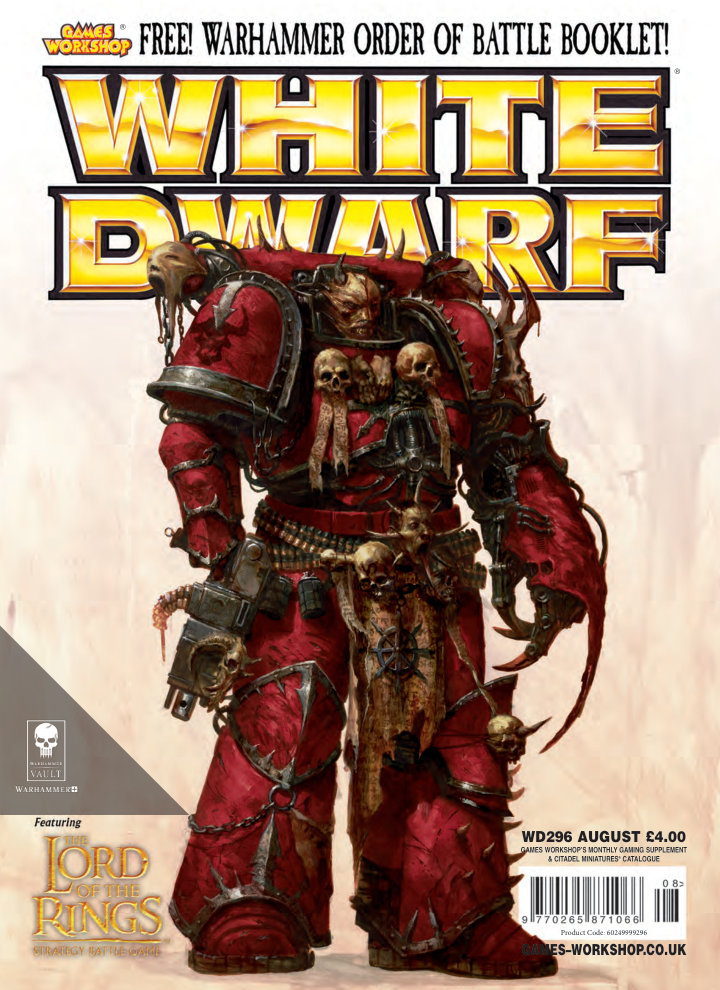
Imprint confirms August 2004, issue 296. Shooting replaces the army-selection article promised by the contents. The Armoured Company material anticipates the revised 40K rulebook, as explicit Scouts and vehicle-firing references show, although legacy wording remains; its edition notes preserve that transition. Main features, complete army-list components and substantial tutorials are included. Advertising, catalogues, directories and art-only pages are excluded.