EditorialWD 292 · p. 2
Paul Sawyer previews the Chaos Hellcannon, describing its miniature, daemon-bound character and Chaos Dwarf crew. A survey of coming Storm of Chaos armies then introduces Archaon’s Horde, Grimgor’s ’Ardboyz, Middenheim’s defenders and the Slayers of Karak Kadrin. The editorial presents the approaching campaign as an opportunity for armies with noticeably different identities and playing styles.
Warhammer Fantasy BattlesWarriors of Chaos
CommunityWD 292 · pp. 4–7
The new plastic Mûmak dominates the news, with an account of the manufacturing challenge and the Perry brothers’ work on beast and crew. Other notices cover a national painting competition, Josef Bugman’s new model, Rogue Trader vessels for Battlefleet Gothic and Forge World’s winged Hive Tyrant and Imperial crew figures. Publishing and Warhammer Online updates complete the month’s news.
Middle-earth Strategy Battle GameWarhammer 40,000Harad
InterviewWD 292 · pp. 18–23
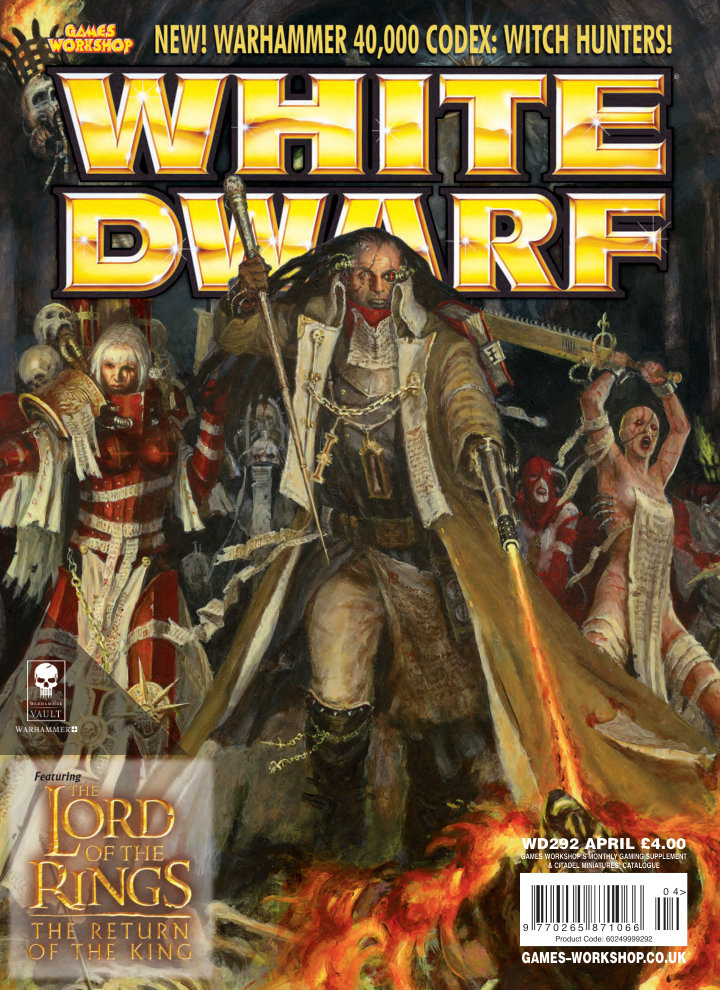
Graham McNeill and Andy Hoare trace Codex: Witch Hunters from concept meetings to its army list and visual presentation. They connect the Sisters’ older history to the Ordo Hereticus while preserving their Ecclesiarchy identity. Transport restrictions, stronger Acts of Faith and new penitent units address different styles of force. Psychological attacks, adversaries and ambiguous Radical or Puritan beliefs distinguish these Inquisitors from the Daemonhunters.
Warhammer 40,000Inquisition
PaintingWD 292 · pp. 24–26
Mike Dodds, Martin Isaksson and Sam Lee show how red, black, white and metal can produce the six major Orders Militant. Shared demonstrations cover hair, skin and weapons before comparing robes and armour in the principal colours. Controlled mixes and layered highlights distinguish materials within the restricted palette. Alternative schemes encourage readers to apply the methods to their own order rather than simply duplicate a studio uniform.
Warhammer 40,000Adepta Sororitas18 paint colours
ShowcaseWD 292 · pp. 30–35
Sander Tijssen develops a Norse Dwarf army after seeking a tactical change from Bretonnians. Marauder shields, horned helmets and textured fur cloaks establish its northern identity, while snow bases and individually named leaders reinforce the theme. Crossbowmen use Empire arms to achieve aiming poses. Tournament participation encourages him to keep adding units, turning the force into a growing collection rather than a fixed competitive roster.
Warhammer Fantasy BattlesDwarfs
RulesWD 292 · pp. 38–49
Gav Thorpe supplies a sequence for generating varied battles after both players have already chosen equal-sized armies. Engagement type, objectives, terrain, deployment and unusual conditions combine to change the tactical problem. Vanguards and rearguards affect how forces reach the table, while weather and magical disturbances add uncertainty. The system is designed for ordinary games and events, with a record sheet for the resulting scenario.
Warhammer Fantasy Battles
RulesWD 292 · pp. 47–48
An advanced version lets army composition and chosen strategies influence pre-battle decisions. Scouts, fast troops and the general contribute to a Strategy Rating, while war machines reduce it. Secret choices can favour terrain, deployment or the first turn, or deny an opponent’s strengths. Objectives are established earlier so commanders can try to arrange a battlefield suited to their mission.
Warhammer Fantasy Battles
TacticsWD 292 · pp. 52–55
Adi McWalter builds a 2,000-point crusading force around a grandson seeking the remains of his fallen ancestor. The narrative guides character vows and equipment, but the army also needs useful roles in every phase. Knights receive support from peasants, Mounted Yeomen, Pegasus Knights and a Trebuchet. His explanation shows how a personal theme and practical combined-arms choices can develop together.
Warhammer Fantasy BattlesBretonnia
TacticsWD 292 · pp. 56–57
Che Webster proposes a staged introduction to Epic through infantry, mechanised troops, tanks and artillery. Each addition teaches a new role: infantry holds ground, Chimeras enable manoeuvre, Leman Russ tanks remove armour and artillery suppresses opposing formations. Template forces let players practise the parts separately before combining them. The approach makes collecting the army a sequence of playable milestones.
EpicAstra Militarum
RulesWD 292 · p. 58
The army list organises the Steel Legion around infantry, mechanised, tank, super-heavy and artillery companies. Each company unlocks supporting formations and limited upgrades, while aircraft and Titan battlegroups provide larger assets. Costs, formation sizes and transport conditions make the collection advice usable as an actual army. Strategy and Initiative ratings establish how these forces operate within Epic’s activation system.
EpicAstra Militarum
RulesWD 292 · p. 59
Matched small forces compete for a central objective that must be held for a complete turn. Guidance covers table size, terrain density, rivers and deployment, allowing the mission to accommodate different training armies. It is intended for short games that introduce the rules in manageable stages rather than immediately requiring a full tournament battle.
Epic
Battle reportWD 292 · pp. 62–85
Adrian McWalter’s new Bretonnians meet Pete Scholey’s Tomb Kings in a sequel to their earlier battle. A custom assault mission sends the crusaders to recover a fallen duke’s remains, with a relief expedition represented by Grail troops. Pegasus and Questing Knights prove valuable as the Undead fail to coordinate their strongest elements. Bretonnia wins decisively, and both players discuss the turning points and the new army’s flexibility.
Warhammer Fantasy BattlesBretonnia
CampaignWD 292 · pp. 90–97
Phil Kelly and Graham McNeill add narrative structure to the local Eye of Terror campaign. Initial control values allow a replay from the beginning, and weekly themes introduce sabotage, Eldar intervention, naval support, warp storms and a final offensive. Time-specific event cards can reinforce armies or magnify strategic results. Guidance on tracking outcomes and incorporating Battlefleet Gothic connects individual battles to the broader war.
Warhammer 40,000Battlefleet GothicImperium
TacticsWD 292 · pp. 98–101
Jeff Leong develops four rules for movement: anticipate, coordinate, support and plan combat resolution. Diagrams show how charges, pursuits and overruns can expose a supposedly successful unit. Teams of different troop types protect one another and concentrate strength, while the wider battle requires coordination between those teams. The advice treats the eventual combat result as something shaped by manoeuvre before attacks are rolled.
Warhammer Fantasy Battles
RulesWD 292 · pp. 102–109
The Games Development team returns to the unusual fauna and encounters associated with Rogue Trader. Some creatures become army units, others disrupt both sides as independent hazards, and several offer substantial modelling projects. The introduction explains how objectives and victory points apply to those different roles. All of the additions are optional and require agreement, encouraging imaginative games beyond a narrowly tournament-focused army list.
Warhammer 40,000
RulesWD 292 · p. 103
Matthew Ward describes territorial Catachan Devils and their younger Devilspawn, then provides profiles and encounter rules. A third player or referee can deploy them as a hidden threat to both armies. Their ability to cross difficult ground, camouflage themselves and burrow makes the jungle dangerous. They cannot claim objectives, so their role is predation and disruption rather than conventional battlefield conquest.
Warhammer 40,000
RulesWD 292 · pp. 104–105
Andy Chambers gives Warp-dwelling Enslavers a shared dice pool for controlling other units. Resources must be divided between using existing slaves and attempting new takeovers; repeated influence can make control permanent. Proximity and psychic sensitivity affect vulnerability, while unused power can strengthen close combat. Background and modelling notes support an enslaved army or an independent force interfering with several players.
Warhammer 40,000
RulesWD 292 · p. 105
Phil Kelly provides Carnosaurs and Megasaurs as either wild predators or controlled riding beasts. Native creatures attack nearby units without regard to side, while mounted versions become Heavy Support choices with handlers represented in the combined profile. Crushing bites and monstrous strength make them dangerous in close combat. Conversion suggestions adapt fantasy creatures to the appearance of different Warhammer 40,000 armies.
Warhammer 40,000
RulesWD 292 · p. 106
Graham McNeill introduces aggressive reptiles whose migration takes them through the Warp to new feeding grounds. A pack appears unexpectedly from reserve and advances towards the nearest creature regardless of allegiance. Fast assault bursts make them more dangerous than their ordinary movement suggests. If resistance proves too strong, failed morale sends the survivors away through the Warp again.
Warhammer 40,000
RulesWD 292 · p. 107
Phil Kelly supplies zombie rules and several explanations for an outbreak, from Nurgle’s plague to psychic puppetry, alien parasites and dangerous plants. Slow movement and fearlessness define the basic horde, with an optional resilience upgrade allowing damaged bodies to keep attacking. Suggestions for combining plastic kits help turn the premise into a modelling project and a scenario suited to the players’ chosen story.
Warhammer 40,000
RulesWD 292 · p. 108
Andy Hoare allows characters to bring small packs of locally adapted hunting beasts. They accompany their owner, use suitable transport and disappear if the master is killed. Optional traits distinguish agile, strong or especially alert creatures, including animals that can detect infiltrators. Appropriate modelling makes the framework usable for many armies rather than tying it to one named species.
Warhammer 40,000
RulesWD 292 · p. 108
The smaller cousin of Catachan’s infamous exploding toad becomes a wandering battlefield hazard. It moves unpredictably and can release a lethal poisonous blast when disturbed by nearby fighting or gunfire. Particular creatures and protected targets interact differently with the explosion. The rules are intended to produce an entertaining complication, with additional toads making the encounter increasingly dominate the battle.
Warhammer 40,000
RulesWD 292 · p. 109
Pete Haines introduces a regimental doctrine replacing Rough Riders’ horses with hunting lizards. The beasts trade some speed for better protection and an extra natural attack. Kashann’s environment and an account of the Talavar campaign explain why such cavalry might develop and prove useful. Modelling suggestions use Cold Ones or older creature kits to represent the riders.
Warhammer 40,000Astra Militarum
RulesWD 292 · pp. 118–119
Che Webster offers a small-force format designed to play in less than an hour. A limited points budget, model-count bounds, hero restrictions and missile limits make forces quick to collect and reasonably focused. Conventions handle unusual matchups and duplicate named heroes. Balin’s Dwarves illustrate how an appealing character and a few packs of warriors can become a complete starting force.
Middle-earth Strategy Battle GameErebor
RulesWD 292 · p. 119
Two War Parties meet on a compact table, deploying in halves before fighting to reduce the enemy to a quarter of its original size. A surviving hero distinguishes a major victory from a minor one. A one-hour limit keeps the encounter brief and can leave the result a draw, making the mission suitable for clubs or other short gaming sessions.
Middle-earth Strategy Battle Game
TacticsWD 292 · pp. 120–123
Matthew Ward compares the demands of defending and attacking a fortress. Defenders must preserve scarce troops, cover weak points and concentrate fire on assault equipment; attackers need a flexible mix and must exploit their freedom to choose the point of attack. A survey of siege engines, towers, ladders, rams and demolition charges explains their practical strengths and vulnerabilities. Priority and heroic movement often decide whether the assault reaches the walls intact.
Middle-earth Strategy Battle GameGondor
ShowcaseWD 292 · pp. 124–125
Mark Jones chooses a movable street scene rather than a complete model of Minas Tirith’s enormous walls. Rounded stone arches, colonnades and a statue-topped fountain distinguish Gondor’s buildings from other Middle-earth architecture. Rearranging the structures makes the same terrain useful for different battles. The commentary shows how recognisable details can evoke a city without reproducing all of it.
Middle-earth Strategy Battle GameGondor
RulesWD 292 · pp. 126–127
Dwarf survivors race towards a warning beacon while Orcs pursue from the opposite edge. Lighting it requires a warrior to remain exposed and inactive, but can bring Men of Rhovanion onto the battlefield. Special morale rules treat both groups as parts of larger forces. An alternative points match lets other armies attempt the same urgent warning mission.
Middle-earth Strategy Battle GameErebor
ModellingWD 292 · pp. 128–129
Steve Cumiskey adds cavalry, a Captain and a standard bearer to give his growing Gondor collection speed and flexibility. Swapped bodies and an impressive sword distinguish the Captain, while scenic bases frame the mounted figures among Osgiliath’s ruins. Warm horses balance the cold armour, and named paint details cover wood grain and dried blood. The new models extend the existing force rather than changing its visual setting.
Middle-earth Strategy Battle GameGondor3 paint colours
PaintingWD 292 · pp. 130–131
Adrian Wood turns Gorbag and Shagrat into personal Captains named Borug and Orgoth. A donor shield and weapon alter their silhouettes, while a brighter metal treatment and additional face highlights make them stand out from the rank and file. Graveyard Earth adds another neutral colour without breaking the army’s scheme. The article combines modest conversions with selective extra painting effort to personalise familiar character models.
Middle-earth Strategy Battle GameMordor7 paint colours
RulesWD 292 · pp. 132–133
Matthew Ward follows Moria from its prosperity and friendship with Eregion to the awakening of Durin’s Bane and Balin’s failed return. Optional scenario rules then make the underground setting matter in play. Darkness limits sight, unstable paths and tremors threaten footing, and different peoples react differently to the ancestral halls. Players can select effects or roll for a more uncertain expedition.
Middle-earth Strategy Battle GameKhazad-dûm
ModellingWD 292 · pp. 134–135
Doug Bachelor recounts building a larger Orthanc after deciding that his first tower would be dwarfed by the Games Day venue. Foamboard structure and thousands of individual details create a transportable model, while surface carving, dark paint, metallic sprays and tinted windows give it character. The account records six weeks of repetitive work and improvisation, including the late discovery that the neat surfaces needed extensive distressing.
Middle-earth Strategy Battle GameIsengard
Imprint confirms April 2004, issue 292. Main features, substantial separate rules and tutorials are indexed. Catalogue pages, event/store directories, advertising and art-only pages are excluded.