InterviewWD 289 · p. 2
Paul Sawyer asks Jervis Johnson about the decision to replace the individual Specialist Games magazines with a single full-colour Fanatic publication. Johnson explains the intended improvement in production, availability and readership, while promising free online articles after publication. Practical answers cover the last issues of the older magazines, submissions and subscriptions. The editorial records a significant change in how the specialist games were supported and presented to their players.
CommunityWD 289 · pp. 4–7
A Bretonnian preview introduces the coming army book and new units, while Warhammer Online supplies screenshots and an interactive map. Other notices cover Epic Armageddon’s return, WarCry’s Dogs of War expansion and results from a Warhammer 40,000 tournament heat. Forge World’s Orca transport, new annuals and a fine-art reproduction project show the breadth of releases surrounding the month, alongside a memorial to an early contributor.
Warhammer 40,000Warhammer Fantasy Battles
CommunityWD 289 · p. 5
A tribute supplied by Chris Turnbull recalls his father’s work in game design and the early years of White Dwarf. It connects the Fiend Factory feature to his later role at TSR UK, then adds personal memories of cooking, running games and playing pinball. The short obituary preserves both a publishing legacy and the family’s affectionate picture of the person behind it.
LoreWD 289 · pp. 10–13
Graham McNeill follows the Runefangs from the alliance between Sigmar and the Dwarfs to Gorbad Ironclaw’s invasion of the Empire. The fall of Solland costs its count his life and sends his sword into enemy hands, while Altdorf survives a siege that nearly ends the nation. Centuries later an adventuring band recovers the weapon from a monstrous treasure hoard. Its return cannot restore the lost province, but makes the blade available again as a symbol and weapon of Imperial authority.
Warhammer Fantasy BattlesThe Empire
ShowcaseWD 289 · pp. 14–17
Johan Kolkjaer’s tournament-winning Emperor’s Children combine older miniatures, current models and extensive conversions. A flesh-toned scheme avoids the usual bright pink and purple, with red and brown ink treatments unifying the force. Captions describe a Daemon Prince assembled from Warhammer and Inquisitor components, a rebuilt Dreadnought and individual champions. The result reflects influences from Realms of Chaos and John Blanche while giving each Marine a distinct appearance.
Warhammer 40,000Chaos Space Marines4 paint colours
LoreWD 289 · pp. 20–21
Ian Hawkes introduces Ulric as a god of battle, winter and direct personal strength. The cult’s relationship with Sigmar is shaped by history and political rivalry as much as theology, while Middenland’s harsh landscape gives its worship a practical foundation. Middenheim’s position on the Ulricsberg, religious importance and knightly orders explain its power. Tales of the sealed Undercity hint at threats beneath a city celebrated for its formidable defences.
Warhammer Fantasy BattlesThe Empire
RulesWD 289 · p. 22
Priests give the cult army a religious character through bound prayers that improve charges, resist fear or punish nearby enemies. Additional rules let devout infantry include a priest without consuming a character slot, but distinguish this gathering from the Empire’s trained detachment system. Knightly leaders inspire particular troops, and hunting hounds move through woodland with their handlers. The mechanics turn faith, independence and aggressive pursuit into practical army differences.
Warhammer Fantasy BattlesThe Empire
LoreWD 289 · p. 23
The chronology follows Middenheim from the Teutogens’ fortress on the Ulricsberg through religious conflict, rival emperors and struggles over Middenland’s rule. Wars against vampires and northern invaders establish the city’s recurring military role. Later entries trace the Todbringer dynasty, Azhag’s defeat and the feud with Khazrak, giving the surrounding army rules a long and politically turbulent setting.
Warhammer Fantasy BattlesThe Empire
RulesWD 289 · pp. 24–25
The armoury distinguishes Ulric’s followers from a standard Empire force by restricting Sigmarite or unavailable treasures and adding their own weapons, armour, standards and talismans. The White Wolf hammer receives separate mounted and foot treatment. New items reward courage, pursuit and priestly fervour, while the Talismans of Ulric use rules different from ordinary magic items. Short histories attach those effects to the cult’s legends and sacred places.
Warhammer Fantasy BattlesThe Empire
RulesWD 289 · pp. 26–29
The complete list combines religious and knightly leaders with independent warriors, White Wolves and the Teutogen Guard. Hounds and hunters provide mobility and scouting, while conventional infantry occupies a different place from its role in a normal Empire army. Wolf-kin supply a stubborn, irregular element. Selection limits, equipment and background for the units make the list usable as a distinct force gathered around Ulric’s cause.
Warhammer Fantasy BattlesThe Empire
RulesWD 289 · p. 30
Middenland’s Elector Count receives a character profile alongside an account of the personal burdens and continuing Beastman war that define him. His Runefang and protective talisman support an unusually resilient mounted leader. Taking Boris also fixes the army’s command and composition, linking the named character to the state army described on the following page rather than freely adding him to the cult list.
Warhammer Fantasy BattlesThe Empire
RulesWD 289 · p. 31
A force led by Boris Todbringer uses the Empire army book with specified substitutions rather than the pure Cult of Ulric list. It retains conventional leaders and troops but changes where artillery, handguns, knights and cult units appear. Detachment restrictions and altered costs distinguish the state army from a religious host. The result allows Middenland’s identity to coexist with more of the Empire’s normal military organisation.
Warhammer Fantasy BattlesThe Empire
RulesWD 289 · pp. 36–39
Phil Kelly resolves questions about Grey Knights, Inquisitors, henchmen, allies, transports and psychic powers. The answers separate intended restrictions from errors, clarify how abilities interact with other codexes and explain the placement and use of Orbital Strikes. Several rulings address the practical consequences of attaching Daemonhunters to another army. Designer comments connect unusual equipment and deployment limits to the faction’s intended playing style.
Warhammer 40,000Grey Knights
CommunityWD 289 · p. 40
Jervis Johnson explains the delayed arrival of Necromunda Enforcers and introduces a Minotaur and Ogre Cheerleader for Blood Bowl. The question column then examines why Warmaster’s new figures often count as existing units. Avoiding continual additions to army lists protects the game from rules creep and keeps players from needing numerous magazine amendments. New visual options can therefore expand a collection without expanding every army’s rules.
NecromundaBlood BowlPalanite Enforcers
LoreWD 289 · pp. 42–45
Olde Weirde’s research into a disturbing rat leads to a survey of the creatures and peoples north of Kislev. The account distinguishes several kinds of Troll and considers their habitats, markings and supposed abilities, then expands to Beastmen, Ogres and Greenskins. Illustrations offer a naturalist’s record of the region’s mutations. The narrator’s scholarly confidence and personal complaints give the dangerous northern landscape a deliberately unreliable, humorous framing.
Warhammer Fantasy BattlesKislev
CommunityWD 289 · pp. 50–53
Ian Huxley and Adam Hall enter a small tournament at Battle Honours UK in Evesham rather than simply helping to run it. Ian’s Chaos force earns three draws after games against Greenskins and both Elven factions, while Adam’s Lizardmen win decisively against Undead, Elves and Dwarfs. Short game accounts and rosters show their contrasting fortunes. The visit also highlights the shop’s gaming space and the resources available to organisers of independent events.
Warhammer Fantasy BattlesWarriors of Chaos
ModellingWD 289 · pp. 54–57
Tammy Haye presents veteran Guard squads whose conversions communicate campaign experience and regimental identity. Personal weapons, scars, extra supplies and altered clothing distinguish the soldiers, while Dave Taylor’s Macharians add devotional details and Mark Tait’s unit draws on the Cityfight cover. Steve Shepherd’s cold-weather palette and Chris Blair’s painted markings show how colour can contribute as much as new parts. The examples encourage individuality without abandoning a squad’s shared equipment and background.
Warhammer 40,000Astra Militarum5 paint colours
PreviewWD 289 · pp. 60–63
The Bretonnian preview presents its knights through their ideals of courage, honour and faith in the Lady of the Lake. The visual spread culminates in a story of Duke Bohemond attacking Beastmen who threaten a village shrine. His rescue of the site celebrates knightly prowess, but his response to a peasant’s gift also exposes the distance between noble and commoner. The combination introduces the army’s heroic self-image alongside its social hierarchy.
Warhammer Fantasy BattlesBretonnia
LoreWD 289 · pp. 64–67
The profile investigates Farsight’s separation from the T’au Empire through conflicting Imperial theories and fragmentary testimony. His victories, the lost expeditionary Ethereals and the fortified enclaves beyond the Damocles Gulf leave observers debating corruption, ideology and concealed loyalty. Reports about Arthas Moloch deepen the uncertainty rather than resolve it. An account of the Arkunasha War places his tactical reputation and possible bitterness within an earlier military experience.
Warhammer 40,000T’au Empire
RulesWD 289 · p. 67
Farsight’s battlesuit and alien Dawn Blade create a commander who departs from the T’au preference for ranged combat. An Ork-fighting upgrade can improve the army’s close-combat abilities, while the breakaway faction’s limited resources restrict its available allies and support units. A bodyguard can accompany him under specified conditions. The entry makes his political isolation and martial reputation visible in both the character and army selection.
Warhammer 40,000T’au Empire
TacticsWD 289 · pp. 68–71
Mike Walker turns basic dice etiquette into a humorous tour of his gaming group’s habits. Declaring intentions before rolling avoids disputes, while a dice box protects models and makes cocked results easier to resolve. Coloured dice help track combat resolution, and plastic rings record wounds without being mistaken for a roll. Stories about saved re-rolls show why remembering a resource and spending it on a decisive event can matter more than improving an insignificant result.
Warhammer Fantasy Battles
ShowcaseWD 289 · pp. 72–75
Selected winners from the French Golden Demon demonstrate a strong Chaos theme alongside Bretonnian knights, an Ork Weirdboy and an Emperor’s Champion. Thomas Barse’s Daemonhunter is identified as the Slayer Sword winner. Captions credit each maker and category, allowing the spread to function as a concise record of the competition. The photographs celebrate finished work and conversions without supplying named paint recipes.
Warhammer Fantasy BattlesWarhammer 40,000
Battle reportWD 289 · pp. 78–101
Geoff Porritt’s Space Wolves face Max Horseman’s Iron Warriors under tournament conditions and the Trial Assault rules. The Wolves try to move assault troops through cover while their supporting vehicles disrupt the Chaos firebase; the Iron Warriors seek to stop the transports and contain the surviving attackers. Both armies suffer enormous losses, and a final duel removes both commanders. The victory-point difference falls exactly short of a minor victory, leaving a tournament draw whose analysis emphasises deployment, target selection and preserving units able to claim quarters.
Warhammer 40,000Space Wolves
RulesWD 289 · p. 79
The tournament mission combines normal victory points with control of table quarters. Deployment order and separation shape the opening, with selected units able to remain in reserve or deep strike and a chance of night fighting at the start or end. A six-turn limit makes mobile survivors valuable even after heavy casualties. The rules provide the framework used by the accompanying Space Wolves and Iron Warriors report.
Warhammer 40,000
RulesWD 289 · pp. 108–109
Hirgon carries Denethor’s call for aid through a scattered Orc patrol on his way to Rohan. The lone mounted messenger must cross the table, using darkness and uncertain sentry movement to avoid an early alarm. Detection or a noisy kill gives the Evil player normal control of the pursuing force. An alternative points match lets other heroes attempt a similar escape, making the scenario a compact test of route choice and restraint.
Middle-earth Strategy Battle GameGondor
PaintingWD 289 · pp. 110–111
Steve Cumiskey begins his Gondor collection by treating each warrior as an individual. Weathered skin and bright but worn silver armour create the look of soldiers defending Osgiliath, while dusty grey cloth and dark shield faces keep the overall scheme restrained. The guide follows the metal layers and finishing details through to rubble bases, then considers conversions that will make duplicate plastic poses distinct.
Middle-earth Strategy Battle GameGondor13 paint colours
PaintingWD 289 · pp. 112–113
Adrian Wood chooses plastic Mordor Orcs for their variety and conversion potential, demonstrating his painting method on their chief Raghat. Brown underlayers, grey fur and muted highlights give the rags and skin warmth without bright colours. A simple metal-and-ink treatment keeps the armour quick to paint, and matching rubble bases prepare the army for ruined city terrain. Contrasting materials within a limited palette unite the horde while allowing individual figures to differ.
Middle-earth Strategy Battle GameMordor7 paint colours
RulesWD 289 · pp. 114–115
Gandalf arrives at Weathertop before Frodo and faces the Nine around the ruined watchtower. Special protections represent his preparation and the stronghold’s lingering nobility, while darkness and arriving Ringwraith reinforcements shape the siege. The wizard must survive and banish enough foes, with linked-campaign rules carrying the wraiths’ remaining Will forward. An optional immediate Weathertop game lets the outcome affect their later attack on the Hobbits.
Middle-earth Strategy Battle GameThe Fellowship
RulesWD 289 · pp. 116–117
Matthew Ward first surveys Mordor’s geography, fortifications and the forces sustaining its armies. Optional environmental rules then let players move Points Match or other scenarios into that oppressive setting. Darkness restricts targets, fumes and thorned ground cause danger, Sauron’s gaze strengthens Evil’s courage, and a roaming Troll can threaten either side. Players can agree on effects or generate them randomly, turning the location into an active part of the battle.
Middle-earth Strategy Battle GameMordor
ModellingWD 289 · pp. 118–121
Mark Jones builds a ruined structure from foamboard inner walls and a textured polystyrene outer layer. Templates establish the arches, while irregular scored brickwork and broken edges avoid a mechanical appearance. A bevelled base, rubble and pieces from the boxed game add structure and detail. Grey drybrushes and brown-green weathering finish a practical terrain piece whose methods can be extended to stairways, multiple storeys and varied city ruins.
Middle-earth Strategy Battle Game6 paint colours
RulesWD 289 · pp. 122–123
Thranduil’s surrounded Elves must withstand attacks from several directions until Dáin’s Dwarves arrive. The relief force’s uncertain entry creates a race between breaking the Evil army and losing two Good heroes. Mirkwood Sentinels receive an extra shooting ability, while the source uses Celeborn’s profile to represent Thranduil. A points-match alternative allows other forces to attempt the same rescue battle.
Middle-earth Strategy Battle GameWoodland Realm
TacticsWD 289 · pp. 124–127
Adrian Champion assesses Gondor’s ordinary warriors, Rangers, elite guards, cavalry and named heroes before combining them into formations. Armour and supportive leadership help human troops endure, while Knights need carefully timed charges and infantry support. Shield walls can curve against encirclement, and a hero-led spearhead offers a route through dispersed enemies. The advice repeatedly warns against isolating valuable troops and shows how coordinated weapons make the force stronger than its separate elements.
Middle-earth Strategy Battle GameGondor
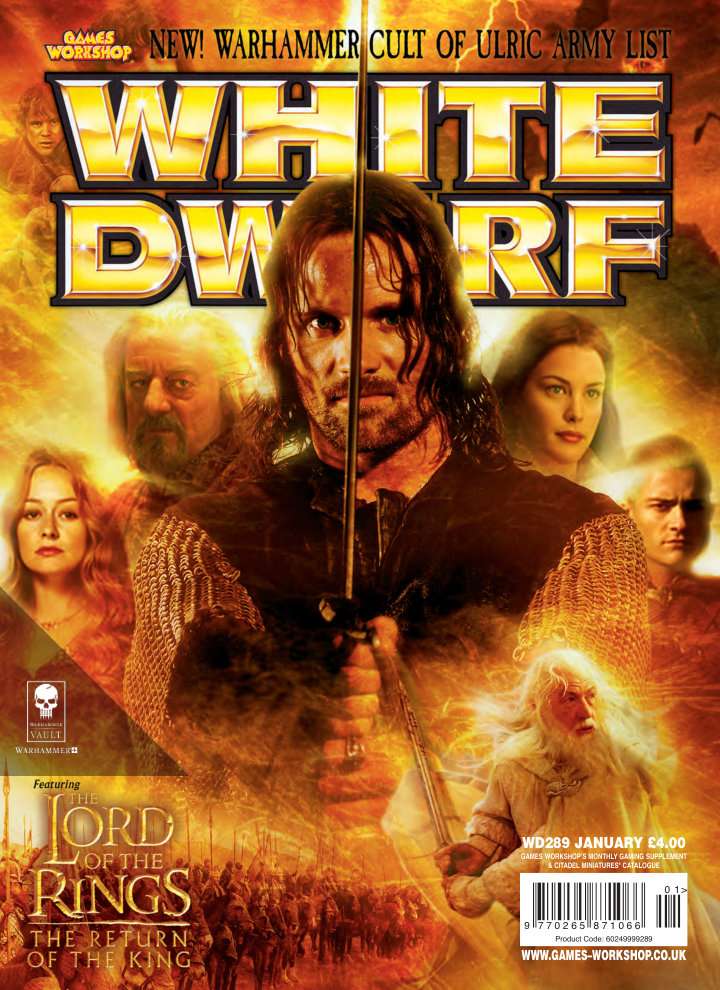
Imprint confirms January 2004, issue 289. Main features, substantial rules, original scenarios and painting guides are indexed; catalogues, directories, advertisements and art-only dividers are excluded.