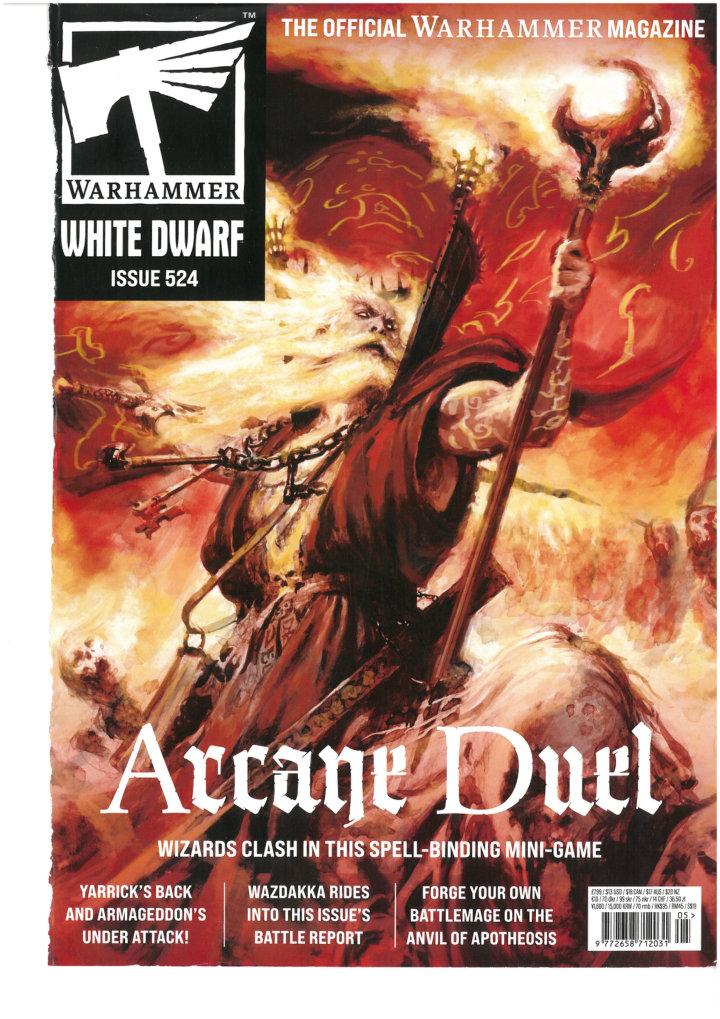
EditorialWD 524 · Inside cover
The editorial uses modelling, painting, gaming and reading as the four pillars that support the hobby. It introduces the issue through concrete examples of each, from converted Knights and Battlemages to Speed Freek painting, a vehicle-heavy battle and the concluding instalment of the Chronicles of Bain.
LoreWD 524 · pp. 2–7
The Collegiate Arcane trains gifted humans to control dangerous realm-magic and channels that expertise into Sigmar’s armies. Its eight Colleges draw elemental motes from the world around them, so even a wizard far from their native realm can find the energies needed for healing, deception, metalworking or destructive battle spells. Masters of Combat Arcana supplement scholarly training with practical wards and counter-spells suited to the front line.
Age of SigmarCities of Sigmar
LoreWD 524 · pp. 6–7
Practised battle spells can become instinctive, while grimoires preserve complex invocations and help a wizard prepare unfamiliar magic in advance. The Colleges also stage dangerous contests suited to their disciplines: Bright College apprentices endure fiery trials in the Crucible, whereas Grey Wizards seek victory through illusions that can imprison an unwary mind. A short scene illustrates the lesson as Blissa abandons a failing shield, sidesteps a sorcerer’s attack and kills him with conjured fire-serpents.
Age of SigmarCities of Sigmar
RulesWD 524 · pp. 8–14
This Cities of Sigmar hero creator builds a custom Collegiate Mage for Path to Glory, with permission required to bring the character into other games. Apprentice, advanced and archmage budgets determine the available destiny points and game points; a basic human wizard then gains an origin, an optional flaw, a bespoke spell, a companion and further upgrades. Flaws deliberately free points for other strengths, making a frail or reckless eccentric as viable a starting concept as a disciplined battlefield specialist.
Age of SigmarCities of Sigmar
RulesWD 524 · p. 11
A modular spell builder lets the player decide whom a custom Battlemage targets, how far the spell reaches and what effects it combines. Damage, healing, concealment, slowed movement, flight and weapon enhancements carry different destiny-point costs, while choosing a harder casting value can recover points. The resulting ability is recorded on a blank spell template and given a name and background that suit the mage’s personality.
Age of SigmarCities of Sigmar
RulesWD 524 · pp. 12–14
A mage can ride a warhorse or acquire a familiar, with separate upgrade paths for fast cavalry, flying companions and fighting familiars. The familiar increases magical capacity but can be drained to rescue a poor casting roll at the cost of later power. Further options develop the wizard’s fighting skills, magical defence or spellcasting mastery, including a blasting wand, a protective ward and the chance to repeat a successfully cast spell.
Age of SigmarCities of Sigmar
ModellingWD 524 · p. 15
Matt builds his flamboyant Bright Wizard around the Strong Fashion Sense flaw, using an Old World Battle Wizard with a swapped Battlemage head and a frog familiar. Red and yellow Contrast-painted robes reinforce the fiery theme without supplying named colours. The accompanying Advanced Arcanist warscroll combines the familiar, a blasting wand and spell mastery with a concealment spell imagined as a cloud of choking ash and cinders.
Age of SigmarCities of Sigmar
ModellingWD 524 · p. 15
Dan turns a spare Freeguild Soul Shepherd into a Celestial Wizard by replacing its head and censer with Battlemage components, then adds a Sylvaneth spite as a familiar. Purple and blue robes, including a blue-grey beard, distinguish the elderly arcanist from his green-clad army. Toya Jian’s example Advanced Arcanist profile pairs magical disruption and improved casting with Celestial Conveyance, a spell that accelerates an allied unit and grants flight.
Age of SigmarCities of Sigmar
RulesWD 524 · pp. 16–19
Two wizards spend a finite pool of power dice to cast spells, move around a magical arena and exhaust the opponent’s reserves. Casting risks miscasts but can produce irresistible total power; defending players instead lock one of their own spells to attempt an unbinding roll. After each turn the used or selected spell rotates out of the player’s hand and a different public spell rotates in, making timing and denial as important as a large casting roll.
Age of Sigmar
RulesWD 524 · p. 19
The arena’s zones add a positional contest to Arcane Duel. Warding zones and the anti-magic aura restore access to locked spells, life-giving spaces replenish dice, and the central nexus increases the harm inflicted by successful attacks. Distortion fields drain reserves, while ley lines move either wizard, allowing a player to displace a rival from a protective position or force them towards danger.
Age of Sigmar
LoreWD 524 · pp. 20–31
A conversational guide introduces Armageddon as an industrial hive world whose huge population, manufacturing capacity and strategic position make its survival important to the Imperium. It separates the planet’s actual wars from the versions preserved in Imperial records, where Angron’s invasion was suppressed, and follows the conflict through Ghazghkull’s assaults and the long rivalry between the Ork warlord and Commissar Yarrick.
Warhammer 40,000Astra Militarum
LoreWD 524 · p. 23
Armageddon’s Steel Legion favour mechanised infantry, with Chimeras and protective clothing suited to a poisoned industrial world. Invasion has reversed the normal outward flow of regiments, as the planet increasingly consumes both its own recruits and soldiers sent from elsewhere. The illustrated survey distinguishes the indigenous legion and jungle-fighting Ork Hunters from supporting Krieg, Cadian, Mordian, Elysian, Savlar and Catachan formations.
Warhammer 40,000Astra Militarum
LoreWD 524 · p. 25
Yarrick and Ghazghkull are presented as enemies whose mutual hatred has become inseparable from a grudging respect. The Commissar frustrated the Ork assault on Hades and pursued his opponent beyond Armageddon, while Ghazghkull repeatedly sought his death yet came to value Ol’ Bale Eye as his best enemy. The sidebar traces that recurring pursuit rather than treating either invasion as a self-contained encounter.
Warhammer 40,000Astra Militarum
LoreWD 524 · pp. 26–29
A survey of the combatants and a double-page planetary map bring the history of Armageddon up to the renewed Ork assault. Ghazghkull’s mass teleportation technology delivers the Great Waaagh! into the system, with Wazdakka’s Speed Freeks leading the attack across Armageddon Prime. The accompanying profiles place surviving veterans, new Imperial leaders, Ork specialists and the returned Yarrick in the same continuing war, while the map distinguishes Imperial, Ork-held and ruined hives.
Warhammer 40,000Orks
LoreWD 524 · pp. 30–31
A gazetteer follows the contrasting fortunes of Armageddon’s major hives and wilderness regions across its successive invasions. Hades survives Yarrick’s famous defence only to be obliterated by an asteroid; Tempestora remains in Ork hands after a submarine assault; and Helsreach’s resistance leaves its lower levels flooded. Other entries explain the devastation of Thoraddis, treachery at Acheron, the relative isolation of Tartarus and the continuing threats hidden in the Equatorial Jungle and Fire Wastes.
Warhammer 40,000Orks
LoreWD 524 · pp. 32–33
Yarrick’s publication history runs from a blue counter in Battle for Armageddon and his first 1992 miniature to successive rules, models and Black Library stories. The retrospective follows the changing claw, banner and heroic imagery, the Fortress of Arrogance Baneblade, and the later suggestion of his death. His May 2026 return preserves a recognisable silhouette while adding reinforced legs, a larger power pack and more support for the enormous claw, details that hint at the cost of his survival.
Warhammer 40,000Astra Militarum
ShowcaseWD 524 · pp. 34–49
The second Knight gallery collects individual Imperial and Chaos war machines painted and converted by studio hobbyists. Each contributor ties a striking model to its pilot, household or personal history, then explains practical choices in construction or colour. The spread ranges from a walking Dark Angels shrine to weathered renegades and daemonic engines, with compact recipes that make the varied armour and metal treatments reusable.
Warhammer 40,000Imperial Knights
PaintingWD 524 · p. 35
Chris’s Knight Abominant weaponises the suffering of captive psykers through a corrupted Throne Mechanicum, allowing its witch-hating pilot to unleash psychic destruction without admitting to sorcery. The battered brass armour is built from successive drybrushes over black, with sepia-darkened metal and pale blue-green corrosion. The model’s carrion daemons and displayed corpses reinforce the accompanying account of expended prisoners being lashed to its hull.
Warhammer 40,000Chaos Knights8 paint colours
ModellingWD 524 · pp. 36–37
Charlie’s ancient Cerastus Knight Lancer is an ally of the Dark Angels whose past reaches back to the Great Crusade and the fall of Caliban. A chapel built from several scenery ranges, plasticard and Dark Angels components turns its carapace into a moving monument; Bretonnian and Legion transfers support a hand-painted family crest on the shield. The supplied scheme combines airbrushed green armour with grey masonry, dark steel and warm gold trim.
Warhammer 40,000Imperial Knights14 paint colours
PaintingWD 524 · p. 38
Duncan’s Knight belongs to a household whose pilots surrender their former identities and assume the recorded personality of an ancestral warrior. Lupinotum’s inherited obsession is astrology, reflected in markings etched across pale and green armour. The recipe uses simple base colours and a luminous blue blade, then seals the model before brown oil washes and brown-orange streaks supply a heavily weathered finish.
Warhammer 40,000Imperial Knights9 paint colours
ModellingWD 524 · p. 39
Nathan imagines an arrogant exile from House Orhlacc returning from underwater imprisonment as a Chaos-tainted knight seeking vengeance. Maulerfiend tendrils, spare Chaos Knight armour and a Great Unclean One’s flail reshape the machine into a bristling sea-monster. Stippled purple armour and distressed mixed-metal surfaces create grime, while Wraithbone and Tesseract Glow give its details a bright, unnatural green contrast.
Warhammer 40,000Chaos Knights10 paint colours
PaintingWD 524 · p. 40
David’s first Knight-scale project creates a renegade household related visually to House Lucaris, but substitutes silver trim, additional bone panels and different transfers. Sacrament of Wrath’s blue-green armour is mixed from Stegadon Scale Green and Kabalite Green, while shaded bone and darkened metal provide strong contrasting blocks. Several brown washes build the rust, and the contributor describes the project as the beginning of a second Knight rather than a finished exploration of every technique.
Warhammer 40,000Chaos Knights13 paint colours
PaintingWD 524 · p. 41
Scott depicts a Knight stolen from House Terryn and presented to Huron Blackheart, with pilot Vultir Luzken now seeking glory among the Red Corsairs. Sponge work and drybrushing leave patches of the old blue-and-bone livery visible beneath new red armour. Ancient brass, yellow plasma glow and green lenses complete a project deliberately restricted to those texturing techniques; a future black hand emblem is discussed as a planned addition.
Warhammer 40,000Chaos Knights11 paint colours
ModellingWD 524 · pp. 42–43
Jason unifies his Knights with an existing Ryza Mechanicus army through white armour and orange markings, while imagining a household absorbed into the forge world. Aggressive poses and scratch-built weapons emphasise that allegiance: a Paladin carries a Basilisk earthshaker and a Skitarii loading crew, and rebuilt leg joints use plasticard hydraulics and guitar-string cables. Gloss varnish before the shade helps preserve crisp armour, with brown stippling adding damage.
Warhammer 40,000Imperial Knights10 paint colours
PaintingWD 524 · p. 44
Jason’s Vostroyan noble escapes his people’s usual first-born conscription but eventually serves alongside their armies as the pilot of an ancient Knight. The model wears a blue scheme with angular dark- and light-grey digital camouflage, highlighted individually to keep the pattern legible. Shaded Leadbelcher forms the chassis, while copper mixed with bright steel provides the brass trim and ties the machine’s worn surfaces together.
Warhammer 40,000Imperial Knights11 paint colours
ModellingWD 524 · p. 45
Adam’s fallen household began as loyal Mechanicus champions in the Halo Stars before isolation after the Great Rift opened the court to Chaos. Lord Byronix’s machine mixes Chaos vehicle components with Archaon’s huge mutated wings, creating a recognisably Knight-sized engine with a much more monstrous outline. The recipe combines dark blue and red armour, shaded gold and steel, corrosion products and a purple-tinted plasma effect.
Warhammer 40,000Chaos Knights10 paint colours
ModellingWD 524 · pp. 46–47
Jonathan builds two diseased Knight brothers from a Knight Tyrant, a Miasmic Malignifier and a Feculent Gnarlmaw. Pavor retains Tyrant legs beneath a furnace-like body, while Dolor rearranges torso plates and uses the original arms and weapons as legs, demonstrating how far a familiar kit can be pushed into organic corruption. Sickly green armour, bruised pale flesh, layered rust and glossy Nurgle’s Rot support the fiction of two decaying pilots enduring largely to spite one another.
Warhammer 40,000Chaos Knights14 paint colours
PaintingWD 524 · pp. 48–49
Matt paints a Hawkshroud lance to accompany his Black Templars on the Lastrati Crusade, reusing techniques from his Imperial Fists. Warm desert-yellow armour rises through several yellow highlights, with red details and dark trim providing the familiar household contrast. Close views distinguish individual pilots through altered badges and campaign honours, including Sir Kenrick’s Templar cross and Sir Mattius’s Imperial Fist emblem, rather than giving every Knight identical heraldry.
Warhammer 40,000Imperial Knights14 paint colours
CampaignWD 524 · pp. 50–53
The escalation series reaches 1,000-point Incursion armies and explains how that extra space changes both collection-building and play. Larger infantry, vehicles and monsters become practical, while earlier games reveal weaknesses or favourite units that justify revising the original plan. Repeated encounters also generate rivalries and unlikely heroes, which the accompanying optional campaign abilities turn into short-lived benefits against the same opponent.
Warhammer 40,000
RulesWD 524 · p. 52
Six optional rewards translate events from a previous battle into abilities for the next meeting with that opponent. Surviving victorious warlords can generate command points, personal enemies encourage precision or vengeance, and unexpectedly successful ordinary troops inspire their comrades. Other benefits acknowledge the army’s last survivors or loyal animal companions; designer notes explicitly exclude already elite exemplars and motorbikes from rewards intended for different narrative situations.
Warhammer 40,000
RulesWD 524 · pp. 54–55
Hammer Blow gives 1,000-point armies an asymmetric clash between a prepared defender and an attacker who must keep the assault moving. Each side’s scoring depends on retaining its own deployment objectives before it can profit from gains elsewhere, while a sticky-control rule lets troops advance without permanently garrisoning every marker. The tactical note warns that reserves and Rapid Ingress can punish an apparently safe rear area, and recommends replaying with roles reversed.
Warhammer 40,000
LoreWD 524 · pp. 56–63
Wazdakka Gutsmek turns the galaxy into a race track, attracting a vast Speedwaaagh! despite his lack of interest in leading followers. The biography follows his exile from an Evil Sunz tribe, obsession with rebuilding Big Revva and frustration when the Great Rift blocks his route. Ghazghkull offers access to the mega-tellyshokka in return for spearheading the new invasion of Armageddon, a bargain that promises both a fresh battlefield and a route to still more worlds.
Warhammer 40,000Orks
LoreWD 524 · pp. 58–59
Big Revva has been destroyed and rebuilt so often that little of its original construction may remain, but each incarnation is faster and more heavily armed. Its current weapons combine a psyko-gatler, teleport-assisted propulsion and Wazdakka’s grabba dragga, which also enables violent turns around convenient obstacles. Fixit survives by understanding every mechanical fault and hiding place, keeping the bike running while knowing when to duck, repair or leap clear of an impending crash.
Warhammer 40,000Orks
LoreWD 524 · p. 59
The account of Scalex VI explains Wazdakka’s most celebrated trophy. Facing a Warlord Titan that his horde could not damage, he rode up an overlooking mesa and hurled his bike through the god-machine’s void shields into its command bridge. The flaming impact and slaughter of the bridge crew turned a likely defeat into a legend, with the princeps’s skull kept as proof of the extraordinary kill.
Warhammer 40,000Orks
LoreWD 524 · pp. 60–61
A campaign map traces Wazdakka’s apparently irrational journey from ruined agri-worlds and the conquest of Scalex VI to rival Ork territories, daemon-haunted Pulvenor and an Exodite hunting ground. Victories bring new followers and trophies, while the Great Rift repeatedly frustrates attempts to reach the galactic north. The route finally converges on Ghazghkull at Golgotha, where an alliance sends the Speedwaaagh! to the Plains of Anthrand as Armageddon’s renewed invasion begins.
Warhammer 40,000Orks
LoreWD 524 · pp. 62–63
Four subordinate bosses give Wazdakka’s horde enough structure to keep moving in roughly the same direction. Deathskull Grizsnag leads mobile salvage workshops, Zotsnik’s Da Shokkas rely on unpredictable teleportation technology, and Gorgot Dakkfist crams gun decks and infantry-crushing weapons onto his Battlewagons. Bad Moon Dorok Kankrumpa supplies fuel for a profit, carrying volatile reserves perilously close to the weapons mounted on his tankers.
Warhammer 40,000Orks
Battle reportWD 524 · pp. 64–87
Grant’s improvised Astra Militarum force attempts to halt Dan’s Speedwaaagh! outside Hive Volcanus while Yarrick escapes towards Death Mire. The Armoured Gauntlet mission rewards Orks for breaking through and the defenders for destroying attackers, with objectives supplementing both sides’ scores. Additional vehicle damage rules leave many machines crippled but still obstructing the battlefield, making repeated repositioning and blocked routes central to the contest.
Warhammer 40,000Astra Militarum
TacticsWD 524 · pp. 66–67
Grant assembles an improvised Armoured Infantry defence around Commissar Graves, mixing Cadian and Krieg squads in Centaurs and Chimeras with Hippogriff armoured fighting vehicles. His plan uses transports and infantry to obstruct the Orks’ route, with a Rogal Dorn acting as a final goalkeeper against anything that escapes the line. The army is chosen to suit the story of delaying Wazdakka while Yarrick travels towards Death Mire, rather than as a detached competitive exercise.
Warhammer 40,000Astra Militarum
TacticsWD 524 · pp. 68–69
Dan combines fast bikes and buggies with heavier Battlewagons, a Morkanaut and a Kill Rig to force a route through the Imperial defence. Turbo Boostas can propel Speed Freek units through a gap, while the towering Morkanaut threatens to step over vehicles used as roadblocks. Transported infantry and a Dakkajet broaden the attack, and the mission rewards reaching or leaving the enemy end of the board rather than simply destroying everything in sight.
Warhammer 40,000Orks
InterviewWD 524 · pp. 88–91
Miniature designer Seb and ’Eavy Metal painter Tom explain how Wazdakka’s first official model became a centrepiece without making the rider as large as Ghazghkull. Real bicycle mechanics informed Big Revva’s proportions, suspension and working details, while a jumping, fist-raised pose expresses the speed-obsessed Ork’s showmanship. The discussion also follows the fairing-mounted gun, reel-out claw, split trophy skull and Fixit’s carefully chosen place on a model designed to remain convincing beneath its extravagance.
Warhammer 40,000Orks
PaintingWD 524 · pp. 92–93
Tom makes bright, highly saturated Evil Sunz red the focal point of Wazdakka’s model, contrasting polished armour with dark working metal, leather and a dusty base. The two pages provide detailed mixed-colour recipes for Wazdakka and Fixit’s differing skin, red and yellow markings, copper, steel, clothing, tyres, skulls and terrain. Layered glazes and fine highlights separate sun-bleached flesh, hard reflective edges and worn surfaces; the rokkit flame’s cyan-to-warm transition is discussed without an accompanying named-colour recipe.
Warhammer 40,000Orks51 paint colours
PaintingWD 524 · pp. 94–97
Harvey’s buggy guide aims for a weathered gaming model using separate crew, armour, tyre and chassis assemblies to keep brush access manageable. Mephiston Red panels receive warm drybrushed edges and successive stipples of highlight colour, Rhinox Hide and Leadbelcher to suggest worn paint and exposed metal. Shared metal recipes keep the crew and vehicle consistent, while different highlight strengths distinguish softer cloth from harder leather.
Warhammer 40,000Orks31 paint colours
PaintingWD 524 · p. 97
The Snazzwagon’s base echoes the two-texture treatment used beneath Wazdakka. Patches of Agrellan Earth dry first to create cracked ground, then Armageddon Dust fills the spaces around them before a shared sepia shade and bone drybrush unify both surfaces. Steel Legion Drab finishes the rim, and Mordian Corpsegrass tufts add small points of interest without obscuring the dusty terrain.
Warhammer 40,000Orks5 paint colours
RulesWD 524 · pp. 98–101
This solo or cooperative Gallowdark mission puts a kill team inside a sinking Ork submarine after planting demolition charges. Shooting can puncture the hull, breached compartments fill with water and flooding spreads through connected rooms, so killing a guard may also shorten the time available to escape. Operatives can spend precious actions draining rooms or using escape pods; once the total flooding reaches its limit the vessel implodes, and success requires at least half the team to have escaped.
Kill TeamOrks
FictionWD 524 · pp. 102–111
An overconfident Ork kommando stalks Elias Bain into a carefully prepared ambush, only to discover that the supposedly vulnerable human has made terror into a weapon. Bain deliberately spares the mutilated survivor to spread his reputation, prompting a friend to question whether he really wants to become the monster the enemy imagines. The squad’s next summons brings him before Yarrick, whose offer of promotion confronts Bain with a responsibility he would rather refuse.
Warhammer 40,000Astra Militarum
CommunityWD 524 · pp. 112–113
The Bunker introduction previews reader miniatures, a vast French battle and a new collection of light-hearted monthly awards on the back page. A recurring painting-challenge calendar gives themes and submission windows, while the achievement tracker explains how painting, scenarios and club events contribute towards hobby ranks. The printed sample log is labelled June 2026 within this May issue and functions as a club record rather than changing the magazine’s publication date.
CommunityWD 524 · pp. 114–115
Readers describe returning to the hobby, finding support through a welcoming local shop and using painting as a satisfying creative routine. Other letters celebrate memorable battle reports and personalised armies, ask for their more frequent return, and welcome scratch-built terrain tutorials. The editorial replies discuss the pleasure of painting outside a main collection and suggest that further terrain-building features are already being considered.
LoreWD 524 · p. 115
A reader asks why Dracothion seems absent after helping Sigmar and why he did not prevent the Age of Chaos. The answer recalls his contribution to the Stormcasts’ creation, his draconic descendants and his actions during the Realmgate Wars, while stressing that a godbeast is neither omnipotent nor guardian of the entire cosmos. His movements through the Great Void remain uncertain, but Azyr’s continuing safety is presented as evidence that his influence endures.
Age of SigmarStormcast Eternals
ShowcaseWD 524 · pp. 116–117
A reader gallery celebrates magical characters in keeping with the issue’s wizard-duel theme. Carlos Gascon Rodriguez’s Be’lakor leads the display, followed by Scott Burns’s Slann Starmaster, Alex Magotti’s Goblin Shaman, Marc Tippler’s Swampcalla Shaman and Pot-grot, and Kev Lawrence’s multiple renditions of Gandalf. The photographs offer contrasting approaches to powerful spellcasters and characterful assistants without supplying named paint recipes.
Age of SigmarMiddle-earth Strategy Battle GameSlaves to Darkness
ShowcaseWD 524 · pp. 118–119
The monthly challenge gathers large reader projects with strongly different silhouettes: Scott Reynolds II’s Megatrakk Scrapjet, Alvin Wong’s Death Guard Rhino and Albert Żygadło’s Akhelian Leviadon. The vehicles emphasise the machinery side of the theme, while the enormous Idoneth sea creature supplies its monster counterpart. The spread celebrates finished work and visual variety rather than introducing new rules or a shared paint recipe.
Warhammer 40,000Age of SigmarOrks
ShowcaseWD 524 · p. 119
Albert Żygadło explains the contrasting blue and red palette chosen for his Leviadon, raising the dark blues into lighter highlights and ending the red areas with yellow edges. Violet-skinned riders and metallic equipment add further separation from the great sea creature. A built-up base of glue, sand, cork and bark receives dark tones followed by drybrushing to emphasise texture; the account names colour families but no specific paint products.
Age of SigmarIdoneth Deepkin
ShowcaseWD 524 · pp. 120–121
The studio team contributes its own large models to the Monsters and Machines theme. Andy’s Morkanaut fills the opening page, followed by Jonny’s Belisarius Cawl, Calum’s Slaaneshi Daemon Prince and Sergi’s Mindstealer Sphiranx. These four finished pieces demonstrate the theme across both major Warhammer settings, with photographs and attribution but no step-by-step recipes.
Warhammer 40,000Age of SigmarOrks
CommunityWD 524 · pp. 122–123
Vincent Assailly recounts organising a fifty-player weekend battle in Dormans, France, with approximately 40,000 points on each side. Over a year, two groups of twenty-five hobbyists worked towards coherent Jormungandr Tyranid and grey Astra Militarum armies, supporting painters of different skill levels so that the finished forces looked unified. The organisers also built sixteen boards in a month, finishing the last terrain during the event itself; the account focuses on cooperation, travel and the practical effort behind the spectacle.
Warhammer 40,000Tyranids
CommunityWD 524 · pp. 124–125
Five months into Bunker Bingo, the team reports progress across painting, army-building and campaign play. Finished Terminators, Lysander and an Iron Warriors officer illustrate different routes through hobby goals, while Dan’s new Cities of Sigmar force joins a studio campaign. The accompanying team notes mix current projects with Cameron’s move to the Warhammer 40,000 editing team and encourage readers to keep using the downloadable annual challenge sheet.
ShowcaseWD 524 · p. 124
Cameron’s Terminators belong to the obscure Halo Dragons, a Chapter represented in the background by little more than a name and sombre heraldry. He describes using such small references as a prompt for research and then expanding the gaps with personal ideas. The feature encourages hobbyists to adopt an overlooked sub-faction and develop a collection around it, with the finished squad demonstrating how a brief mention can sustain a distinctive project.
Warhammer 40,000Space Marines
Battle reportWD 524 · p. 124
Dan brings his Cities of Sigmar collection into the Vanishing of the Emberwing studio campaign after previously participating with Kharadron Overlords. His Survivors of Hardship suffer badly against Kell’s Cult of a Thousand Beaks, with magical attacks and close pressure leaving only nine models on the battlefield. Victory comes from the crew of Old Inaccurate carrying their cannon into neutral ground at remarkable speed, a small action that rescues an otherwise disastrous first encounter.
Age of SigmarCities of Sigmar
PaintingWD 524 · p. 125
Matt paints Lysander in separate body, cape, shield and base assemblies to preserve access while working to a high finish. The base begins in Mechanicus Standard Grey and gains earthier variation through several drybrushed colours, preventing a flat monochrome result. A sequence from Word Bearers Red through progressively brighter reds builds the cloak, giving the finished character a strong warm accent against his Imperial Fists armour.
Warhammer 40,000Space Marines9 paint colours
ShowcaseWD 524 · p. 125
Adam follows his previous month’s Legionaries with a battered Iron Warriors Saturnine Praetor, using plentiful damage to imply a veteran of hard fighting. Martian Ironcrust gives the base a contrasting reddish texture against the extensive metal armour. He is also eager to exploit the officer’s ability to bring his six heavily armed Saturnine Terminators into a deep strike, linking the newly finished character to a wider Legion project.
The Horus HeresyIron Warriors1 paint colour
CommunityWD 524 · p. 126
The revived back-page round-up picks the month’s favourite details: wizard conversions, research into Armageddon, new armoured vehicles and spectacular explosions. Wazdakka’s psyko-gatler takes Weapon of the Month, a Battlemage crystal ball becomes Bit of the Month, and a tramplasquig trying to eat a guardsman supplies the new photographic award. The page also invites reader miniatures, club stories, tactics, lore questions and practical hobby tips for future issues.
RulesWD 524 · Unnumbered arena insert
The tear-out arena supplies the physical battlefield for Arcane Duel, with a central red nexus, opposed starting zones and surrounding spaces marked by distinct magical colours. Its layout makes the movement and displacement spells meaningful by linking the pool of power dice to position. Players use the board together with the rules in the main article and the supplied reference cards, rather than treating it as a separate scenario.
Age of Sigmar
RulesWD 524 · Unnumbered card insert
Seven double-sided spell cards provide fourteen possible spells, with only the randomly exposed sides used in a game. Direct attacks compete with ways to steal or replenish power dice, force movement, prevent a rival’s next move or exploit proximity; some powerful choices also risk the caster’s reserves or give the opponent a chance to reposition them. Two additional reference faces explain the arena zones, keeping the board’s defensive, restorative and hazardous effects close at hand.
Age of Sigmar
RulesWD 524 · Unnumbered card insert
This matched-play battleplan initially rewards controlling objectives in pairs as well as holding ground more generally. Magical liferoots tempt the underdog to strengthen a wizard’s casting, but failure or a successful unbinding inflicts a cost, and the flank objectives disappear when vegetation erupts at the start of the fourth round. Players therefore balance early gains on the edges against a later battle for the remaining objectives, with battle tactics resolving otherwise tied scores.
Age of Sigmar
RulesWD 524 · Unnumbered card insert
Poisoned Chalice scatters increasingly hazardous strategic prizes across the battlefield. A player can try to raise the power of objectives they control, increasing their scoring potential, but units near those markers face a growing risk of mortal wounds every Movement phase. The mission makes victory a calculation between possession, exposure and escalation: stronger prizes produce more points while becoming harder for either army to occupy safely.
Warhammer 40,000
May 2026 features and all supplied arena, spell and scenario inserts are indexed. The Bunker sample log and monthly scenarios carry June labels while the cover and imprint identify May. Covers, contents, the legal card notice and advertising are excluded. The image-only source was read through OCR and visual inspection, including recipe charts and unnumbered game material.