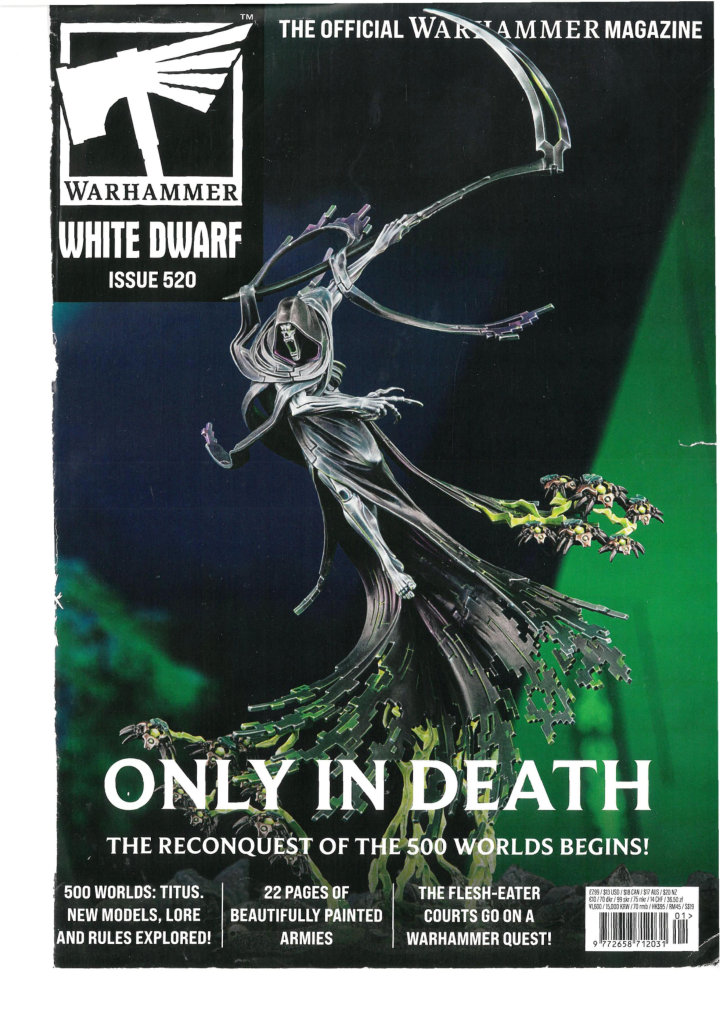
EditorialWD 520 · Inside cover
The new year prompts a call to turn long-delayed projects into painted models and try fresh games, terrain or events. The editorial introduces a Bunker rank tracker and the first Five Hundred Worlds sourcebooks, connecting individual hobby goals with a larger setting full of new campaign possibilities.
InterviewWD 520 · pp. 2–9
The designers introduce a set of background and campaign books centred on the reclamation of Ultramar. Captain Titus provides a viewpoint on the wider war, while the combination of a regional narrative, map campaign, Boarding Actions and detachments gives collectors several ways to develop armies and stories within the same setting.
Warhammer 40,000Ultramarines
InterviewWD 520 · pp. 4–6
Product developer Rich contrasts earlier connected end-of-edition campaigns with a new approach built around substantial, self-contained war-zone sets. Familiar characters and events supply an entry point, but the emphasis is on giving gaming groups enough background and materials to create their own campaigns rather than simply follow one prescribed sequence.
Warhammer 40,000
InterviewWD 520 · pp. 7–9
Colin and Andy discuss Guilliman’s attempt to rebuild the Five Hundred Worlds and the political problems hidden inside that apparently orderly plan. Titus must become a commander and diplomat, while Nekrosor Ammentar’s obsession with reuniting the Nightbringer brings a different kind of fanaticism into a campaign involving far more than its two principal armies.
Warhammer 40,000Ultramarines
LoreWD 520 · pp. 10–19
Titus’s command circle combines transhuman warriors with officers, a diplomat and an astropath who supply skills a Space Marine company cannot provide alone. Their backgrounds and early victories explain how a mobile intervention force supports the reclamation through diplomacy, intelligence, naval power and coordinated ground warfare.
Warhammer 40,000Ultramarines
LoreWD 520 · p. 11
Titus’s long path through suspicion, Deathwatch service and rehabilitation ends with his return to command after Acheran’s death. Charged by Guilliman with supporting the reclamation, he gathers specialists around a force intended to relieve crises and enable the wider offensive, rather than personally lead every advance.
Warhammer 40,000Ultramarines
LoreWD 520 · p. 12
Gadriel’s promotion reflects his ability to inspire ordinary soldiers as well as his service beside Titus. Some brothers consider him too young and impetuous for the honour, but his captain values his direct advice and makes the standard-bearer a constant presence wherever the Second Company’s intervention is most needed.
Warhammer 40,000Ultramarines
LoreWD 520 · p. 13
The veteran who recruited and trained Titus remains one of his strongest supporters after centuries of shared history. Metaurus now serves as both bodyguard and adviser, trusting his former pupil’s integrity while fearing that the same determination which makes him effective could carry him too far in the pursuit of duty.
Warhammer 40,000Ultramarines
LoreWD 520 · p. 14
Silva combines precise void warfare with the difficult task of translating uncompromising Space Marine orders for human crews. His flagship’s orbital support and the fleet’s ability to sustain long naval operations complement the Chapter’s assault vessels, showing why the reclamation relies on a substantial mortal naval organisation.
Warhammer 40,000Ultramar Defence Fleet
LoreWD 520 · p. 15
Raised in a military family on Mortendar, Minervas earns promotion through service and survival during the Plague Wars. Her study of both human and Astartes doctrine helps integrate her regiment with Titus’s warriors and Silva’s fleet, overcoming the rivalries that can otherwise separate Imperial ground and naval forces.
Warhammer 40,000Ultramar Auxilia
LoreWD 520 · p. 16
Kornelius’s abrasive manner is tolerated because his psychic communications remain unusually clear under extreme conditions. Titus recognises a shared dedication beneath that difficult personality, employing the elderly astropath’s choir, divinations and battlefield powers to connect the fleet with threatened worlds and guide its interventions.
Warhammer 40,000Adeptus Astra Telepathica
LoreWD 520 · p. 17
Vestha’s rise from hive intermediary to imperial envoy begins with her role in negotiating Styrus’s return to Ultramar. Her methods range from persuasion to engineered upheaval and assassination, exposing the coercion beneath the reclamation’s language of peaceful compliance and the compromises Titus accepts to avoid a full invasion.
Warhammer 40,000Imperium
LoreWD 520 · pp. 18–19
Three accounts show the retinue’s specialities working together: political intervention precedes a strike against rebels, intelligence and gunnery expose an ork fleet, and a colony’s distress call draws Titus into a Necron war. Novamagnor then becomes a meeting point for the reclamation and Ammentar’s search for a shard of its god.
Warhammer 40,000Ultramarines
InterviewWD 520 · pp. 20–27
The miniature designers explain how a shared command vignette, a monstrous Destroyer and a new Nightbringer carry the campaign’s themes into physical models. Clothing, pose, scale and damaged surfaces communicate social status and personality, with the Imperial retinue’s composed presentation set against the Necrons’ increasingly unnatural forms.
Warhammer 40,000Ultramarines
InterviewWD 520 · p. 21
Neil develops the established face and surviving service details into the more ceremonial presentation of a captain. Smooth fur, formal honours and a restrained pose emphasise representation and authority, while the retinue’s bases originate as one scenic arrangement before being divided into individual models.
Warhammer 40,000Ultramarines
InterviewWD 520 · p. 22
The two Marines must remain recognisable from their screen appearances while reflecting different responsibilities within Titus’s retinue. Metaurus leans toward action despite his stationary pose, whereas Gadriel’s sculpted banner and new regalia make him a dependable rallying point rather than simply another aggressive warrior.
Warhammer 40,000Ultramarines
InterviewWD 520 · pp. 23–24
Samir uses exposed faces, opulent clothing and distinctive equipment to show the personalities and offices of Titus’s human advisers. A fleet officer’s mag-boots, an elderly astropath’s stoop and an envoy’s concealed pistol make each role legible, while their smaller bodies reinforce the physical scale of the surrounding Space Marines.
Warhammer 40,000Ultramar Auxilia
InterviewWD 520 · p. 25
Steve combines the visual languages of several Destroyer subcults into a many-limbed character that exceeds their familiar forms. Pitted metal, a damaged blackstone power source and an unnaturally coiled silhouette shift the emphasis from clean robotics toward the horror of an ancient reanimated corpse.
Warhammer 40,000Necrons
InterviewWD 520 · pp. 26–27
Christian preserves the Nightbringer’s reaper identity while giving its living metal the fragmented digital edges seen on the Void Dragon. Robes merge into flesh and weapon, and the hanging rather than windblown silhouette creates an apparition that seems present without conventional movement; scarabs and damaged noctilith reveal the strain of its confinement.
Warhammer 40,000Necrons
ShowcaseWD 520 · pp. 28–35
Daz builds a playable successor Chapter around a quick metallic scheme, brighter helmets and red weapons that identify its Third Company. Classic imagery and available skull transfers provide a firm visual identity, while converted leaders and a growing assault contingent expand a collection initially weighted toward shooting.
Warhammer 40,000Silver Skulls26 paint colours
ModellingWD 520 · pp. 30–34
A skull-masked Calgar conversion becomes Chapter Master Argentius, and Tigurius gains a tribal-looking back banner as the Chief Librarian. Borrowed Iron Warriors symbols, carefully positioned squad and company numbers and a freehand standard give the army consistent heraldry without requiring a dedicated transfer sheet.
Warhammer 40,000Silver Skulls
PaintingWD 520 · p. 31
A traditional brown groundwork recipe gives the metallic army a warm, consistent foundation. Two drybrushed highlights bring out the texture before a solid brown rim completes each model, showing how a simple repeated base treatment can unify infantry, characters and armoured support.
Warhammer 40,000Silver Skulls4 paint colours
PaintingWD 520 · p. 35
Controlled washes over metallic bases do most of the work on the silver armour, leaving extensive edge highlights for the characters. Separate recipes distinguish helmets, dark details, blue lenses, warm red cloth and gun casings, while shaded gold adds a second metal without competing with the Chapter’s main colour.
Warhammer 40,000Silver Skulls22 paint colours
RulesWD 520 · pp. 36–47
The cooperative mini-game gains a Chaos enemy roster and four operations inspired by Space Marine 2. Teleporting reinforcements, high-rend attacks and sorcery require different responses from the earlier Tyranid encounters, while each mission supplies its own map, spawning instructions, deadline and degrees of victory.
Space Marine OperationsWarhammer 40,000Space Marines
RulesWD 520 · pp. 37–47
Threat tables assemble groups from expendable guardsmen and Tzaangors through Rubric Marines, Terminators and sorcerers to a two-stage Helbrute. Individual cards define movement priorities and surge effects, with spellcasters disrupting Marine abilities and the largest opponent becoming a different threat after its first stage is defeated.
Space Marine OperationsWarhammer 40,000Thousand Sons
RulesWD 520 · pp. 38–39
The Marines must destroy the totems suppressing an astropathic relay while Chaos reinforcements arrive continuously. Working on an objective also attracts teleporting enemies, so progress creates its own danger; the final result distinguishes a clean extraction of the task from one achieved through casualties and revives.
Space Marine OperationsWarhammer 40,000Space Marines
RulesWD 520 · pp. 40–41
The team advances through a compound in successive sections as enemy spawns follow the moving front line. Heldrake fire punishes Marines and enemies caught in the leading area, and the limited escape routes at higher difficulty force the players to coordinate their withdrawal rather than simply bunch around one exit.
Space Marine OperationsWarhammer 40,000Space Marines
RulesWD 520 · pp. 42–43
A fusion-battery train must reach a destination while enemies converge on it. Escorting Marines control its speed and must leave it to align a junction, turning the operation into a balance between protecting a moving objective and reaching the controls quickly enough to complete the sequence before time runs out.
Space Marine OperationsWarhammer 40,000Space Marines
RulesWD 520 · pp. 44–45
The Marines carry a sacred relic between plinths while destroying the control totems that protect Aurora. Its light makes enemies vulnerable to execution and can support revives, but carrying it limits defensive options, making the choice between mobile illumination and a fixed sanctuary central to the mission.
Space Marine OperationsWarhammer 40,000Space Marines
LoreWD 520 · pp. 48–55
The Jade Abbey begins as a holy stronghold protecting a healing spring associated with Alarielle. Its priesthood’s control of that resource fosters privilege and resentment, giving Gelgus Pust an opening for betrayal; the surviving wards preserve the Everspring even as the surrounding monastery becomes a haunted and contaminated ruin.
Warhammer QuestMaggotkin of Nurgle
LoreWD 520 · pp. 50–53
The Abbey’s promised harmony breaks down when an effectively immortal elite keeps the spring’s benefits while ordinary servants suffer and die. Pust exploits the resulting grievances for personal advancement, opens the sanctuary to Rotigus and survives the loyalists’ desperate flooding of the Abbey to pursue a longer campaign against its protections.
Warhammer QuestMaggotkin of Nurgle
LoreWD 520 · pp. 54–55
The ruined Abbey’s locations preserve several different legacies of its fall: a saint’s resting place, corpse-choked waters and chambers whose contemplative purpose became punishment. Accounts from Inara Sion, Bren Tylis and the Ironhead grudge record connect those places to the adventurers’ motives and the wider damage inflicted by Pust.
Warhammer QuestJade Circle
RulesWD 520 · pp. 56–57
Four deluded champions answer Ushoran’s call to confront the corruption of the Jade Abbey. They can join either a campaign or a skirmish alongside other heroes, sharing a special set of randomly dealt delusion equipment whose upgraded state persists even when the individual card changes between encounters.
Warhammer QuestFlesh-eater Courts
PaintingWD 520 · pp. 58–59
Emily achieves an iridescent green armour finish with translucent colours over a light metal base, then contrasts it with carefully glazed rotten flesh. The complete guide covers mouldy cloth, rusty chainmail, horns, scars, chipped armour and groundwork, encouraging variation between individual warriors while keeping their materials and palette coherent.
Age of SigmarMaggotkin of Nurgle25 paint colours
ModellingWD 520 · pp. 60–71
Nathan and Phil construct a corrupted Ghyranite landscape around a ramshackle settlement, corpse mill and diseased trees. Their account follows concept sketches into individually textured masonry, household materials and repurposed miniature parts, showing how architecture and living scenery can share Nurgle imagery without becoming indistinguishable.
Age of SigmarMaggotkin of Nurgle24 paint colours
ModellingWD 520 · p. 63
Nathan builds a curved bridge shell before covering it with individually cut and distressed XPVC blocks. Chipped edges, scored grooves and impacts from a rough stone create the irregular masonry texture, making the project a practical example of using repeated small components to disguise a simple underlying structure.
Age of Sigmar
ModellingWD 520 · pp. 64–65
Phil turns pieces of real bark and old Citadel Woods branches into a corrupted ancient tree with only the suggestion of a face. Repurposed Nurgle parts, protected polystyrene globes and cast pustules establish its diseased anatomy, while hot glue supplies the drooping slime around its toothed wound.
Age of SigmarMaggotkin of Nurgle
ModellingWD 520 · pp. 66–67
Templates define the buildings, but roughened coffee stirrers, sticks, broom bristles and gritty caulk give them an improvised and decaying character. A hand-built water wheel completes the newer corpse mill; separate airbrushed translucent browns and greens followed by a pale drybrush tie the mismatched construction materials together.
Age of SigmarMaggotkin of Nurgle6 paint colours
ModellingWD 520 · pp. 68–69
Two Nexus Chaotica rings form a complete monumental symbol around a trilobe built from fillable baubles. Reversed flames suggest movement and glue-made slime connects it to the polluted ground, while green-shaded brass and warm glazed pustules provide separate finishes for the constructed and fleshy elements.
Age of SigmarMaggotkin of Nurgle9 paint colours
ModellingWD 520 · pp. 70–71
Found branches become further diseased trees through fanged Nurgle parts, sculpted transitions and sturdy textured bases. Airbrushed dark browns deepen the bark before successive green and khaki drybrushes recover its relief, while the shared grey-and-orange groundwork links these organic pieces with the rest of the battlefield.
Age of SigmarMaggotkin of Nurgle9 paint colours
ShowcaseWD 520 · pp. 72–85
Martin and Claire Waller describe how collecting opposing armies became a shared hobby and a route into gaming together. His richly uniformed Lethis soldiers and her eerie Nighthaunt meet through common basing and a Realm of Death setting, while their account distinguishes the pleasures of competition painting, learning techniques and playing games.
Age of SigmarCities of Sigmar31 paint colours
ShowcaseWD 520 · pp. 74–79
Martin chooses Lethis to connect a favourite purple palette with Claire’s spectral opponents. Bright metal and pale cloth keep the darker wooden equipment readable, and his adaptation of a competition painter’s habits considers how a whole army must work both at close range and across a tabletop.
Age of SigmarCities of Sigmar22 paint colours
PaintingWD 520 · p. 77
A prepared mixture of purple and pink ensures consistency across the collection, with a final warm glaze restoring richness after the highlights. Separate recipes cover pale cloth, reflective brass, darkened steel and black wood, balancing the rich uniform colour with enough light and material contrast to keep the army legible.
Age of SigmarCities of Sigmar22 paint colours
ShowcaseWD 520 · pp. 80–85
Claire’s interest in supernatural horror leads from a first playable Nighthaunt force into revisiting earlier models and inventing more personal methods. Lady Olynder and the Black Coach become milestones in conversion, airbrushing and subassemblies, while fast Spearhead games make the collection practical within family evenings.
Age of SigmarNighthaunt16 paint colours
PaintingWD 520 · p. 81
Weaving ghostly forms through graveyard railings lets Claire make Olynder’s base part of the model’s story. Airbrushed darkness toward the robe ends supplies depth and becomes a technique she repeats on other spirits, marking her move from following an established recipe toward choices shaped by the character’s own atmosphere.
Age of SigmarNighthaunt1 paint colour
PaintingWD 520 · p. 83
Blue-green shading over white gives Claire’s spirits a paler character than the standard green Emerald Host. Dark turquoise cowls and repeated drybrushing define their upper bodies, while red trims identify important figures and a shared black-wood sequence connects the spectral collection with Martin’s living soldiers.
Age of SigmarNighthaunt15 paint colours
FictionWD 520 · pp. 86–95
Neil Andrew Miller introduces Elias Bain as a newly inducted member of the Callous Jacks, certain that faithful service has earned the Emperor’s personal protection. A mission to eliminate an unusually cunning ork kommando leader becomes a test of that certainty when Bain ignores orders to pursue his quarry alone.
Warhammer 40,000Astra Militarum
CommunityWD 520 · pp. 96–97
The Bunker begins the year by merging its reader sections into Your Warhammer and outlining the recurring monthly painting challenges. A rank tracker rewards games and completed painting in manageable increments, while the studio chariot event supplies a model for clubs that want to combine a creative competition with a game.
CommunityWD 520 · p. 97
Players record repeated activities such as scenario games, club games and completed units, subject to a monthly cap. Accumulated points move the hobbyist through increasingly senior ranks, turning varied achievements into a long-term record rather than requiring everyone to complete the same army or attend the same kind of event.
CommunityWD 520 · pp. 98–107
The reorganised reader section combines letters, a rank-and-file gallery, painting advice and a club competition report. A display representing a hundred Space Marine Chapters and friends learning Spearhead show different scales of participation, while individual showcases and the Brussels event illustrate how collections become something to share.
Warhammer 40,000Age of Sigmar15 paint colours
LoreWD 520 · p. 99
Grombrindal explains why service to Chaos need not fit a neat pattern of exclusive worship. A warrior can honour several gods knowingly or indirectly, and rival patrons may still offer competing blessings, making personal belief and the gods’ own quarrels more useful explanations than a fixed system of equal shares.
Warhammer 40,000Age of SigmarSlaves to Darkness
PaintingWD 520 · p. 102
Rodrigo Akore takes his Corsairs toward a clean modern science-fiction palette of cream and orange with blue accents. A slight zenithal start and crisp double edges define the surfaces, while named mixtures keep the warm armour distinct from the cool highlights on black equipment.
Warhammer 40,000Aeldari Corsairs7 paint colours
PaintingWD 520 · p. 103
The reply to Jiunn Tai explains how the studio creates strongly shaded silver armour with progressively deeper blue glazes over a bright metallic mixture. Generous medium and attention to the bottoms of armour panels keep the transition controlled, before a dark recess mixture and sharp silver edges restore definition.
Age of SigmarStormcast Eternals8 paint colours
CommunityWD 520 · pp. 106–107
The Brussels store presents its Blades & Brushes competition through a range of winning models and categories. The account describes an annual event spanning individual figures, units, large models and dioramas, with Ernesto Corral’s Blood Bowl scene taking the overall award among a broad community entry.
CommunityWD 520 · pp. 108–121
The studio combines a parade judged for painting, conversion and monstrous spectacle with races using the earlier chariot mini-game. Entrants explain how unlikely kits become coherent vehicles, and the lively report records collisions and opportunistic driving alongside the awards, giving clubs a complete model for a themed build-and-play event.
Age of Sigmar69 paint colours
ModellingWD 520 · p. 110
Joshua makes a skeletal chariot appear to have emerged from an ancient tomb through heavy texture and varied translucent weathering. Paint is splattered, diluted and finally wiped back from raised areas with a wet cotton bud, leaving a finish that emphasises recesses and earns the event’s conversion award.
Age of SigmarSoulblight Gravelords
ModellingWD 520 · p. 110
A Snarlboss chariot carries Wildercorps scouts in Pete’s repurposed patrol vehicle. Replacement chains solve the mismatched harness alignment, and old duardin and human shields cover recognisably grot-shaped details, demonstrating how a few targeted alterations can change a model’s apparent owner.
Age of SigmarCities of Sigmar
ModellingWD 520 · p. 111
Matt places a Darkoath God-speaker on a Chaos Chariot to embody a cantankerous old shaman from his Path to Glory army. Additional chains, a banner and skulls connect the conversion to its existing collection, while a desert-inspired finish gives the character a specific environment and personality.
Age of SigmarDarkoath
ModellingWD 520 · p. 111
Francois adapts Horticulous Slimux’s mount with a chariot assembled from Skaven components for a Nurgling crew. Purple and green suggest growth and decay together, and unrestricted weathering turns the vehicle into a comic expression of Nurgle’s slow, determined progress.
Age of SigmarMaggotkin of Nurgle
PaintingWD 520 · p. 112
James uses the challenge to add a Stormstrike Chariot to his existing Astral Templars rather than begin an unrelated display model. Matching its Gryph-chargers to earlier cavalry gives the collection continuity, with a simple sand-coloured base, recess shade and pale blended highlight supplying their shared finish.
Age of SigmarAstral Templars3 paint colours
PaintingWD 520 · p. 112
Doug paints the boss and chariot in separate assemblies, using an airbrush and successive browns to establish the structure. Vivid red details and torches built from a white start to smoky black provide warmer accents, completing a vehicle that also demonstrates spectacular straight-line speed during the race.
Age of SigmarGloomspite Gitz10 paint colours
PaintingWD 520 · p. 113
Lewis combines Squig Herd, Mangler Squigs and Sunsteala Wheelas into a chariot whose bickering crew barely seem safe aboard it. Contrasting zenithal layers support washes and drybrushing, with complete recipes for squigs, wood, black robes and grot skin; the finished model wins the painting award.
Age of SigmarGloomspite Gitz16 paint colours
ModellingWD 520 · p. 114
Owen turns an Ironweld Great Cannon into a dog-drawn wagon by reversing its base, repurposing the winch and reshaping the protective shield. Crew and animals from Wildercorps Hunters complete the conversion, showing how the structural parts of an artillery kit can supply an entirely different vehicle.
Age of SigmarCities of Sigmar
ModellingWD 520 · p. 114
John fits a Lord-Celestant and lion team onto a Stormstrike Chariot using components from the High Elf Tiranoc Chariot. Sculpted fur hides the join between different kits, while the absence of reins reinforces the idea that the animals understand their heroic passenger’s destination.
Age of SigmarStormcast Eternals
ModellingWD 520 · p. 115
Dan combines a Horus Heresy jetbike chassis with a Kharadron platform and Frigate crew member to create a flying chariot. Moving the aether-endrins into the body improves the silhouette but raises a playful question about the vehicle’s classification, illustrating how experiments can reshape the original brief.
Age of SigmarKharadron Overlords
ModellingWD 520 · p. 115
Howard builds a Gorebeast Chariot for an Old World army from a Glutos creature, Tomb King wheels, a Scourgerunner chassis and Hedonite crew. A real chain joins beast and vehicle, while sculpted dunes place the finished model within his army’s desert background in Araby.
Age of SigmarWarhammer: The Old WorldWarriors of Chaos
PaintingWD 520 · p. 116
Josh replaces the usual draught animals with Mournfangs and extends a War-Wheela to accommodate an additional orruk. Separate dark and light undercoats support icy animals, pale grots and cool metalwork, while matching blue-white base highlights connect the enlarged machine to a wider winter Destruction collection.
Age of SigmarGloomspite Gitz15 paint colours
PaintingWD 520 · p. 117
Will deliberately contrasts a racing brief with a snail-powered Nurgling vehicle. A stolen Knight banner, freehand sacred number and sponge pom-poms supply its comic details, while separate purple shell, sickly green skin and pink flesh recipes make the creature’s different surfaces distinct.
Age of SigmarMaggotkin of Nurgle16 paint colours
PaintingWD 520 · p. 118
Jon gives Horticulous Slimux a travelling greenhouse hauled by two snails, with a scratch-built cart and home-grown cactuses completing the gardening story. Oxidised metal, rotten timber and translucent diseased skin unify the construction, whose exuberant organic forms earn the Most Monstrous award.
Age of SigmarMaggotkin of Nurgle13 paint colours
ModellingWD 520 · p. 119
Matt expands the story of Brillz’s Gitmob with a chariot whose different materials all share the same bright yellow identity. The explanation imagines dye harvested from flowers crushed by the wheelas, connecting the exaggerated colour choice to the verdant Ghyranite base and the army’s own background.
Age of SigmarGloomspite Gitz
ModellingWD 520 · p. 119
Graham combines a Tomb Kings chassis, Dryad sides and an Arachnarok web to create a chariot for his Forest Grots. The project extends its spider theme onto the base with a practical-effects webbing technique, making the vehicle appear native to a dense, infested woodland.
Age of SigmarGloomspite Gitz
PaintingWD 520 · p. 120
Connor combines Glutos’s chariot, two Tzeentch warbands and a Draconith into the event’s Best in Show. Painting the separate assemblies keeps the complex scene manageable, with vibrant translucent colours and a final dark blue wash connecting the dragon, cultists, stonework and richly coloured vehicle.
Age of SigmarDisciples of Tzeentch14 paint colours
CampaignWD 520 · pp. 122–123
The first search round leaves Hope’s Forge with a damaged propeller clue and a narrower area in which to locate the missing Kharadron ship. A player diary shows Skaven overwhelming a Khorne force through a concentrated flank attack, demonstrating how individual battle results feed the opposing teams’ wider search.
Age of SigmarKharadron Overlords9 paint colours
PaintingWD 520 · p. 123
Ben’s Skryre force mixes shooting and close combat around four Doomflayers and a converted Verminlord with technological weapons. Orange armour and blue details contrast with sickly white fur, and the compact recipes explain how a bright complementary scheme supports the army’s unstable, warpstone-saturated identity.
Age of SigmarSkaven9 paint colours
CommunityWD 520 · pp. 124–126
New editor Cameron joins the team’s progress diary with pale Plaguebearers, while Ben tries gold Marines and Matt finishes more of his Imperial Fists. The remaining updates combine event preparation, fresh army projects and a cautionary game in which good positioning cannot save Dan’s plan after a disastrous Dark Pact.
Warhammer 40,000Age of SigmarMaggotkin of Nurgle4 paint colours
PaintingWD 520 · p. 124
Ben’s first fully metallic collection takes its inspiration from familiar gold biscuit wrapping. A brown foundation supports warm gold, mixtures with silver lift the panels toward their edges and a final flesh-coloured recess wash separates the armour, producing a defined finish without abandoning the broad reflective surfaces.
Warhammer 40,000Space Marines4 paint colours
RulesWD 520 · Unnumbered card insert
Rawthroat’s imagined royal authority lets the player choose which enemies activate in the enemy turn following his own, replacing the usual priority for those nearest to him. The profile makes control of activation order his defining contribution, allowing companions to plan around a more deliberate selection of threats.
Warhammer QuestFlesh-eater Courts
RulesWD 520 · Unnumbered card insert
Porvyle’s belief in proper heroic decapitation can abruptly end the life of a lesser foe. The ability tests the chosen adjacent enemy and compensates for a successful execution with improved damage for the encounter, linking a deliberately theatrical character concept to a lasting combat reward.
Warhammer QuestFlesh-eater Courts
RulesWD 520 · Unnumbered card insert
The Friar’s bellows weaken attacks from nearby enemies and make adjacent heroes’ critical hits more productive. His imagined congregation therefore has both protective and offensive value, rewarding a position close enough to support companions while also interfering with the foes threatening them.
Warhammer QuestFlesh-eater Courts
RulesWD 520 · Unnumbered card insert
Bledivir imagines himself an airborne protector who can carry another hero across the Abbey. An adjacent companion can leave the board during his movement and return in the nearest empty space afterward, while his special sprint passes through enemies, making mobility and coordinated repositioning the profile’s defining strengths.
Warhammer QuestFlesh-eater Courts
RulesWD 520 · Unnumbered card insert
The four delusions provide copying, disruption, healing, variable energy and the promise of a holy treasure. Their upgraded sides make the imagined roles more dependable or rewarding, while the temporary Knight of the Bloody Chalice can lose its exalted status, preserving the uncertainty that defines these adventurers’ shared view of the world.
Warhammer QuestFlesh-eater Courts
RulesWD 520 · Unnumbered card insert
Half of each army begins off the battlefield while the opposing commanders contest the generator of a restrictive force field. Holding the central control point opens access for reinforcements and earns points, but the surrounding resource objectives still matter, preventing the entire game from becoming a simple fight over one location.
Warhammer 40,000
RulesWD 520 · Unnumbered card insert
Armies searching for Aqua Ghyranis must plan around paired objectives that are initially inactive and only partly become available when an unpredictable geyser erupts. An underdog ability strengthens attacks around a contested target, while the scoring and tie-break rules reward both control and completed battle tactics over the five-round game.
Age of Sigmar
January 2026 features and all supplied game cards are indexed. The numbered body runs to page 126; game cards follow as unnumbered inserts. The Bunker log and monthly scenarios carry February labels. A duplicate contents page, advertising and purely decorative pages are excluded. Recipe tables and text omitted by the scan’s original OCR were checked visually.