CommunityWD 489 · pp. 4–7
Readers describe how painting supports their wellbeing, returning after long breaks, and building collections with friends. Donal Bisanzio recounts secretly preparing two Heresy armies before surprising Alberto Demarchi with a Nottingham gaming trip; Yvan Tavares explains his softly blended Master Lazarus. The replies also cover the editorial team’s Sylvaneth collection and how the Blood Angels Legion was organised before the Heresy.
Warhammer 40,000The Horus HeresyBlood Angels7 paint colours
PaintingWD 489 · p. 6
Matt Hutson answers a reader’s question about his Gnarlroot Sylvaneth by explaining the warm bark and green growth recipes. Mournfang Brown and Agrax Earthshade establish the wood, followed by Bugman’s Glow drybrushing and opaque highlights; Straken Green, Athonian Camoshade and progressively paler highlights supply the contrasting foliage.
Age of SigmarSylvaneth7 paint colours
LoreWD 489 · p. 7
The answer describes the Blood Angels before their division into Chapters, when a Legion of roughly 120,000–150,000 warriors arranged its companies within three Spheres. Rank-and-file formations occupied the Third Sphere, command roles the Second, and the First contained orders such as the Sanguinary Guard whose duties also expressed the Legion’s spiritual traditions.
Warhammer 40,000The Horus HeresyBlood Angels
LoreWD 489 · pp. 8–11
Callum Davis returns to the pronunciation of Warhammer names, covering Imperial worlds and recent World Eaters and Leagues of Votann terminology. He explains how invented words acquire a character of their own and how internal pronunciation guidance helps narrators keep a shared setting consistent, while allowing readers room for accents and personal interpretation. The examples range from ancient planetary names and warp phenomena to the Kin’s technical vocabulary.
Warhammer 40,000World Eaters
LoreWD 489 · pp. 14–19
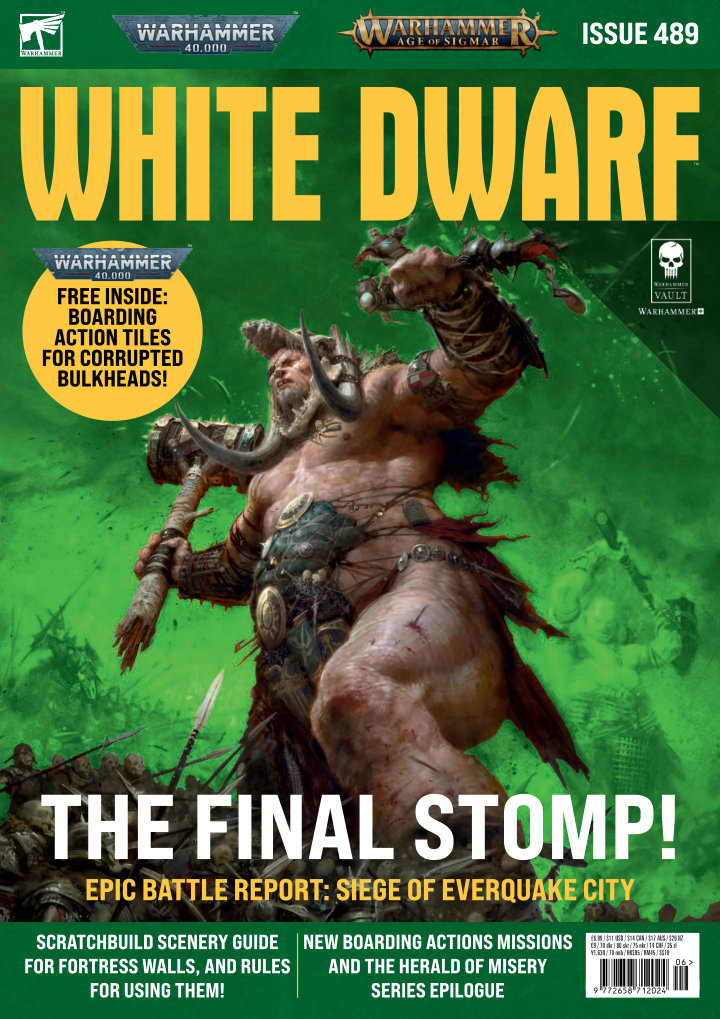
Ka-rokk’s Waaagh! emerges from the dangerous Skavenskrol realmgate and reaches Everquake City much sooner than its defenders expect. The city’s industry depends on mysterious golden pylons restraining a tectonic realmgate, while Lord-Imperatant Kamahana’s attempt to bring relief ends in a mutually fatal naval duel with the ogor pirate Targug. Orruks, gargants and ogors batter the walls as the citizens prepare a desperate defence.
Age of SigmarOrruk Warclans
CampaignWD 489 · pp. 20–21
The campaign finale links an optional Warcry sabotage battle beneath Everquake City to a siege fought by teams of Age of Sigmar players. It explains when a territory holder can spend achievement points to trigger the conclusion, how to choose commanders and participating players, and which territory effects carry into the battle. Final rankings combine the value of controlled or pillaged territories with a bonus for the winning siege team.
Age of SigmarWarcry
RulesWD 489 · pp. 22–23
Attackers infiltrate Everquake’s underground vault to shatter three pylons while defenders try to preserve the city’s stability. The scenario supplies both a conventional terrain layout and a Cursed City tile arrangement, plus cramped fighting that restricts flying and large creatures, rewards driving enemies into walls, and connects entrances through unreliable secret passages. The number of pylons destroyed determines how many fortification-damage rolls are made before the linked siege.
Warcry
RulesWD 489 · pp. 24–25
Two to six players divide into attacking and defending teams, each with a warlord who resolves shared decisions. The defenders construct a continuous fortress, divide their troops between garrison and delayed relief, and hold a gatehouse objective and a deeper strongpoint. Rules give walls and gates destructible profiles, adapt garrisons and monstrous demolition, and make the result depend on both captured objectives and the proportion of fortifications ruined.
Age of Sigmar
Battle reportWD 489 · pp. 26–31
Lyle Lowery’s Kraken Blades defend three subterranean pylons against Nyle Ajina’s Ironjawz in the sabotage game that will shape the siege above. Secret passages send Brutes to unexpected positions, while Stormcast fighters use the tunnel-fighting pushbacks to keep demolition teams away from their targets. The report follows the four rounds through named fighters and a running tally of damage.
WarcryStormcast Eternals
ModellingWD 489 · pp. 32–37
The White Dwarf team explains how it produced over six feet of fortress wall in a week for the Great Stomp finale. Measured XPS foam components form removable sections with textured masonry, a parapet and a firestep; a gate, stairs, guardian idols and broken sections make the structure usable throughout a siege. The project shows how repeatable dimensions, simple tools and fast painting turn an ambitious gaming backdrop into manageable pieces.
Age of Sigmar12 paint colours
ModellingWD 489 · pp. 33–34
Measured foam blocks are cut into outer wall, inner wall, firestep and buttress components, then scored with overlapping brick courses. Aluminium foil and a small rock impress stone texture without specialised sculpting tools. Joining the pieces back to back produces sturdy 330mm wall modules that can be stored separately and lifted from the table as the siege destroys them.
Age of Sigmar
PaintingWD 489 · p. 35
Two coats of diluted PVA seal the foam before a Zandri Dust spray establishes a Ghurish sandstone colour. Broad drybrushes of Screaming Skull and Pallid Wych Flesh bring out the impressed rock and brick textures quickly. Sparse sponge applications of Dryad Bark weather intact stone, while Abaddon Black marks scorched or badly damaged sections.
Age of Sigmar5 paint colours
ModellingWD 489 · p. 36
The basic wall module becomes a gateway by cutting an arch and fitting an XPVC door, its lion face scored with a pen and its beaten-metal surface indented with rounded tools. A staircase uses stacked XPS blocks topped by successively shorter thin foam layers. Matching brickwork, texture and painting tie these architectural additions to the fortress’s reusable wall sections.
Age of Sigmar
PaintingWD 489 · p. 37
Realmscape idols replace conventional crenellations and give Everquake’s defences a magical silhouette. The guide mounts them on stepped XPVC squares and pairs shaded brass with warm amber bone, then reuses the scheme on protective symbols and shrines. Gargoyles from the Cleansing Aqualith and Azyrite decorations from the Shattered Plaza finish the walls.
Age of Sigmar7 paint colours
ModellingWD 489 · p. 37
Off-cuts from the fortress project become separate heaps of broken masonry for destroyed breaches. The team cuts them to the same brick dimensions, batters or tears their edges, and glues them to XPVC bases shaped to fit around wall sections. A broken guardian idol makes the rubble visibly belong to Everquake City and preserves the scenery’s story after intact modules are removed.
Age of Sigmar
Battle reportWD 489 · pp. 38–61
Six players bring two 5,000-point alliances to the siege that concludes the Great Stomp. Lyle Lowery, Jimbo Warth and Erik Niemz defend with Kraken Blades, Cities of Sigmar and Kharadron Overlords; Nyle Ajina, Jes Bickham and Ben Johnson attack with Ironjawz, regenerating troggoths and Mega-Gargants. Damage from the preceding Warcry battle helps the attackers break the walls early, forcing the defenders into desperate fights around the breaches and gatehouse.
Age of SigmarStormcast Eternals
CampaignWD 489 · pp. 62–69
Soulblight Gravelords receive a narrative expansion for hunting in the Gnarlwood, where abundant prey is matched by trees and beasts capable of devouring vampires themselves. Three quests develop ancient artefacts, a hero’s authority and a permanent castle, with associated rewards and a new encampment. Name, origin and leader-background tables help turn those campaign developments into a distinctive undead dynasty.
WarcrySoulblight Gravelords
LoreWD 489 · p. 63
The background describes vampires’ supernatural strength, necromantic armies and dependence on living blood, which complicates their obligation to Nagash’s vision of universal death. With the Great Necromancer temporarily absent, ambitious nobles venture into the Gnarlwood for prey, relics and territory. Its endless flow of treasure seekers offers rich hunting, but carnivorous terrain makes even an immortal predator vulnerable.
WarcryAge of SigmarSoulblight Gravelords
RulesWD 489 · p. 64
A warband pursues a chosen ancestral artefact by having its leader defeat enemies and its fighters search isolated terrain. The reward table offers six relics with markedly different uses, from amplifying abilities and healing undead to disrupting enemy powers, restricting escape and punishing rival heroes. These are campaign prizes earned through play, rather than an unrestricted starting equipment list.
WarcrySoulblight Gravelords
RulesWD 489 · p. 65
An eligible hero earns a new trait as the warband demonstrates leadership through kills and characteristic necromantic abilities. Six possible rewards specialise the emerging ruler in resilience, command, empowering minions, close combat or an increasingly dangerous aura of death. The quest makes advancement reflect the vampire’s exercise of power rather than simply the passage of battles.
WarcrySoulblight Gravelords
RulesWD 489 · pp. 66–67
Undead fighters tear down small terrain pieces to accumulate building materials, unlocking a battle in which they must secure foundations across the battlefield. Winning allows the warband to relocate to a Grand Edifice of Death without the normal glory expenditure. The new castle increases its points and reputation allowances, encourages heroic renown and makes recruitment cheaper, giving the construction quest a lasting campaign payoff.
WarcrySoulblight Gravelords
LoreWD 489 · pp. 68–69
Random tables combine personal names and noble epithets with reasons a Soulblight warband has come to the Gnarlwood. Possible origins include service to a Mortarch, an ancestral claim, political rivalry and stealing blood-rich corpses from Gnarloaks. Leader traits add motivations such as relic recovery, affinity with Dire Wolves or contempt for decaying flesh, supplying story hooks for a campaign roster.
WarcryAge of SigmarSoulblight Gravelords
CommunityWD 489 · pp. 72–73
A new collecting series introduces James Ashbey, Joe Naber, Rhuairidh James and Andy Barlow and changes the challenge’s structure. Participants now score points for painting, games, victories and special tasks, while the freedom to change armies permits anything from one growing force to several Combat Patrols. The first target is completing a Combat Patrol, and a timetable invites readers to follow the same stages with their own collections.
Warhammer 40,000
PaintingWD 489 · p. 74
James Ashbey begins a personalised World Eaters warband inspired by older Chaos books and the artwork of John Blanche and Adrian Smith. His test Berzerker preserves Khorne’s red, brass and bone while using shaded steel and organic stains for a darker, blood-soaked appearance. Separate recipes explain the armour and skull-strewn bases, establishing a scheme he can carry into the new kits.
Warhammer 40,000World Eaters18 paint colours
PaintingWD 489 · p. 75
Joe Naber uses the revised challenge to embrace short, focused projects and starts with a bright Leagues of Votann force. Applying most base colours before a diluted all-over Skeleton Horde wash gives the pale armour, fatigues and red markings a coherent finish efficiently. The account also establishes an uneasy narrative relationship with Joe’s Ingeniators Space Marines and provides a warm rock recipe for the bases.
Warhammer 40,000Leagues of Votann12 paint colours
PaintingWD 489 · p. 76
Rhuairidh James takes Typhus and his Harbingers as the inspiration for a scavenging plague fleet, planning stripped-down conversions and infantry squads tied to particular characters. Typhus provides a test for white armour, rusted metal and fleshy details, with Mortarion Grime lending the armour its diseased cast. The recipe uses stippled corrosion and orange rust, while Ardcoat distinguishes wet organic surfaces and insect carapaces.
Warhammer 40,000Death Guard13 paint colours
PaintingWD 489 · p. 77
Andy Barlow plans a campaign force assembled from several regiments, inspired by Gaunt’s Ghosts and classic Imperial Guard artwork. A Cadian Combat Patrol test trooper establishes a fast Zandri Dust-based camouflage scheme, using Contrast colours and a restrained final drybrush to unify fatigues, armour and boots. Saving painting time leaves room for converted officers and support vehicles as the army grows.
Warhammer 40,000Astra Militarum10 paint colours
LoreWD 489 · pp. 78–81
After the loyalists escape, Czagra repairs the Herald of Misery’s damaged wards and crushes resistance in the Lume System. Worlds are bombarded, stripped or left to destructive environmental forces, while an evacuation carries selected Imperial personnel and Strike Force Rhalion’s survivors away from Leonus Stellarium. Czagra then brings his Ark and fleet against the void fortress, personally ending its defence.
Warhammer 40,000Iron Warriors
FictionWD 489 · pp. 82–84
Three vignettes follow the victors into new dangers. Vurnok the Grey pursues stranded Blood Angels through rearranging decks and malignant warp phenomena; Czagra tears into an astropathic sanctuary to lure a Black Templars crusade into a trap. Meanwhile Mekranteer, secretly invaded by a daemonic presence during the portal disaster, divines a possible cure on Gydoria and begins plotting a journey that must not reveal his corruption to the Warsmith.
Warhammer 40,000Iron Warriors
LoreWD 489 · pp. 84–85
Czagra turns against the Orks previously sealed into the Herald of Misery’s prow, launching a three-pronged assault before their numbers become overwhelming. The attack bogs down in vicious fighting amid Ork-built weapons and spreading fungal growth, until the unexpectedly surviving and newly mutated Kahrbol Mandrax kills Warboss Grymzag. The Iron Warriors recapture decks and fragment the surviving greenskins into rival bands, containing their greatest threat without eradicating them.
Warhammer 40,000Iron Warriors
RulesWD 489 · pp. 86–88
Boarding Action battlefields gain living machinery and warp-tainted infestations represented by Corrupted Bulkhead tiles. Attacking a creature in one zone triggers a reaction in the zone on its other side, allowing players to exploit the ship itself against nearby enemies. Techno-fungal Lesions blind units with spores and ooze, while Mechanotendril Lairs hinder movement and charges with grasping cables.
Warhammer 40,000
RulesWD 489 · pp. 89–91
A complete setup sequence combines each player’s chosen half-board into a modular Boarding Action battlefield. It explains compatible connecting edges, entry zones, alternating placement of corrupted terrain and objectives, squad splitting, reserves, command points and scoring. Restrictions on nearby tiles and objective positions preserve useful routes, while six selectable halves give the accompanying mission many different layouts.
Warhammer 40,000
RulesWD 489 · pp. 92–93
This Boarding Action mission represents repeated struggles to reclaim portions of a space hulk from rivals and spreading biomechanical corruption. Players score progressively for holding objectives and gain an end-game reward for killing the opposing warlord, with an extra command point helping an understrength patrol. Six half-board maps combine with the preceding corrupted-bulkhead procedure to vary the geometry of each game.
Warhammer 40,000
TacticsWD 489 · pp. 94–95
An annotated Boarding Action position examines the moment after Angron tears a vessel into separated halves. With movement across the gap impossible but shooting still viable, World Eaters must use Khârn’s threat and an Eightbound hatchway stratagem to compensate for their numbers, while Astra Militarum protect their Kasrkin and commit vulnerable troops to one side. The example highlights how a changed battlefield and a missed enemy movement option can overturn an apparent advantage.
Warhammer 40,000World Eaters
TacticsWD 489 · pp. 96–99
Duncan Waugh explains how objective placement, safe entry zones, corridor widths and room spacing control a Boarding Action’s tempo. Maps must accommodate both numerous small bases and a few large models, offer several routes around defensive chokepoints, and match their complexity to a clear mission idea. Progressive objectives keep forces moving, while carefully weighted end-game goals preserve a comeback opportunity without erasing the importance of earlier turns.
Warhammer 40,000
LoreWD 489 · pp. 100–101
The feature introduces the Dark Angels’ ancient service, the shame of the Fallen and the secret cooperation of their successor Chapters. It outlines Deathwing, Ravenwing, company and battlefield-role markings, then offers a practical framework for inventing an Unforgiven Chapter through its name, Founding, attitude to its inherited secret, current campaign and colours. The Angels of Absolution illustrate how a successor can retain the lineage while interpreting its guilt differently.
Warhammer 40,000Dark Angels
PaintingWD 489 · pp. 102–103
Jim Lister’s long-standing wish for a Terminator army becomes a Deathwing collection inspired by Angels of Death and the original anthology. He keeps the recipe accessible with pale armour shaded by Skeleton Horde, contrasting green robes and warm red details. A carefully painted banner uses Contrast colours, wet blending and highlights to give the otherwise restrained force a focal point.
Warhammer 40,000Dark Angels11 paint colours
PaintingWD 489 · pp. 104–105
Steve Copp’s home-grown Unforgiven Chapter pairs quartered dark and pale green heraldry with the Dark Angels’ knightly imagery. Its small force specialises in hunting Necrons and retrieving treasures from tomb worlds. Two concise armour recipes explain how Caliban Green and Death Guard Green sections remain distinct while sharing a coherent shaded finish.
Warhammer 40,000Dark Angels6 paint colours
PaintingWD 489 · pp. 104–105
Adam Troke deliberately changes methods for his second substantial Dark Angels army, replacing his usual layered finish with drybrushed greens and conspicuous battle wear. Metal stippling and Typhus Corrosion roughen the armour, while skull-filled bases recall classic Warhammer art. The result shows how a familiar Chapter scheme can feel like a fresh project through texture and painting technique.
Warhammer 40,000Dark Angels6 paint colours
ShowcaseWD 489 · pp. 106–111
Converted Dark Angels and successors demonstrate ways to express the Chapter’s identity beyond a standard green infantry squad. Examples include Billy Ho’s weathered Invictor, Luke Dunford’s cyber-owl Librarian and Ravenwing riders, Les Martin’s sculpted-robed Ancient, Ken Fung’s illuminated Dark Talon and Łukasz Frączek’s high-contrast leaders. Other contributors explore subtle edge highlights, veteran parts and contrasting gold finishes.
Warhammer 40,000Dark Angels37 paint colours
FictionWD 489 · pp. 112–119
Skysplinter Assassin Vypos Nyqist helps a Hand of the Archon capture an escaped psyker aboard the Gallowdark while surviving Adeptus Arbites pursuit. His true assignment is a second layer of intrigue: Lady Malys has told him to submit to the rival Veskine’s torture, memorise the information it reveals and use an implanted trigger to escape. When the device fails, Veskine imprisons his soul instead.
Kill TeamWarhammer 40,000Drukhari
RulesWD 489 · pp. 120–123
A three-player Gallowdark mission recreates the hunt in The Maze of Malys. Two conventional kill teams compete to incapacitate and extract a powerful psyker, while a third player controls the prisoner and ten thralls trying to escape. Multiplayer initiative, extra central cover and restrictions on indiscriminate shooting support the asymmetric contest; the battle ends with extraction or escape rather than after the usual four turning points.
Kill TeamCult of the Unshackled
RulesWD 489 · pp. 124–125
The prisoner’s improvised kill team receives profiles for expendable thralls and an exceptionally dangerous psyker. Followers can take attacks meant for their master, while psychic fire, spreading parasites and explosive sacrifice threaten better-equipped hunters. Strategic and tactical ploys provide hidden movement, coordinated attacks, returning thralls, intensified flames and healing through consuming a follower, making the under-resourced side an active opponent.
Kill TeamCult of the Unshackled
LoreWD 489 · p. 126
The Vindicator’s background traces its Rhino-based hull, heavily armoured frontal aspect and devastating but restricted-traverse siege gun. Accounts link its development to early technological patterns and Guilliman’s campaign on Rostern I before the demolisher cannon became standard. Laser-destroyer variants broadened its anti-armour role, but limited fields of fire and weaker rear protection still demanded infantry support and caution against fast flanking enemies.
The Horus HeresyLegiones Astartes
RulesWD 489 · p. 127
A Vindicator squadron and supporting infantry must advance through an enemy position before heavy defenders can halt them. Restricted army choices focus the exercise on the tanks’ practical role, and the defender’s Heavy Support begins in reserve. Victory requires at least one mobile, unwrecked Vindicator to reach the specified depth by the sixth turn, making protecting the assault’s momentum more important than indiscriminate destruction.
The Horus HeresyLegiones Astartes
RulesWD 489 · pp. 128–129
Entrenched Legion troops and Imperial Bunkers hold out against attacking Vindicators while fast units may arrive in a flanking assault. Both sides earn points for destroyed or fleeing enemy formations, but the larger bonus depends on whether the attackers retain an operational siege tank. A short maximum battle length turns the defender’s response into a race to destroy the guns before they secure their objective.
The Horus HeresyLegiones Astartes
RulesWD 489 · pp. 130–131
A Vindicator force begins concentrated around the centre of a compact battlefield while its enemies deploy around the edges. The scenario reverses the siege tank’s normal advantage by exposing its limited traverse and rear armour to converging threats. Restricted 750-point forces and a survival bonus for the Vindicators make screening, direction of fire and preserving at least one tank the key tactical problems.
The Horus HeresyLegiones Astartes
FictionWD 489 · pp. 132–141
In the fifth Ancestor’s Burden instalment, Rigo leads five damaged companions towards Karak Thorga after sending the other rescued duardin away. Each traveller reassesses the old obligations they have abandoned, while Justec recognises memories of an earlier life and hopes returning the stolen horn can change his fate. The cursed hold attacks Rigo with collapsing ancestor statues, and the companions’ different skills save one another at its gate.
Age of SigmarDuardin
CommunityWD 489 · p. 142
A studio Warcry league begins with freshly painted warbands and a painting competition won by Ben Johnson’s Hunters of Huanchi on a thematic Gnarloak display base. Players then take their collections to a three-game Warcry Rumble at Warhammer World. Matt Rose’s Lumineth win all three games by threatening opponents at range before moving onto objectives, showing the hobby and gaming sides of the shared project.
WarcryAge of SigmarHunters of Huanchi
PaintingWD 489 · p. 143
Paul Claridge converts a large action figure into a World Eater using Lord of Skulls parts, a reshaped resin tank-door icon and sculpted Butcher’s Nails, teeth and spikes. The accompanying recipes give its armour a deep red finish, contrast bright shaded gold trim, and weather black weapon casings with metallic drybrushing. The account shows how familiar miniature details can be adapted to a much larger surface.
Warhammer 40,000World Eaters9 paint colours
CommunityWD 489 · pp. 144–145
Studio hobbyists update their 2023 bingo cards with Heresy and skirmish games, Lyle’s new Kraken Blades and Sophie’s Moon Eaters. Matt Hutson explains painting the chassis and armour of two Hawkshroud Armigers separately; Ben Humber gives Hexbane’s Hunters individual accent colours and reflective wet bases. Dan Harden’s Blood Angels Eliminators use angular brown camouflage to match the ash wastes of Armageddon.
Warhammer 40,000Age of SigmarAngels of Absolution13 paint colours