CommunityWD 427 · p. 2
The team’s short updates connect the production of the issue with their own army projects, games and favourite features. Custodes, Orlock painting, Malign Portents and the video-game interview draw particular enthusiasm, while their unfinished personal models provide a familiar counterpart to the polished armies elsewhere in the magazine.
EditorialWD 427 · p. 3
The editor introduces an issue combining new gaming material with several accompanying gifts from Black Library and licensed partners. Paint Splatter adopts an explicit stopping point for a model ready to play, while later stages remain available for readers who want to return and refine their work.
CommunityWD 427 · pp. 6–31
The release roundup moves from the Adeptus Custodes’ first dedicated codex to new Thousand Sons options, Orlock gangs and Malign Portents. Two Shadespire warbands, starter collections, licensed games and a Black Library celebration complete the picture of a month supporting both large armies and specialist games.
CommunityWD 427 · p. 7
The issue announces a separate Black Library chapbook, an Inquisitor – Martyr code and additional Black Reach heroes. These gifts link magazine coverage to short fiction, a video-game mission chain and a board game; the source scan provides the announcement, so the entry does not imply that the separately supplied material is fully present.
Warhammer 40,000: Inquisitor – MartyrHeroes of Black Reach
ReviewWD 427 · pp. 8–11
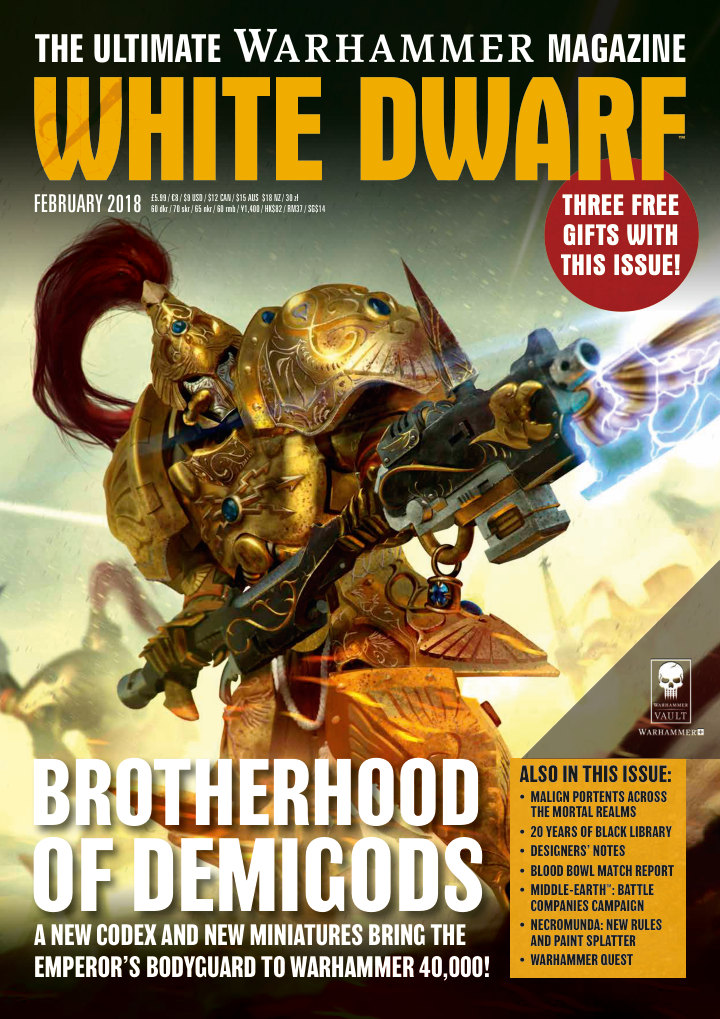
The Custodes range gains a dedicated codex and several new ways to build a compact army. Trajann Valoris, jetbike-mounted Vertus Praetors, Allarus Terminators and stoic Wardens broaden the existing Guard kit, with annotated model previews explaining their equipment, command options and visual differences.
Warhammer 40,000Adeptus Custodes
TacticsWD 427 · p. 9
The quick tactical portrait contrasts exceptional durability and damaging melee weapons with an army’s very low model count. It also flags the absence of dedicated aircraft, encouraging players to consider how mobility and the jetbikes’ weapon options might address opponents the infantry cannot easily reach.
Warhammer 40,000Adeptus Custodes
ReviewWD 427 · p. 12
The Thousand Sons codex is introduced as both a history of the Legion and an expanded collection of battlefield tools. Three psychic disciplines sit beside familiar Rubric warriors, while Enlightened, Shamans and the Mutalith Vortex Beast bring more of the Planet of the Sorcerers into the army.
Warhammer 40,000Thousand Sons
ReviewWD 427 · p. 13
Gang War 2 adds House Orlock, hired fighters and the support characters who keep a gang operating between battles. The adjoining Badzone Delta-7 preview describes double-sided tiles with hazards such as turbines, alien nests and cult chambers, extending the underground game through terrain that can be dangerous in its own right.
Necromunda
ReviewWD 427 · pp. 14–15
The plastic Orlock gang is presented as rugged, dependable fighters favouring sturdy guns and massed fire. Modular heads, weapons and equipment provide variety within the ten-model set, while cards and dice support the release without replacing the separate gang list in the new supplement.
NecromundaHouse Orlock
LoreWD 427 · p. 15
The House of Iron draws its wealth from mines, factories and transport monopolies, but gang membership offers an escape from its workers’ brutal servitude. The background contrasts the appearance of collective unity with the house’s violent history, explaining the code that places gang and house loyalty above outsiders.
NecromundaHouse Orlock
ReviewWD 427 · pp. 16–17
The Malign Portents preview describes a growing magical crisis whose full purpose remains concealed. Optional Shyish rules, prophecy points and four harbingers allow players to take part, while skull-strewn terrain, a Warscryer Citadel and related fiction offer modelling and narrative ways to reflect the same ominous atmosphere.
Age of SigmarDeath
ReviewWD 427 · pp. 18–19
Four new characters express contrasting responses to the coming crisis: a celestial engineer, a brutal Darkoath ruler, a treacherous wraith and a fungus-ridden grot visionary. Their tools, armour and mutations make their roles legible before any rules are read, connecting the models to their individual histories and divine allegiances.
Age of SigmarStormcast Eternals
ReviewWD 427 · pp. 20–21
Legions of Nagash reorganises a wide undead collection through allegiance rules for Nagash and his Mortarchs. The preview highlights Shyish’s background and the role of gravesites, while short unit notes explain how skeletons, necromancers, spirits and Vargheists can contribute different strengths to an army.
Age of SigmarLegions of Nagash
TacticsWD 427 · p. 22
Kevin Chin recommends combining objective-holding with upgrades that make inspired Fyreslayers dangerous at close range. Movement ploys compensate for their slow approach, while healing and rerolls keep a small warband effective; the article links these choices to the Chosen Axes’ particular inspiration condition.
Warhammer UnderworldsThe Chosen Axes
TacticsWD 427 · p. 23
Tom Merrigan focuses on speed, objective play and ploys that inspire the Skaven without asking them to endure a straightforward fight. Returning Clanrats to distant starting hexes creates board pressure, while cheap upgrades and rewards for expendable fighters help exploit a warband whose leader must remain safe to sustain it.
Warhammer UnderworldsSpiteclaw’s Swarm
ReviewWD 427 · p. 24
Two starter collections offer different routes into an Order army: a small Kharadron sky-fleet and a mounted Vanguard hunting party. The preview explains the units and alternative builds in each, then discusses using them either as the basis of a new force or as allies for an existing collection.
Age of SigmarKharadron Overlords
ReviewWD 427 · p. 25
The new resin Space Wolves wear Cataphractii armour decorated with runes, furs and unmistakably Fenrisian details. A Praetor’s elaborate equipment distinguishes him from Russ’s hand-picked Varagyr, while interchangeable wrist joins permit alternative Terminator weapons and an optional knife alters the character’s silhouette.
The Horus HeresySpace Wolves
ReviewWD 427 · pp. 26–27
The sequel preview joins the returning heroes to a broader invasion by ratmen and Nurgle’s followers. New careers, abilities and locations accompany the additional missions, with the coverage emphasising cooperative first-person combat and a continuation of the original story that can still introduce newcomers to the setting.
Warhammer: VermintideSkaven
ReviewWD 427 · p. 27
This short preview introduces a fast dice-and-card game in which Gretchin take part in lethal races for Orkish amusement. Its small player group and brief play time make it an alternative between miniature battles, while combining sets expands the number of competitors able to join the mayhem.
GretchinzOrks
CommunityWD 427 · pp. 28–30
A dedicated celebration brings together new fiction, a returning Inquisitor miniature, reprints selected by readers and limited accompanying merchandise. The roundup places The Magos and Lukas the Trickster at its centre, while the free collection and author-focused material turn the release day into a broader celebration of Warhammer storytelling.
Warhammer 40,000Age of Sigmar
InterviewWD 427 · p. 28
Maxime Corbeil explains how the new miniature recalls the earlier large-scale Eisenhorn while choosing a particular moment in the character’s history. His bolt pistol, runestaff and warding scrolls place him near the confrontation with Quixos, and the pose aims to communicate the determination that makes him dangerous beyond any individual weapon.
Warhammer 40,000Inquisition
ReviewWD 427 · p. 29
The announcement introduces a new Eisenhorn novel together with twelve earlier Inquisition short stories arranged to establish its context. The review praises the depth given to an apparently unimportant world and the continuing combination of investigation, character and action, presenting the collection as both a return and a substantial new chapter.
Warhammer 40,000Inquisition
ReviewWD 427 · p. 30
Lukas faces Duke Sliscus during a Helwinter invasion of Fenris, placing two unusually cunning antagonists against one another. The preview foregrounds the Space Wolf’s uncomfortable place among his own brothers and explains the additional short fiction accompanying the special edition.
Warhammer 40,000Space Wolves
ReviewWD 427 · p. 31
The former Knight Scion now known as the Knight of Ashes pursues traitorous kin after his house’s fall. A call for help from his home world forces a choice between private vengeance and a return that could expose him to Imperial judgement, continuing the story begun in Kingsblade.
Warhammer 40,000Imperial Knights
ReviewWD 427 · p. 31
The anthology gathers Heresy fiction about servants of both the Emperor and the Warmaster, including stories previously heard as audio dramas. Wolf King and Cybernetica are highlighted examples, with the announcement offering a prose collection for readers who prefer those tales in print.
The Horus HeresyLegiones Astartes
ReviewWD 427 · p. 31
Duruthiel and the Masque of the Fading Dawn confront Orks in a night ambush whose purpose extends beyond its apparent spectacle. The audio-drama preview treats performance, deception and violence as closely related elements of a Harlequin story rather than revealing the entire plot.
Warhammer 40,000Harlequins
InterviewWD 427 · p. 31
Josh Reynolds explains his wish to write about every First Founding Chapter and his particular attraction to Lukas’s irreverent humour. He also discusses the technical detail that makes far-future fiction demanding and ends by choosing Blood Bowl stars as characters he would like to explore next.
Warhammer 40,000Age of SigmarSpace Wolves
CommunityWD 427 · pp. 34–35
Returning hobbyists describe rediscovering painting through newer miniatures, while other readers praise the personal voices in the monthly magazine. Suggestions include Chaos-focused army challenges and undead giants, with replies discussing conversion opportunities and the period’s developing background rather than promising future releases.
LoreWD 427 · p. 35
Grombrindal answers a reader who sees the Realm of Fire as too hostile for ordinary settlement. Native peoples have adapted to its conditions, while magical resources, gems and metals make it valuable for trade; the reply frames Aqshy as a lived-in realm rather than simply a battlefield of constant flame.
Age of Sigmar
CommunityWD 427 · pp. 36–37
The retrospective returns to Albion’s Dark Shadows campaign, early Inquisitor material and the first hints of the T’au. Giant fighting, variant Hydras, Saurus cavalry, campaign scenery and the Cursed Founding demonstrate the range of experimental rules and background in the older magazine, while Eisenhorn links its painting coverage to the current issue.
Warhammer Fantasy BattlesWarhammer 40,000
TacticsWD 427 · pp. 38–39
Eleven introductory themes explain team variety, league progression, injuries, star players and the appeal of unpredictable disasters. The practical advice begins with understanding a team’s strengths and limitations, then stresses performing safe actions before risky ones and making the opponent roll difficult dice whenever possible.
Blood Bowl
InterviewWD 427 · pp. 40–44
Neocore Games discusses adapting the setting into an action roleplaying game built around individual Inquisitors exploring the Caligari Sector. Classes, equipment, cooperative cabals, procedural environments and investigations support the central campaign, while the developers explain how early player feedback shapes progression and their planned seasonal expansion of the game.
Warhammer 40,000: Inquisitor – MartyrInquisition
InterviewWD 427 · pp. 46–49
Phil Kelly explains how Nagash’s accumulation of Shyishan realmstone produces terrifying side effects throughout the Mortal Realms. The story shifts toward gothic horror and the experience of ordinary inhabitants, while optional battlefield rules let players interpret prophecies and choose how extensively to reflect that atmosphere in their own games.
Age of SigmarDeath
InterviewWD 427 · p. 48
Christian Hardy combines engineer, warrior and blacksmith in the Lord-Ordinator, drawing on Valten’s paired hammers from the old world. An older face and substantial facial hair communicate experience and authority, making him appear a respected practical expert rather than another conventional spellcaster.
Age of SigmarStormcast Eternals
InterviewWD 427 · p. 48
Ben Jefferson describes Sergi Torras’s deliberately aggressive alternative to the earlier Darkoath Chieftain. Damaged armour, torn cloth and a roughly worked shield suggest a ruler interested in conquest rather than decoration, with inscribed oaths and an active pose conveying the character’s priorities.
Age of SigmarDarkoath
InterviewWD 427 · p. 49
Mike Fores makes the Knight a noble warrior whose body has long vanished, leaving ancient equipment as a sign of status. The Cairn Wraith informs both the skull-shaped helm and floating silhouette, while hiding the joins inside the hollow torso poses a practical challenge for the plastic kit.
Age of SigmarNighthaunt
InterviewWD 427 · p. 49
Gaku Matsubayashi treats the shaman as a fusion of grot and fungus, supplying several kinds of mushroom as both bodily growths and potion ingredients. The face’s projecting ornaments form a crescent profile, while the uncertain anatomy beneath them extends the sculpt’s deliberately unsettling humour.
Age of SigmarMoonclan Grots
CommunityWD 427 · pp. 50–55
The history follows Black Library from magazines and early novels into longer series, background books, audio productions and digital releases. Its central theme is fiction’s ability to explore life beyond the tabletop battlefield, with author events and miniature adaptations showing how stories feed back into the wider hobby.
Warhammer 40,000Warhammer Fantasy Battles
CommunityWD 427 · pp. 50–51
Inferno! introduces characters and forms of fiction that can later sustain larger works, while Warhammer Monthly gives visual storytelling a regular home. The move into novels establishes Gaunt’s Ghosts and Gotrek and Felix as enduring series, providing the foundation for more writers and a broader range of perspectives.
Warhammer 40,000Warhammer Fantasy Battles
CommunityWD 427 · p. 52
Art collections preserve concept work and images that reveal stranger corners of the settings, while background volumes can masquerade as objects from those worlds. The survey highlights sketchbooks, scholarly accounts and soldiers’ handbooks, showing how design and an in-universe voice can make a reference book an experience in its own right.
Warhammer 40,000Warhammer Fantasy Battles
CommunityWD 427 · pp. 53–54
The Heresy novels expand a once-distant founding myth into a sustained account of betrayal and civil war. The survey describes the sense of discovery created by seeing famous events and figures directly, then connects the series’ popularity with its growing range of authors, related stories and bestseller recognition.
Warhammer 40,000Warhammer Fantasy Battles
CommunityWD 427 · p. 54
The article traces audio dramas from early adaptations into a substantial range alongside unabridged audiobooks. Dedicated events bring readers together with authors through seminars and signings, while fiction-inspired miniatures allow familiar characters to appear on the gaming table as well as the page.
Warhammer 40,000Warhammer Fantasy Battles
CommunityWD 427 · p. 55
Digital editions restore access to older fiction while new Mortal Realms stories build depth around a recently created setting. City-based intrigue, expeditions and Kharadron trade complement the wars of gods and monsters, continuing the publisher’s practice of using fiction to show experiences that army books cannot cover in the same detail.
Warhammer 40,000Warhammer Fantasy Battles
InterviewWD 427 · pp. 58–63
The designers explain how classic Custodes artwork becomes a coherent plastic range distinct from ordinary Space Marines. Ornate armour, controlled posing and varied cloth textures carry the visual work, while the rules writers translate individual mastery into a small army whose strength depends on careful use rather than attrition.
Warhammer 40,000Adeptus Custodes
InterviewWD 427 · pp. 58–60
Dave Thomas uses the long-established visual language of high helms, plumes and elaborate weapons to distinguish Custodians from utilitarian Space Marines. John Blanche’s gate scene and later Heresy art provide continuity, but the discussion stresses adapting selected details so that they work as physical plastic miniatures.
Warhammer 40,000Adeptus Custodes
InterviewWD 427 · p. 60
Samir Battistotti enlarges the Custodian silhouette into weighty Terminator armour without losing its regal freedom of movement. Recessed heads and broad shoulders communicate protection, while extra leather and cloth give painters opportunities to interrupt the otherwise dominant gold surface.
Warhammer 40,000Adeptus Custodes
InterviewWD 427 · p. 61
Nic Ho develops a veteran unit through calm, immovable poses, flowing robes and revised helmets rather than simply adding more ornament. Their luxurious fabric and patient bearing express the Emperor’s personal sentinels, while new axes connect the expanded weapons range with some of its earliest artistic references.
Warhammer 40,000Adeptus Custodes
InterviewWD 427 · p. 62
Trajann Valoris combines motifs from across the range with references to Constantin Valdor and the Emperor’s own imagery. Armour, a long tabard, a halo and a lion skin suggest an exceptional individual, while the explanation treats the Custodian as a solitary regal predator rather than a member of a Space Marine pack.
Warhammer 40,000Adeptus Custodes
InterviewWD 427 · pp. 62–63
The Dawneagle shares a design ancestry with Sammael’s Corvex but looks sleeker and less burdened by millennia of added decoration. Its eagle-shaped front, weapons and flowing rider garments convey both Imperial symbolism and forward speed, with the armour adjusted to suggest practical movement in the saddle.
Warhammer 40,000Adeptus Custodes
InterviewWD 427 · p. 63
Dave Sanders turns the idea of an army of individual heroes into independent commanders, small squads and characterful stratagems. The discussion highlights the flexibility of a single kit and the danger of losing even one unit, then uses splitting Allarus warriors into individuals as an example of background expressed directly through rules.
Warhammer 40,000Adeptus Custodes
CommunityWD 427 · pp. 64–68
All four warlords complete their opening collections using different ways to fit painting into ordinary life. The feature contrasts carefully planned evening sessions with concentrated bursts of work, while new army histories and the first proposed games begin to turn their separate collections into an interconnected project.
Age of Sigmar
PaintingWD 427 · p. 65
Andy Keddie attributes his progress to planning the whole collection and reserving an hour each night for painting. Purple flesh works well beside his preferred blue-green hues, and a little early gold anticipates future additions so the army’s eventual scheme will not look assembled from unrelated decisions.
Age of SigmarDaughters of Khaine2 paint colours
PaintingWD 427 · p. 66
Jes Bickham deliberately limits the techniques used on his daemons, relying on a sprayed green foundation, a wash and drybrushing to finish ahead of schedule. Horticulous receives extra care and Plague Drone shells a glossy finish, while graduated shading on their wings suggests advancing necrosis.
Age of SigmarMaggotkin of Nurgle6 paint colours
PaintingWD 427 · p. 67
Anthony Saliba paints the Coven Throne in separate assemblies and uses washes and drybrushing to suggest aged stone and ghostly attendants. The same spirit method carries into the supporting units, while carefully painted vampire details and Black Knights help realise his intended Von Drak character for the army.
Age of SigmarLegions of Nagash4 paint colours
PaintingWD 427 · p. 68
Nick Bayton enjoys the small number of large figures, linking them with rusty orange elements while varying the riders’ skin and mounts’ fur. His original jungle basing gives way to snow, and he leaves names and additional markings open until actual games help define the army’s identity.
Age of SigmarBeastclaw Raiders1 paint colour
Battle reportWD 427 · pp. 70–85
Matthew Hutson’s Custodes face Michael Wieske’s Nihilakh Necrons in Ascension, where characters can build an increasing score by holding central objectives. An early loss of the C’tan and a decisive assault on a Monolith leave the Necrons struggling to break the golden defenders; concentrated attacks prevent resurrection and the Custodes finish with a clear victory.
Warhammer 40,000Adeptus Custodes
Battle reportWD 427 · pp. 86–95
Jonathan Taylor-Yorke’s Elfheim Eagles score quickly against John Bull’s Mongrel Horde, but the Renegades answer with protective cages and steadily mounting injuries. Failed Elven dodges and useful Special Play cards let the Horde control the clock for a 2–1 win, despite several of its own players being sent off for fouling.
Blood BowlElven Union
RulesWD 427 · p. 98
The concluding instalment introduces the Darkhold Garrison as the last of three optional adventures beneath and around Cinderfall. Gamesmasters are directed to the concealed foldout, while the earlier artefact cards remain useful rather than essential; the new material also supplies a way to carry surviving heroes into another boxed adventure.
Warhammer Quest
RulesWD 427 · p. 98
Recovering the three artefacts reveals Red Yugol’s hidden nature and opens a route into the Silver Tower. The rules retain a gamesmaster, adapt adversary decisions and preserve earned skills when transferring the Hammerhal heroes, while making a return to Cinderfall a final departure from the tower rather than a reversible excursion.
Warhammer Quest
RulesWD 427 · p. 98
The mapped garrison combines waiting warriors, alarms, a concealed pit and a potentially useful set of loaded dice. Its final trap rewards heroes who cooperate rather than simply evade danger, with Hezerek’s Bracers hidden among the destructive sculptures; alternative adversaries allow use of the existing Hammerhal collection.
Warhammer QuestSlaves to Darkness
CampaignWD 427 · pp. 99–105
Jay Clare concludes the Evil Battle Companies journey with three encounters leading through the Dead Marshes and Drúadan Forest to Osgiliath. Each continues the book’s campaign structure with bespoke objectives and rewards, and the notes adapt unusual recruits or the final destination for groups using a Good company instead.
Middle-earth Strategy Battle Game
RulesWD 427 · pp. 100–101
Six spectral enemies threaten to lure members of the company into the marshes, where failure can make their later injury rolls worse. Surviving with enough fighters brings rewards such as equipment, fearlessness or a bound spectre, turning an apparently simple extermination battle into a test of positioning and survival.
Middle-earth Strategy Battle GameAngmar
RulesWD 427 · pp. 102–103
Hidden Woses fire from the woodland as the company enters the Drúadan Forest. Moving into the separate woods reveals their occupants, with Ghân-buri-Ghân emerging only after the other warriors; victory offers campaign recovery, poison, experience or the Dark Lord’s recognition for the company’s leader.
Middle-earth Strategy Battle GameDrúadan
RulesWD 427 · pp. 104–105
The finale asks the company to discover which concealed objective contains the stone and escape with it while Gondor holds the ruins. A random commander changes the defending patrol’s strength, and successful recovery can produce powerful artefacts or a blessing that permanently improves a hero beyond ordinary campaign limits.
Middle-earth Strategy Battle GameGondor
TacticsWD 427 · pp. 106–109
The tactics guide combines resilient Rubric infantry, short-ranged weapons, Tzaangors and a broad selection of psychic powers. It emphasises mobile sorcerers, extended casting ranges and carefully timed stratagems, while distinguishing the abilities available to ordinary characters, daemon princes and Magnus himself.
Warhammer 40,000Thousand Sons
TacticsWD 427 · p. 107
Matthew Hutson focuses his army on psykers that inflict mortal wounds and flamers that remain dangerous at short range. Ahriman supplies several powers from a mobile platform, while warpflamer-equipped infantry and fast Heldrakes force enemies to respect both the psychic phase and the threat of close-range fire.
Warhammer 40,000Thousand Sons
TacticsWD 427 · p. 108
Playtester Tony Kopach demonstrates three ways the codex’s rules can reinforce one another. Extra psychic reach makes short-ranged powers practical, infiltration and magical movement deliver a large Tzaangor assault, and careful use of Magnus’s powers lets the expensive centrepiece support allies while exploiting gaps in the enemy line.
Warhammer 40,000Thousand Sons
RulesWD 427 · pp. 110–111
Runners attempt to reach a locked vault and recover a chrono crystal while hunters exploit hidden routes through Badzone Delta-7. The hunters can appear and disappear instead of acting normally, neither gang bottles out, and the campaign rewards recognise both the spectacle and the danger of pushing opponents into the machinery.
Necromunda
ShowcaseWD 427 · pp. 112–113
Alessandro Marinone’s gold-winning Dwarfs use ornate gold armour against cold blue clothing, with particularly careful transitions on their beards. He describes repeated controlled washes and progressively brighter highlights, using the competition entry as a reason to improve metallic painting across an entire team rather than a single figure.
Blood BowlDwarfs8 paint colours
ShowcaseWD 427 · pp. 114–115
Martin Waller reuses a successful yellow-and-black scheme with purple accents for his silver-winning team. A subdued Troll becomes the display’s focal point, while warm shading and a unifying glaze keep the yellow armour rich without making every model equally dominant.
Blood BowlOrcs6 paint colours
ShowcaseWD 427 · pp. 114–115
Piotr Zielinski’s bronze-winning team carries jagged tiger stripes across bright yellow armour, with cool clothing and plumes as counterpoints. Additional stars, staff and referees create a lively extended roster, and the judges stress the consistency required to sustain such an unusual freehand scheme over so many models.
Blood BowlOrcs
ShowcaseWD 427 · pp. 116–117
Sten Frödin gives his gold-winning patrol respirators and a ragged banner, suggesting a city seized through a chemical uprising. Neutral armour balances strong red and blue, while fine marks imitate worn cloth and careful shared posing turns individually detailed models into a convincing unit.
Warhammer 40,000Genestealer Cults5 paint colours
ShowcaseWD 427 · p. 118
Angelo Di Chello builds a unit around Cypher with a shared dark mood and distinct individual figures. Cool highlights make the black armour glossy, while a deliberately irregular foundation, stippling and tiny fabric lines give the cream robes a worn texture quite different from the surrounding hard surfaces.
Warhammer 40,000Fallen8 paint colours
ShowcaseWD 427 · p. 119
Scott Geeson treats red armour with non-metallic reflections to make the bronze-winning squad appear polished and opulent. Gold trims reinforce the warmth, while the Chaplain’s cool black makes him a focal point; details on the backs of the figures receive the same careful treatment as their fronts.
Warhammer 40,000Blood Angels
ShowcaseWD 427 · pp. 120–123
Three further Studio armies show how agreed stages and a finishing date can focus otherwise wandering projects. A Khorne collection, a mixed Imperial crusade and an ancient-looking Mechanicus cohort each develop a clear identity, with the participants balancing ambitious models against the time available.
Warhammer 40,000Age of Sigmar
ShowcaseWD 427 · p. 120
Jay Goldfinch chooses daemons partly because they serve two settings and partly to revisit a favourite older Herald. Red flesh and black iron establish the expected identity, with cool blue eyes and blades as contrast, while a Heldrake painted in many subassemblies only reveals its complete appearance at the project’s end.
Warhammer 40,000Age of SigmarDaemons of Khorne
ModellingWD 427 · p. 121
James Gallagher builds a cross-section of an Imperial crusade rather than one uniform faction. Hostile-environment Guardsmen, a Commissar commanding a Vanquisher and a reposed House Taranis Knight provide contrasting scales and colours, letting a succession of different modelling subjects remain part of a single force.
Warhammer 40,000Astra Militarum
ModellingWD 427 · pp. 122–123
Stu Black gives the Iron Nine Kastelan Robots individual histories and ancient liveries under their Tech-Priest commander. Swapped Enginseer parts distinguish Datasmiths, Stormfiend weapons mark a leading robot, and weathered metal with tinted visors and warning transfers makes the machines look like functional relics rather than anonymous troops.
Warhammer 40,000Adeptus Mechanicus2 paint colours
ModellingWD 427 · pp. 126–129
Four terrain projects combine existing kits with skulls, vines and bracken to suggest locations with a history. The article recommends painting flexible foliage on its sprues before fitting it into place, then demonstrates how additions can alter a scenery piece’s story as well as its outline.
Warhammer 40,000Age of Sigmar
ModellingWD 427 · p. 127
Dave Andrews covers a Magewrath Throne with around a hundred skulls, deliberately excluding alien examples to keep it appropriate to the fantasy setting. A pale spray dusting over a warm foundation provides fast highlights before washes, transforming a familiar kit into a much more obsessive monument.
Age of Sigmar4 paint colours
ModellingWD 427 · p. 127
Dave Cross uses vines, bracken and underlying green patches to suggest an ancient arch gradually absorbed by its environment. Several foliage greens are unified with one wash before the plants leave their sprues, giving variety without losing the impression that the growth belongs to one place.
Age of Sigmar5 paint colours
ModellingWD 427 · p. 128
John Manders fits an Ophidian Archway into a Citadel Wood base, trimming obstructions and masking attachment points before painting the parts separately. Texture paint and bracken conceal the joins, while washes suggest algae and wear so that the ruins and woodland appear to have grown together over time.
Age of Sigmar3 paint colours
ModellingWD 427 · p. 129
James Littler imagines a neglected underhive fungus farm where plant growth has become part of the supporting structure. Vines twist through displaced railings, Shardwrack Spines merge into industrial scenery through texture paint, and concealed sprue offcuts fill larger gaps without wasting the surface medium.
Necromunda1 paint colour
PaintingWD 427 · pp. 130–131
The introductory spread explains how the numbered photographs, technique labels and brush names combine into a usable painting guide. It covers the standard paint families and the difference between foundation, shading and highlight methods, supplying the basic steps required for the Orlock example over the following pages.
PaintingWD 427 · pp. 132–133
Neat base colours and controlled washes provide a usable first finish for the practical-looking Orlock fighter, with later stages deliberately optional. Broader cloth and leather highlights suggest soft materials, while crisp metallic and weapon edges appear harder; keeping the shades separate and letting each dry prevents muddy transitions.
NecromundaHouse Orlock28 paint colours
PaintingWD 427 · p. 133
The industrial base uses a metallic foundation, selected brass panels and a unifying wash before a quick drybrush. The advice recommends painting model and base separately, producing enough interest to establish the underhive setting while keeping the brighter and more detailed ganger as the main focus.
Necromunda4 paint colours
ShowcaseWD 427 · pp. 136–141
An extended reader gallery moves from an Ork Stompa and other large centrepieces to individual Marines, daemons and Mortal Realms characters. The variety of painting styles and settings is accompanied by practical photography advice, with a weathered Mechanicus walker selected for a closer look as the model of the month.
Warhammer 40,000Age of Sigmar
PaintingWD 427 · p. 141
David Martin’s Metalica walker combines chipped red markings with a pale body and an elevated rocky base. Broken cork creates ledges for the machine’s legs, and a cracked texture layer supplies a parched landscape, reinforcing the vehicle’s battle-worn appearance without needing a complicated scenic construction.
Warhammer 40,000Adeptus Mechanicus1 paint colour
CommunityWD 427 · pp. 144–148
The team records a busy painting month as Malign Portents collections expand and the Firestorm campaign approaches its conclusion. Their updates combine finished centrepieces, quick paint methods, a return to painting after many years and reflections on the gaming material produced for the issue.
Age of SigmarWarhammer 40,000
ReviewWD 427 · p. 144
Michael Wieske and Stuart Edney try different Inquisitor types while the rest of the team watches. Their brief account contrasts a heavily armed Crusader with a more elusive Assassin and praises the recognisable visual setting, ending with a brutal encounter that illustrates the game’s immediate action rather than a detailed systems review.
Warhammer 40,000: Inquisitor – Martyr
TacticsWD 427 · p. 145
Jonathan Taylor-Yorke explains how successive pushbacks can move a friendly scorer farther than its normal movement allowance. Occupied squares and carefully chosen blocks create the chain, but the setup needs enough players in the right places, explaining why the battered Eagles could not complete the proposed one-turn touchdown in the match report.
Blood Bowl
CampaignWD 427 · p. 145
Jonathan moves ahead in the Flamescar Plateau campaign after victories and a completed empire objective, while Dan remains far short of the territory needed for his own ambitious goal. The short update shows how secret objectives can amplify battlefield success and how choosing a demanding target can delay progress even after territorial gains.
Age of SigmarKharadron Overlords
InterviewWD 427 · p. 145
Jonathan and Dan reconsider the Necron defeat, suggesting larger Warrior units, more immediate shooting and different Monolith placement. Their discussion weighs preserving models against contesting objectives, showing that the Custodes’ durability was only part of a battle also shaped by deployment, timing and concentrated attacks.
Warhammer 40,000Necrons
PaintingWD 427 · p. 146
Matthew Hutson establishes a strongly red centrepiece by mixing dark red and black beneath warmer highlights on the chassis and statue. He also changes the starting colour of his aelves’ skin to speed the process, adjusting a test method as the collection grows into a larger army.
Age of SigmarDaughters of Khaine4 paint colours
PaintingWD 427 · p. 146
Martyn Lyon finds the large models quicker to bring together than expected, with broad drybrushing rapidly establishing the Mournfangs. The ogors’ flesh receives more gradual thin highlights over a shaded pale foundation, balancing a fast method for the beasts with smoother transitions on their riders.
Age of SigmarBeastclaw Raiders4 paint colours
PaintingWD 427 · p. 147
Jonathan uses the challenge to reconsider how he paints metallic surfaces, finding drybrushing faster without sacrificing the effect he wants. A newly completed Frigate supplies a major addition to the fleet, while heavy snow on the bases gives its individual figures a consistent landscape.
Age of SigmarKharadron Overlords1 paint colour
PaintingWD 427 · p. 147
Melissa Holland creates the beast’s changing skin colour mostly with drybrushing, carrying each base colour into the adjacent region before shading. The lighter belly and darker back produce a natural transition, while leaving the wings separate allows access to areas that would be awkward after assembly.
Age of SigmarIronjawz6 paint colours
PaintingWD 427 · p. 148
Dan paints his Frigate in separate hull, endrin, strut, turret and crew assemblies, completing the brass before restoring and highlighting the black areas. A restrained blue hull stripe adds visual interest without overwhelming the sombre scheme, and spare Ophidian Archway components turn the flying base into a small scenic setting.
Age of SigmarKharadron Overlords2 paint colours
All substantive body features read and indexed, including each named Golden Demon entry, the four warlords, scenery conversions and complete Orlock recipes. Contents page references occasionally differ from the actual folios. Separate chapbook, promotional codes and loose game pieces are announced but are not treated as fully scanned publications. Mission Xenopurge has a contradictory final Necron score, noted on its article.